Vertical Form Fill Seal (VFFS) Machines
How a vertical form fill seal (VFFS) machine forms bags from roll film, doses and seals each pack, and how to choose the filler, bag format and line.
Start with your product and packaging format. Explore the configurations and information needed to plan your line.
How a vertical form fill seal (VFFS) machine forms bags from roll film, doses and seals each pack, and how to choose the filler, bag format and line.
Package single-serve coffee, creamer and supplement powders in parallel lanes with auger dosing and vertical stick-pack forming.
How premade pouch filling and packing machines pick, open, fill and seal ready-made stand-up, zipper and spout pouches, and how to compare them with VFFS.
Define the complete path from bulk product to a weighed, formed and sealed bag, including the equipment that joins each stage.
Review powder dosing, replenishment and lane coordination for a four-lane single-serve stick-pack configuration.
Plan piston filling for sauce sachets around viscosity, temperature, particles and portion size, and test dosing and four-side sealing as one trial.
Define the gas-flushing option and its trial conditions without confusing machine configuration with a shelf-life guarantee.
Review forming, filling, extraction and sealing as a coordinated packaging sequence for the desired vacuum pack.
Choosing a bagger before the package and dose are defined can leave equipment outside the quotation. Start with product behavior and roll film or finished pouches, then select dosing and line interfaces.
Roll-film VFFS — Product: assess discrete pieces such as nuts, chips or frozen food. Material: roll film formed into a bag. Dosing: review the multihead weighing configuration with the actual product. Inputs: product condition, bag drawing, fill quantity and accepted output.
Multi-lane stick pack — Product: assess each powder formula separately. Material: roll film divided into parallel sticks. Dosing: review the auger tooling for the formula and dose. Inputs: powder sample, density information, dose and complete web drawing.
Premade pouch — Product: specify the solid or liquid and the required filling arrangement. Material: finished pouches. Dosing: confirm the filler for that material rather than inferring it from pouch shape. Inputs: actual pouch, usable opening, fill quantity and material condition.
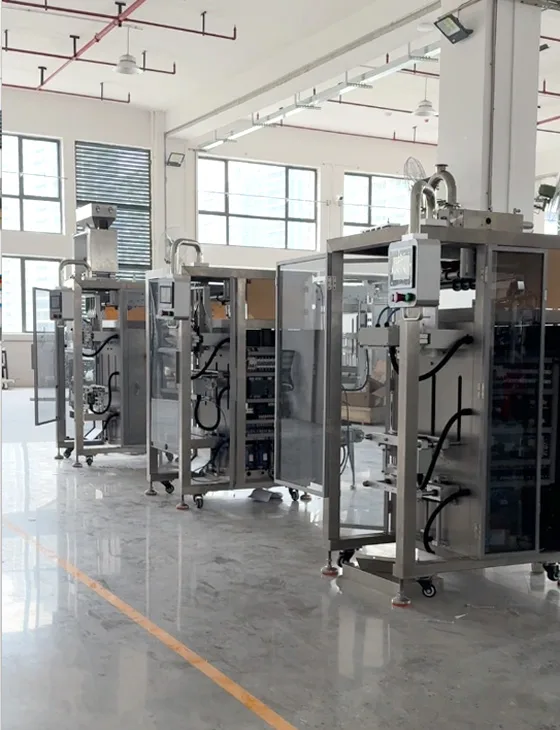
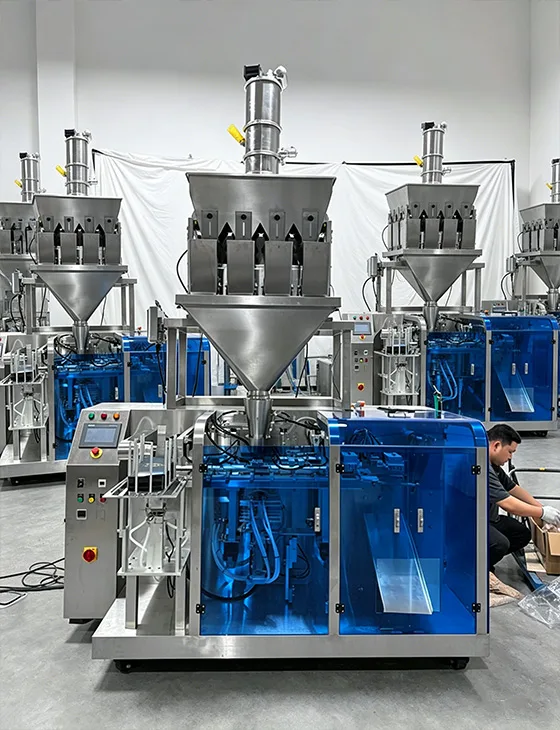
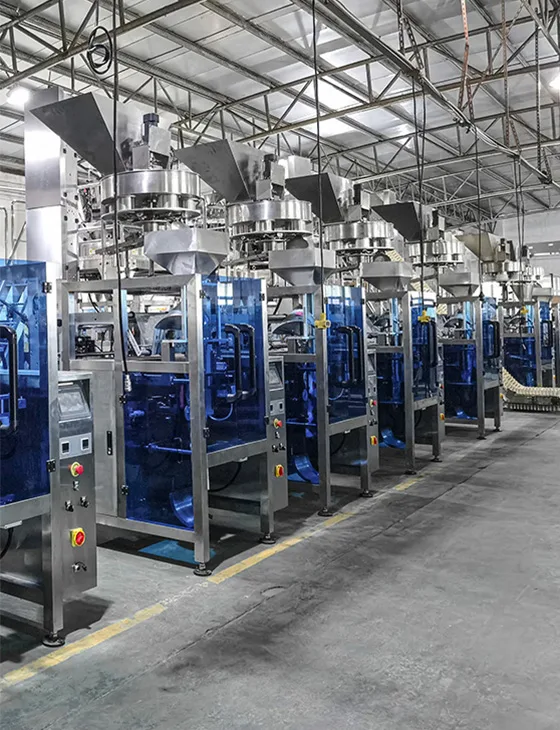
These are text process comparisons; workshop photographs illustrate equipment families, not validated process flows. Takeaway: Carry one product-and-package brief into the selected system discussion.
The first decision is whether the machine makes the package or receives it ready-made. Brand and speed come later. A vertical form fill seal system pulls printed film from a roll, forms it around a tube, fills it and seals it. A premade-pouch system picks up a pouch that a converter has already made, opens it, fills it and closes the top. A multi-lane stick-pack system also works from roll film, but slits a wide web into several narrow packs that run side by side.
This choice decides what you buy every month. Compare film and pouch quotations for the same finished-pack specification and order basis; this page does not establish a material-cost advantage. The roll-film machine has to create the bag shape. Premade pouches move zippers, spouts and shaped bottoms to the pouch supplier, and the machine has to handle pouches that vary from lot to lot. If you are unsure, compare both routes with the same product and the same finished-pack sample before narrowing the shortlist.
Takeaway: Choose the packaging-material route before comparing machine rates.
Common mistake: Assuming roll film is cheaper without comparing equivalent pack specifications and order quantities.
You choose the filler by how the product moves, whatever it is called. Discrete pieces such as nuts, chips, candy and frozen dumplings are usually weighed by a multihead combination weigher, which picks a combination of partial weights close to the target. Fine and aerated powders such as coffee mixes, creamer and collagen are usually dosed by volume with an auger screw. Viscous sauces are metered by a piston through a nozzle.
Borderline products need a trial, not a debate. Granules that flow like a powder, sticky dried fruit and sauces with particles can each suit more than one route, and the right answer depends on the dose size, the variation you can accept and how the product behaves after an hour on the line. Describe temperature, particle size, stickiness and fragility in the enquiry, and send the material as it will arrive at the machine.
Takeaway: Send the material in its expected filling condition, with the dose requirement.
Send your product behavior, packaging-material route, fill quantity, accepted packs per shift and available height with your system enquiry. We reply within 24 hours.
Nitrogen flushing and vacuum stages are options added to a base system. Each one adds a supply, a sequence step and something that has to be measured. Add them when you can state the package result you need: a cushioned snack bag with reduced oxygen in the headspace, or a tight pack around dried fruit. A competitor listing them is no reason to ask.
An option on the machine does not give you a shelf life. The gas result depends on the film, the seal quality, the bag volume and how the packs are sampled after the run. Before accepting the option, agree how the residual gas or pack firmness will be measured, on how many packs and at what point after sealing. Coffee valves belong in the same talk. The valve changes the pack and how it is supplied.
Takeaway: Specify the package result and how it will be assessed before adding gas or vacuum.
A brochure speed is a machine cycle under stated conditions. Your purchase needs a figure for accepted packs per shift with your product, your bag and your mix of jobs. Start from the orders you must fill, subtract planned stops for film changes, cleaning and changeovers, and work out the rate the line has to hold while it runs.
Fill weight and bulk density matter here. The same target weight can need very different bag lengths, hopper volumes and forming tube sizes for chips and for nuts, and an undersized bag needs a filling-clearance and seal review. Give the supplier the net weight range and a density measurement from production material, then compare proposals by the output they commit to under those conditions.
Takeaway: Compare accepted output for the same product, bag and working schedule.
A machine alone rarely makes a working line. Discrete-product systems usually need a feed elevator, a platform with access stairs for the weigher, and a discharge conveyor. Powder systems need a refill method that keeps the auger hopper at a steady level. Premade-pouch systems need a pouch magazine that operators can reload without stopping the line too often.
Measure the ceiling height at the installation point, because a multihead weigher on a platform above a bagger is a tall assembly. Confirm the power supply, compressed air quality and any nitrogen supply for the complete quoted line, not one component. Mark which conveyors, checkweighers or coders you already own. Then ask each supplier to state which interfaces they are responsible for.
Takeaway: Mark existing equipment and assign responsibility at every handoff.
Narrow the choice to one or two system types, then write a brief that a supplier can answer in the same format: product, target weight or volume, bag style and dimensions, required output, utilities and destination country. Attach photos of the product and a finished pack. The machine pages on this site list the published configurations for each family, with parameter tables that describe listed configurations rather than guaranteed results.
A decision is only as good as its trial. Send representative samples, agree which results matter before the run, and keep the report with the quotation. When the system type is settled, the individual system pages below explain the checks that belong to each one.
Takeaway: Keep sample identity and open requirements with the quotation.
Can a project cover only some stations? Mark the required stations and existing equipment on the line drawing, then ask the quotation to state included and excluded scope. A family description does not confirm the scope of an individual offer.
How should an existing conveyor connect? Provide its discharge height, direction and handoff point, and ask who owns the mechanical connection and readiness or fault signals. Keep both suppliers on the same layout revision.
When should I compare premade pouches? Start there when you intend to buy finished pouches. Compare the actual opening, zipper or spout and fill requirements against the roll-film alternative before selecting equipment.
Takeaway: Resolve supply boundaries before treating a system list as a complete line.
Item | Why we need it | Example format
Item: Product behavior. Why we need it: Select the handling and dosing discussion. Example format: Labeled photographs and sample notes.
Item: Packaging route and fill quantity. Why we need it: Identify forming or pouch handling and the dose. Example format: Bag drawing plus fill-weight sheet.
Item: Accepted shift output. Why we need it: Describe the production result and stops. Example format: Shift plan with changeovers.
Item: Height and existing equipment. Why we need it: Locate the line interfaces. Example format: Dimensioned layout with equipment labels.
Send the product notes, package and dose sheet, shift plan and dimensioned layout through the contact page. We reply within 24 hours.
Takeaway: Mark undecided fields as open rather than substituting assumed values.
This October 2026 revision reorganizes the published site descriptions into buyer inputs and route comparisons. It adds no test results, cost ranking or machine performance guarantee. Samples, drawings and the quotation establish the project-specific scope. Takeaway: Use the guide to prepare the comparison, and keep the agreed conditions with the selected configuration.