
Multihead Weigher Packing Machine: Working Principle, VFFS Synchronization & Dosing Setup Guide
A guide to the computer combination weighing working principle, PLC handshake signals, timing hopper release delay, and cross-seal drop clearance for multihead weigher packing machines.
On This Page
Multihead Weigher Working Principle and OIML R 61-1 Metrology
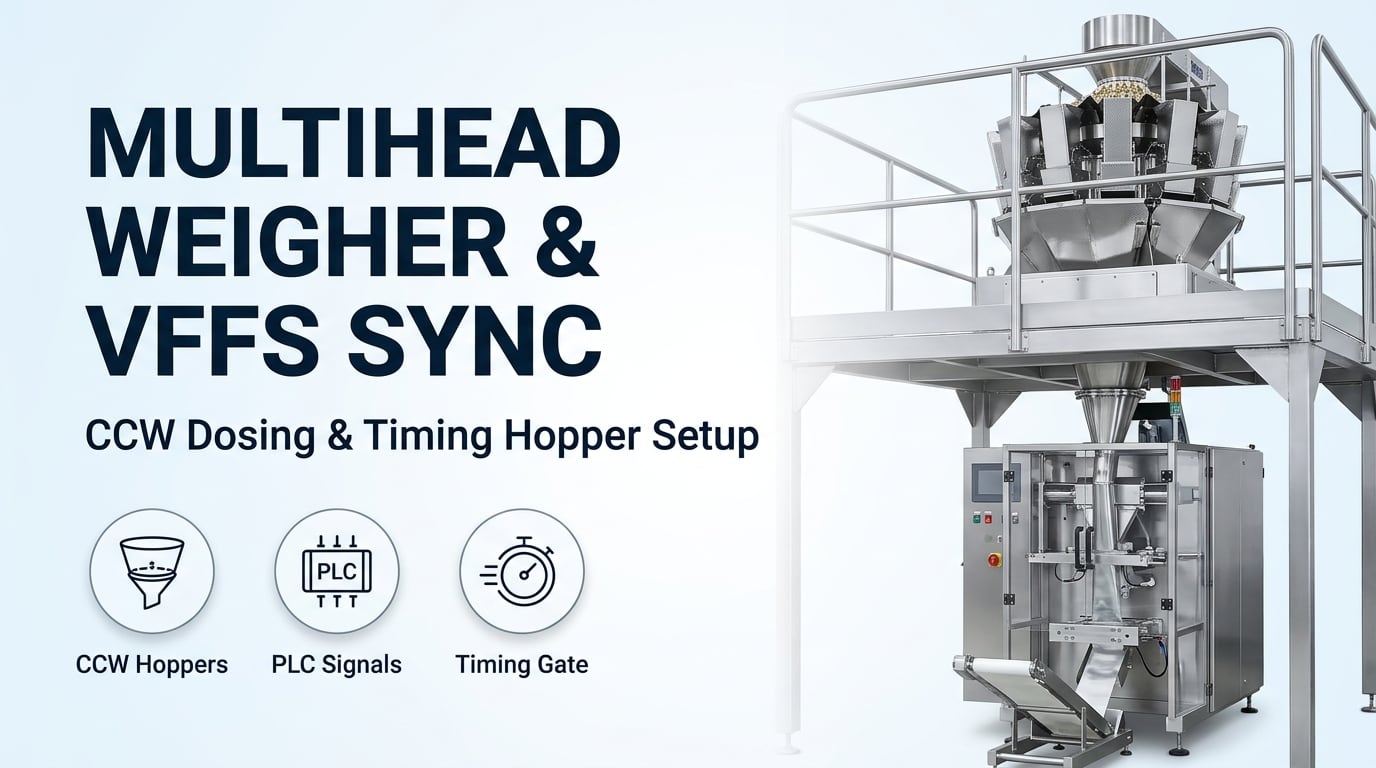
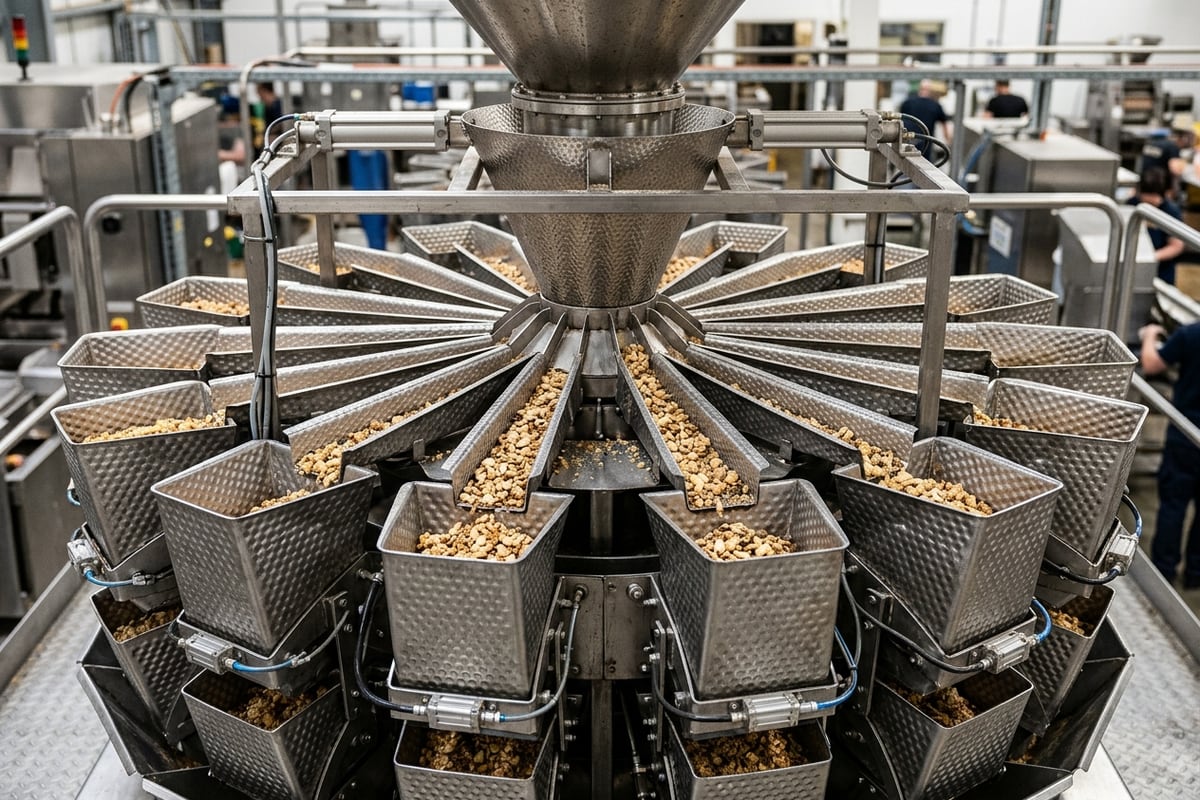
Selecting and synchronizing a multihead weigher packing machine starts with understanding how computer combination weighing (CCW) divides bulk product into discrete sub-loads and recombines them above the vertical form fill seal bagger. Developing the first ever multihead weigher in 1972, Ishida accounts for approximately 50% of the global market and 75% of the Japanese market, and states that its multihead weighers achieve full automation with speeds of up to 210 weighments per minute and accuracy of 0.5-1.0 grams. In Ishida's computer combination weighing (CCW) system, operation follows three steps: (1) the product is distributed into groups of separate quantities that are individually weighed in their hoppers, (2) a computer calculates combinations of the weights in each hopper and selects the combination nearest to, but not lower than, the set target weight, and (3) the chosen hoppers' product is released and collected for packing. In a multihead weigher method of operation illustrated with a typical target weight of 100 grams, product is dispersed to the pool hoppers, each pool hopper drops the product into a weigh hopper beneath it as soon as the weigh hopper becomes empty, the weigher's computer determines the weight of product in each individual weigh hopper and identifies which combination contains the weight closest to the target weight of 100 g, and all hoppers of that combination open so the product falls via a discharge chute into a bagmaker.
Product geometry and surface cohesion dictate how material moves across the top cone, radial feeders, and hopper tiers. Across multihead weighers, dispersion is normally by gravity, vibration, or centrifugal force while feeding can be driven by vibration, gravity, belts, or screw systems, and an extra layer of hoppers ('booster hoppers') can be added to store product which has been weighed in the weigh hoppers but not used in a weighment, thus increasing the number of suitable combinations available to the computer. In circular multihead weigher designs such as Ishida's circular range, Large Volume Weighers handle products in bulk such as frozen foods, pet food, salad leaves, and vegetables, Gentle Slope Weighers are designed to handle fragile products with slopes adjusted to prevent product damage, and Screwfeeders use a classic rotating screw system for products that are sticky, soft, or too difficult to move using vibration. For multi-ingredient blends, mix-weighing allows products containing up to eight components to be mixed on a multihead weigher very accurately at high speeds by dividing the weigher into sections each with its own infeed, such as eight heads devoted to each of two more expensive components and four heads to each of two other components.
Metrological verification of a multihead combination weigher is governed by international legal metrology rules for automatic gravimetric filling instruments. In international legal metrology, OIML R 61-1:2017 (E) Section 2 (Scope) specifies the metrological and technical requirements, metrological controls, and tests for automatic gravimetric filling instruments (AGFIs) which produce a predetermined mass of individual fills of products from one or more loads by automatic weighing. Under OIML R 61-1:2017 (E) Clause 3.2.2.1 and Clause 3.2.2.1.1, a multi-load AGFI may be a cumulative or selective combination AGFI, where a selective combination weighing instrument is defined as an AGFI comprising more than one weighing module and which computes an appropriate combination of the loads and combines them into one fill. By contrast, OIML R 61-1:2017 (E) Clause 3.2.2.1.2 defines a cumulative weighing instrument as an AGFI comprising one weighing module with the facility to apply more than one weighing cycle for the composition of the desired fill, while Clause 3.2.2.2 defines a subtractive weighing instrument as an AGFI for which the fill is determined by controlling the output feed from the weigh hopper. Under OIML R 61-1:2017 (E) Section 3.4 (Metrological characteristics), the product reference quantity is a calculated quantity value equal to the mean of at least ten of the largest pieces of the product taken from one or more fills, and a weighing cycle is a combination of operations including the delivery of material to the load receptor(s), a weighing operation, and the discharge of a single discrete load. Under OIML R 61-1:2017 (E), for AGFIs which accomplish the fill by more than one weighing cycle, the rated minimum fill (Minfill) is larger than the minimum capacity (Min), and the average number of loads per fill is half the sum of the maximum and minimum number of loads per fill that can be set by the operator.
Compliance testing evaluates both individual fill deviation around the mean and preset target offset. Under OIML R 61-1:2017 (E) Section 4.3, at initial verification the AGFI shall comply with accuracy class X(x) specified by the manufacturer, for which the maximum permissible deviation (mpd) of each fill from the average of all fills in a test shall be equal to the limits specified in Table 2 multiplied by the class designation factor (x), where the class designation factor (x) shall be <= 2. In OIML R 61-1:2017 (E) Table 2 for class X(1), the maximum permissible deviation (mpd) of each fill from the average for fill mass F (g) is 7.2 % of F at initial verification and 9 % of F in-service for F <= 50 g, and 3.6 g at initial verification and 4.5 g in-service for 50 < F <= 100 g. Across larger pouch fills in OIML R 61-1:2017 (E) Table 2 for class X(1), the maximum permissible deviation (mpd) at initial verification and in-service is 3.6 % of F and 4.5 % of F for 100 < F <= 200 g, 7.2 g and 9 g for 200 < F <= 300 g, 2.4 % of F and 3 % of F for 300 < F <= 500 g, 12 g and 15 g for 500 < F <= 1 000 g, and 1.2 % of F and 1.5 % of F for 1 000 < F <= 10 000 g. Under OIML R 61-1:2017 (E), for AGFIs set with a preset value (R 61-2, 8.6), the maximum difference between the preset value and the average value of the mass of all the fills in a test sequence (R 61-2, 8.7)—the maximum permissible preset value error (mpse)—shall not exceed 0.25 mpd in-service (4.3.1) for the preset value. In addition, under OIML R 61-1:2017 (E), the fault limit for selective combination weighing instruments is a fault greater than 0.25 mpd in-service of each fill (Table 2) divided by the square root of the average (or optimum) number of loads in a fill, for a fill equal to the Min multiplied by the average (or optimum) number of loads in a fill. Under OIML R 61-1:2017 (E) Section 4.4 (Product reference quantity correction, 3.4.2), for material tests, when the absolute value of the difference between the product reference quantity and the test fill is greater than 10 % of the mpd for the value of the mass of the test fills, an mpd corresponding to a value of 1.5 times the value of the mass of the test fills may be applied. Buyers comparing combination weighing against volumetric dosing can review our vertical form fill seal packaging system overview and multihead weigher vs auger filler comparison.
:::quick-specs title: OIML R 61-1:2017 (E) Metrological Parameters and Class X(1) Deviation Limits rows:
- Selective combination AGFI definition | OIML R 61-1:2017 (E) Clause 3.2.2.1.1 defines a selective combination weighing instrument as an AGFI comprising more than one weighing module that computes an appropriate combination of loads and combines them into one fill
- Multi-cycle minimum fill and load count | For AGFIs which accomplish the fill by more than one weighing cycle, Minfill is larger than the minimum capacity, Min, and the average number of loads per fill is half the sum of the maximum and minimum number of loads per fill that can be set by the operator
- Class X(1) mpd up to 100 g | For class X(1) in OIML R 61-1:2017 (E) Table 2, mpd is 7.2 % of F at initial verification and 9 % of F in-service for F <= 50 g, and 3.6 g at initial verification and 4.5 g in-service for 50 < F <= 100 g
- Class X(1) mpd from 100 g to 300 g | In OIML R 61-1:2017 (E) Table 2 for class X(1), mpd is 3.6 % of F at initial verification and 4.5 % of F in-service for 100 < F <= 200 g, and 7.2 g at initial verification and 9 g in-service for 200 < F <= 300 g
- Class X(1) mpd from 300 g to 10 000 g | In OIML R 61-1:2017 (E) Table 2 for class X(1), mpd is 2.4 % of F (3 % of F in-service) for 300 < F <= 500 g, 12 g (15 g in-service) for 500 < F <= 1 000 g, and 1.2 % of F (1.5 % of F in-service) for 1 000 < F <= 10 000 g
- Preset value error limit | Under OIML R 61-1:2017 (E), for AGFIs set with a preset value (R 61-2, 8.6), the maximum permissible preset value error, mpse, shall not exceed 0.25 mpd in-service (4.3.1) for the preset value :::
Sizing Weigher Head Count, Hopper Volume, and Feeding Geometry
Matching head count, hopper volume, and feeding geometry to the product prevents giveaway inflation and speed bottlenecks before the bagger is even wired. In Smartpack's comparison of multihead weigher types, using the wrong type of weigher can cut throughput by 15–25% and raise the giveaway by 0.5% to 1.2%, whereas rotary multihead weighers feature 10-32 heads, a 60-120+ weighments/minute speed range, ±0.5g~1.5g precision maintained, and a compact radial footprint optimizing factory floor space by 30%. In the same comparison of linear and belt linear combination weighers, linear combination weighers use 14-16 heads and a 20-40 weighments/minute speed range for sticky food like meat and kimchi, while belt linear combination weighers use 12-14 heads, a 100-1000 grams weighing range per belt, and IP65-rated construction supporting washdown environments.
Published machine data shows how increasing the number of weigh heads can raise rated cyclic speed while filling range and frame footprint change by model. Published machine specifications illustrate how head count scales speed and filling range: the Wintech WM3010 Multihead Weigher Packaging Machine (10 heads) specifies a hopper capacity of 1.6 L / 2.5 L, a filling weight range of 10 – 1500 g, a filling accuracy of ±0.2 – 3 g, a packaging speed of up to 65 bags/min, machine dimensions (L × W × H) of approx. 1490 × 1070 × 1270 mm, and power requirements of AC 220 V, three-phase / single-phase, 60 Hz. Stepping up to fourteen heads, the Wintech WM3014 Multihead Weigher Packaging Machine (14 heads) specifies a hopper capacity of 1.6 L / 2.5 L, a filling weight range of 10 – 1000 g, a filling accuracy of ±0.2 – 3 g, a packaging speed of up to 80 bags/min, machine dimensions (L × W × H) of approx. 1530 × 1130 × 1310 mm, and power requirements of AC 220 V, three-phase / single-phase, 60 Hz. At sixteen heads, the Wintech WM3016 Multihead Weigher Packaging Machine (16 head) specifies a hopper capacity of 1.6 L / 2.5 L, a filling weight range of 5 – 2000 g / 10 – 3000 g, a filling accuracy of ±0.5 – 5 g, a packaging speed of up to 120 bags/min, machine dimensions (L × W × H) of approx. 1330 × 1330 × 1630 mm, and power requirements of AC 220 V, three-phase / single-phase, 60 Hz.
When integrating a multihead weigher with an existing or new VFFS machine, actual stable speed matters: a bagger rated at 80 bags per minute may run one product at 70 and another at 45 because product size, dust, bag format, and sealing time all affect usable output, so engineers must select the weigher against the real production cycle rather than the largest number in the brochure. Evaluating the platform height, infeed elevator discharge clearance, and weigher head count together avoids over-sizing the filler or starving the vertical bagger. You can compare complete line architectures across our multihead weigher VFFS systems and the broader packaging systems integration hub.
PLC Handshake Signals and Reset Logic Between Weigher and VFFS
Reliable dosing synchronization depends on a deterministic interlock sequence between the weigher controller and the VFFS programmable logic controller. On our Multihead Weigher VFFS Systems page, we emphasize that once a weighing combination is selected, you must look at the chute and tube for restrictions, ledges, or changes in direction that could hold up individual pieces, settle early how the weigher and bagger exchange ready, discharge, and fault signals, and work out where a released dose would be held during a planned pause and how the next cycle is kept from causing a double fill. In a multihead weigher and VFFS integration where the VFFS often acts as master, a typical handshake may include these signals (names vary; not every installation needs all of them): Weighment ready (Weigher to VFFS, indicating a complete target dose is available), Discharge request or bag ready (VFFS to weigher, indicating the bagger is ready to receive product), Discharge complete (Weigher to VFFS, indicating the dose has been released), Run enable or discharge inhibit (Either direction, which holds production during a stop), and Machine fault or not ready (Either direction, which prevents the other machine from continuing).
When documenting the electrical interface between the weigher and VFFS, engineers must define for each signal whether it is a pulse or maintained signal, which edge activates it, how long it must remain on, and whether the contact is normally open or closed, while ensuring that after reset both controls agree whether an earlier request and prepared dose remain valid, and keeping emergency stops and safety interlocks in the approved safety system rather than ordinary production I/O.
:::quick-specs title: Multihead Weigher and VFFS Electrical Handshake Signal Specification rows:
- Ready and Request Signals | In a typical handshake that may include the following signals (names vary; not every installation needs all of them), where the VFFS often acts as master, Weighment ready (Weigher to VFFS) confirms a complete target dose is available, and Discharge request or bag ready (VFFS to weigher) confirms the bagger is ready to receive product
- Completion, Inhibit, and Fault Signals | Discharge complete (Weigher to VFFS) confirms the dose has been released, Run enable or discharge inhibit (Either direction) holds production during a stop, and Machine fault or not ready prevents the other machine from continuing
- Electrical Signal and Safety Rules | Define whether each signal is a pulse or maintained signal, which edge activates it, how long it must remain on, whether the contact is normally open or closed, and whether the earlier request and prepared dose remain valid after reset, while keeping emergency stops and safety interlocks in the approved safety system :::

Timing Hopper vs Direct Chute, Drop Flight Window, and Cross-Seal Protection
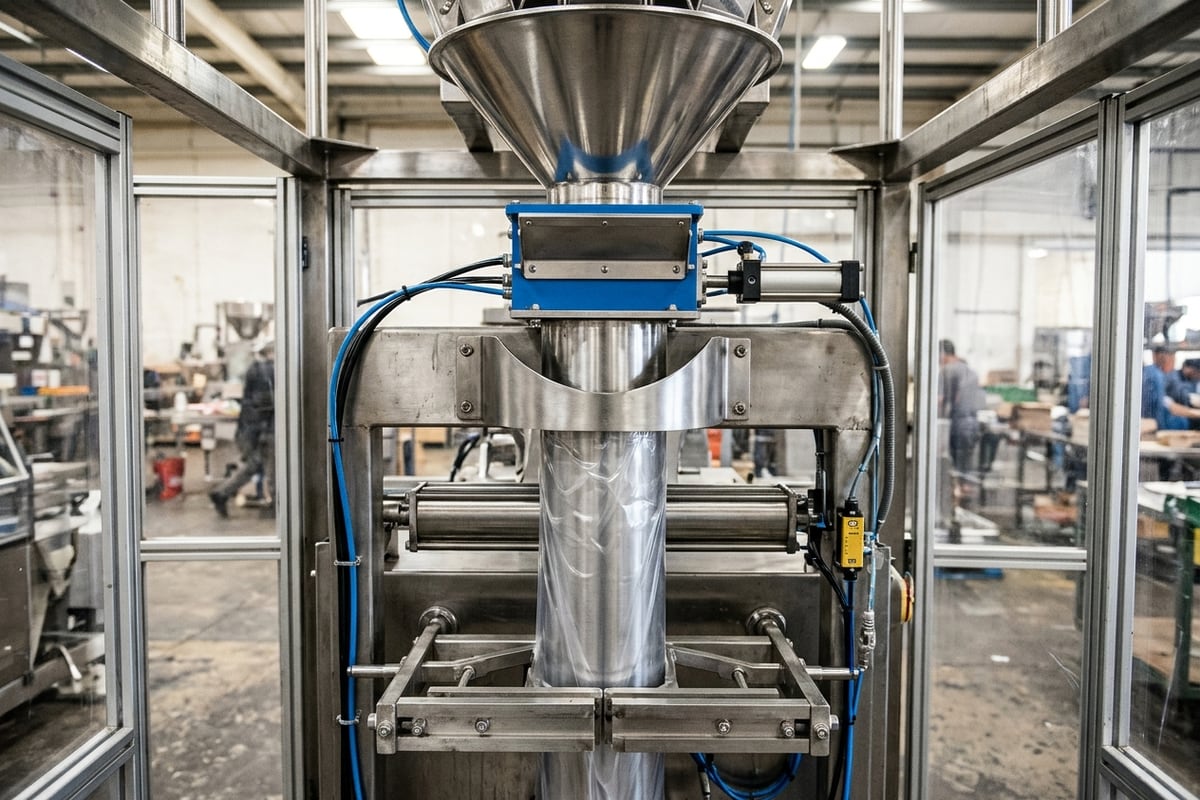
Even when the electrical handshake is wired correctly, the physical product charge must fall through the collection cone, forming collar, and vertical tube as a compact slug before the horizontal cross-sealing jaws close. In VFFS operations, world-class manufacturing targets an OEE of 85 percent while standard packaging lines often operate between 60 and 70 percent; the filler and the bagger must operate in perfect harmony because if the product drops too early it bridges in the forming tube, and if it drops too late it gets caught in the end seal. In a synchronized cycle—where the weigher prepares the target dose, the VFFS reaches its filling position, the VFFS sends a discharge request, the collection or timing hopper opens, product travels through the chute and forming tube, the product clears the cross-sealing area, and the VFFS closes the jaws—controls must allow for gate-opening, product flight, and settling, and a delay that works for 100 g may be too short for 1 kg of the same product.
Deciding between a direct discharge chute and an intermediate timing hopper requires balancing cycle window gains against vertical stack height and sanitation time. A timing hopper is not always required on a multihead weigher VFFS line: a timing hopper may help when the bagger has a short filling window, the drop is long, or a prepared dose must be staged close to the bagger and released quickly, whereas a direct chute may be simpler and easier to clean when the timing already works because a timing hopper adds height, another gate, and more surfaces to clean. Incorrect discharge timing between a multihead weigher and VFFS usually leaves five visible production symptoms and first areas to check: an empty bag points to a missed request or dose not ready, a double-filled bag points to a repeated or remembered request, product in the cross seal points to flight or settling time being too long, the VFFS waiting every few cycles indicates the weigher cannot sustain the requested rate, and unstable speed after restarting indicates the reset sequence is not clearly defined.
High-speed VFFS platforms also incorporate jaw-level protection against late-arriving pieces: Syntegon's SVX series VFFS machine reaches speeds of up to 300 bags/min using a Cross-Seal Drive with four independently controlled servo motors, automatically detects when a product is in the sealing area to adjust the process accordingly, and allows sealing force and parameters to be set directly via the HMI. Similarly, ROVEMA's continuous-motion Form Fill and Seal Machine BVC 165 TwinTube covers a bag width of 50 – 165 mm, a bag length of 80 – 220 mm (optional 320 mm), a nominal output of up to 500 B/min, and a cross-sealing force of 6000 N, combining synchronization with multihead weighers and electronic product detection for protection of sealing jaws independent for both lines with automatic discharge of defective bags without production downtime. For lines running intermittent versus continuous jaw motion or fragile snacks that require gentle stripping, see our intermittent vs continuous motion VFFS comparison and pillow bag packaging format guide.
Application Configuration Benchmarks, Commissioning Trials, and Fault Diagnostics
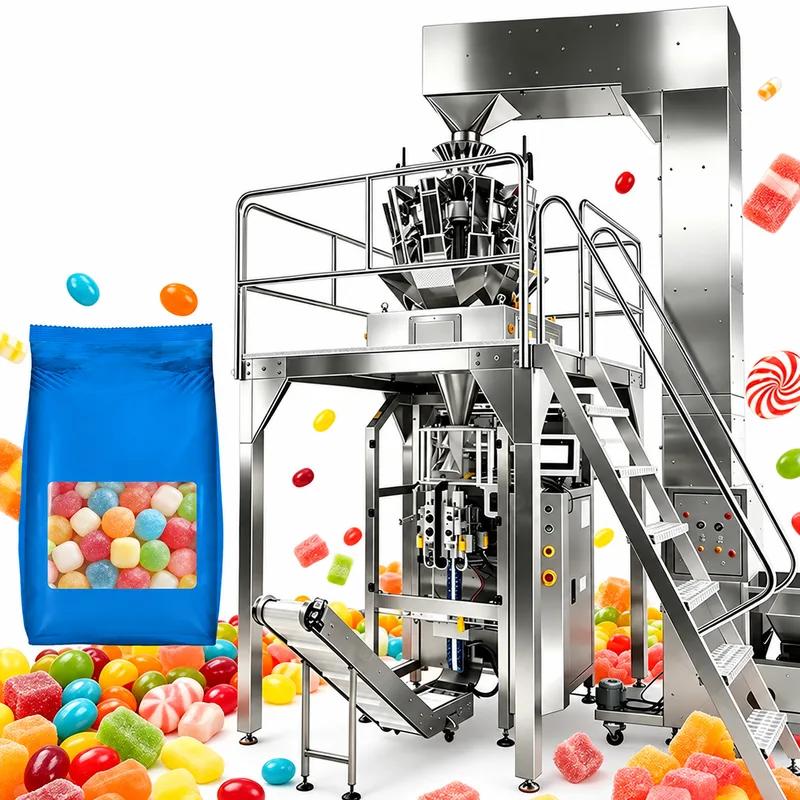
Catalog machine configurations demonstrate how dosing speed, bag dimensions, and discharge timing adapt to specific food categories. On our Candy Multihead Weighing & Packaging profile, the published configuration lists a packaging speed of 30–70 bags/min (subject to candy condition, weight, and bag type), a bag size range of Length 80–300 mm and Width 60–200 mm (customizable for the candy condition and bag type), and power and voltage of 3.5 kW at 220 V / 380 V, 50 Hz / 60 Hz. On our Candy Multihead Weighing & Packaging configuration, the discharge signal, candy travel time, and the closing motion must work as one sequence because a long gummy strand or an irregular marshmallow can hang in the tube after the rest of the dose has fallen, and trials must include normal starts and stops because retained candy can behave differently after a pause. During daily reject diagnostics on our candy multihead VFFS line, if weight drifts while the bag looks stable, operators should check product distribution and whether the hoppers empty fully; if the weight is fine but candy is trapped in the top seal, operators should look at discharge timing and the free space above the fill; and if film alignment wanders, operators should examine the roll and forming path before touching the product feed.
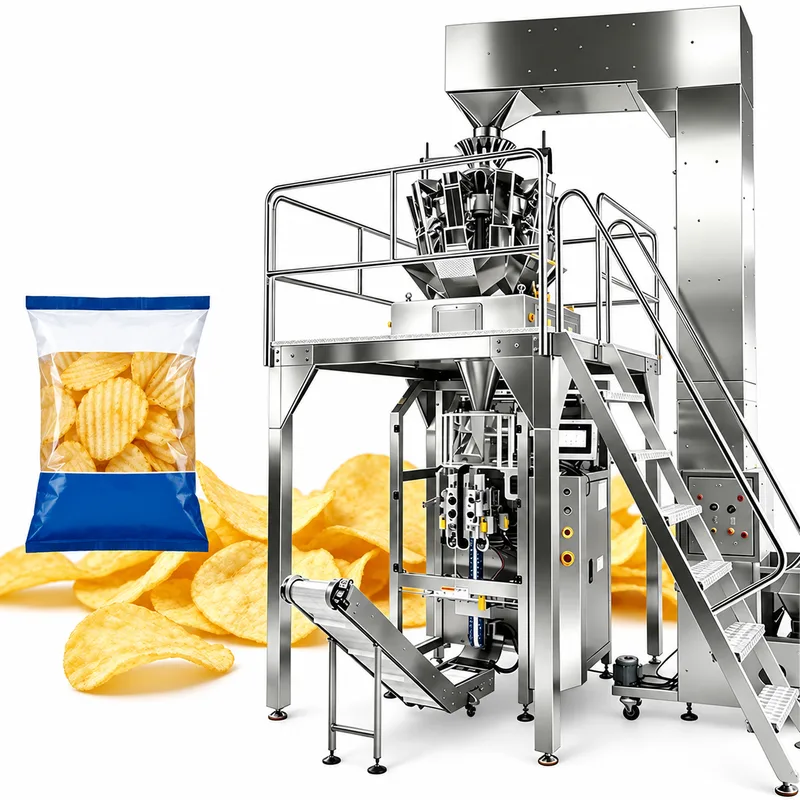
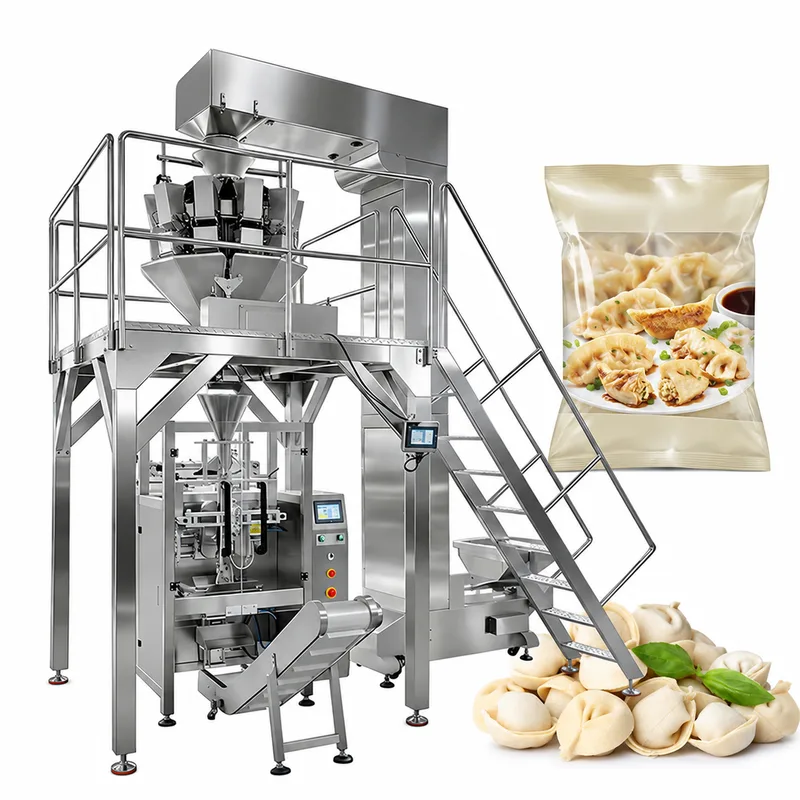
Fragile snacks and frozen pieces require controlled transfer geometry and surface textures to prevent breakage, bridging, and delayed pieces. On our Chips Packaging with Nitrogen Flushing profile, the published configuration lists a packaging speed of 20 - 45 bags/min (subject to bag volume and gas flushing volume) and bag size support of Length 150-400mm and Width 100-280mm (customizable formers). On our Chips Packaging with Nitrogen Flushing line, the transfers to watch for chip breakage are the elevator discharge, the spreader area, the feeder pans, the weighing hoppers, and the last chute into the forming tube, and operators should watch the area above the transverse jaws through several cycles and after a short stop to learn when the last particles pass the sealing zone and whether the discharge path leaves enough clearance before the jaws close. In our authorized catalog specification for the Frozen Food Multihead Weigher VFFS Packing Machine, the weighing system is a 10 / 14 / 20 Head Combination Multihead Weigher (Dimpled Surface Option), packaging speed is 25 - 70 bags/min (depending on product characteristics and weight), weighing accuracy is ± 0.2 - 1.5 grams, bag size range is Length 100-350mm and Width 100-250mm, machine material is food-grade SUS304 stainless steel (IP65 waterproof design), and power supply is 220V/380V, 50Hz/60Hz, 4.5KW. Our Frozen Food Multihead Weigher VFFS configuration stores up to 50+ product packaging configurations in its intelligent HMI touchscreen with recipe memory and uses specialized dimpled plates, staggered dumping sequences, and soft-drop chutes to keep dumplings, buns, and rice cakes intact while preventing frozen items from sticking together or smashing due to high drops. On our Frozen Food Weighing & Packaging line, retained product in a hopper causes two problems—the current bag may get less than intended and a later bag may get pieces from an earlier portion—so operators must look for both patterns in the run record because the displayed weight does not prove that mass reached the bag.
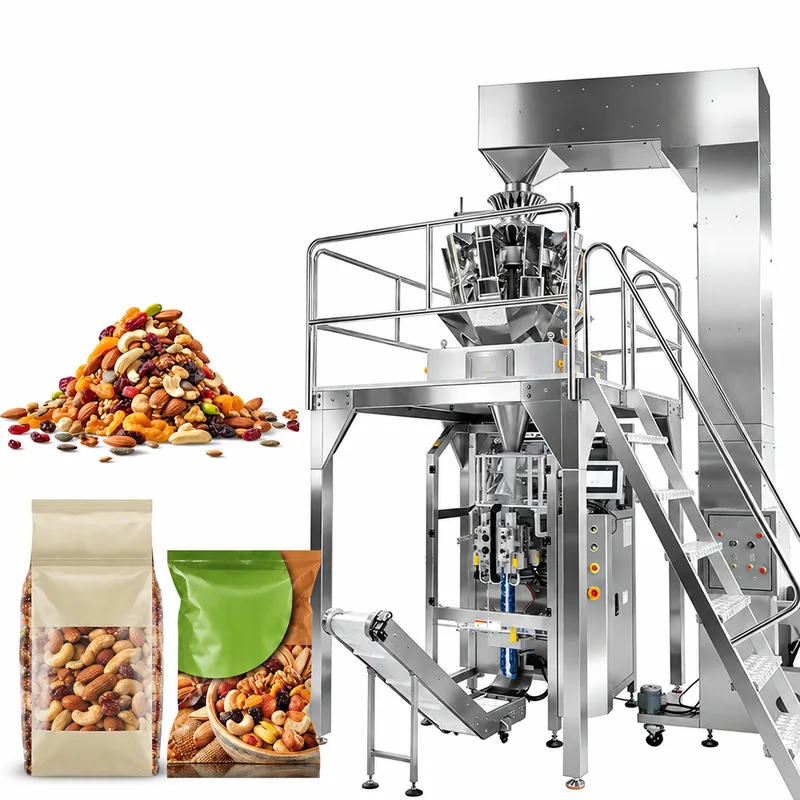
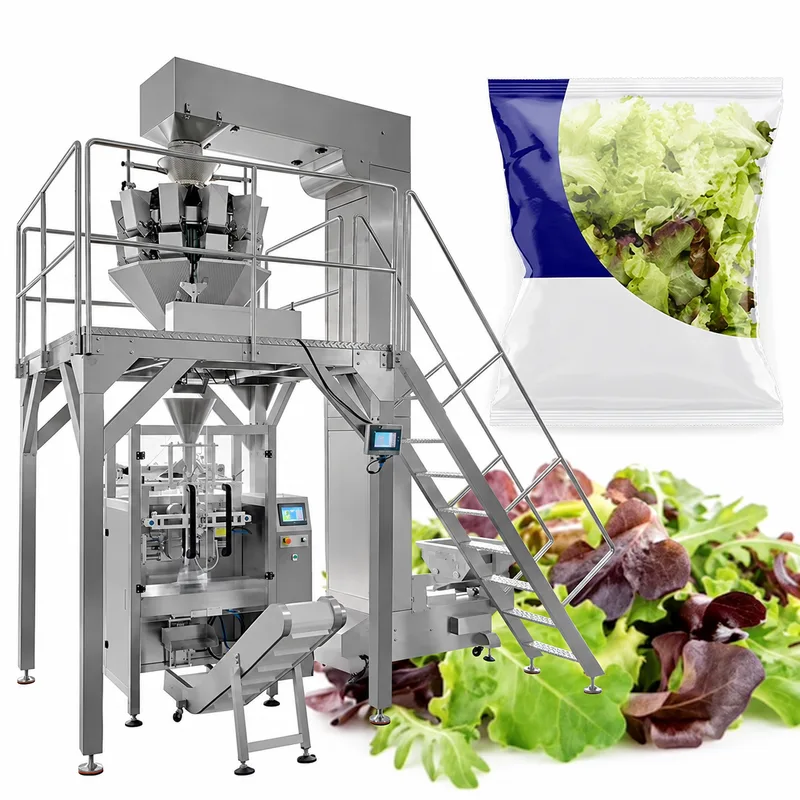
Granular nut mixes and leafy produce highlight the role of fast changeover formers, embossed contact surfaces, and settling delays. In our authorized catalog specification for the Automatic VFFS Packaging Machine with Multihead Weigher for Nuts & Dry Fruits, weighing accuracy is ± 0.3g - 1.5g (depending on product uniformity and blend ratio), packaging speed is 30 - 70 bags/min (subject to bag volume, target weight, and material flow), bag size support is Length 80-350mm and Width 60-240mm (customizable formers), and food-contact parts use food-grade SUS304 stainless steel. Our Nuts & Dry Fruits Multihead VFFS configuration features a toolless fast-changeover design that allows contract packers to adjust weight formulas and bag formers for 50g single-serve packs to 1kg family-size pouches in under 15 minutes, along with customized dimpled (embossed) stainless steel texture on all vibratory pans, feeder buckets, and discharge chutes to prevent high-sugar dried fruits like raisins or cranberries from sticking or bridging. On our Nuts & Dried Fruit Multihead VFFS profile (/machines/nuts-multihead-vffs), where published packaging speed is 30 - 70 bags/min and bag size support is Length 80-350mm and Width 60-240mm, a repeated seal contamination pattern from small nut fragments, salt, or fruit residue may come from timing or the product path, and raising the seal temperature alone may leave the underlying cause in place. On our Vegetable & Salad Weighing Packaging profile, the published configuration lists a packaging speed of 20 - 55 bags/min (subject to bag volume, target weight, and leaf density), bag size support of Length 100-450mm and Width 80-300mm, and power and voltage of 4.5KW at 220V/380V, 50Hz/60Hz, noting that long leaves and irregular florets can arrive later than the main portion.
Before placing a synchronized multihead weigher VFFS line into full production, validate the integration across three testing phases: (1) Product FAT, running representative material through the weigher including the largest, smallest, and most difficult pieces; (2) Interface Simulation FAT, using a signal simulator or test PLC to reproduce the VFFS handshake across normal, early, held, and repeated requests plus a bagger stop, weigher alarm, and reset sequence; and (3) On-Site Acceptance Test (SAT), performing the final test with the real VFFS, forming tube, film, product, and utilities. Packers preparing snack and produce trials can also consult our snack food VFFS application guide to align film selection, nitrogen flushing, and weigher dosing.
:::quick-specs title: Authorized Catalog Multihead Weigher VFFS Application Benchmarks rows:
- Candy Multihead VFFS (/machines/candy-multihead-vffs) | Candy configuration lists 30–70 bags/min, Length 80–300 mm, Width 60–200 mm, and 3.5 kW at 220 V / 380 V, 50 Hz / 60 Hz
- Chips Nitrogen VFFS (/machines/chips-nitrogen-vffs) | Chips configuration lists 20 - 45 bags/min (subject to bag volume and gas flushing volume) and Length 150-400mm by Width 100-280mm
- Frozen Food Multihead VFFS | 10 / 14 / 20 Head Combination Multihead Weigher (Dimpled Surface Option), 25 - 70 bags/min (depending on product characteristics and weight), ± 0.2 - 1.5 grams accuracy, Length 100-350mm, Width 100-250mm, SUS304 IP65 waterproof design, 220V/380V 50Hz/60Hz 4.5KW
- Frozen Food HMI and Drop Control | Stores 50+ product packaging configurations in HMI recipe memory and uses specialized dimpled plates, staggered dumping sequences, and soft-drop chutes
- Nuts & Dry Fruits Multihead VFFS (/machines/nuts-multihead-vffs) | Nuts & Dry Fruits configuration lists ± 0.3g - 1.5g accuracy, 30 - 70 bags/min speed, Length 80-350mm, Width 60-240mm, and SUS304 contact parts
- Vegetable & Salad Multihead VFFS (/machines/vegetable-vffs) | Vegetable & Salad configuration lists 20 - 55 bags/min speed, Length 100-450mm, Width 80-300mm, and 4.5KW at 220V/380V, 50Hz/60Hz for long leaves and irregular florets :::
Sources
Technical references consulted for this guide include International Organization of Legal Metrology (OIML) recommendations on automatic gravimetric filling instruments, Ishida technical documentation on computer combination weighing, Wikipedia multihead weigher reference material, Wintech multihead weigher packaging machine specifications, Syntegon and ROVEMA vertical form fill seal technical documentation, Smartpack and Zeepack multihead weigher integration notes, and VerticalPackingMachine.com authorized machine catalog profiles and integration guides.
Explore the Equipment
Vertical Form Fill Seal
Candy Multihead Weighing & Packaging
A correct bag weight can still hide broken, stuck or wrongly mixed sweets. Residue held on a contact surface can release into the next bag. This multihead weigher and VFFS line is set up around your candy's coating, size and pack.
Vertical Form Fill Seal
Chips Packaging with Nitrogen Flushing
An inflated bag can hide broken chips, a short fill or a weak seal. Size this weigher, VFFS and nitrogen-flush line from your chip volume, breakage limit and gas supply.
Vertical Form Fill Seal
Frozen Food Weighing & Packaging
Frosted pieces retained in a hopper can leave a bag underweight and turn up in later fills. Specify this frozen-food weigher and VFFS line from product temperature, frost, piece size and cleaning method.
Vertical Form Fill Seal
Nuts & Dried Fruit Multihead VFFS
A nut-mix bag can be on weight and still hold the wrong ratio of ingredients. Configure this multihead VFFS line from your blend, coatings, target weight and bag size.
Vertical Form Fill Seal
Vegetable & Salad Weighing Packaging
Fresh leaves and frozen vegetables need separate checks of hoppers, surfaces and cleaning; sharing an unproven setup can damage salad or hold up frosted pieces. Specify this weigher and VFFS line per product condition.
What to send us
| Item | Why we need it | Example format |
|---|---|---|
| Product piece size, bulk density, and surface condition | Determines radial feeder drive, dimpled or smooth hopper surfaces, and drop angle. | Dry roasted nuts, sugar-coated gummies, fragile potato chips, frozen dumplings, or cut salad leaves. |
| Target fill weight range and pouch format | Sizes weigher head count, pool and weigh hopper volume, forming collar width, and tube diameter. | Single-serve snack pillow pouches, medium retail packs, or family-size gusseted bags. |
| Required sustained output and changeover frequency | Aligns combination calculation speed, staggered dump settings, and toolless former selection. | Target accepted bags per minute per shift and number of daily recipe or film width changeovers. |
| Ceiling height, infeed layout, and PLC interface | Confirms whether a direct chute or timing hopper fits under the mezzanine and defines handshake wiring. | Available vertical clearance, Z-bucket or incline conveyor path, and plant voltage and frequency. |
Our team reviews the product, package and configuration requirements.