
Packaging Machines / Vertical Form Fill Seal
Chips Packaging with Nitrogen Flushing
An inflated bag can hide broken chips, a short fill or a weak seal. Size this weigher, VFFS and nitrogen-flush line from your chip volume, breakage limit and gas supply.
- Published speed: 20–45 bags/min, subject to bag volume and gas flushing volume
- Published bag range: length 150–400 mm, width 100–280 mm (customizable formers)
- Nitrogen flushing before the top seal; gas supply equipment scoped separately
- Low-drop handling for fragile snacks, judged on your own chips
We reply within 24 hours.
Published Configuration Data
| Packaging Speed | 20 - 45 bags/min (Subject to bag volume and gas flushing volume) |
|---|---|
| Bag Size Support | Length: 150-400mm | Width: 100-280mm (Customizable Formers) |
These values describe the listed configuration. Output depends on the product, fill quantity, bag and options. Confirm the final specification and trial conditions in your quotation.
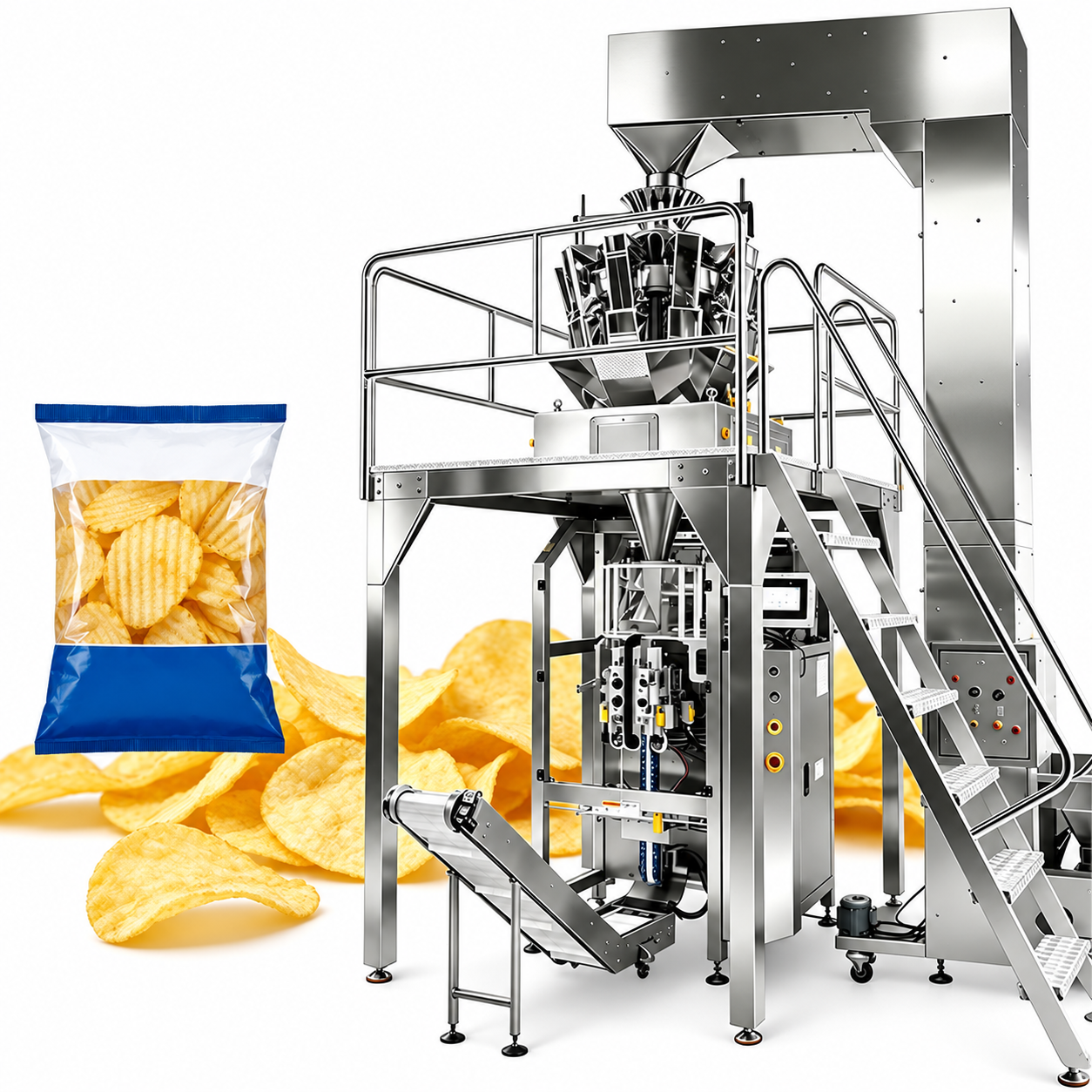
Configuration & Selection
Choose the weigher, chute and bag size from your chip volume and breakage limit first, then the gas stage. Bulky chips may fill a hopper before reaching the target weight, and hard transfers can add broken pieces that inflation will not hide. Confirm bulk density, acceptable breakage, bag volume and the gas supply available at your factory. Send details of your chip samples with typical fines, target weight, filled bag volume, film and gas-supply details through the enquiry form or WhatsApp; physical samples are arranged separately.
On This Page
The complete snack packaging sequence
This configuration combines bulk feeding, multihead weighing, vertical bag forming and nitrogen introduction before the package closes. It is meant for potato chips, banana chips, popcorn and puffed snacks, with the handling arrangement chosen for their fragility and volume. The machine makes bags from roll film, so nobody has to hold a purchased pouch under the filler. That difference affects the film supply, the change parts and the production layout.
The relationship that matters most is between snack volume, product travel and the sealing time available. Large chips take up a lot of space. A denser snack may hit the target weight with a smaller dose. Nitrogen adds another step to the cycle and a utility requirement. Review the product route and the gas stage together, so that a nicely inflated bag does not hide broken product, a short fill or an unstable seal.
Takeaway: Review product travel and the gas stage together, not the inflated bag on its own.
Locating the transfers that damage chips
Follow one representative chip from the supply container to the finished bag. The transfers to watch are the elevator discharge, the spreader area, the feeder pans, the weighing hoppers and the last chute into the forming tube. Impacts and sharp turns add breakage. The source configuration describes low-drop and gentle-handling arrangements. Whether they suit your chips has to be judged with your chips, not from an equipment drawing.
Where access is safe and the trial plan allows it, collect samples at several points. Compare whole pieces and fines with one consistent inspection method. A bagger trial cannot show whether damage happened upstream if nobody examined the incoming product first. The bottom of a production container often holds more small fragments than the top, so sample there as well. Note how the feeder copes with that variation, and whether fines build up in the pans or near the sealing area as the run continues.
Takeaway: Sample chips before the line as well as after it, so damage can be located.
Weigher capacity is also a volume decision
For chips and popcorn, hopper volume can matter as much as target mass. Bulky product may fill the space before a hopper holds a useful weighing portion. Large curved pieces can also bridge across an opening. They can travel unevenly over a feeder, too. The supplier should be able to relate the hopper arrangement and discharge throat to the measured bulk behavior of your actual snack. A photograph of a multihead weigher says nothing about your largest pieces.
Run the low and high target weights that matter to your production plan, with representative chip sizes. Watch whether product stays in a hopper after it opens and whether simultaneous discharges collide in the chute. The dosing pattern also has to be reviewed against bagger timing. Raising the feed rate while a discharge path is still restricted only makes the pile-up worse. So the trial record should tie weight results to visible product flow instead of showing the final weight distribution alone.
Takeaway: Match hopper volume and discharge throat to your bulkiest chips at both target weights.
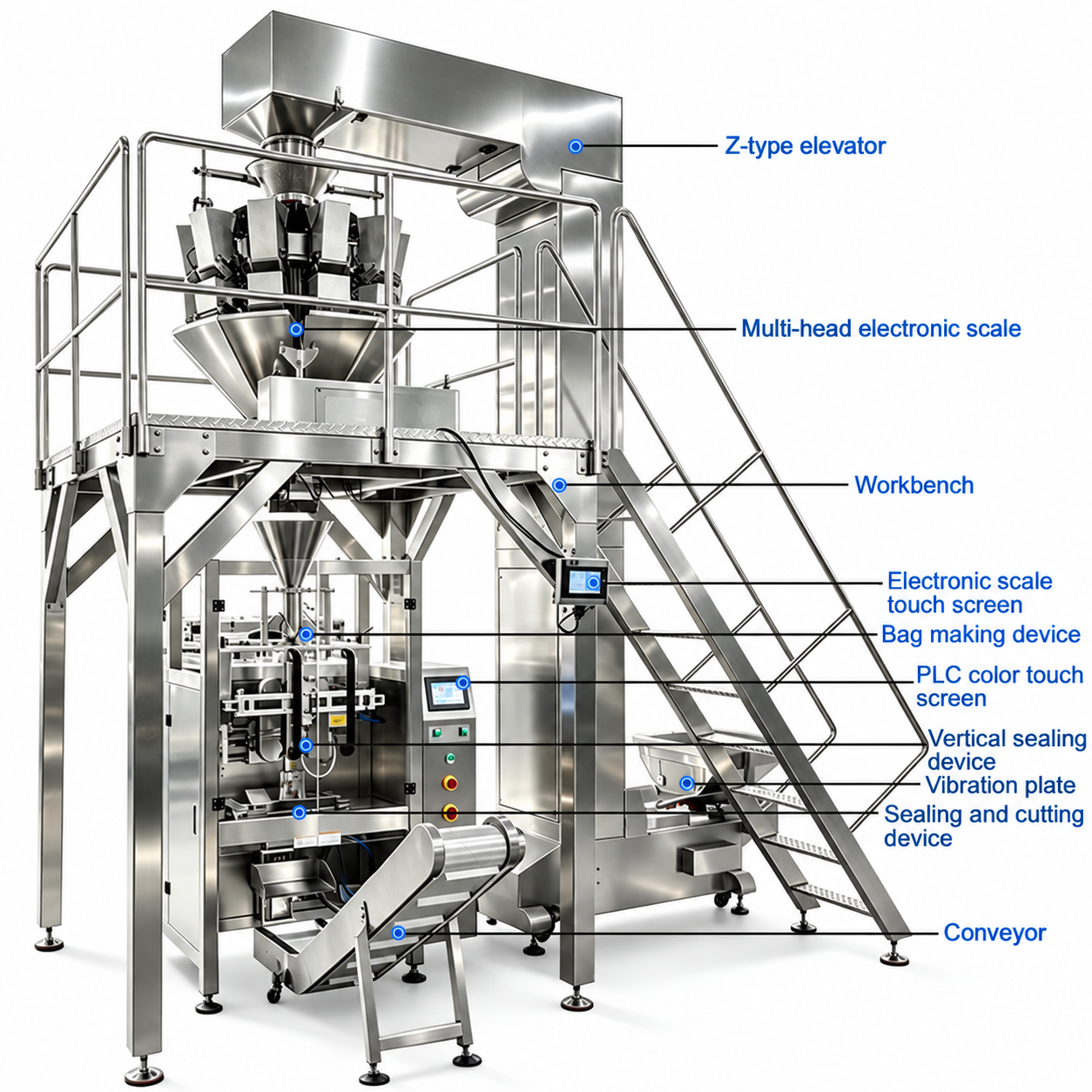
Nitrogen flushing and package headspace
The nitrogen stage puts gas into the bag before the top seal closes, and it has to match the bag volume, the filling sequence and the gas supply you have. Find out where the gas enters the bag, how its flow is controlled and what the line does if the supply runs short. The quotation should separate the flushing device from any external nitrogen supply equipment, regulators or plant connections that the buyer provides.
An inflated bag is something you see. It is not a measurement of the atmosphere inside. If residual oxygen is part of your acceptance requirement, agree the sampling procedure and measurement timing with the packaging team. A catalog shelf-life statement is no substitute for testing your product in your package. Headspace affects handling too. Too little room may press fragile chips against the film. A very bulky pack can cause trouble in cartons. Set the gas level with the intended retail appearance and the transport arrangement in mind.
Common mistake: Treating a well-inflated bag as proof of low residual oxygen.
Takeaway: Agree how and when any gas measurement is taken before the trial starts.
Choosing the film and filled bag volume
The Published Configuration Data table on this page lists bag lengths of 150 to 400 mm and widths of 100 to 280 mm with customized formers, and a packaging speed of 20 to 45 bags per minute that depends on bag volume and gas flushing volume. The Nitrogen Flush VFFS Systems page explains how the gas stage fits that cycle. Read these as ranges for discussion. A long, highly inflated family pack and a smaller compact snack pack are two separate operating points, even on the same basic machine family.
Supply the laminate specification and a finished-pack sample with its real fill. Measure the usable internal volume below the intended top seal. The outside dimensions of the empty bag are not enough. Printed artwork needs room for sealing, cutting and coding in the selected arrangement. During the trial, look at film tracking and wrinkles around both seams. Test the package with the quality method chosen for your laminate and distribution needs. A seal that looks smooth may still need a closer look at folds and contaminated areas.
Takeaway: Compare speeds only at the same bag volume and gas volume.
Keeping seasoning away from the closing area
Seasoning dust and broken chips travel differently from whole pieces, and they may fall late, settle on contact surfaces or get disturbed during the gas stage. Watch the area above the transverse jaws through several cycles and after a short stop. The aim is to learn when the last particles pass the sealing zone and whether the discharge path leaves enough clearance before the jaws close. Seal timing against the falling dust is what the observation is meant to catch.
Cleaning should target the build-up points you found during that observation. Talk through access to the feeder pans, hopper interiors, chute and forming assembly. If different flavors share the equipment, add a line-clearance and cleaning procedure that fits the plant's own allergen and flavor controls. A metal contact surface cannot be assumed washable in place by just any method. Get the cleaning instructions for the supplied components and leave the access they require in the layout. After refitting parts, check that their alignment still gives the gentle product path shown in the trial.
Takeaway: Find when the last fines pass the jaws, then plan cleaning around the build-up points.
- Measure incoming and packed chip condition with the same breakage method.
- Provide filled bag volume and nitrogen-supply details with the target weight.
- Check gas measurements, seal contamination and carton fit on trial packs.
Matching the bagger to conveyors and packing
A nitrogen-filled snack bag does not behave like a dense solid pack on a conveyor, and it can roll, bounce or pile up unevenly when transfer heights and guides are poorly matched. The line review should cover the discharge conveyor and the next inspection or packing step. Watch bags leave the jaws and travel through a realistic series. Samples lifted off by hand before they reach the normal outlet tell you little.
Carton packing may cap how much inflation and what bag size are practical. Compare filled packs in the intended case, and look at how pressure builds when the case is closed. The layout also needs space to change film rolls, reach the gas controls and remove product-contact parts. If you need inspection equipment, the proposal should say where it sits and how rejects are handled, and these interfaces decide whether the bagging cell works inside your factory. The catalog description will not.
Takeaway: Check bag transfer and carton fit with real filled packs.
Setting useful trial and quotation criteria
Send snack samples from normal production, with the usual range of piece sizes and seasoning. State the target weight, empty-bag dimensions, desired filled volume and acceptable appearance after packing. Give the film construction and describe the nitrogen supply you have. If none is selected yet, ask for a clearly scoped supply proposal. Mark the product most prone to breakage. The handling demonstration should test that requirement first.
Agree how incoming and packed breakage, weight, seal condition and any gas measurements will be recorded. Include startup, a pause and a restart. Those expose retained fragments and timing changes. The equipment arrangement and the optional features should be itemized separately in the proposal. Tie final operating claims to the tested product, film and bag size. That gives you a usable basis for comparing configurations, and it avoids treating the maximum catalog speed as the output for every snack in the range.
Breakage record: incoming versus packed chips
Use the same inspection method before and after the line, so damage from the raw material is not blamed on the bagger. Record values you measure; this page does not set a breakage limit.
Incoming sample: where it was taken (top or bottom of the container), share of whole pieces and fines.
After the weigher: the same measurement on product collected at the discharge chute, where access is safe.
Packed bag: whole pieces and fines after opening, plus bag volume and gas setting used.
After handling: the same packed bags after conveyor transfer and carton packing.
Takeaway: More fines in packed bags than in incoming chips shows breakage inside the observed process; compare adjacent sampling points to find the transfer. A high incoming fines share shows damage before the line.
When this does not apply
The published speed and bag ranges are configuration ranges tied to bag volume and gas volume, not results for every snack. Check whether the quotation includes the gas source, regulators and connections, and who provides each. Neither inflation nor a gas connection establishes shelf life or residual oxygen. Popcorn and very large or curved pieces may need different hopper volume and chute geometry from flat chips.
Takeaway: Fix bag volume, gas volume and the measurement method before comparing quotes.
Frequently asked questions
Does a puffed-up chip bag show that residual oxygen is low?
No. Inflation is visible; the atmosphere inside is not. If residual oxygen is an acceptance criterion, agree the sampling procedure and measurement timing with your packaging team.
How should speed be compared when the bag gets bigger?
Treat each bag size as its own operating point. The published 20–45 bags/min range depends on bag volume and gas flushing volume, so record accepted output for each bag and gas setting, and compare suppliers only at the same bag and conditions.
How can I tell raw-material breakage from machine breakage?
Measure the incoming chips with the same method you use on packed bags, including product from the bottom of the container. Damage that appears only after a transfer points to that transfer.
Is nitrogen flushing expensive?
The cost depends on the gas volume per bag and your gas supply arrangement, which this page does not price. The quotation should separate the flushing device from external nitrogen supply equipment and plant connections.
What is the best packaging for chips?
There is no single answer on this site. The film, bag volume and gas level follow your chips, retail appearance and transport; submit the laminate specification and a filled sample so the format can be evaluated.
Why is nitrogen used in packaging chips?
On this configuration nitrogen replaces air in the bag headspace before the top seal closes, and the gas level also sets how full the bag looks and travels. Whether it extends shelf life for your snack is a product-testing question, not a machine setting.
Bag Format Selection
Review the pack requirements for your enquiry. Compatibility is confirmed for the selected equipment and sample.
Planning Guides for This Configuration
These pages cover the system type, trial preparation and project checks that apply to this configuration.
Request a Packaging Configuration
We reply within 24 hours. Tell us what you need to pack. Leave quantity and output blank if you are still deciding. When you continue, WhatsApp opens with your enquiry written out so you can review it and send it to our team.
Explore the application · Configuration and project support
What to send us
| Item | Why we need it | Example format |
|---|---|---|
| Chip samples with normal fines | Hopper volume, feeder behavior and breakage depend on real pieces. | Bags from normal production, including product from the bottom of a container. |
| Target weight and filled bag volume | Bag volume and gas volume both set the achievable speed. | Net weight in g plus a filled sample or internal volume estimate. |
| Film construction | Forming, wrinkles and seals follow the actual laminate. | Laminate structure, thickness and printed layout PDF. |
| Gas supply details | Decides what the quotation must include for flushing. | Existing nitrogen source and connection, or 'none selected'. |
| Breakage limit and test method | Lets the trial be judged against your own standard. | Your inspection method and acceptance value as a short document. |
We reply within 24 hours.