
Reduce Product Damage During Packaging
A gentle-handling claim cannot identify where breakage occurs. Compare an incoming baseline with safely collected samples at adjacent transfers, then judge damage together with accepted bag output.
| Input or item | Value or source | Why it matters |
|---|---|---|
| Incoming baseline | Representative product lot | Separate existing damage from trial changes |
| Defect definition | Buyer classification and denominator | Make comparisons interpretable |
| Safe sampling points | Approved collection procedure | Keep guarding and access boundaries intact |
| Adjacent stages | Matched sampling records | Locate the transfer needing review |
| Accepted output | Filled bags, seals and quantity | Show the tradeoff behind an adjustment |
Choose the next review for your project
Use the records below to identify the unresolved decision. These related pages explain the corresponding configuration, measurement or service scope.
On This Page
Define damage and establish the incoming baseline
Say what counts as an unacceptable chip, broken edge or deformed piece for your product. Agree how samples are collected and assessed. A claim that a line is gentle can't be compared between proposals. Supply representative incoming material, so the starting level of damage is known.
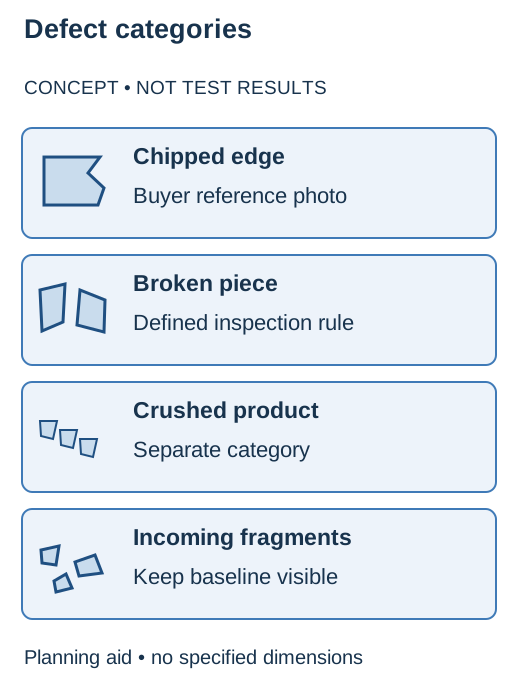
Use a product-specific classification that the buyer agrees. A cosmetic chip, a broken dumpling seam and a crushed snack are different defects. Decide how samples will be collected and sorted, and keep the sample size and counting method in the trial record. An apparent improvement can then be compared with the starting condition. A percentage with no stated denominator or inspection method means little.
Look beyond the smoothest stretch. Replenishment, emptying a hopper and restarting after a pause can change how material flows. Record those events and inspect the matching packs. Check the final discharge and case-loading step as well. A gentle dosing arrangement can't protect product from an unsuitable downstream drop or from compression in the shipping case.
Take an incoming sample before the first machine transfer. Use the same collection and inspection approach planned for downstream samples. Agree whether fragments will be counted, weighed or sorted into defined size groups. For irregular products, reference photographs of accepted and unacceptable pieces help different reviewers apply the same rule. Keep the original photographs. A later argument about appearance then can't quietly shift the damage definition.
Think about normal lot variation. Large thin chips may behave differently from compact pieces in the same delivery. A test using only hand-selected intact pieces misrepresents ordinary feeding. Ask production staff how the product arrives after upstream conveying and storage, and make that condition part of the trial. If the sample already has shipping damage, document it. Not every broken piece found after packaging came from the bagger.
Trace the route and choose safe observation points
Review feeding, weighing, discharge, bag entry and downstream handling, and find out which contact and drop points the supplier proposes for your product. Where practical, compare samples at agreed stages to find where changes happen. Run the packaging trial at the intended quantity and configuration, because a simplified demonstration can hide a difficult transfer.
Evaluate fragile-product handling from the first transfer to the finished pack. Photograph and sample the incoming product before you judge the equipment. If broken pieces are already there, keep that baseline apart from damage introduced during the trial. Otherwise the team may blame the bagger for an upstream condition, or miss damage that happens after filling.
Draw every transfer point: receiving hopper, elevator discharge, weighing buckets, collection chute, forming tube and takeaway conveyor. Watch where the product changes direction or lands on another surface. A low-drop option on the quote tells you little by itself. Judge it by how your actual product moves through the proposed arrangement at the flow you need. Large thin chips, brittle snacks and frozen items fail in different ways.
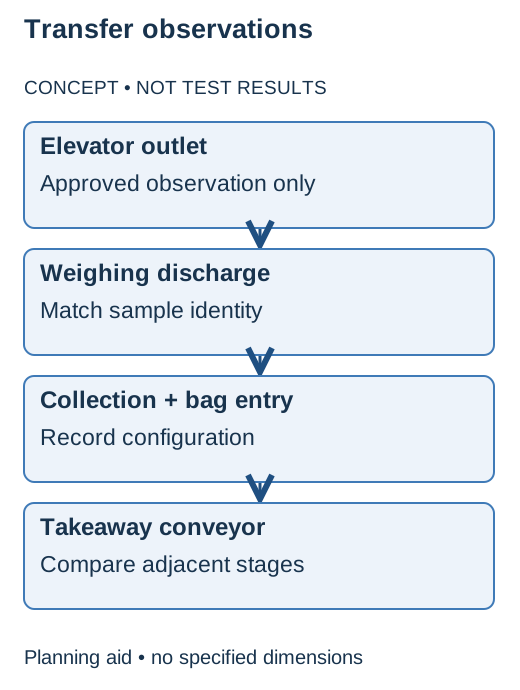
Sketch the feed route as a chain of handoffs. Possible observation points are the supply container, elevator outlet, weighing discharge and finished package. Pick only points that can be sampled under the approved procedure, without entering guarded areas or disturbing the process. A useful comparison needs traceable collection positions, since loose fragments swept from the floor won't tell you where the damage occurred.
Compare adjacent stages. Use matched samples. If deterioration shows up before weighing, changing the bag drop alone won't solve it. If loose product looks fine but the finished package holds more fragments, examine package entry and downstream handling. Hold run conditions steady while you investigate one transfer. Changing feed rate, discharge timing and bag dimensions together may improve the outcome but leaves the team unable to say which change mattered.
Balance handling with accepted output
Judge damage together with finished-bag output, fill consistency and seal condition. A slower or incomplete demonstration may not represent the planned run. Record any configuration changes made during the trial, along with what each one did to the agreed measures. Records like that support a proposal far better than one favorable sample.
The supplier should explain each proposed adjustment, and you should test it under otherwise comparable conditions. A softer transfer may change the time available for filling. A larger bag may change presentation or material use. Record the tradeoff. Not every modification is a universal improvement. The production goal is an acceptable packaged product at an agreed rate.
Keep representative product and pack photographs in the report, with sampling positions clearly labelled. They help you decide whether more tooling or handling trials are justified. If the formulation, dimensions or storage condition changes later, reassess the baseline. One fragile item running well does not show that the same settings suit an entire snack or frozen-food range.
Complete the observation record
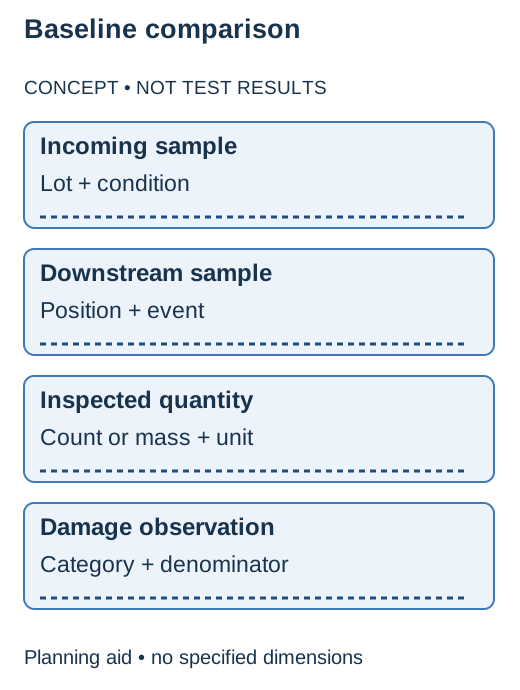
Use the record to compare the same defect definition at the incoming point and the selected downstream handoffs. Identify whether the denominator is inspected pieces, inspected mass or another buyer-approved basis. Do not combine unlike denominators into an apparent improvement. Name the physical collection position, not only the machine nearby, and retain the original sample labels and photographs. Collect material only at locations and times allowed by the approved procedure. If a stage cannot be sampled safely, mark it unavailable and ask the responsible team for another observation method. The empty fields deliberately contain no damage allowance or improvement percentage; those decisions belong to the agreed product assessment.
| Field | Your record | Keep with this record |
|---|---|---|
| Sampling position / sample ID | ________ | Record the source, identity or agreed method. |
| Product lot / incoming condition | ________ | Record the source, identity or agreed method. |
| Inspected count or mass / unit | ________ | Record the source, identity or agreed method. |
| Defect category / denominator | ________ | Record the source, identity or agreed method. |
| Observation / photo reference | ________ | Record the source, identity or agreed method. |
| Operating event / configuration revision | ________ | Record the source, identity or agreed method. |
Review bag occupancy and downstream handling
A larger bag is not automatically gentler. Product movement, settling and the space around the fill all matter, and they have to be observed with the intended material and dose. For a snack project, compare the proposed retail bag with a filled sample of the current package. Is the customer's concern broken product during filling, crushed product during handling, or both? The evidence needed differs for each.
The chips configuration in the catalog includes a weighing route and an optional gas-related packaging discussion. Keep that option separate from any claim that it eliminates breakage. A machine trial shows how product enters a particular bag. Transport performance needs its own defined evaluation. An inflated demonstration pack, or a fresh sample on a table, is no distribution guarantee.
Keep the accepted configuration identifiable
Find out which adjustment or component produced the accepted result, and record it in the configuration file. If a contact surface or transfer arrangement differs from the original quotation, name the revision. A demonstration run with a temporary chute should not become the basis for buying a different standard arrangement without another review. Photograph the assembly from safe viewpoints. The maintenance team can then recognise the accepted setup.
Plan a comparison after installation, using the same damage categories and a representative incoming lot. Upstream delivery and downstream case handling may differ at your site, so a factory result does not close every transfer question. Keep all findings. The point is to choose and maintain a process that protects your actual product at the required accepted output, with a record that explains the compromises made.
Method and scope of this guide
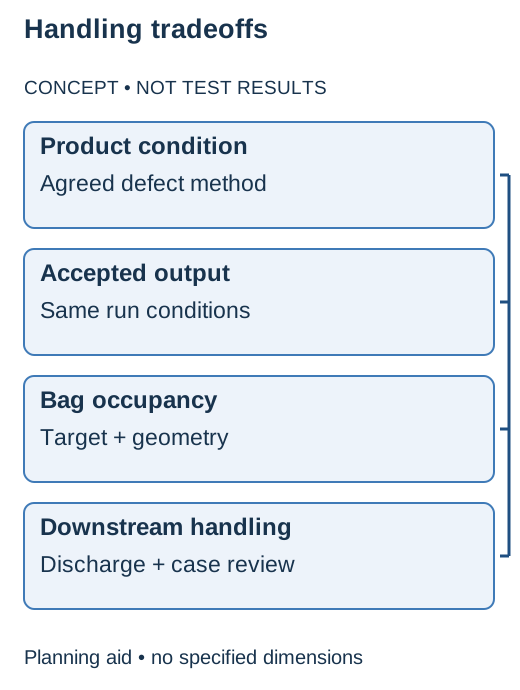
This revision of Reduce Product Damage During Packaging organizes the existing published review points into a buyer preparation record. The diagrams illustrate transfer observations, defect categories, baseline comparison, handling tradeoffs. They contain no measured trial results, approved engineering dimensions or acceptance thresholds. The empty record fields are prompts for project evidence, not a completed inspection. Source: the existing guide and the published Configuration Review and Sample Testing service descriptions, accessed October 8, 2026. Before sending physical samples, confirm receiving arrangements, quantity and costs. Keep any recommendation tied to the supplied material, proposed configuration and outstanding questions.
Frequently asked questions
How do we separate incoming fragments from damage added by the line?
Keep a representative incoming baseline and use the same defect classification and inspection basis downstream. Do not attribute every fragment in a finished bag to the bagger.
Is a lower drop enough to establish gentle handling?
No single transfer option answers the whole question. Observe the actual route, configuration and product condition at the required accepted output.
Is a larger bag always gentler?
Review product occupancy, presentation, material use and downstream handling together. A larger format is a trial variable, not a general damage remedy.
How can damage after conveying be located?
Compare samples at approved adjacent positions and include discharge and case handling. Do not enter guarded areas or disturb the process to obtain a sample.
Explore the Equipment
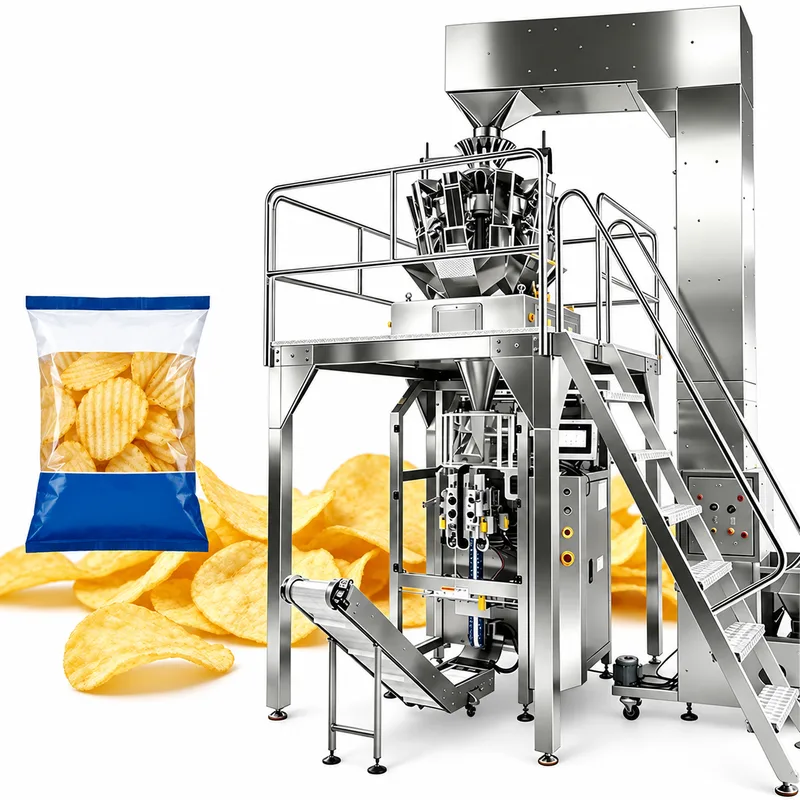
Vertical Form Fill Seal
Chips Packaging with Nitrogen Flushing
An inflated bag can hide broken chips, a short fill or a weak seal. Size this weigher, VFFS and nitrogen-flush line from your chip volume, breakage limit and gas supply.
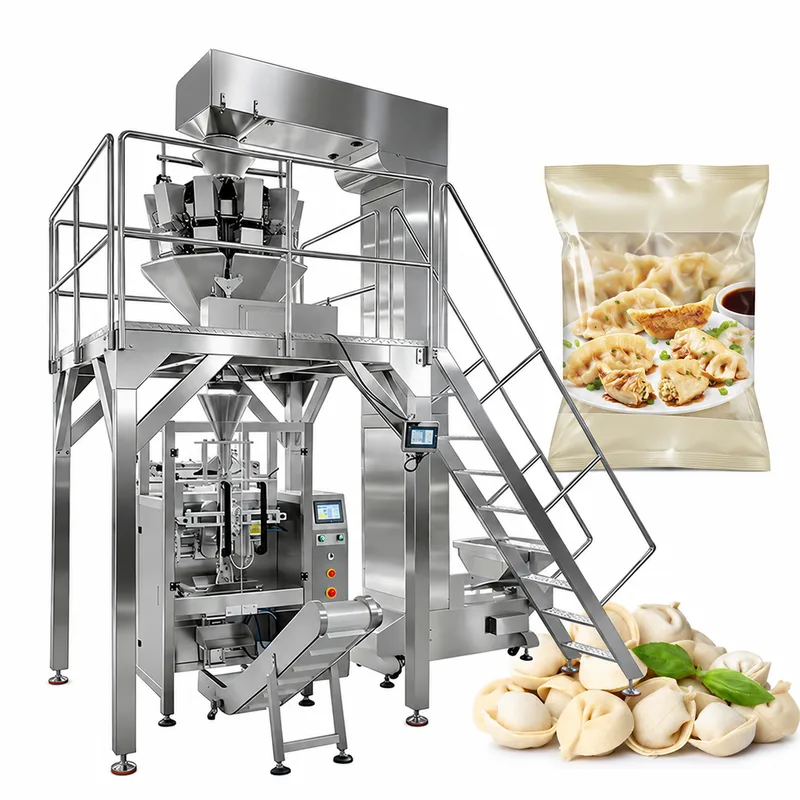
Vertical Form Fill Seal
Frozen Food Weighing & Packaging
Frosted pieces retained in a hopper can leave a bag underweight and turn up in later fills. Specify this frozen-food weigher and VFFS line from product temperature, frost, piece size and cleaning method.
What to send us
| Item | Why we need it | Example format |
|---|---|---|
| Incoming product samples and damage definition | Establish what arrives damaged and what counts as a defect. | Incoming lot label + accepted / defect photo sheet |
| Transfer-path review with sampling locations | Choose safe, traceable handoffs for comparison. | Route sketch + approved observation-point labels |
| Target quantity and complete operating configuration | Match the trial to the intended production requirement. | Fill target + arrangement revision + operating recipe |
| Comparable damage and output records | Compare damage without hiding output or configuration changes. | Sample ID / position / denominator / output record |
We reply within 24 hours.