
VFFS Machine Manufacturers: Technical Comparison & RFQ Checklist
Compare vertical form fill seal machine manufacturers across film pull-down belts, cross-sealing jaw drives, multihead weigher handshakes, and factory acceptance checkpoints.
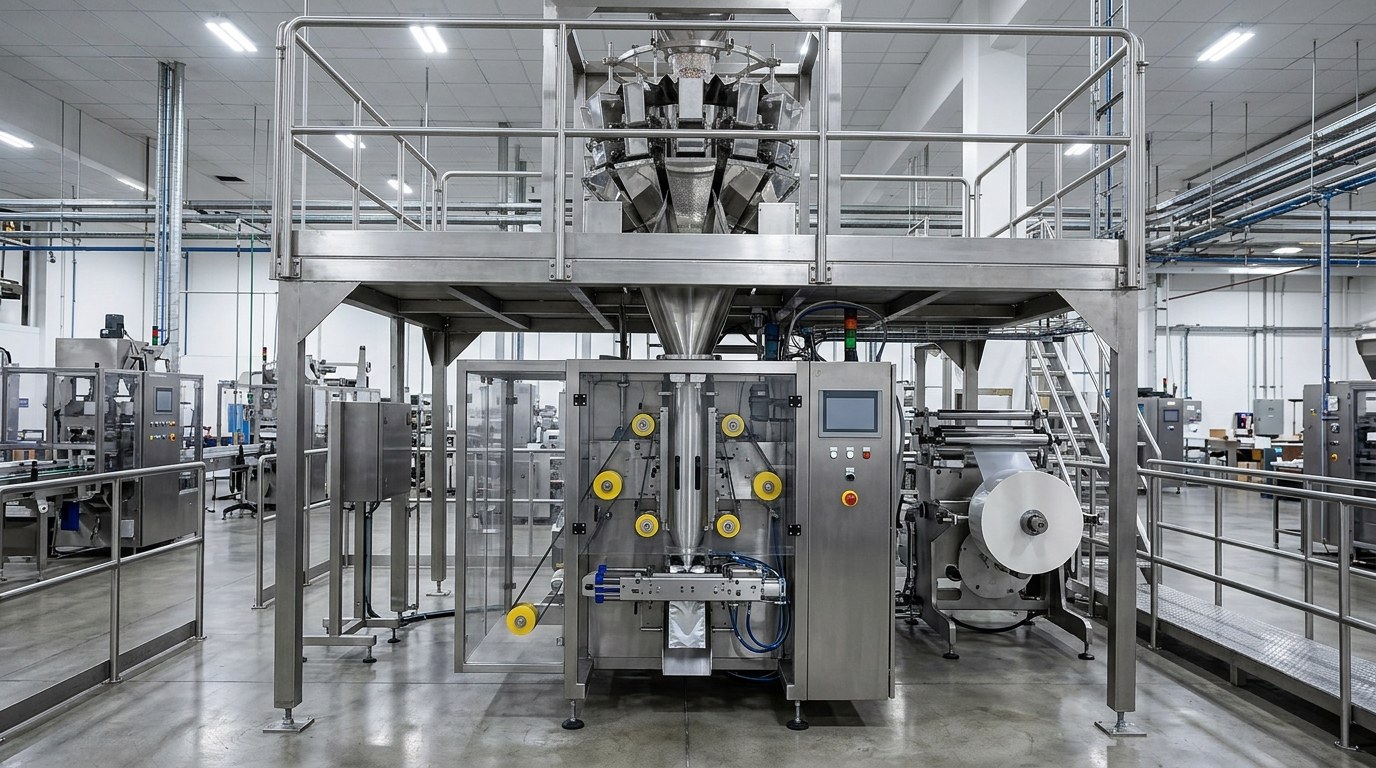
On This Page
Servo film-pulling structure, vacuum vs friction belts, and former web geometry
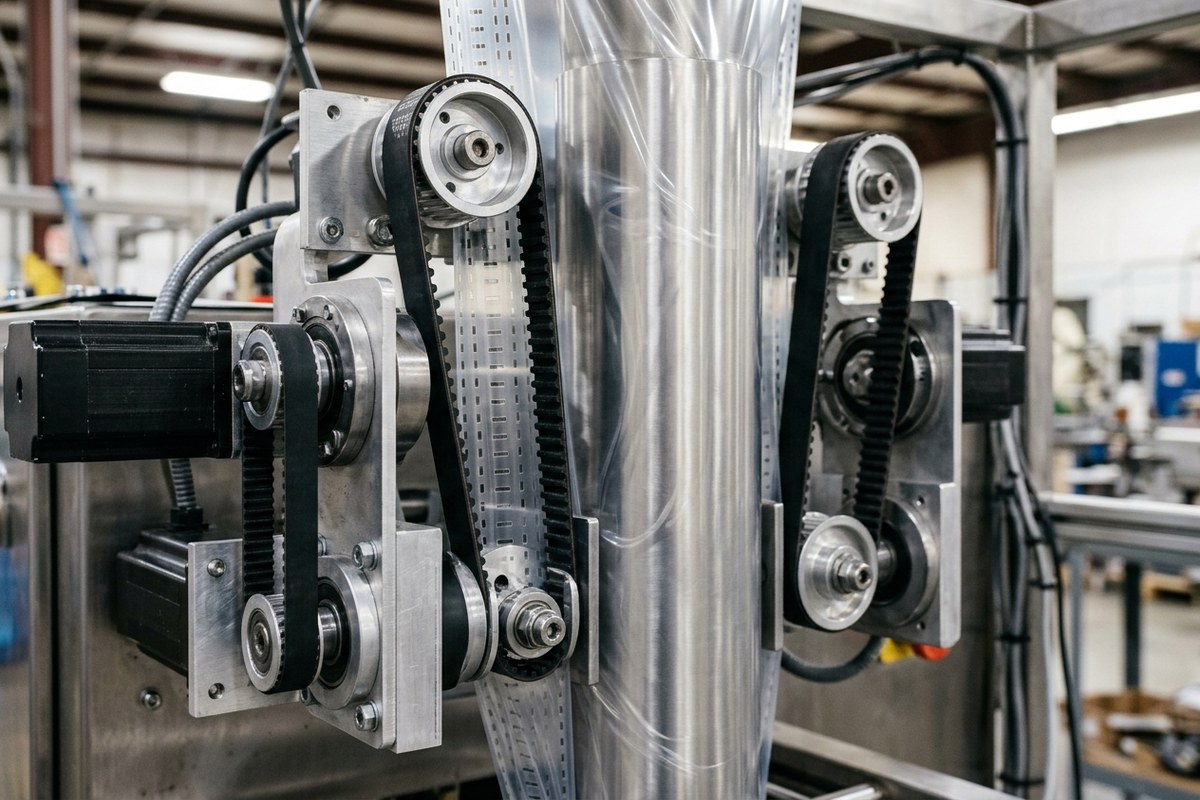
Comparing vffs machine manufacturers starts at the film transport assembly, where the pull-down belt mechanism governs how packaging film advances down the forming tube. In Viking Masek's vacuum pull belt maintenance guide, vacuum pull belts use a vacuum to suck the film against the belts for transport through the VFFS machine. By contrast, friction pull belts use friction to grip and pull or push the film, and an ideal coefficient of friction must be achieved between the belts/film and film/forming tube for friction belts to work properly. Vacuum pull belts help reduce wear by lowering the pressure needed to pull the film through the VFFS machine, and although more expensive, the expected life of a vacuum belt can span years while the life of friction belts can be mere weeks. During vacuum pull belt replacement on Viking Masek's Velocity VFFS machine, technicians remove the M8 bolt that holds the electrical cabinet to the side of the machine with a 13mm wrench and loosen or remove the nut that holds the top pulley in position with a 24mm wrench. In CECLE's comparison of servo-driven and pneumatic VFFS systems within the 10–60 pouches/min range, a servo-driven VFFS achieves ±0.5 mm bag-length accuracy, whereas a pneumatic VFFS achieves ±1.5 mm bag-length accuracy. Per 1,000 bags in CECLE's comparison table, a servo-driven VFFS uses ~3–5 cm less film, while a pneumatic VFFS uses ~8–12 cm more film. In addition, a servo-driven VFFS is independent of compressed air and maintains tolerance across 10+ hour runs, whereas a pneumatic VFFS requires a stable 0.6–0.8 MPa supply and drifts slightly after 4+ hours. Based on typical film thickness (40–60 microns) and width (150–200 mm), saving 5 cm of film per 1,000 bags equates to approximately 1.5–2.5 kg of film saved annually for a machine running 60 pouches/minute, 20 hours/day, 250 days/year, which at an average film cost of $8/kg translates to $12–20/month in savings—adding up to $144–240/year, or $720–1,200 over five years.
When specifying film pulling timing belts with vertical form fill seal machine manufacturers, common tooth pitches are 5mm pitch (often designated as 5M in HTD belts), 8mm pitch (often designated as 8M in HTD belts), 10mm pitch (often designated as T10 or 10mm in trapezoidal belts), and 12.7mm pitch (often designated as L in trapezoidal belts, as in 240L, where a 240L belt has a circumference of 640mm), while common widths for VFFS applications are 17mm and 25mm. Fill Package VFFS timing belts are manufactured in an ISO 9001:2015 Quality Management System certified production facility in compliance with DIN 7721 and ISO 5296 international timing belt standards, achieving ±0.3mm dimensional accuracy—tighter than the industry standard of ±0.5mm. Fill Package states that under normal operating conditions its timing belts deliver service life of 12-18 months for standard applications (8-10 hours/day, moderate speed), 8-12 months for high-duty applications (16-20 hours/day, high speed), and 18-24+ months for light-duty applications (intermittent use, low speed). In a snack food manufacturer case on Songchuan ZL220 machines running metallized OPP film at 60 bags/minute where belts were replaced every 2-3 months, switching to a red high-friction coated 240L belt extended belt service life to 14 months and increased production uptime by 8%, saving the customer approximately $15,000 annually. As Rezpack notes on bag-length drift where one bag comes out at the correct length, the next is 5mm too long, and the one after that is short, the film either slips relative to the pull belts, stretches under tension, or the registration system fails to correct for minor variations.
Upstream of the pull belts, VFFS bag formers crafted from SUS304 stainless steel resist deformation; high-precision VFFS bag formers accommodate a wide range of film thicknesses (0.02mm – 0.12mm); and custom forming shoulders cover a film width customization range of 35mm (min) to 800mm (max). To verify that a manufacturer's quoted forming tube matches your film reel, apply the geometric estimates where pillow bag film width = 2W + A and side-gusseted bag film width = 2W + 2G + A. With assumed inputs of W = 160 mm and fin height = 10 mm, so A = 20 mm, the pillow estimate is 2 × 160 + 20 = 340 mm, and with G = 50 mm, the side-gusset estimate is 2 × 160 + 2 × 50 + 20 = 440 mm. Use the links and reference table below to verify film pull-down belt specifications and unfolded web dimensions before issuing an RFQ.
- Prepare your product, bag format, and film specification brief before requesting quotes
- Explore our complete VFFS and sachet packaging machine catalog
| Subsystem Area | Mechanical Specification | Tolerance & Service Benchmark |
|---|---|---|
| Vacuum vs Friction Pull Belts | Vacuum suction vs COF-dependent belt grip (13 mm / 24 mm pulley access) | Multi-year vacuum belt life vs weeks/months on high-dust friction belts |
| Servo vs Pneumatic Film Drive | Closed-loop servo indexing vs 0.6–0.8 MPa pneumatic cylinder | ±0.5 mm (10+ h stability, -3–5 cm/1,000 bags) vs ±1.5 mm (4+ h drift) |
| Timing Belt & SUS304 Former | 5M, 8M, T10, 12.7 mm (240L = 640 mm) belts (17/25 mm wide); 35–800 mm web | DIN 7721 / ISO 5296 ±0.3 mm belt tolerance; 0.02–0.12 mm film thickness |
Horizontal cross-sealing jaw drives, motion kinematics, and impression testing
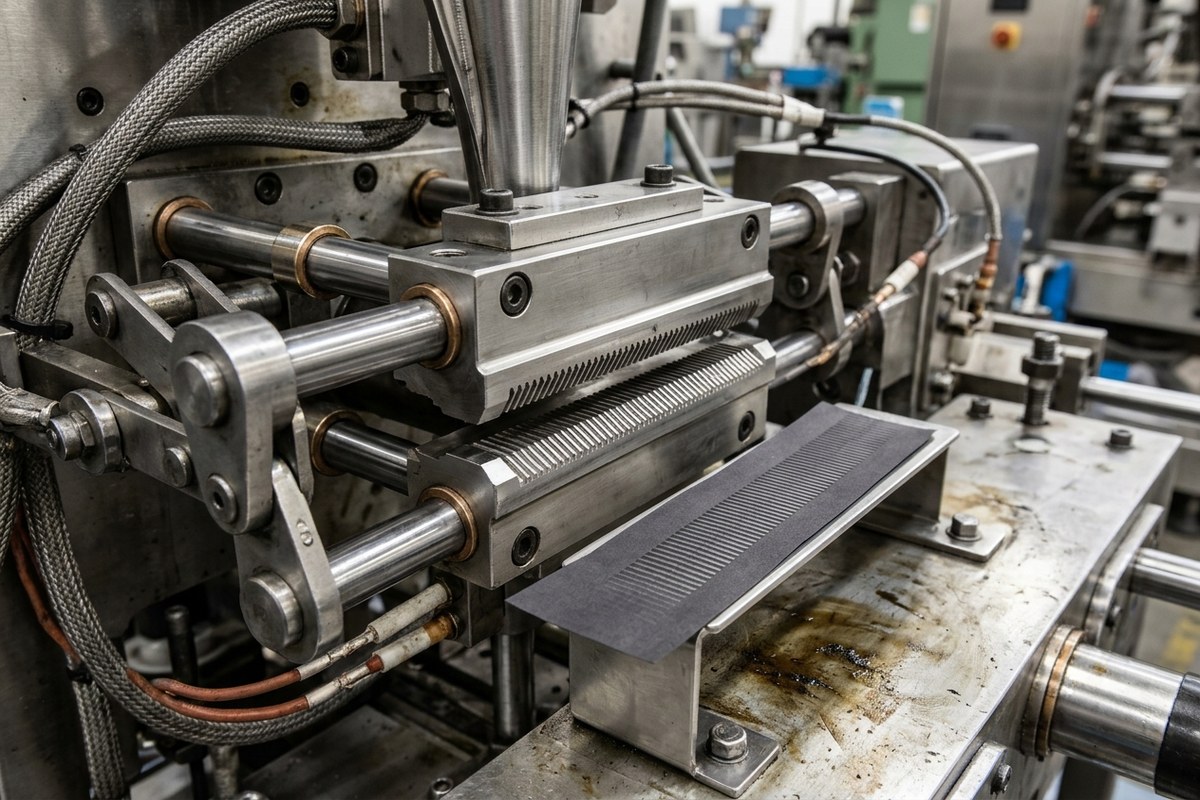
The second engineering differentiator when comparing vffs machine manufacturers is how the horizontal cross-sealing jaws actuate, apply pressure, and coordinate with vertical film movement. As ZEEPACK notes, a servo VFFS machine eliminates the need for continuous compressed air generation, frequently reducing energy consumption at the machine level by up to 70-80%. In ZEEPACK's analysis, servo motors execute smooth acceleration and deceleration profiles, often utilizing S-curve motion, and the jaws can begin closing while the film is still completing its final millimeter of travel, while facilities should install line reactors or isolation transformers to protect the machine's electrical components. In PFM horizontal flow-wrap sealing systems, each sealing shaft can also be configured with 1 to 4 jaws, while in PFM vertical intermittent motion the film stops during sealing for maximum contact time and maximum precision—ideal for flat-bottom, doy-style, or pillow-bag packs up to 80-120 depending on pack length—whereas in continuous motion the jaws seal the moving film. For high-barrier or structured laminates, PFM's patented Long Dwell rotary head provides extended dwell without giving up continuous motion, ensuring airtight seals on barrier films, recyclable mono-materials and paper-based films, including MAP applications, while for structured bags—block bottom, Steelo Bag, doy-style—the box-motion unit applies prolonged, even pressure while following the film's travel. On Syntegon's SVX series, a unique Cross-Seal Drive with four independently controlled servo motors ensures precisely guided sealing movements at speeds with up to 300 bags/min per lane.
Published OEM specification sheets illustrate how cross-sealing force, protection class, and utility demands vary across architectures: Rovema's BVI 260 intermittent-motion vertical form/fill/seal machine features vacuum draw down belts, a Sense&Seal function, and a wear-free servo motor based main drive for the cross-sealing station, with a max speed (PPM) of 120 and a sealing force of 6000. Rovema's BVI 260 specification sheet lists a shipping weight of 770 kg, min package width of 2.36 in and max package width of 260 mm (optional for gusseted bags: 320 mm), cut-off min of 1.6 in and cut-off max of 350 mm, film reel width of 680 mm max, film reel diameter of 450 mm (optional: 600 mm), compressed air of 0.5 NI/cycle, electrical volts of 230/400, and class of protection IP54. For continuous-motion washdown duty, Rovema's REVO 3800 continuous-motion vertical bagger lists a speed per minute of 120 for Pillow Bags and 80 for Gusseted Pillow Bags, a sealing force of 5000, package width of 80-380 mm (3.15 - 14.96 in), cut-off up to 550 mm (up to 21.65 in), voltage of 480 VAC 3 Phase at 60 Hz, and class of protection IP66-69k. At higher output, Rovema's BVC-165 Twin Tube continuous-motion VFFS lists a rated mechanical speed of up to 500 bags per minute with a forming-tube centerline distance of 320 mm, programmable sealing pressure up to 6,000 N, minimum package width of 50 mm (1.97 in) to maximum package width of 165 mm (6.49 in), cut-off range of 80–320 mm (3.15–12.6 in), machine height of 1,325 mm (53 in), and machine footprint of 1,300 × 2,850 mm (52 × 113 in). Across Viking Masek's VFFS portfolio, the ES400 features a 45° angled frame, servo-drive jaw actuation, two separate IP66 enclosures, self-centering pull belts, and VFD powered film unwind, with a max speed of 60 bpm, bag size min 100 mm x 100 mm to max 400 mm × 600 mm, maximum roll diameter 450 (17.72"), maximum roll width 850 (33.46"), weight 1,225 kg (2,700 lbs), air pressure 6 bar (20 SCFM at 90 PSI), and power supply 8.4kVA (480V, three phase, 50/60H Hz., 20 AMPS). Viking Masek's M300i intermittent-motion closed-frame VFFS with a Siemens or Allen Bradley control system, servo-drive jaw actuation, self-centering pull belts, and VFD powered film unwind lists a max speed of 120 bpm across bag sizes from min 60 mm x 60 mm (2.36" x 2.36") to max 300 mm x 400 mm (11.8" x 15.74"), a weight of 2100 lbs, and a power supply of 7.9 kVA (480 V, 3 phase, 60 Hz., 10 AMPS). Its continuous-motion counterpart, Viking Masek's M300c, shares the closed frame design, Siemens or Allen Bradley control system, servo-drive jaw actuation, self-centering pull belts, VFD powered film unwind, 2100 lbs weight, and 7.9 kVA (480 V, 3 phase, 60 Hz., 10 AMPS) power supply while raising max speed in continuous motion to 200 bpm across bag sizes from min 60 mm x 60 mm (2.36" x 2.36") to max 300 mm x 400 mm (11.8" x 15.74").
For ultra-high-speed continuous bagging, Viking Masek's Velocity combines patented dual-jaw technology, servo jaw actuation, and vacuum pull belts to reach a max speed of 300 bpm across bag sizes from min 60 mm x 90 mm (2.3" x 3.54") to max 300 mm x 1,000 mm (11.8" x 39.37"), with maximum roll diameter 450 (17.75"), maximum roll width 530 (20.87")/630 (24.8"), weight 900 kg (1,985 lbs), air pressure 6 bar (15-20 SCFM at 90 PSI), and power supply 6 kVA (480 V, three phase, 60 Hz., 20 AMPS). Meanwhile, Viking Masek's M250 features enclosed, direct drive jaw actuation and self-centering pull belts (with vacuum pull belts and a horizontal jaw for up to 340 mm as options), operating at a max speed of 140 bpm across bag sizes from min 60 mm x 60 mm to max 250 mm x 400 mm, with maximum roll diameter 500 mm (19.6"), maximum roll width 545 mm (21.4"), weight 750 kg (1,655 lbs), air requirements 6 bar (15-18 CFM at 90 PSI), and power supply 6 kVA (480 V, three phase, 60 Hz., 20 AMPS). Regardless of which jaw drive a manufacturer supplies, plain paper does not provide adequate details for a sealing jaw impression: for cold or hot reciprocating sealing jaws on a vertical FFS bagger, technicians must use carbon paper, whereas once rotary jaws are hot, carbon paper begins to melt and technicians must switch to carbonless paper while also using a surface pyrometer to check multiple points across the sealing face.
- Normalize VFFS machine quotations across jaw drives, utilities, and included tooling
- Review carbon jaw impression and surface pyrometer inspection procedures
Dosing and multihead weigher synchronization, fieldbus protocols, and PackML
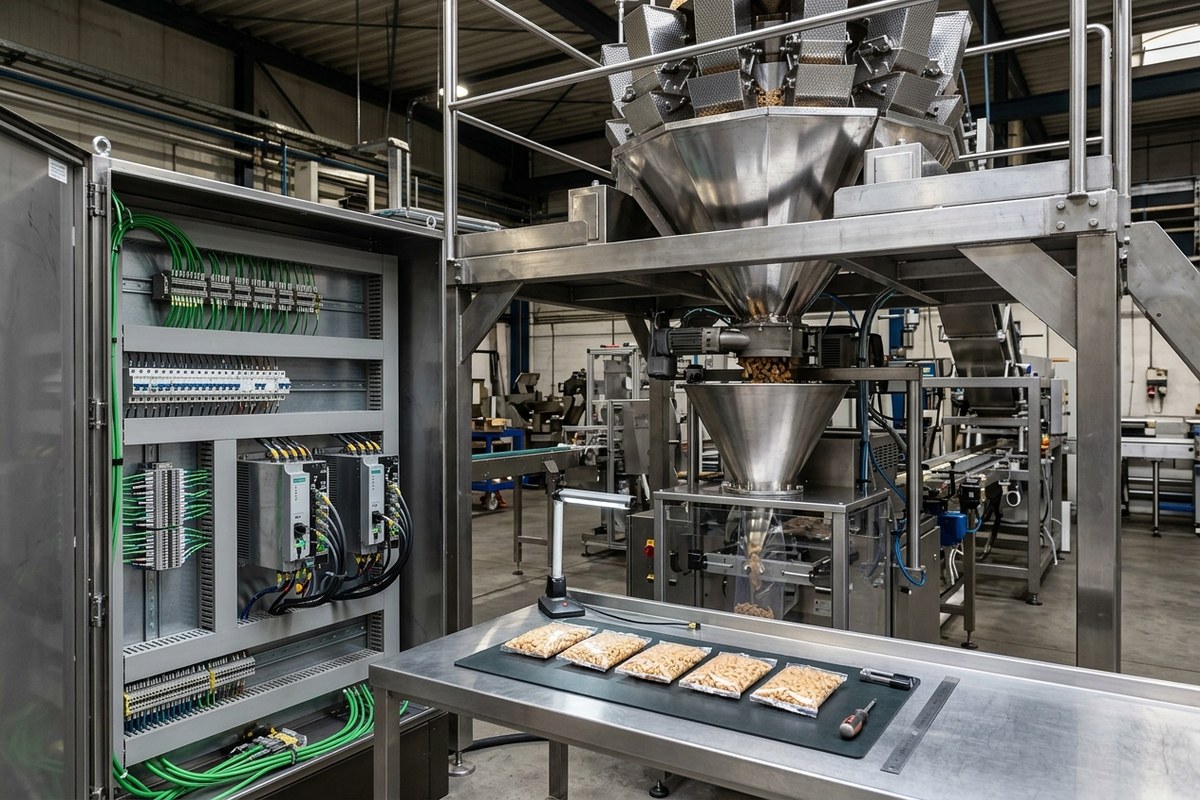
Even a mechanically rigid bagger will underperform if the dosing filler and vertical bagger cannot exchange deterministic cycle signals. In Smartpack's multihead weigher and VFFS integration guide, the VFFS often acts as master, using a core handshake of Weighment ready (Weigher to VFFS), Discharge request or bag ready (VFFS to weigher), Discharge complete (Weigher to VFFS), Run enable or discharge inhibit (Either direction), and Machine fault or not ready (Either direction), while emergency stops and safety interlocks belong in the approved safety system, not ordinary production I/O channels. Because product size, dust, bag format, and sealing time all affect usable output, a bagger rated at 80 bags per minute may run one product at 70 and another at 45, and a delay that works for 100 g may be too short for 1 kg of the same product. During line synchronization, specific fault symptoms pinpoint timing mismatches: an empty bag indicates a missed request or dose not ready, a double-filled bag indicates a repeated or remembered request, product in the cross seal indicates flight or settling time is too long, and the VFFS waiting every few cycles indicates the weigher cannot sustain the requested rate.
As Kenwei notes for multihead weigher and VFFS lines, modern systems usually integrate via digital I/O, Ethernet/IP, Profinet, or OPC UA, and for a standard setup, mechanical mounting and electrical integration typically take 2-5 days followed by 2-4 days of commissioning and recipe setup, depending on SKU complexity and factory readiness. For multi-vendor packaging lines, PackML published under ISA-TR88.00.02 provides a broadly recognized state model of 17 states (such as running, stopped, faulted, blocked, or starved) and standardized PackTags data structures to support MES layer interlocks and OEE collection. In Packaging Strategies' report on OEM PackML adoption, the 10 percent more effort it took to introduce PackML allowed 90 percent of the code to be reused and reduced lead times by 25-30 percent, while OEM Axon cut debug testing time by 60 percent, reduced overall engineering and manufacturing time by 40 percent, and made 80 percent of the company's code reusable.
| Integration Layer | Signal & Protocol Standard | Commissioning & Diagnostic Check |
|---|---|---|
| Master-Slave Handshake | Weighment Ready, Bag Ready, Discharge Complete, Inhibit, Fault (safety on dedicated relays) | Diagnose empty bags (missed ready), double fills (latched request), and seal jams (flight delay) |
| Fieldbus & Site Timeline | Digital I/O, EtherNet/IP, PROFINET, or OPC UA | 2–5 days mechanical/electrical install + 2–4 days recipe and drop-window tuning |
| ISA-TR88.00.02 PackML | 17-state machine model + standardized PackTags for MES/OEE | Up to 80–90% PLC code reuse, 25–30% shorter lead time, 60% faster debug |
Three-stage FAT acceptance, seal testing standards, and PLC obsolescence checks
Before releasing a deposit or final shipment payment to any supplier, structure your acceptance protocol around real product runs, interface fault injection, and properly scoped package tests. In Smartpack's validation framework, a practical plan comprises three stages: (1) Product FAT to run representative material through the weigher, (2) Interface Simulation FAT using a signal simulator or test PLC to reproduce the VFFS handshake and test normal, early, held, and repeated requests plus a bagger stop, weigher alarm, and reset sequence, and (3) On-Site Acceptance Test (SAT) to complete the final test with the real VFFS, forming tube, film, product, and utilities. In Kenwei's flexible packaging quality control guide, a food-safety management system can be aligned with ISO 22000, while ASTM F88/F88M is a recognized method for seal-strength testing of flexible barrier materials (though seal strength alone does not prove that a package is leak-free), ASTM F1929 addresses dye penetration for detecting leaks in porous medical packaging, and ASTM F2096 describes internal pressurization bubble testing. Buyers writing FAT clauses should keep each test method within its actual scope: NIST Handbook 133 provides procedures for checking packaged net contents and does not impose a universal Cpk target, 100-bag FAT plan or OEE release threshold, while ASTM F88 measures seal strength, ASTM D3078 addresses gross leaks in flexible packages containing headspace gas, and ISO 11607 concerns packaging for terminally sterilized medical devices.
Documented plant installations show how combining speed, OEE, and headspace gas targets works in practice: in Rovema's Reunion Coffee Roasters case study, installing a BVK 260 with auger delivered a capacity increase by a factor greater than two based on run rate along with a 30% OEE increase, while a BVC 260 with scale tripled capacity based on run rate and improved OEE by 20%; the new equipment held a 2% residual oxygen level; both machines were expected to deliver additional OEE increases of 15% or more. When verifying CE machinery safety and commercial terms on specialist baggers, Spack Machine's SPM-T300 drip coffee bag packing machine specification sheet (speed 30–70 bags/min, AC 220 V, 50/60 Hz, 5.65 kW, 0.5 MPa minimum compressed air, 1203 × 809 × 2141 mm L × W × H, about 440 kg) lists conformity with Machinery Directive 2006/42/EC and standards EN ISO 12100, EN 60204-1, and EN 415-1 (UDEM certificate M.2024.206.C100050, valid to 2029-04-25), along with a 12 months warranty from machine receipt and a 28-day standard lead time. For facilities subject to US federal machine-guarding regulation 29 CFR § 1910.212(a)(5) on cooling or exhaust fans, when the periphery of the blades of a fan is less than seven (7) feet above the floor or working level, the blades shall be guarded, and the guard shall have openings no larger than one-half (1/2) inch.
Finally, require every manufacturer to list exact PLC, I/O, and servo drive catalog numbers in the quotation so your new bagger is not built with phased-out stock: in industrial control systems most electronic equipment has a 15-year maximum lifespan, Siemens' 10-year spare-parts guarantee always counts from the P.M400 phase-out announcement date, and SIMATIC S7-300 PLCs and SIMATIC ET 200M I/O reached P.M400 Phase-Out Announcement on Oct 1, 2023 and P.M410 Product Cancellation on Oct 1, 2025 (with S7-1500 and ET 200MP as the recommended upgrades). Similarly, Siemens SINAMICS S210 (6SL3) servo drives reached P.M400 on Sep 30, 2025 and P.M410 on Oct 1, 2025, with P.M490 End of Spare Parts Obligation scheduled for Oct 1, 2034 and S210/6SL5 as the recommended upgrade. When a quotation specifies Allen-Bradley hardware, verify active status by part number as well, since of 27,368 Allen-Bradley parts in the KKM catalog that carry a lifecycle status, 7,710 (28 percent) are marked discontinued, obsolete, or end of life and 19,658 are marked active, as of 21 October 2026.
Output planning (N_ref), five-year TCO, and our factory-direct VFFS RFQ benchmarks
To hold all vertical form fill seal machine manufacturers to a uniform throughput target, specify the reference rate formula N_ref = Q / (T × A × P × Y), with Q in accepted packs and T in planned minutes. In a hypothetical arithmetic example, 12,000 accepted packs over 400 planned minutes requires 30 accepted packs/min on average, and assuming A = 0.80, P = 0.90 and Y = 0.98 gives N_ref = 12,000 / (400 × 0.80 × 0.90 × 0.98), approximately 42.5 reference packs/min. When comparing machine quotes over a multi-year horizon, apply the total cost of ownership formula TCO = capital and installation costs + included operating costs + maintenance and format costs − credited residual value. In an illustrative scenario where you assume $80,000 capital and installation, $30,000 annual included recurring cost and 1,000,000 accepted packs per year, five-year TCO = $80,000 + (5 × $30,000) = $230,000, and over 5,000,000 accepted packs the allocated total is $0.046 per accepted pack. For initial capital budgeting across configuration tiers, Kingdom Packaging's indicative market ranges list a basic VFFS machine at $5,000–$15,000, a standard automatic VFFS machine at $10,000–$30,000, a high-speed VFFS machine at $25,000–$60,000+, a multi-lane VFFS machine at $20,000–$80,000+, and a customized VFFS system at $30,000–$100,000+.
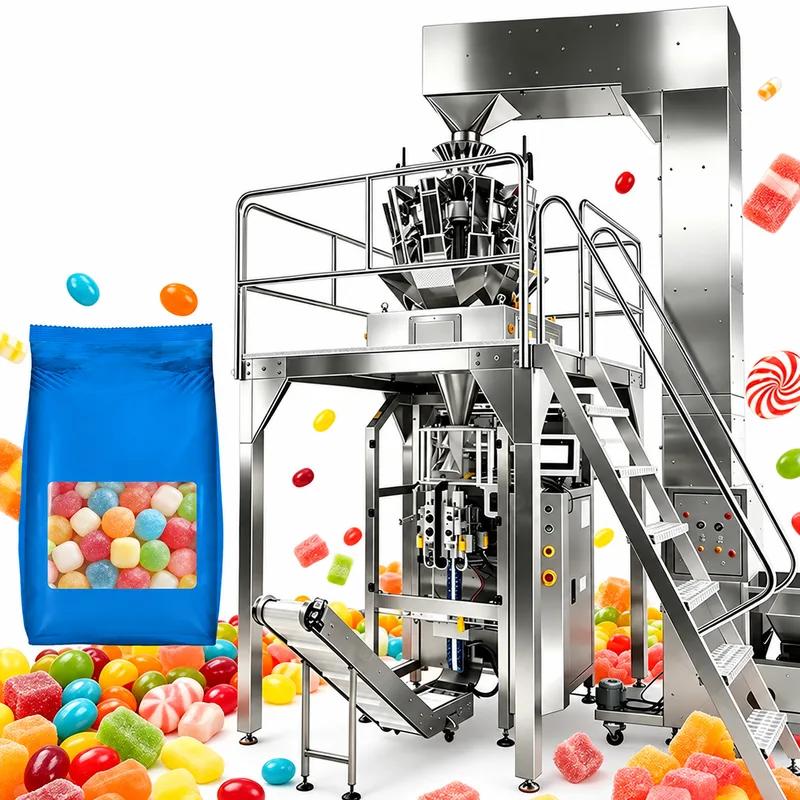
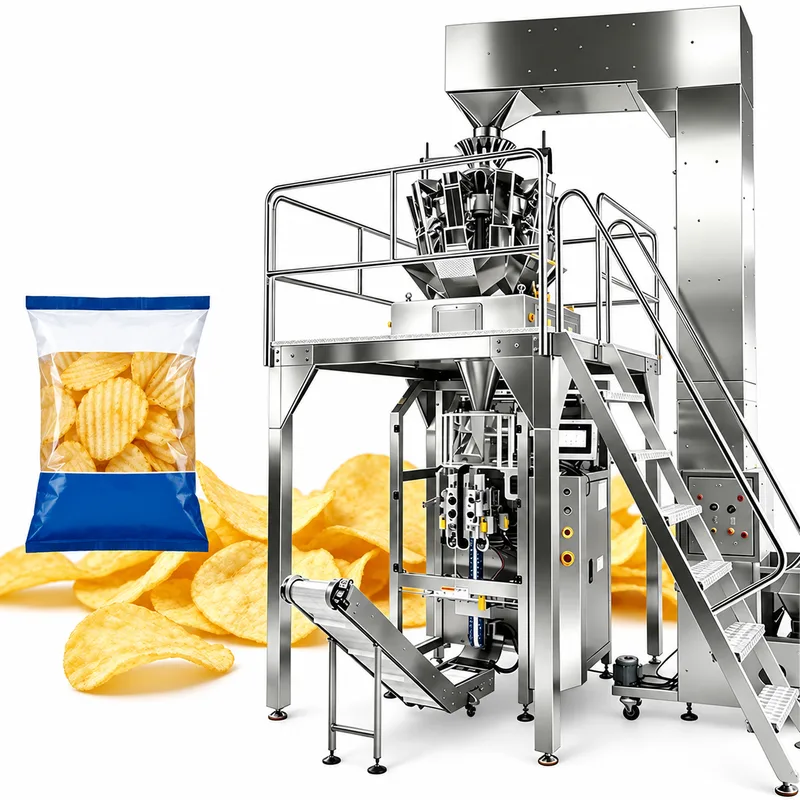
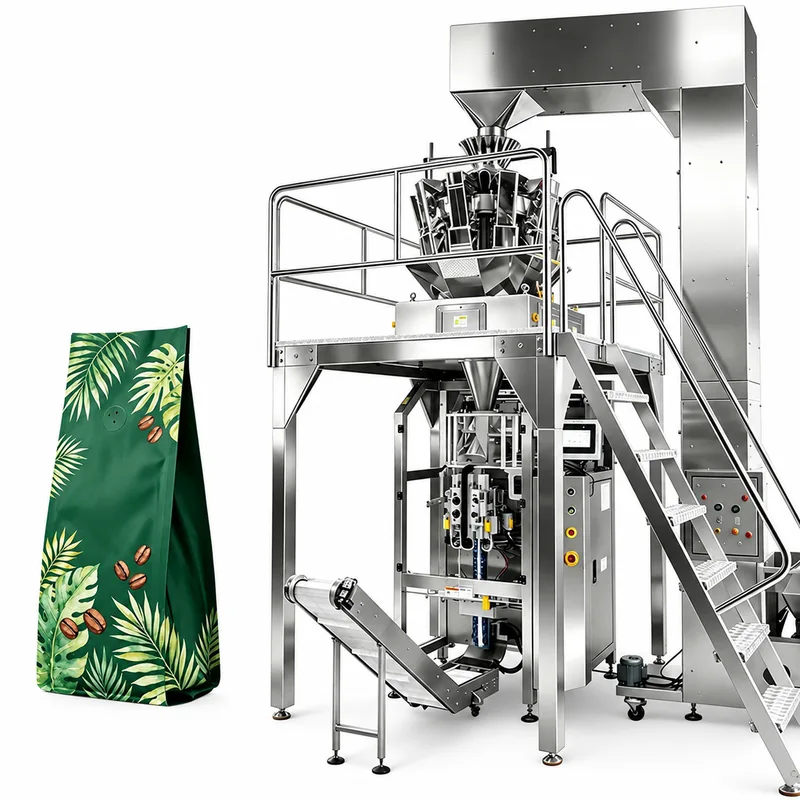
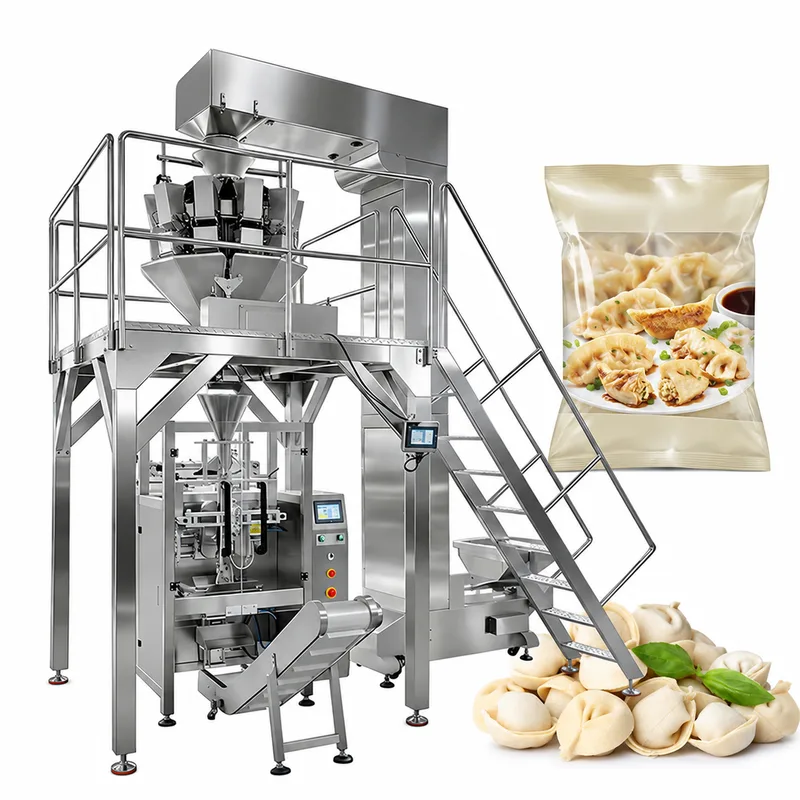
When scoping a factory-direct line with our VFFS engineering team, our Candy Multihead Weighing & Packaging configuration in our VFFS lineup lists a packaging speed of 30–70 bags/min (subject to candy condition, weight and bag type), a bag size range of length 80–300 mm and width 60–200 mm, and power & voltage of 3.5 kW at 220 V / 380 V, 50 Hz / 60 Hz. For fragile snacks, our Chips Packaging with Nitrogen Flushing configuration lists a packaging speed of 20 - 45 bags/min and a bag size range of length 150-400mm and width 100-280mm. For roasted coffee, our Coffee Bean Valve-Pouch Packaging configuration lists a packaging speed of 25 - 50 bags/min and power & voltage of 4.5KW at 220V/380V, 50Hz/60Hz. Across cold-chain applications, our Frozen Food Weighing & Packaging configuration pairs a 10 / 14 / 20 Head Combination Multihead Weigher at 25 - 70 bags/min across bag length 100-350mm and width 100-250mm at 220V/380V, 50Hz/60Hz, 4.5KW. For dry snacks, our Nuts & Dried Fruit Multihead VFFS configuration lists a packaging speed of 30 - 70 bags/min and a bag size range of length 80-350mm and width 60-240mm. For fresh produce, our Vegetable & Salad Weighing Packaging configuration lists a packaging speed of 20 - 55 bags/min and a bag size range of length 100-450mm and width 80-300mm. For narrow stick packs and liquid sachets, our Four-Lane Collagen Stick-Pack Machine lists 4 Lanes at 120 - 160 sticks/min (where the counting basis must be verified rather than multiplied by four), a 1 - 30g filling range, length 50-180mm, stick width 15-30mm, and AC 220V/380V, 50Hz/60Hz, 4.5 KW, while our Sauce Four-Side-Seal Sachet Machine lists a packing speed of 30 - 60 bags/min, filling range of 5 - 100 ml (which can be extended up to 500ml), bag length 50 - 180 mm, bag width 30 - 140 mm, maximum film width 320 mm, and 220V, 50/60Hz, 2.2KW. Explore our machine catalog links and complete the RFQ preparation table below to request a configuration review for your packaging line.
- Compare five-year total cost of ownership and cost per accepted pack across VFFS options
- Review our Candy Multihead Weighing & Packaging configuration profile
- Review our Chips Packaging with Nitrogen Flushing configuration profile
- Review our Coffee Bean Valve-Pouch Packaging configuration profile
- Review our Frozen Food Weighing & Packaging configuration profile
- Send your product, bag format, and output requirements to our engineering team
Sources
Technical references consulted for this guide include Viking Masek VFFS product specifications and vacuum pull belt maintenance documentation; Rovema North America intermittent, continuous rotary, and twin-tube VFFS technical documentation and Reunion Coffee Roasters case study; Syntegon Technology SVX cross-seal drive documentation; PFM sealing systems technical documentation; Packaging Strategies and Packaging Digest OMAC PackML implementation reports; Smartpack multihead weigher integration and factory acceptance guidance; ZEEPACK and CECLE servo versus pneumatic VFFS comparisons; Guangdong Kenwei flexible packaging quality control and weigher integration guides; Rezpack bag-length diagnostic guidance; Fill Package VFFS timing belt and bag former specifications; Spack Machine drip coffee bag packing machine documentation; Kingdom Packaging VFFS cost guide; and our VFFS machine configuration profiles and engineering buyer guides.
Explore the Equipment
Vertical Form Fill Seal
Candy Multihead Weighing & Packaging
A correct bag weight can still hide broken, stuck or wrongly mixed sweets. Residue held on a contact surface can release into the next bag. This multihead weigher and VFFS line is set up around your candy's coating, size and pack.
Vertical Form Fill Seal
Chips Packaging with Nitrogen Flushing
An inflated bag can hide broken chips, a short fill or a weak seal. Size this weigher, VFFS and nitrogen-flush line from your chip volume, breakage limit and gas supply.
Vertical Form Fill Seal
Coffee Bean Valve-Pouch Packaging
A misplaced or poorly attached degassing valve can spoil a run of coffee bags. Specify this weigher and VFFS valve line from your valve drawing, film, roast and weight.
Vertical Form Fill Seal
Frozen Food Weighing & Packaging
Frosted pieces retained in a hopper can leave a bag underweight and turn up in later fills. Specify this frozen-food weigher and VFFS line from product temperature, frost, piece size and cleaning method.