
Used Vertical Form Fill Seal Machine: Inspection Before Purchase
Inspect a used vertical form fill seal machine for sale across forming shoulder shark's teeth wear, sealing jaw carbon impressions, film pull-down timing belts, and PLC lifecycle status.
On This Page
Forming collar, tube clearance, and unfolded film web audit
Evaluating a used vertical form fill seal machine for sale begins at the forming assembly, where worn vffs machine parts directly determine whether packaging film tracks cleanly or tears under tension. As packaging material moves across a vertical FFS bagger, it wears the lip of the forming shoulder and can eventually create an uneven edge often referred to as shark’s teeth that creases the material and creates jagged score marks down the outside surface of the package. At the intersection between the forming tube and the forming shoulder, narrow pinch points where clearance is too tight create excess tension that can tear or break the packaging material and create score marks that reduce barrier capacity. Conversely, formers built without precise, constant clearance must have wider clearance between the tube and shoulder to avoid pinch points, which can result in more variable bag sizes and wrinkles. Behind the shoulder on vertical FFS baggers, rollers that are adjusted too far back can cause score marks on the inside and outside of the bag, while formers that are not correctly positioned can cause open back seals. Misaligned film rollers also prevent the film from making full contact with the forming collar, causing wrinkles, creases, and package distortions that reduce shelf appeal and cause seal problems. On vertical baggers, guide rollers must be adjusted to create even contact between the material and the forming collar wing between positions 1 and 2, whereas too much, too little, or uneven tension demonstrated by positions 3 and 4 can cause wrinkles and creases.
Low-precision forming collars and mechanical deformation over time cause inconsistent bag sizes and misaligned seals, whereas bag formers crafted from SUS304 stainless steel resist deformation; SUS304 forming tubes are corrosion- and wear-resistant. High-precision VFFS bag formers accommodate a wide range of film thicknesses (0.02mm – 0.12mm), ensuring consistent and aesthetically pleasing bags. When a second-hand machine lacks the right former for your pouch format, custom forming shoulders can be customized to your machine brand, film width, and bag geometry across a film width customization range of 35mm (min) to 800mm (max). Where an existing forming assembly is worn, dropped, or misaligned, refurbishing the forming set restores structural integrity and alignment while saving up to 50% compared to purchasing new forming sets. Inspectors should also check whether the forming tube carries a specialized surface treatment such as Kenray KFlow, an Armoloy coating used mainly on tubes to reduce the wear and friction caused when film moves across a flat surface. With thinner films (typically around 35 microns) that tend to stretch and force production speeds to lower, KFlow Armoloy coating on the forming tube can help maintain bag speeds similar to those achievable with thicker film. For abrasive films, Kenray Former Guard provides a wear-resistant coating on forming shoulders, while for applications packaging sticky products it is often prudent to place a food-approved KSlip coating inside the tube.
Before accepting the installed former on a used bagger, verify the unfolded web width against your target bag dimensions using the geometric estimates where pillow bag film width = 2W + A and side-gusseted bag film width = 2W + 2G + A, obtained by adding the unfolded faces, side panels where present, and back seal. In an example with assumed inputs of W = 160 mm and fin height = 10 mm, so A = 20 mm, the pillow estimate is 2 × 160 + 20 = 340 mm, and with G = 50 mm, the side-gusset estimate is 2 × 160 + 2 × 50 + 20 = 440 mm. Use the inspection checkpoints and internal engineering guides below to compare the installed forming collar against your required film web envelope.
- Calculate unfolded pillow and side-gusset film width before inspecting a forming set
- Compare new VFFS and sachet packaging machine configurations in our catalog
| Forming assembly area | Defect mechanism and specification scope | Pre-purchase inspection action |
|---|---|---|
| Forming shoulder lip and tube intersection | Worn shoulder lips develop an uneven shark’s teeth edge that creases film, while narrow tube-to-shoulder pinch points create excess tension and score marks that reduce barrier capacity | Inspect the shoulder lip and verify precise, constant tube-to-shoulder clearance; formers that need wider clearance to avoid pinch points can produce more variable bag sizes and wrinkles. |
| Guide roller positions and collar contact | Guide rollers adjusted too far back can cause score marks on the inside and outside of the bag, while misaligned rollers prevent full contact with the forming collar | Adjust guide rollers for even contact between the material and the forming collar wing between positions 1 and 2 rather than uneven tension at positions 3 and 4 |
| Former material, thickness range, and web formula | SUS304 stainless steel bag formers resist deformation; high-precision formers accommodate 0.02mm – 0.12mm film thicknesses; custom forming shoulders cover a 35mm (min) to 800mm (max) film-width range; refurbishing worn sets saves up to 50% | Check unfolded web width with pillow bag film width = 2W + A and side-gusseted bag film width = 2W + 2G + A before ordering reels |
Horizontal sealing jaw carbon impressions and multi-point pyrometer profiling
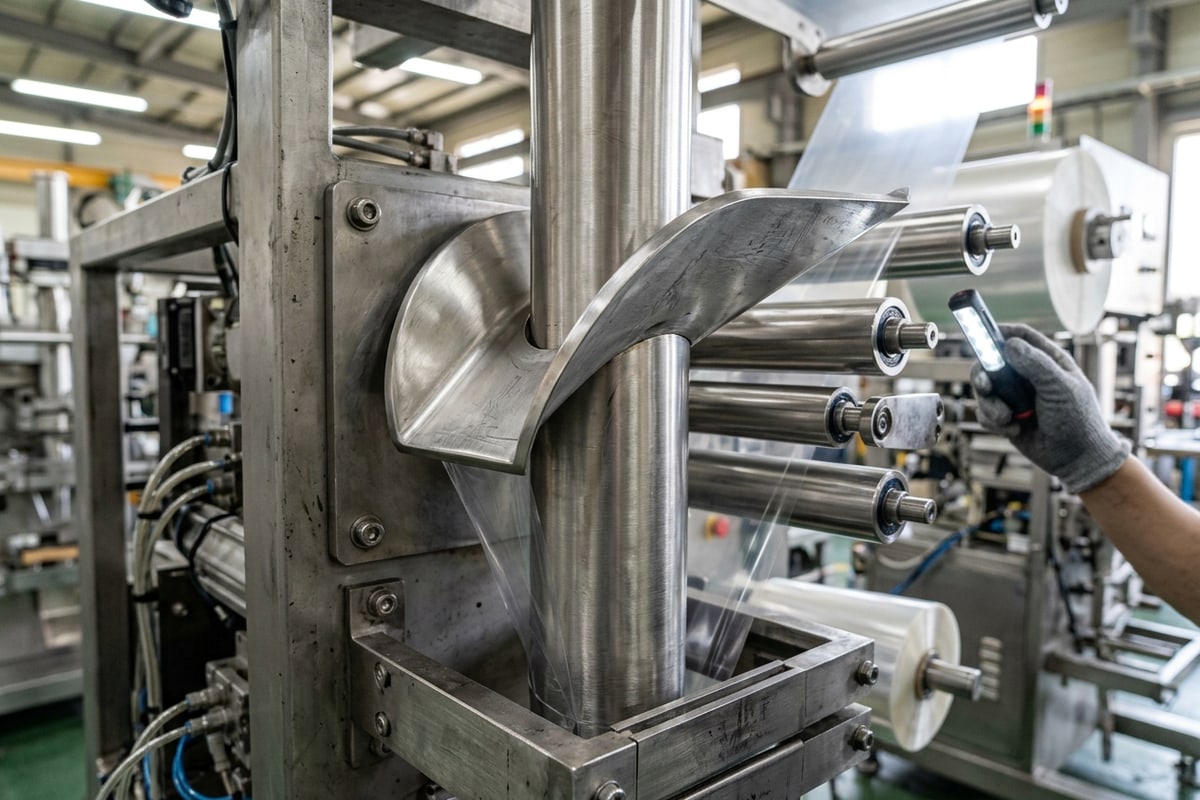
Plain paper does not provide adequate details for a sealing jaw impression, as a plain paper impression that led a mechanic to think sealing jaw set-up was good hid uneven end-to-end jaw clearance and misaligned serrations revealed by alternating light and dark lines. For cold or hot reciprocating sealing jaws on a vertical FFS bagger, technicians must use carbon paper for initial installation and all adjustments because carbonless paper is not properly activated by reciprocating jaws. By contrast, on hot rotary sealing jaws, once rotary jaws are hot, carbon paper begins to melt and no longer provides a clear impression, so technicians must switch to carbonless paper to fine tune setup.
When a carbon impression made by reciprocating jaws on a vertical bagger shows uneven pressure on the upper and lower seals, that disparity is often created by damage or product buildup on jaw mounting surfaces, carriage misalignment, or worn linear bearings. During pre-purchase testing and preventative maintenance, always label your impression with the date, line and machine, direction arrow, and sealing jaw pair number so you can compare results over time and track changes. Inspect the jaw serration teeth closely for abrasion from improper cleaning, since stiff, coarse bristled brushes damage the serrations and cause sealing problems, whereas brushes with finer, softer bristles are more forgiving before running a post-cleaning carbon impression.
Check the jaw mounting hardware as well: to ensure accurate setup and prevent the jaws from shifting out of alignment, jaws should be installed with new mounting bolts using hardened, flat washers on flat surfaces and spherical washers or split washers on round shafts. Finally, because sealing jaws are often hotter in the middle than at the ends where heat dissipates more quickly—a variability the controller does not reveal since it usually indicates temperature at only one point—inspectors must use a surface pyrometer to check multiple points across the sealing face. Use our spare parts and factory acceptance guides below when documenting jaw condition during a machine audit.
- Review our Packaging Machine FAT Checklist for structured mechanical and seal verification
- Identify replacement sealing jaws, heaters, and wear parts before purchase

Film pull-down timing belts, drive rollers, and encoder shaft run-out
When a used vertical form fill seal machine exhibits varying bag lengths or a photo-eye system that constantly loses track, the root cause often lies in low tooth profile accuracy and uneven pitch in inferior film pull timing belts that accumulate micro-errors over cycles. Inspect the drive pulley and belt tooth geometry carefully because Rounded (HTD/Arc) teeth and Trapezoidal teeth on VFFS film pulling timing belts are not interchangeable, and using the wrong profile will result in poor engagement, inaccurate positioning, rapid wear, and potential belt failure. Common VFFS timing belt tooth pitches include 5mm pitch (often designated as 5M in HTD belts), 8mm pitch (often designated as 8M in HTD belts), 10mm pitch (often designated as T10 or 10mm in trapezoidal belts), and 12.7mm pitch (designated as L in trapezoidal belts). When measuring the total length of a removed belt laid flat in millimeters to determine circumference, a 240L belt has a circumference of 640mm. When measuring the width of the belt from edge to edge using a caliper or ruler, common widths for VFFS applications are 17mm and 25mm, though custom widths are available.
Precision VFFS timing belts produced on German-engineered molding equipment achieve ±0.3mm dimensional accuracy—tighter than the industry standard of ±0.5mm. On machines running smooth films like OPP or PET or heavy packaging materials under the dynamic loads of rapid acceleration, standard rubber pull belts have insufficient surface friction to maintain a secure grip, whereas an optional high-friction red coating in specialized PU/rubber increases grip. Budget replacement pull belts into your maintenance plan based on shift intensity: published VFFS timing belt service life is 12-18 months for standard applications (8-10 hours/day, moderate speed), 8-12 months for high-duty applications (16-20 hours/day, high speed), and 18-24+ months for light-duty applications (intermittent use, low speed).
Beyond the belts themselves, inspect the rotary drive and encoder shafts: coupling a solid shaft encoder with a rigid coupling transfers misalignment and shaft movement straight into small internal bearings, and if a hollow-shaft stator is clamped solid to the frame, the shaft run-out and thermal growth will flex the bearings with each revolution. During mechanical inspection, bring the two shafts into line with a dial indicator or a straightedge before you tighten the coupling, then rotate the shaft by hand through a full turn and feel for binding or uneven resistance. Review our spare parts enquiry service below if your inspection identifies worn pull belts or misaligned drive shafts.
| Drive and pull-down component | Published profile, dimension, and tolerance data | On-site verification procedure |
|---|---|---|
| Tooth profile and pitch designations | Rounded (HTD/Arc) and Trapezoidal tooth profiles are not interchangeable; common pitches are 5mm pitch (5M) and 8mm pitch (8M) in HTD belts, and 10mm pitch (T10) and 12.7mm pitch in trapezoidal belts | Verify belt tooth profile matches the drive (Rounded HTD/Arc vs Trapezoidal) to prevent poor engagement, inaccurate positioning, and rapid wear |
| Belt dimensions, tolerance, and service life | A 240L belt has a flat circumference of 640mm, common VFFS belt widths are 17mm and 25mm, and precision molded belts hold ±0.3mm dimensional accuracy versus ±0.5mm industry standard | Budget belt replacements at 12-18 months for 8-10 hours/day, 8-12 months for 16-20 hours/day, or 18-24+ months for light-duty use |
| Encoder coupling and shaft run-out | Coupling a solid shaft encoder with a rigid coupling transfers misalignment and shaft movement into the bearings; if a hollow-shaft stator is clamped solid to the frame, shaft run-out and thermal growth flex the bearings each revolution | Align shafts with a dial indicator or straightedge before tightening the coupling and rotate by hand through a full turn to feel for binding |
PLC, servo drive, and HMI control cabinet obsolescence audit
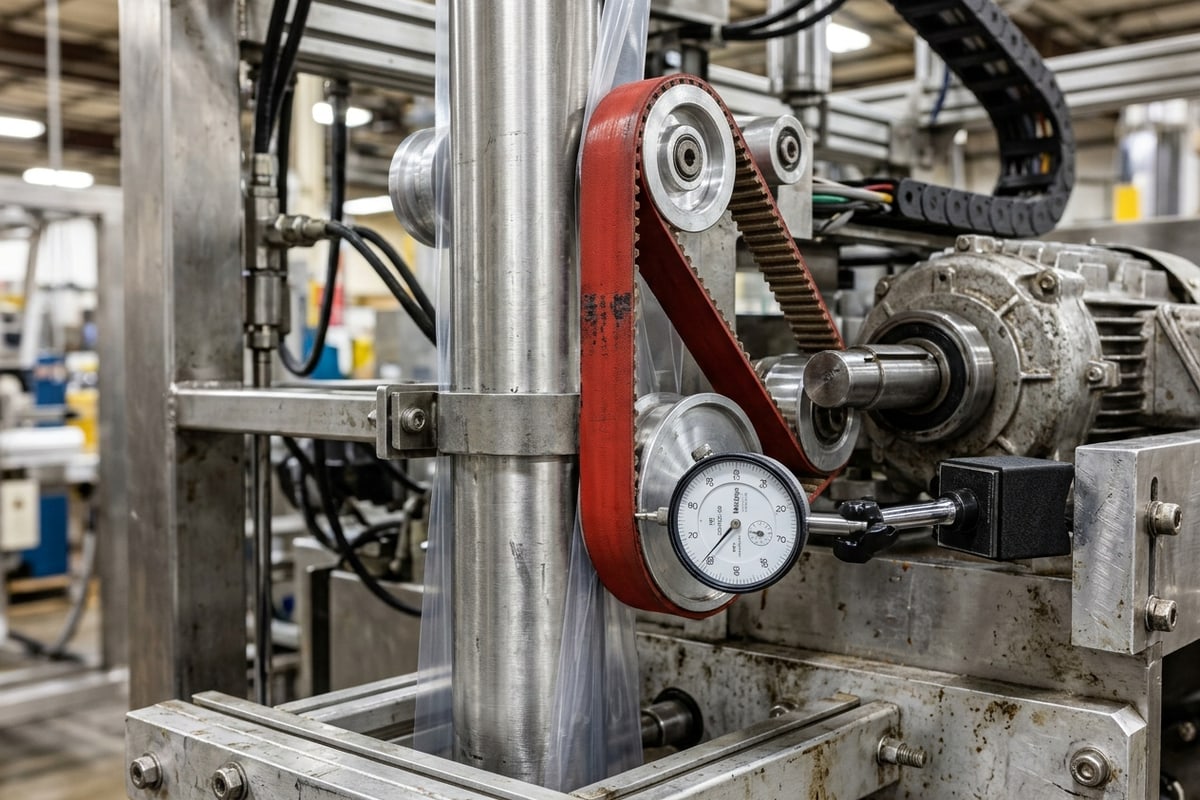
Opening the electrical cabinet is one of the most consequential steps when evaluating a used vertical form fill seal machine for sale, because in industrial control systems most electronic equipment has a 15-year maximum lifespan and requires replacement long before the mechanical frame wears out. When auditing a Siemens control cabinet, note that Siemens' 10-year spare-parts guarantee always counts from the P.M400 phase-out announcement date, not from P.M410 (product cancellation)—meaning that if P.M400 is announced in 2023, Siemens commits spares until 2033. Specifically, Siemens SIMATIC S7-300 PLCs and SIMATIC ET 200M I/O reached P.M400 Phase-Out Announcement on Oct 1, 2023 and P.M410 Product Cancellation on Oct 1, 2025 (with S7-1500 and ET 200MP as the recommended upgrades), while SIMATIC S7-200 PLCs reached P.M410 on Oct 1, 2014 (recommended upgrade S7-1200). In addition, SIMATIC ET 200S I/O reached P.M410 Product Cancellation on Oct 1, 2023 (with ET 200SP as the recommended upgrade), and the HMI MP277 operator panel reached P.M400 on Oct 1, 2011 and P.M410 on Oct 1, 2019. Even newer servo hardware requires part-number verification: Siemens SINAMICS S210 (6SL3) servo drives reached P.M400 on Sep 30, 2025 and P.M410 on Oct 1, 2025, with P.M490 End of Spare Parts Obligation scheduled for Oct 1, 2034 and S210/6SL5 as the recommended upgrade.
If the used VFFS bagger uses Rockwell Automation controls, check each catalog prefix carefully: of 27,368 Allen-Bradley parts in the KKM catalog that carry a lifecycle status, 7,710 (28 percent) are marked discontinued, obsolete, or end of life and 19,658 are marked active, as of 21 October 2026. Discontinuation is very uneven by part-number family: all 476 listed 190S parts are marked not active, along with 53 percent of 800T and 45 percent of 800H, against 5 of 2,038 in the 109 family.
Replacing an obsolete HMI panel on a second-hand bagger also requires original project files and logic validation: when converting an obsolete Allen-Bradley PanelView Standard application into FactoryTalk View Machine Edition, Rockwell notes that the first state of a PanelView multistate object has a value of 1, while in Machine Edition it is 0, so every multistate indicator and button must be checked. Similarly, on legacy Siemens operator panels, Siemens' migration guide states that WinCC flexible 2008 SP2 or SP3 projects can be migrated into WinCC in the TIA Portal, whereas older WinCC flexible or ProTool projects must be upgraded to WinCC flexible 2008 first. Check the lifecycle summary table below against the part numbers inside the control enclosure before committing to a used machine.
| Control hardware family | Published lifecycle status and cancellation dates | Migration path and pre-purchase requirement |
|---|---|---|
| Siemens SIMATIC S7-300, S7-200, and ET 200M / ET 200S | S7-300 and ET 200M reached P.M400 on Oct 1, 2023 and P.M410 on Oct 1, 2025; S7-200 reached P.M410 on Oct 1, 2014; ET 200S reached P.M410 on Oct 1, 2023 | Siemens 10-year spare-parts guarantee counts from P.M400 (2023 commits spares until 2033); budget upgrades to S7-1500, S7-1200, ET 200MP, or ET 200SP |
| Siemens HMI MP277 and SINAMICS S210 (6SL3) servo | HMI MP277 reached P.M400 on Oct 1, 2011 and P.M410 on Oct 1, 2019; SINAMICS S210 (6SL3) reached P.M400 on Sep 30, 2025 and P.M410 on Oct 1, 2025 (P.M490 Oct 1, 2034) | Verify whether WinCC flexible 2008 SP2 or SP3 source files exist for TIA Portal migration and plan S210/6SL5 servo drive migration |
| Allen-Bradley part families and PanelView Standard | Of 27,368 Allen-Bradley parts in the KKM catalog (as of 21 October 2026), 7,710 (28 percent) are discontinued/obsolete/EOL, including all 476 listed 190S parts, 53 percent of 800T, and 45 percent of 800H against 5 of 2,038 in the 109 family | When converting PanelView Standard to FactoryTalk View Machine Edition, check multistate objects where state 1 shifts to 0 |
Machine guarding compliance, five-year TCO, and new small VFFS benchmarks
Before signing a purchase order for a pre-owned vertical bagger, verify physical machine guarding and calculate whether the cumulative cost of mechanical and electrical remediation exceeds the price of a new configuration. Under US federal machine-guarding regulation 29 CFR § 1910.212(a)(5), when the periphery of the blades of a fan is less than seven (7) feet above the floor or working level, the blades shall be guarded, and the guard shall have openings no larger than one-half (1/2) inch.
In our total-cost calculation on VerticalPackingMachine.com, TCO = capital and installation costs + included operating costs + maintenance and format costs − credited residual value; in an illustrative 5-year scenario, $80,000 capital plus 5 × $30,000 annual cost equals a five-year TCO of $230,000, which over 5,000,000 accepted packs yields an allocated total of $0.046 per accepted pack. When a used vertical form fill seal machine for sale requires a replacement forming set, new reciprocating jaws, pull-down timing belts, and a PLC or HMI control retrofit, adding those remediation costs and unscheduled downtime to the purchase price rapidly inflates your cost per accepted pack.
Buyers comparing a second-hand unit against a new small vertical form fill seal machine can benchmark against our published catalog profiles: our Sauce Four-Side-Seal Sachet Machine lists a published speed of 30–60 bags/min depending on volume and viscosity and a published filling range of 5–100 ml with extension up to 500 ml (not every 50–180 × 30–140 mm sachet holds 500 ml). In our Sauce Four-Side-Seal Sachet Machine specification table, bag length is 50 - 180 mm, bag width is 30 - 140 mm, film width is Max. 320 mm, and power supply is 220V, 50/60Hz, 2.2KW (Customizable). For solid piece products, our Candy Multihead Weighing & Packaging configuration lists a published speed of 30–70 bags/min subject to candy condition, weight, and bag type, across a published bag range of length 80–300 mm and width 60–200 mm. Use the links and enquiry table below to compare our new machine configurations or share your film width, bag dimensions, and target output with our engineering team.
- Compare five-year total cost of ownership and cost per accepted pack across VFFS options
- Review our Sauce Four-Side-Seal Sachet Machine configuration profile
- Review our Candy Multihead Weighing & Packaging configuration profile
- Send your bag dimensions, film structure, and output requirements to our engineering team
Sources
Technical references consulted for this inspection guide include Greener Corporation vertical FFS forming, sealing jaw carbon impression, and preventative maintenance guides; Kenray Global forming set refurbishment and surface coating documentation; Fill Package VFFS bag former and film pull-down timing belt technical specifications; KKM Solutions rotary encoder shaft alignment, obsolete HMI replacement, and Allen-Bradley lifecycle status documentation; Patti Engineering Siemens control system lifecycle analysis; Cornell Law School Legal Information Institute federal machine-guarding regulation text; and VerticalPackingMachine.com bag width, total cost of ownership, and machine configuration profiles.
Explore the Equipment

Vertical Form Fill Seal
Candy Multihead Weighing & Packaging
A correct bag weight can still hide broken, stuck or wrongly mixed sweets. Residue held on a contact surface can release into the next bag. This multihead weigher and VFFS line is set up around your candy's coating, size and pack.

Sauce Sachets
Sauce Four-Side-Seal Sachet Machine
Sauce strings or drips can contaminate the seal area, leading to leaks and rejected sachets. Specify this piston-dosing four-side-seal machine from your sauce, portion, sachet drawing and film.