
Packaging Machines / Sauce Sachets
Sauce Four-Side-Seal Sachet Machine
Sauce strings or drips can contaminate the seal area, leading to leaks and rejected sachets. Specify this piston-dosing four-side-seal machine from your sauce, portion, sachet drawing and film.
- Published speed: 30–60 bags/min, depending on volume and viscosity
- Published filling range: 5–100 ml; extension up to 500 ml (not for every sachet size)
- Published sachet range: length 50–180 mm, width 30–140 mm, film width max. 320 mm
- Dosing: piston volumetric; heated or stirred hopper as product-led options
We reply within 24 hours.
Published Configuration Data
| Packing Speed | 30 - 60 bags/min (Depends on volume & viscosity) |
|---|---|
| Filling Range | 5 - 100 ml (Can be extended up to 500ml) |
| Bag Length | 50 - 180 mm |
| Bag Width | 30 - 140 mm |
| Film Width | Max. 320 mm |
| Power Supply | 220V, 50/60Hz, 2.2KW (Customizable) |
These values describe the listed configuration. Output depends on the product, fill quantity, bag and options. Confirm the final specification and trial conditions in your quotation.
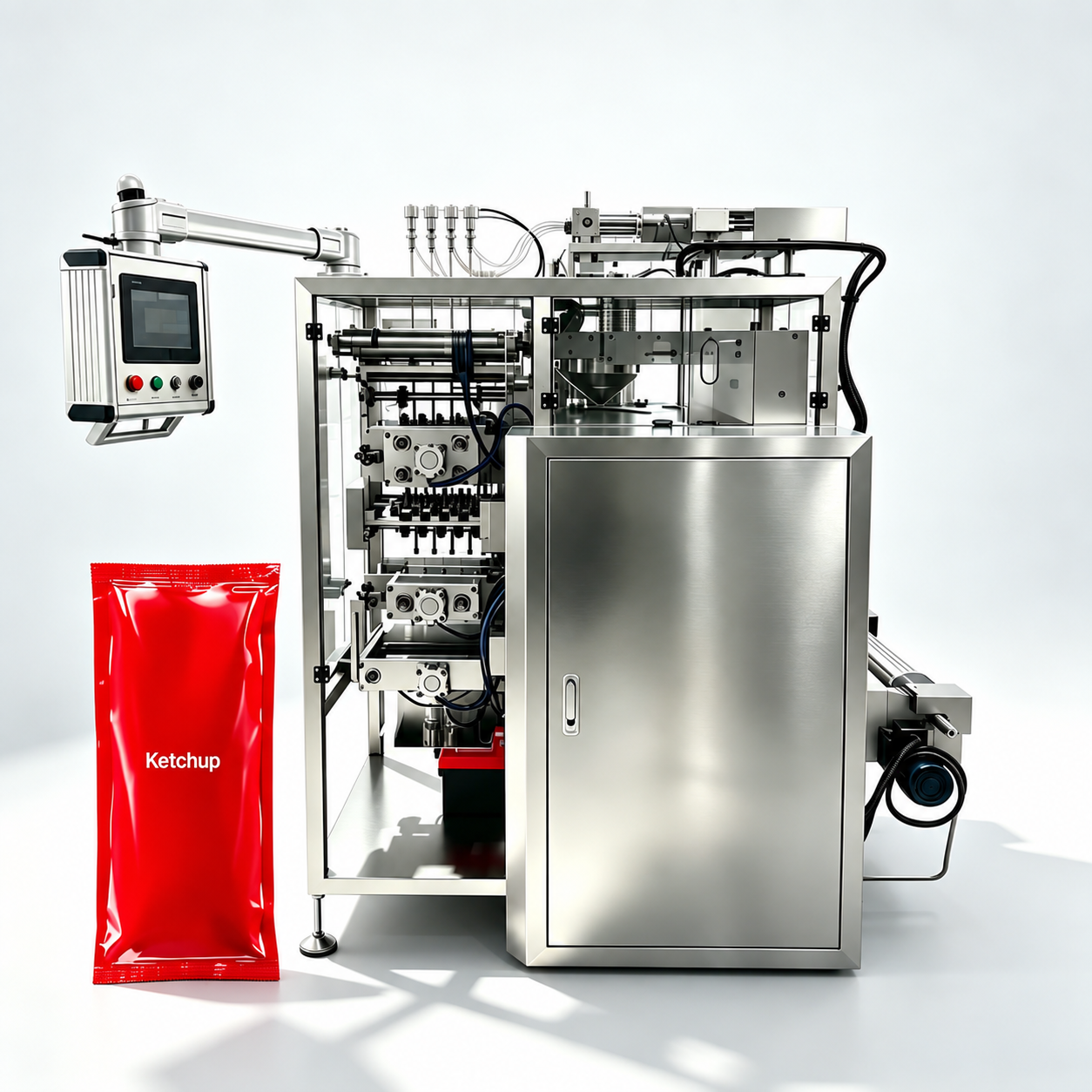
Configuration & Selection
Choose the piston, valve and nozzle from your sauce's viscosity, temperature and particles, then check the sachet size against the portion. A trailing drop or an oversized portion can reach the seal area and cause leaks even when the dose is right. Specify viscosity, filling temperature and particle size, and confirm pump, nozzle and sealing against your sauce sample. Send details of your sauce temperature, viscosity and particle description, portion in ml or g, sachet drawing, film and seal layout through the enquiry form or WhatsApp; physical samples are arranged separately.
On This Page
Piston dosing for flat sauce portions
This configuration pairs piston volumetric dosing with a film-fed sachet process for ketchup, tomato paste and other viscous products. The package is a flat four-side-seal sachet. Sauce enters through a nozzle while the machine forms, closes and separates the portions. The question that matters is whether the pump, product path, nozzle and sealing arrangement work together with your actual sauce and the serving you need.
Start from the formulation, not a general label like "liquid filler". Smooth ketchup, a thick paste and a chili sauce with particles make different demands on the product path. The catalog also mentions alternative sealing arrangements. So the quotation should name the exact sachet format being supplied. This profile covers the four-side-seal configuration only. Moving to a back-sealed package is a separate forming and tooling discussion. Do not assume it is a cosmetic choice available on the same installed setup.
Takeaway: Name the exact sachet format and your actual sauce before comparing quotations.
Follow the sauce from hopper to sachet
Go through the material path in order: incoming product, hopper, piston chamber, valve, delivery connection and filling nozzle. Find out how the piston volume is adjusted and how the proposed system completes the discharge before the package closes. A heated or stirred hopper is optional. Discuss it against how your sauce behaves, and do not add it simply because the catalog lists it.
Watch the product enter and leave the filling system at the intended operating condition. If the sauce separates, traps air or changes consistency while it waits in the hopper, describe that during the review. A piston setting measures a volume, while the label quantity may be a mass. Work out how the trial will compare delivered portions with the product specification. Record changes in the sauce condition next to the measurements. Otherwise a dosing adjustment gets judged apart from the material actually being filled.
Takeaway: Agree how delivered volume will be compared with a mass-based label quantity.
Viscosity, particles and nozzle clearance
Give the supplier the sauce temperature and consistency expected at the filler, plus the size and nature of any particles. Seeds, chili fragments or soft pieces need a product path that passes them without blocking or damage. The source catalog describes larger valve and nozzle options for particulate sauces. Whether they suit your product depends on the sample and the selected dose, so review them together.
In the trial, watch the end of each discharge. A trailing strand or drop can reach the closing area even when the portion amount is fine. Inspect the nozzle behavior and the resulting sachets together. If the product needs a different filling temperature, that has to be considered with the film and the product process as well. Hopper heating is not proof of hot-fill, sterilization or preservation capability. Those processes need their own specification, assessed properly, beyond this general sauce portion configuration.
Common mistake: Treating hopper heating as proof of hot-fill or preservation capability.
Takeaway: Watch the end of each discharge for trailing strands reaching the seal.
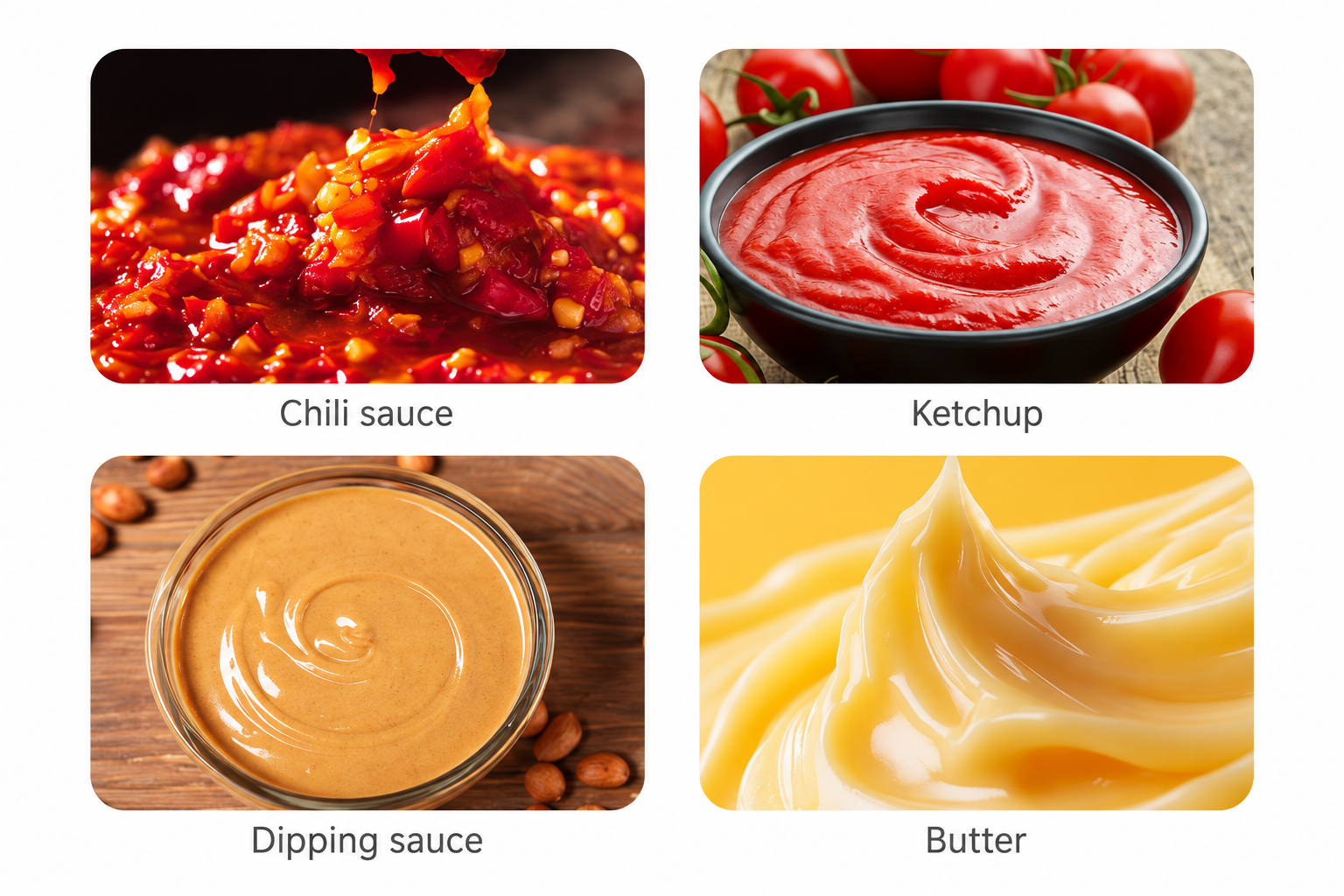
Sachet dimensions and seal allocation
Nominal bag dimensions include the space the seals use. Work from a drawing showing the external length and width, seal bands, usable filling area, code location and tear feature. A sauce portion can fit geometrically and still leave too little clear film around the closing zone. That is why the actual filled sample matters so much in the size review.
State the requested serving in the right units and provide the product information needed to relate volume and mass. Each substantially different portion size should be reviewed with the proposed tooling. The published range depends on the configuration. The 500 ml extension in the Published Configuration Data table sits beside the 50–180 mm by 30–140 mm sachet range, but it does not promise that the largest portion fits every listed sachet size; which tooling and sachet sizes go with the extension has to be confirmed for your format. Find out which format changes need parts, which use approved adjustments and which fall outside the selected machine arrangement. If the pack design has a shaped cut or a notch, inspect the sample around that feature. It should give the intended opening without shrinking the usable seal to a geometry nobody has reviewed.
Takeaway: Review each substantially different portion with its tooling and a filled sample.
Film preparation and printed package presentation
Supply the film specification and artwork layout early. The supplier needs time to check them against the forming and sealing arrangement. Confirm how the printed web is presented to make the front and back of the flat sachet, and where registration sensing and coding happen. Four-side-seal machines do not all route film the same way, even if the finished packages look alike.
In a trial, check print centering, cut position and code readability across a run of filled sachets. Keep samples from after a roll change or registration adjustment, as well as from settled operation. Review the laminate with your packaging supplier for compatibility with the sauce and the intended storage conditions. A machine trial can assess forming and sealing with the supplied film. It cannot establish the product's shelf life. Claims of leak-free packaging or longer storage should come from defined package checks and the relevant product validation. The number of sealed sides does not support them.
Takeaway: Check print, cut and code across a run, including after a roll change.
Cleaning the complete wet product path
Build the cleaning review around the sauce ingredients, including any allergens, oils, particles and colorants that affect your site's procedure. Name the hopper outlet, valve recesses, piston chamber, delivery connections and nozzle components that need access. How are the selected pump and nozzle dismantled or cleaned in place? Get the actual instructions for this configuration. A particular cleaning capability should not be assumed.
See how residues are removed and how cleaned parts are inspected and reassembled. Where water or cleaning chemicals are used, set the drying or rinsing requirements through your approved site procedure, and protect equipment areas that were not designed for the same treatment. A stainless steel look does not make the whole machine washable. The review should also cover the switch between two sauces. Changing a recipe setting will not remove product retained in a valve or hose.
Takeaway: Record the checks needed before the first portion of the next sauce is accepted.
- Specify sauce condition, particle size and serving units before selecting the piston and nozzle.
- Inspect nozzle cutoff and seal contamination after refills and controlled restarts.
- Confirm the four-side-seal format and demonstrate cleaning of the complete wet product path.
Evaluate seals under realistic handling
A sauce trial should judge delivered quantity and the finished package together. Collect portions from the start, middle and end of the run, and mark those made after a refill or restart. Inspect the seal area for sauce contamination, creases and a closure that looks incomplete, then run the package checks agreed with the quality team. Keep the tested samples tied to their film, sauce condition and machine settings.
Think about handling after the cutter as well. Sachets may be collected into bins, counted into kits or packed into cartons, and the discharge arrangement should suit that process. How are startup or suspect packs kept out of the acceptable stream? If an external inspection system is planned, define the interface and reject handling clearly. What you want to learn is how many acceptable sachets come out, and in what condition, under recorded circumstances that include observed interruptions. A brief run at one setting is not evidence of uninterrupted production, and it says nothing about transport performance that nobody has evaluated.
Takeaway: Judge delivered quantity and finished sachets together under recorded conditions.
Prepare a sauce-specific quotation request
Send the sauce formulation category, particle information, normal filling temperature and a representative sample. State the portion range, required sachet dimensions and intended film, and include a drawing or physical pack if you can. If you want hopper stirring or heating, say so and give the process reason. List the coding, opening features, product feeding and downstream collection that belong in the proposed scope.
The configuration response should name the selected piston, valve and nozzle arrangement and the format tooling supplied. In the quotation, standard equipment, optional modules and any conditions that must be confirmed by trial should be kept apart. Request the utilities and access dimensions for the selected arrangement, including space for cleaning the product path. Differences between the catalog description and the proposed equipment should stay visible until they are clarified. An edited catalog illustration helps when discussing layout. The acceptance basis, though, should be the agreed drawing, the configuration record and results from your actual sauce and packaging material.
When this does not apply
The 30–60 bags/min, 5–100 ml and sachet-size ranges describe the configuration, not every sauce and size combination; the 500 ml extension applies only to formats confirmed for it. This page covers the four-side-seal format only; back-sealed sachets are a separate tooling discussion. Hopper heating is not hot-fill or sterilization. Leak-free or shelf-life claims need package checks and product validation.
Takeaway: Confirm the format, portion and tooling combination for your sauce in the quotation.
Frequently asked questions
Does the 500 ml extension work with every sachet size?
No. The extension is listed beside a 50–180 mm by 30–140 mm sachet range, but the largest portion cannot fit every listed size. Which tooling and sachet sizes go with the extension has to be confirmed for your format.
How do grams relate to millilitres on a piston filler?
A piston measures volume, while the label may state mass. Provide the product information needed to relate the two, and agree how the trial will compare delivered portions with your specification.
Does a heated hopper mean the machine can hot-fill or sterilize?
No. A heated or stirred hopper is an option chosen for how your sauce behaves while it waits to be dosed; hot-fill, sterilization or preservation are separate processes that need their own specification and assessment.
How much does a sachet filling machine cost?
This page does not publish prices. The quotation depends on the selected piston, valve and nozzle, the format tooling, hopper options and downstream scope; send your sauce and sachet details to get a configuration-specific answer.
How are ketchup packets made?
On a configuration like this, film is formed into a flat four-side-seal sachet, a piston doses the sauce through a nozzle, and the sachet is sealed and cut. The pump, nozzle and seals have to suit the actual sauce.
Bag Format Selection
Review the pack requirements for your enquiry. Compatibility is confirmed for the selected equipment and sample.
Planning Guides for This Configuration
These pages cover the system type, trial preparation and project checks that apply to this configuration.
Request a Packaging Configuration
We reply within 24 hours. Tell us what you need to pack. Leave quantity and output blank if you are still deciding. When you continue, WhatsApp opens with your enquiry written out so you can review it and send it to our team.
Explore the application · Configuration and project support
Related Packaging Configurations
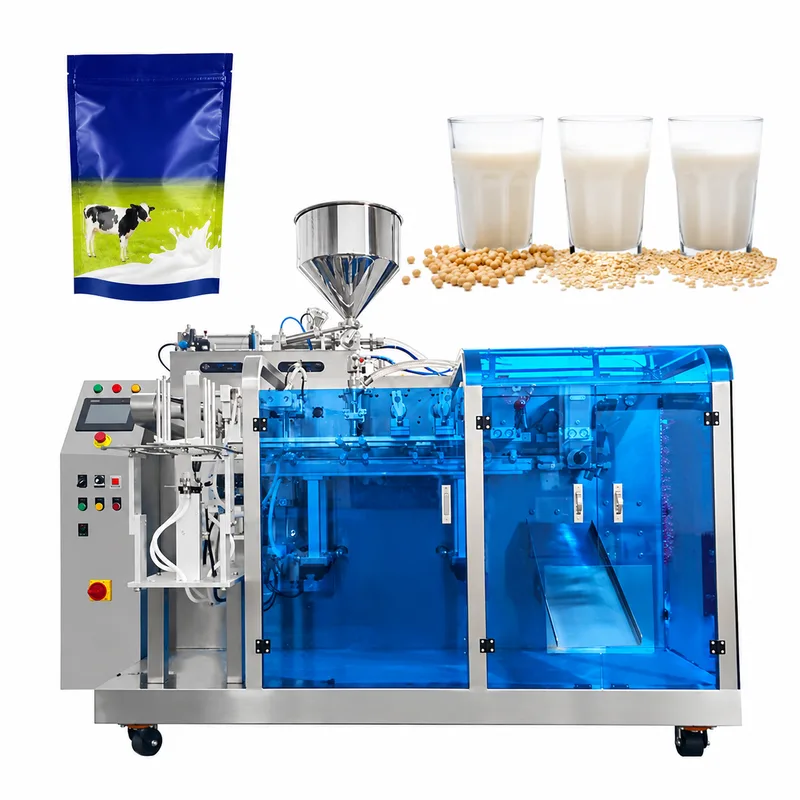
Premade Pouches
Milk & Beverage Premade-Pouch Filling
Treating a beverage pouch filler as a ready dairy system leaves treatment, cleaning and cold chain unspecified. Use this premade-pouch configuration as the starting point for a milk or beverage review.
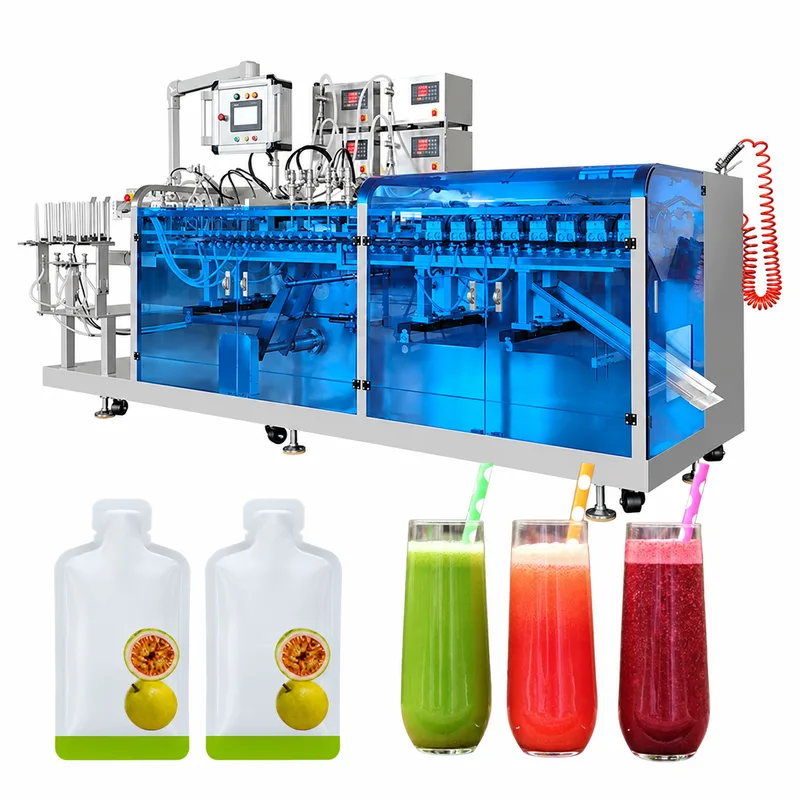
Premade Pouches
Juice & Beverage Pouch Packaging
Foam or a trailing drop at the pouch mouth contaminates the top seal and the pouch leaks. Specify this premade-pouch juice filler from your beverage condition, fill quantity and actual pouches.
Premade Pouches
Spout-Pouch Filling Machine
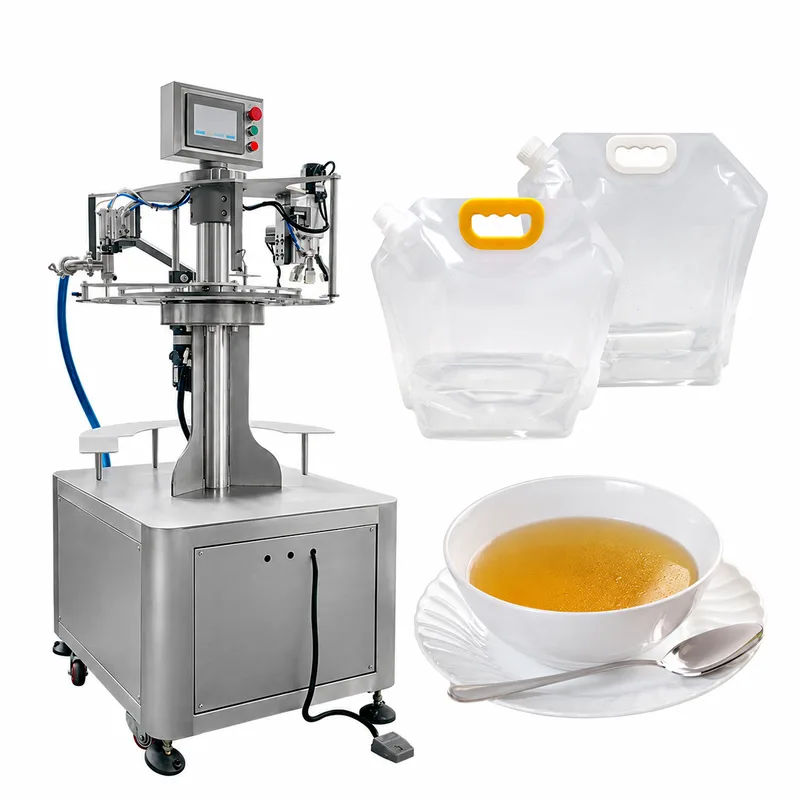
A cap that looks seated but is not engaged leaks after shipping. Specify this spout-pouch filler and capper from your pouch, neck drawing, matching cap and liquid, as a stand-alone or integrated station.
What to send us
| Item | Why we need it | Example format |
|---|---|---|
| Sauce sample and description | Viscosity, temperature and particles set the piston, valve and nozzle. | Production sample plus filling temperature in °C and largest particle size in mm. |
| Portion and units | A piston measures volume; labels often state mass. | Portion in ml and g, with density if known. |
| Sachet drawing | Seal bands and usable area decide whether the portion fits. | Dimensioned drawing with seal widths, code and tear position. |
| Film and artwork | Forming, registration and sealing depend on the web. | Laminate sheet, film width and artwork layout PDF. |
| Hopper and scope options | Heating, stirring and downstream collection change the quotation. | One line each: stirring, heating (with reason), coding, collection. |
We reply within 24 hours.