
Ketchup Sachet Packaging
Sauce strings at cutoff can dirty the seal and waste sachets. Start with actual ketchup consistency, portion units and usable space inside the four sealed borders.
| Input or item | Typical value or source | Why it matters |
|---|---|---|
| Sauce state | Formula, temperature and particles from buyer | Review supply and nozzle arrangement |
| Portion | Buyer target in g or mL | Keep trial and commercial quantity definitions aligned |
| Usable cavity | Drawing inside four seal borders | Check dose space and nozzle entry |
| Film | Converter specification and print repeat | Review forming, closure and opening |
| Cutoff | Consecutive sample observations | Record drips or strings near the seals |
Use the published configuration and related checks
Use these references to connect the review inputs with the published equipment scope and the next decision.
On This Page
Understand the four sealed borders of a portion sachet
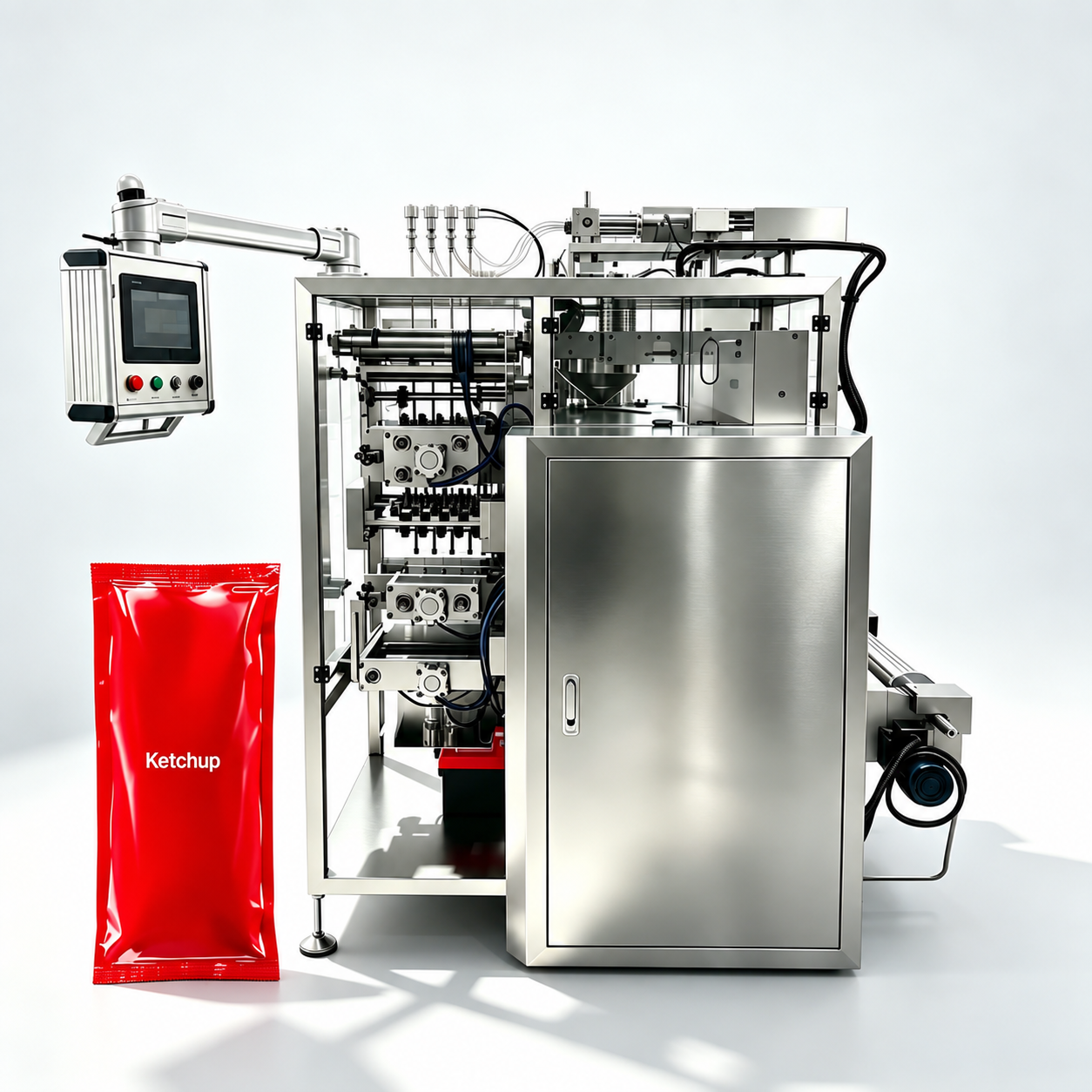
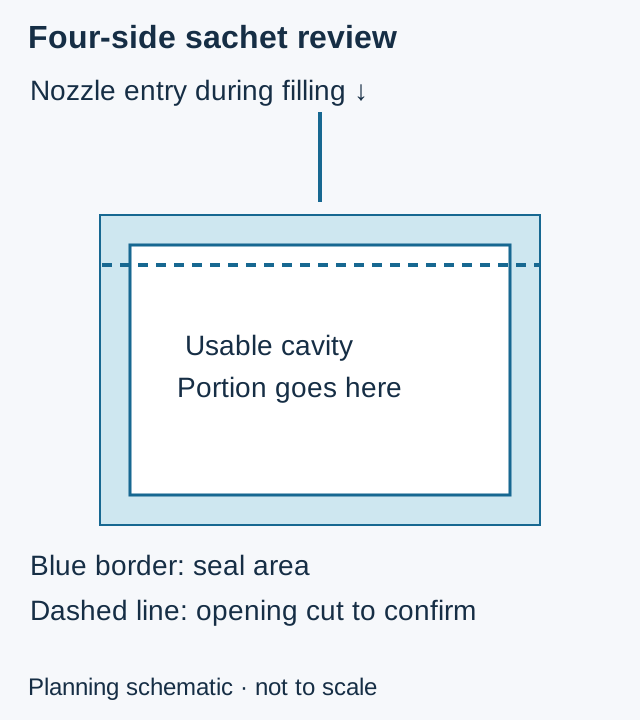
The ketchup sachet route in the catalog combines film feeding, piston dosing, filling, sealing on four sides and cutting. The finished format has a sealing border around the portion area. Show that border on the original package drawing. It is not extra room for sauce. The nozzle, dose and film-formed opening you propose must fit inside the usable internal area within those borders.
Put an empty sachet outline next to a filled reference and mark the opening notch, cut line and coding area. The equipment supplier should say which dimensions define the format parts. It should also say where the dosing nozzle enters during filling. If marketing asks for a narrower packet, check the internal fill space before anyone approves the new external dimensions.
The source range also mentions a back-seal option. Treat it as a separate requested configuration. If you prefer that format, ask for an actual sample and a confirmed tooling scope. Comparing the two finished outlines makes the packaging decision concrete. Not every sachet shape comes from changing a length setting on the same machine.
Describe the ketchup at the filling point
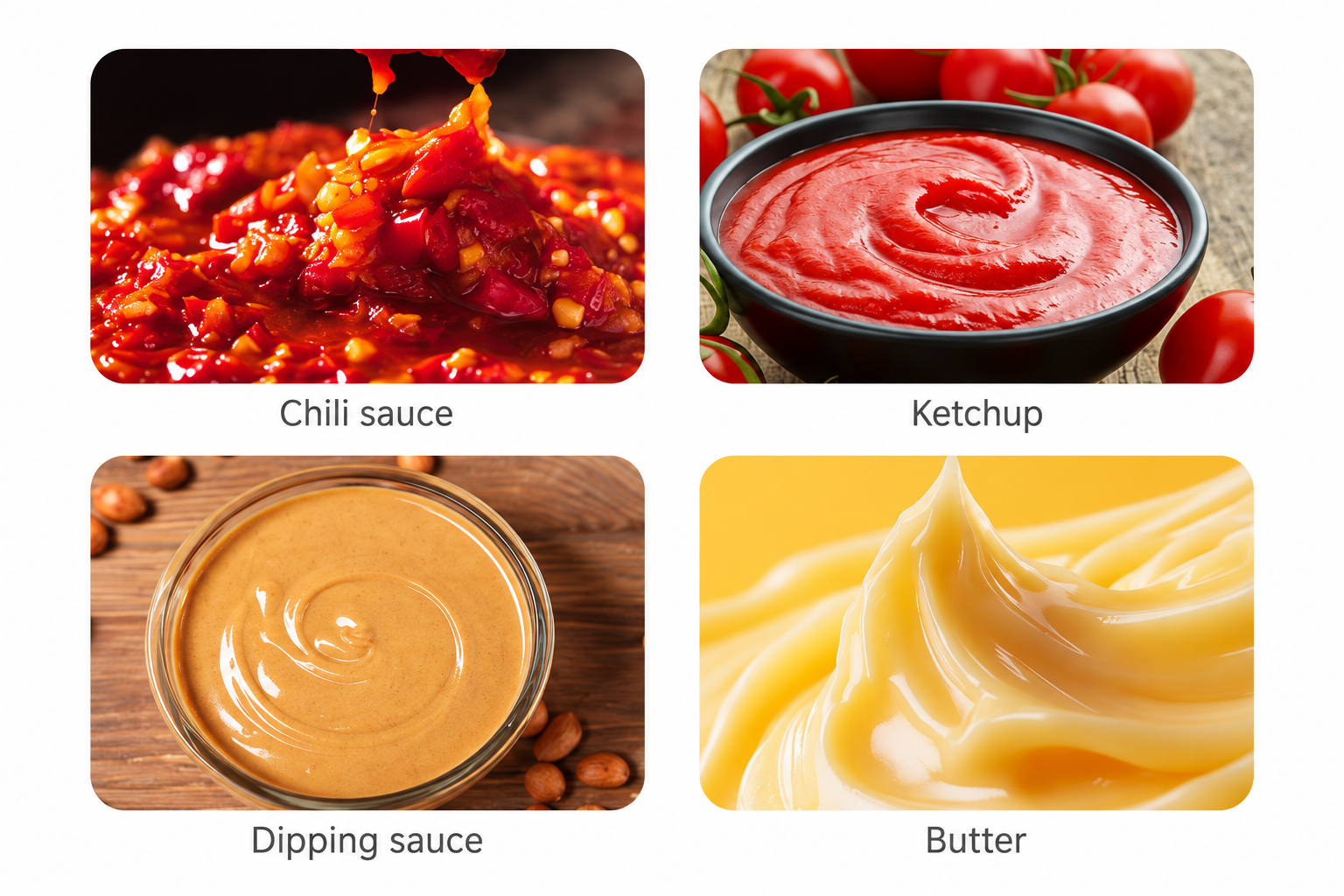
A ketchup packaging enquiry should identify the actual formula and its condition when it reaches the dosing system. Include the filling temperature you intend, any visible particles or fibers and the consistency variation across a batch. Explain how the sauce is supplied from the previous process. A product name, or a retail sample at unrelated conditions, is not enough to choose the product-contact and nozzle arrangement.
The catalog's sauce sachet configuration uses piston dosing and a four-side-seal format, and hopper options need confirmation; that gives a defined starting route for portion packs. Supply representative sauce under an agreed handling arrangement and say whether the line must also run other recipes. A demonstration on a smooth substitute is a limited illustration. Do not report it as confirmed performance on every ketchup formulation in the commercial range.
Design the usable sachet space before ordering film
Provide a drawing with the outside sachet dimensions, seal margins, print repeat and opening. Add the target portion and a filled reference sample where you have one. The space usable for sauce is smaller than the outside rectangle. So the equipment and packaging teams need to review quantity and format together. A good-looking artwork mockup does not settle that question.
If the portion is specified in one unit and your purchasing documents use another, agree the intended basis with the responsible product team. There is no universal conversion from volume to mass that works for every formula. Put the agreed portion definition in the quotation and the trial record. Otherwise the equipment demonstration and the commercial package may later be judged against different readings of the required amount.
Observe the end of each piston-dosed fill
The filling review should cover delivered quantity, consistency of supply and what happens at nozzle cutoff. Watch for drips or strings of sauce that reach the film near the sealing area. The supplier should explain the proposed nozzle and product-contact arrangement using your actual sauce. A good quantity reading says nothing about whether the next sealing cycle will be clean.
Record observations by run stage and sauce condition. If an adjustment or component change is proposed, identify it clearly and repeat the checks it affects. Not every contaminated seal can be fixed by changing a sealing setting. The cause may lie in product presentation, fill cutoff, timing or material selection. The supplier and packaging team should look at the specific evidence, and not apply a generic remedy from an application description.
Confirm hopper options without enlarging their claims
Heating or stirring may come up as hopper options in the sauce configuration. State what your process requires and find out which functions are in the offer. Confirm their scope, interfaces and intended operating conditions with the equipment team. A product category or a photograph is no reason to assume an optional hopper function is available.
Keep these machine features separate from the product's treatment and preservation process. A sachet filler does not prove that a sauce is stable under a particular storage regime. The business responsible for the product has to define and validate those process requirements with the right specialists. Mark the equipment boundary and the compatibility questions that remain in your purchasing file. Then the filler can be assessed inside your actual ketchup production process.
Inspect completed sachets across the run
Agree the package observations before the demonstration: portion result, visible sauce near seals, alignment, appearance and the opening you want. Collect consecutive samples from startup, established running, replenishment and an ordinary pause. Keep each sample linked to the conditions that produced it. A handful of visually perfect sachets tells you less than a record that includes interruptions and rejected packs.
Use the actual packaging material where you can, and state any substitute. If the film construction, sachet dimensions or sauce formula change later, work out which checks need repeating. The equipment trial should give you an evidence base for the configuration you are buying. Keep the material change and the checks it affects on the same sample record.
Plan recipe changes around the product-contact path
Describe the sauces that will follow one another in a normal schedule and the cleaning method your factory requires. Get access information for the supply connection, hopper, piston-dosing components and nozzle. Confirm the proposed parts for formulas with different particle or flow characteristics. A shared sachet size does not mean every product-contact component can stay unchanged.
If a representative change is demonstrated, record what was inspected, removed, adjusted or replaced under the supplied procedures. Note the first accepted sachets of the next formula and the basis for accepting them. Your factory remains responsible for its cleaning and product-control process. The demonstration should make the practical work and access needs clear. A general "rapid changeover" statement with no defined activities does not.
Ask for a complete portion-pack proposal
Include the upstream sauce supply, factory layout and downstream sachet collection in the enquiry. Confirm the space needed for film loading, product replenishment and access to contact parts. If you need coding or extra package handling, say so and ask whether it is included. Compare proposals on the same scope, with the same sauce and film conditions.
The quotation should name tested formats, proposed options and unresolved requirements. Use that list to plan the remaining checks before the equipment specification is final.
Send the sauce conditions, portion definition, cavity drawing and inspection questions for a configuration review. The useful reply is a proposed equipment scope with missing information identified, not an assumption that every hopper option is included. Before shipping sauce, confirm whether evaluation can be arranged, the required quantity and handling, and the timing and costs. Keep those arrangements with the sample label so the recipient can relate it to the intended production conditions.
Keep sachet artwork revisions connected to tooling
Give the package drawing used in the trial a revision number and keep a matching film sample. If marketing later moves the opening, changes the printed repeat or adjusts the outer dimensions, send the revised drawing for a compatibility review. These changes can alter the produced format even when the ketchup portion stays the same. A shared revision record means the film converter, equipment supplier and buyer are all discussing the same package, and not approving different versions on their own.
Method and sources
This revision reorganizes the existing ketchup sachet packaging guidance and the linked published configuration descriptions, reviewed on 8 October 2026. The blank records and diagrams are planning aids, not customer results or independently verified equipment tests. Questions below come from the existing page’s buying questions and the 8 October editorial review, not a claimed survey or search-frequency dataset. Confirm sample arrangements, quantities and costs before sending material.
Frequently asked questions
Can the ketchup configuration also run chunky chili sauce?
Particles, product-contact parts and cutoff need a separate assessment. A smooth ketchup demonstration does not settle suitability for a chunky recipe.
Does the catalog dosing range guarantee every sauce and portion?
No. Confirm the final dose, consistency, nozzle and pack with representative material on the proposed configuration.
Should the portion be specified in g or mL?
Use the unit defined by the responsible product team and carry it into the quote and trial record. There is no universal mass-to-volume conversion for every sauce.
Is back seal an automatic change on the same machine?
The catalog mentions it as an option. Request a separate confirmed configuration and tooling scope; do not assume automatic switching.
Are heating and stirring standard hopper functions?
Treat them as options to confirm in the offer. Their presence does not establish a product treatment or preservation process.
Do the outside sachet dimensions show all the filling space?
No. Mark the cavity inside the four seal borders and review nozzle entry, portion and opening with a filled reference.
Explore the Equipment
Sauce Sachets
Sauce Four-Side-Seal Sachet Machine
Sauce strings or drips can contaminate the seal area, leading to leaks and rejected sachets. Specify this piston-dosing four-side-seal machine from your sauce, portion, sachet drawing and film.
What to send us
| Item | Why we need it | Example format |
|---|---|---|
| Sauce sample with temperature and consistency details | Review flow and cutoff for the actual recipe. | Recipe / lot / filling-temperature / consistency note |
| Portion quantity and sachet cavity dimensions | Define quantity and the cavity available for filling. | Portion in g or mL + annotated cavity PDF |
| Film construction and opening feature | Align seals, registration and the consumer opening. | Film structure / revision / tear-position drawing |
| Fill, drip and seal-inspection criteria | Separate dose results from contamination and closure checks. | Sample ID / run stage / portion / drip / seal log |
We reply within 24 hours.