
Peanut Butter Packets: Viscosity, Jaw Temperature and Seal Contamination
Troubleshoot leaking peanut butter packets: separate viscosity and nozzle stringing from seal contamination, then check film-specific jaw conditions.
On This Page
Start with the failed packet, not the heater setting
For peanut butter packets, investigate product flow and nozzle cutoff before increasing jaw temperature when paste or oil reaches the closing seal band. Then compare clean-film seals with filled-pack seals under recorded conditions to decide whether filling, film or jaw contact needs attention.
This guide is for teams producing single serve peanut butter on sachet equipment. Begin with the actual pack drawing: a three-side seal, four-side seal and back-seal pouch place their seams differently. Mark the failed edge on an unopened sample, identify the film reel and formulation, and record whether the fault occurred at startup, during continuous running or after a stop. That operating context is more useful than a photograph of a squeezed, already-open packet.
Keep two observations separate: how much product enters the packet, and where the final discharge goes. An acceptable average weight can coexist with an intermittent tail across the seal. Conversely, drifting weights can occur while the sealing area remains clear. Use the branches below to choose the next observation, then retain the sample and settings together so subsequent changes can be compared.
| Observed symptom | Inspect this location | Next discriminating check |
|---|---|---|
| Weights drift during a batch | Supply vessel, hopper and dosing path | Compare individual doses with product temperature, refill events and material condition. |
| A strand remains after discharge | Nozzle outlet and upcoming closing band | Observe tail clearance relative to film motion and jaw closure. |
| Paste or oil crosses the seal area | Film margin before jaw contact | Locate where contamination first appears; compare clean-film and filled-pack seals. |
| Clean-film seals are also weak | Film interface and jaw contact area | Check laminate identity, surface condition, temperature, dwell and contact loading. |
| Faults concentrate after a stop | Product path and restart sequence | Compare the first restart packs with the stable-run record under the same recipe. |
Read viscosity with temperature, shear and formulation
A useful viscosity report identifies the formulation and measurement conditions. Include the test temperature, instrument or method, shear rate or spindle and speed, and sample conditioning. A value copied without those details gives the equipment team too little information to relate the laboratory sample to material flowing through a valve and nozzle.
Ebatco's application note, Temperature Dependance of Peanut Butter Viscosity and Spreadability, tested two commercial peanut butters with a 25 mm parallel-plate system and a shear-rate ramp from 0.01 to 10 s⁻¹. Its Table 1 reports the inferred yield points below. The laboratory obtained these from the low-shear intercept of the stress curve. Yield point is a stress in Pa; viscosity is a different quantity, commonly reported in Pa·s or cP.
The two samples responded differently. Sample 1's yield point rose between 15°C and 25°C before falling at 35°C, while sample 2's fell across the reported temperatures. These results show why formulation-specific flow characterization matters. Use your product's measured response to select conditioning trials within its approved processing limits.
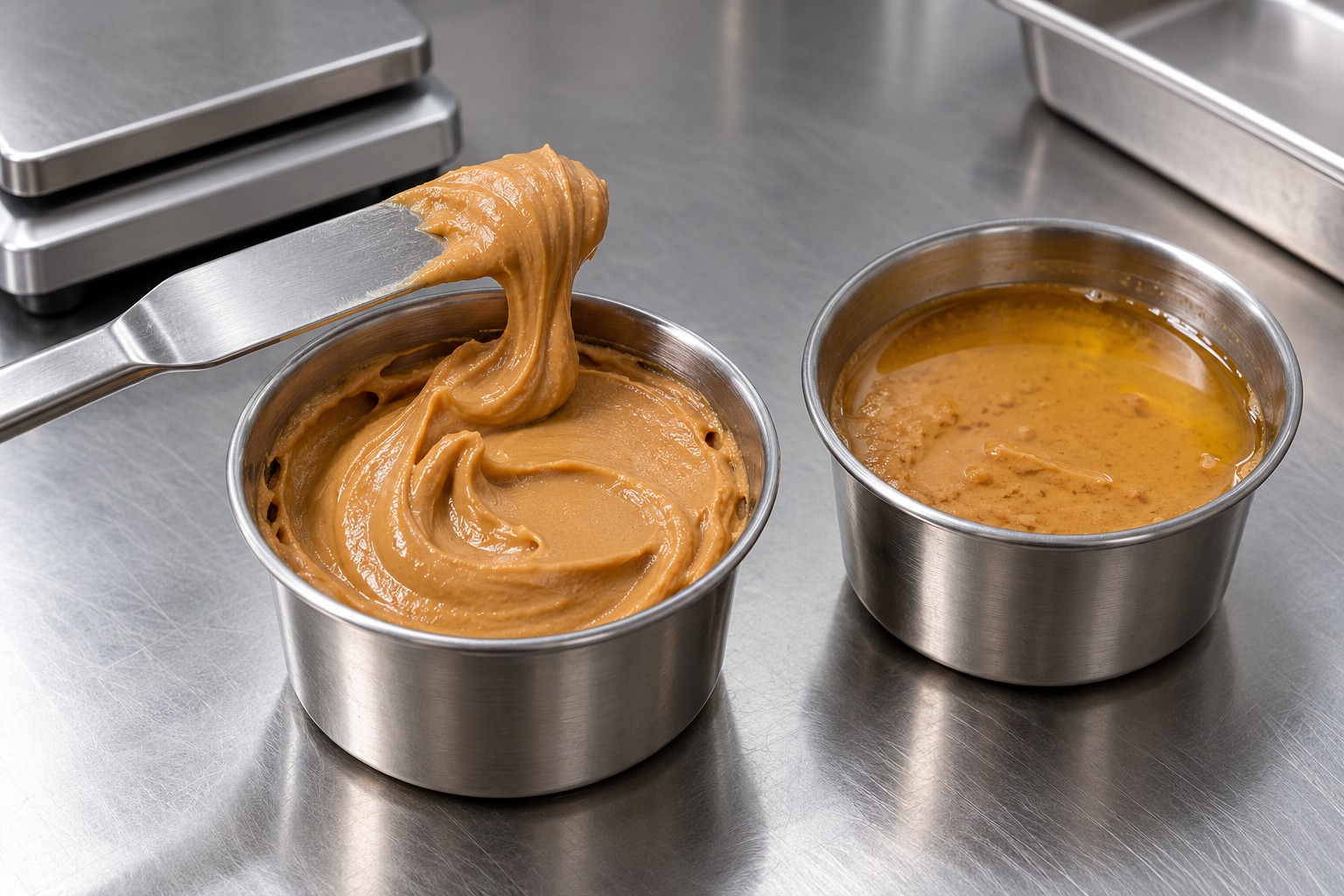
On the line, identify smooth or crunchy formulation, visible oil separation, batch age and recent mixing or standing history. Photograph the material condition and retain the same batch identification with the dose record. This gives the formulation and equipment teams a common starting point when an apparently unchanged recipe begins behaving differently.
| Laboratory sample temperature | Peanut Butter 1: yield point | Peanut Butter 2: yield point |
|---|---|---|
| 15°C | 17.6 Pa | 7.9 Pa |
| 25°C | 21.9 Pa | 7.8 Pa |
| 35°C | 9.5 Pa | 5.8 Pa |
Map product temperature from supply vessel to nozzle
Measure the product where it travels, rather than treating a hopper controller as a complete picture of the filling condition. Record product temperature at the supply vessel, hopper and nozzle using the site's approved sampling and measurement procedures. Take the readings during the same operating state and pair them with the corresponding filled-pack weights.
Keep jacket-fluid setpoint, measured product temperature and jaw temperature in separate fields. They describe different parts of the process. A warm vessel does not establish the condition of material farther along the transfer path. Likewise, changing the jaw setting changes the sealing operation; it does not characterize the material entering the dosing chamber. Record any pause, refill or mixing change beside the observations so the comparison remains meaningful.
If a temperature change coincides with unstable discharge, review where conditioning is controlled and where material stands during a stop. Heating or agitation should be considered against the formulation's permitted temperature and hold-time limits, the wetted path and the required mixing behavior. Repeat the comparison after the agreed restart interval. The useful outcome is a documented product condition at the filling point, linked to consistent dosing and cutoff, which can be reproduced during the next run.
Watch the product tail through cutoff and jaw closure
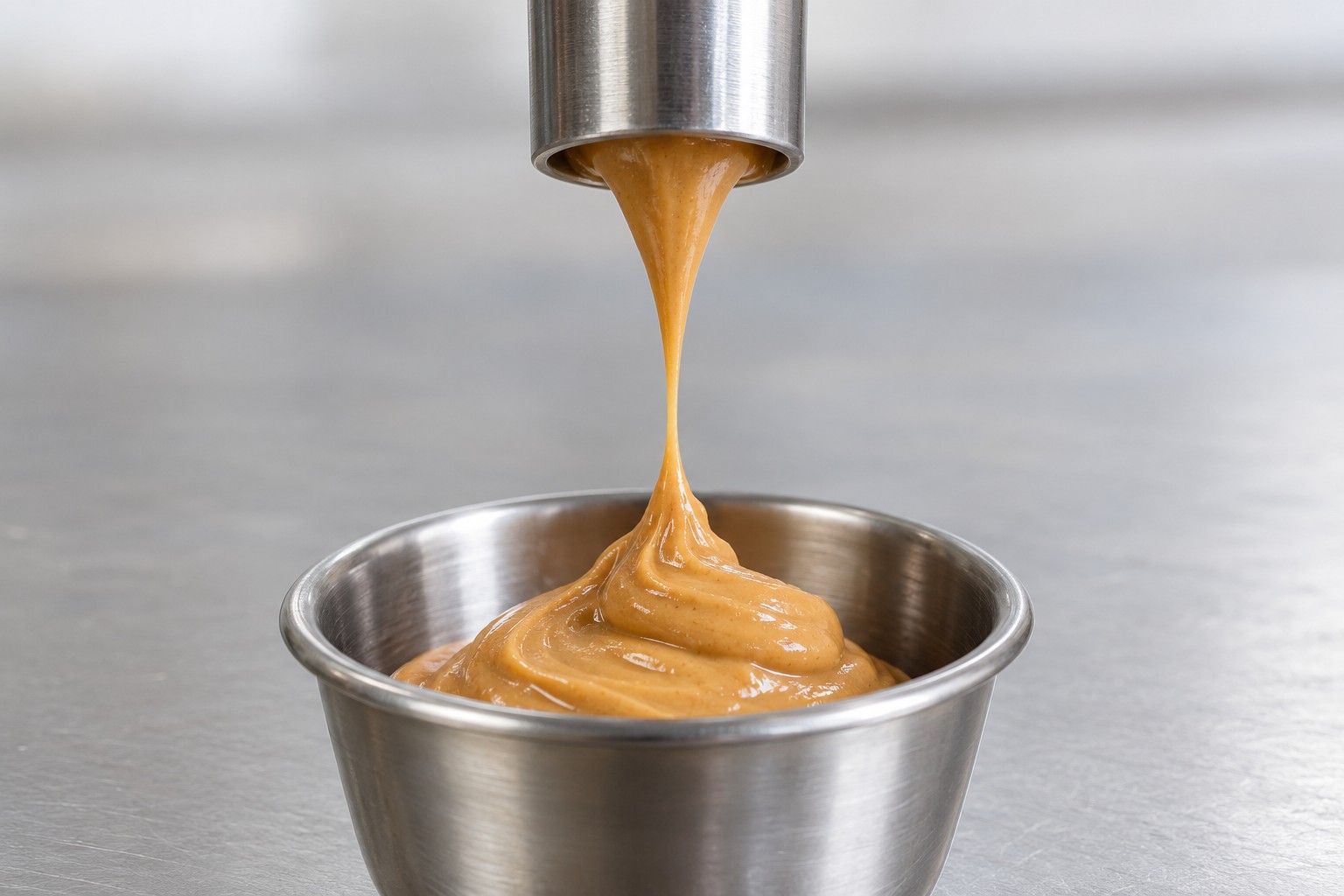
Observe the end of discharge to see whether the material tail clears the future seal band before the jaws close. A safely recorded sequence should show the nozzle outlet, final discharge, film movement and jaw contact in relation to one another. Use the guarded viewing arrangement approved for the machine; keep personnel and recording equipment outside moving and hot parts.
Review the actual nozzle assembly before changing timing. Positive shutoff closes the flow path, while suck-back retracts residual material; identify which function the fitted assembly provides and how it is actuated. Inspect its condition, cleanliness and wear according to the equipment manual. On a piston-filling system, follow the complete path through the inlet, dosing chamber, valves and outlet instead of assuming the visible nozzle is the only possible contributor.
If the tail persists after the dosing command ends, record when it releases and where it lands. Compare that event with the next film movement and jaw closure. Adjust only the relevant sequence parameter through the manufacturer's procedure, retaining the original recipe for comparison. A pouch-separation knife setting describes a different action from product shutoff; identify each control by its actual function.
Judge the change at the intended production rate and after a representative stop. A setting that clears the band during slow observation may need further assessment under normal cycling. Keep the resulting packets with the video and dose record so apparent improvement at the nozzle can be checked against the finished seal.
Trace seal contamination before changing the heat recipe
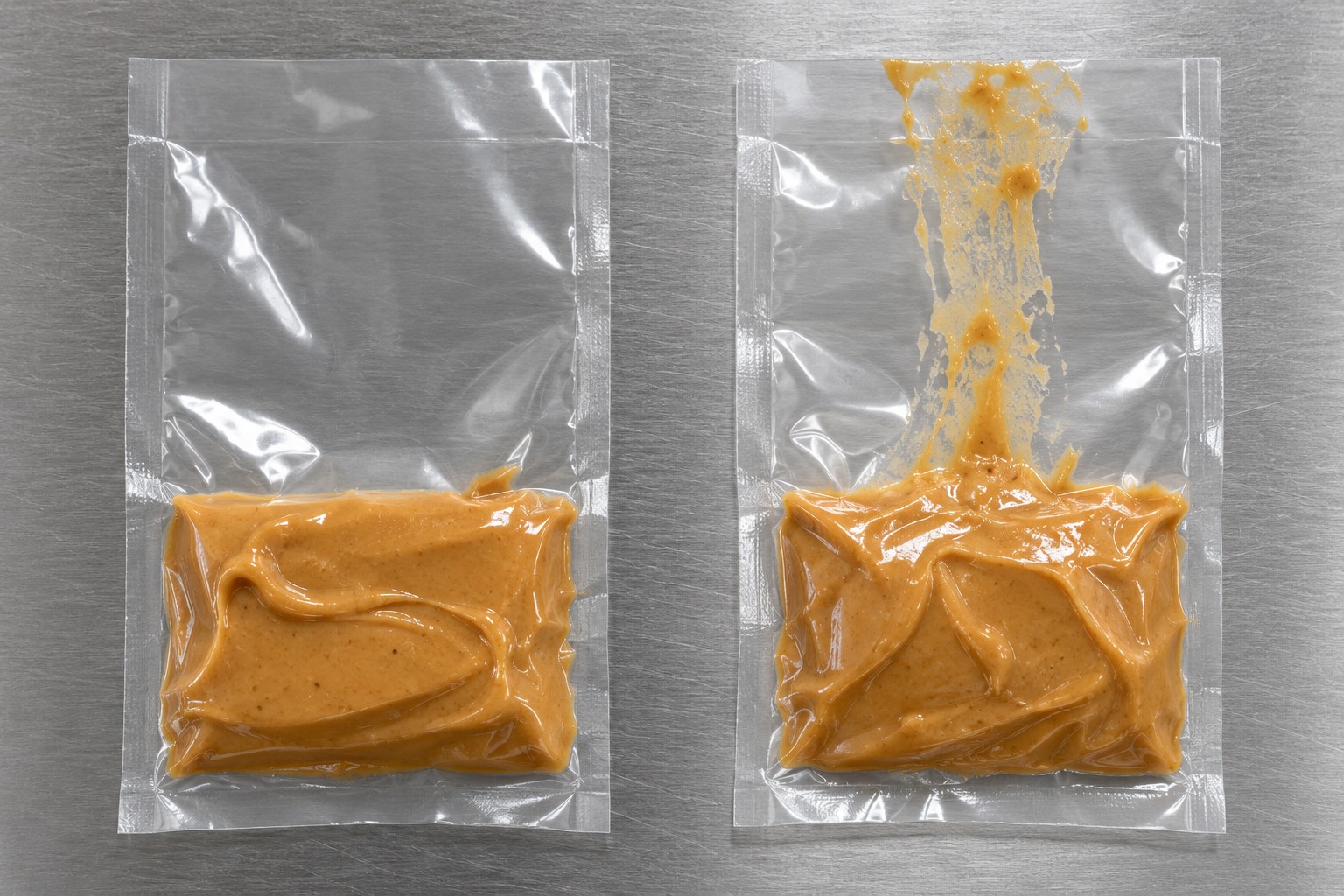
Locate the first appearance of product in the intended seal area. Follow the film from the filling point to jaw contact, looking for a trailing strand, a smear from contact with product, or contamination already carried on the film. Inspect the relevant jaw faces under the machine's safe shutdown procedure. Cleaning the face and eliminating the source of contamination are separate tasks.
The FDA's Guide to Inspections of Low Acid Canned Food Manufacturers: Part 3 explains, in its retortable-pouch discussion, that trapped food, grease or moisture can prevent or weaken fusion. That mechanism makes a clean closing band a useful diagnostic priority for a peanut-butter sachet. The location and continuity of the contamination matter: record whether it remains inside the packet or crosses the intended bonded area toward an edge.
Compare an uncontaminated film reference with filled packets made under recorded sealing conditions, using a procedure agreed with the film supplier and machine manufacturer. If clean material also produces weak seals, investigate film compatibility, alignment, contact and thermal conditions alongside filling. If the clean reference performs satisfactorily but production packs carry paste into the band, focus the next investigation on discharge and product placement. Preserve both sample groups; the comparison narrows the search and gives the next adjustment a clear purpose.
Set jaw temperature from the film window and actual contact
Use the selected laminate supplier's sealing window as the starting point for jaw temperature, dwell and contact loading. Confirm the film construction and sealant layer from the specification; packet appearance alone cannot identify the sealing polymer. Keep the film lot and its technical data with the trial settings so a reel change does not silently change the basis of the comparison.
The FDA's retort-pouch guidance treats temperature, pressure and dwell as interacting factors. Changing production speed can change the available contact time, so compare seals at the rate the line will actually run. Check jaw alignment, face condition and uniform contact before attributing every weak area to insufficient heat. Record the contact or pressure setting using the machine's terminology and units so the result can be reproduced.
CFIA's Flexible Retort Pouch Defects Manual, section 3.3.1, distinguishes the controller indication from the actual hot-bar surface temperature. Have trained personnel verify the surface through the OEM's approved measurement procedure and compare locations across the working area. Section 3.3 also describes overheating damage in a polyester/foil laminate. The practical response is to stay within the chosen film's limits and evaluate the seal result as a combination of material, heat, time and contact.
Change one investigated factor at a time while retaining the remaining settings and sample identification. If additional heat improves a clean reference but contamination remains in filled packets, keep pursuing the filling fault. The trial should establish a repeatable operating window for that film and product combination, with the acceptance criteria agreed before settings are selected.
Verify the correction with finished packs and restarts
Assess the corrected combination using filled packets from startup, stable production and the agreed restart condition. Record individual weights, visible seal condition and the relevant settings with each sample group. Count accepted packs and rejects over a defined operating interval, retaining the reasons for rejection so a reduction in one fault does not conceal another.
ASTM F2029 covers laboratory preparation of heat seals for heat-sealability evaluation. Its public scope distinguishes the cooled seal-strength assessment associated with F88 from hot-tack assessment associated with F1921, and addresses strength rather than seal continuity. Its laboratory sealing curves provide a starting point for production settings. Choose the strength and integrity checks appropriate to the finished packet with the packaging specialist, and document their methods and acceptance criteria separately.
A useful trial record therefore joins the product-condition record to the dose, cutoff and package results. Include the formulation and film identifiers, packet drawing, actual product temperatures, jaw settings, operating state, sample times and observations. Keep failed and accepted examples traceable to the same sequence. Repeating the check after a stop is particularly valuable when the original complaint concerned the first packets after restart.
Close the trial only when the agreed criteria are met across the conditions being approved. Save the selected recipe together with the inspection points that keep it reproducible: the product preparation state, the relevant nozzle condition and the film/jaw setup. These records give production a practical reference for distinguishing a material change from a maintenance or setting change later.
Choose maintenance or configuration changes from the findings
Repair a demonstrated maintenance fault before treating it as a need for different machinery. If inspection finds residue, worn shutoff parts or damaged contact surfaces, follow the equipment manufacturer's cleaning, replacement and setup instructions, then repeat the same recorded comparison. Keep the part identification and changed condition with the samples so the improvement can be connected to the intervention.
Consider a configuration review when a correctly maintained assembly still cannot deliver the required dose and clear the closing band under the intended conditions. Bring the formulation, particle information, product-temperature record, actual nozzle arrangement and sequence observations into that discussion. A larger or differently controlled outlet, a different cutoff function, or revised product conditioning is a question for the matched material and equipment review; select the change against the observed failure and the packaging requirement.
When evaluating a peanut butter sachet vertical packer, include the finished packet drawing from the outset. The sauce-sachet catalog profile linked below describes a four-side-seal configuration. Compare its layout with the required packet format and use the troubleshooting record to define the application discussion. A concise enquiry containing the failed-pack photographs, safe cutoff video and film specification gives the team a concrete basis for reviewing the next step.
Technical Reading
- FDA — Guide to Inspections of Low Acid Canned Food Manufacturers: Part 3 — Retortable-pouch discussion of fusion-seal contamination and interacting sealing factors.
- ASTM F2029-16(2021) — Laboratory Heat Sealability — Public scope and significance distinguish laboratory seal preparation, strength and continuity.
Explore the Equipment
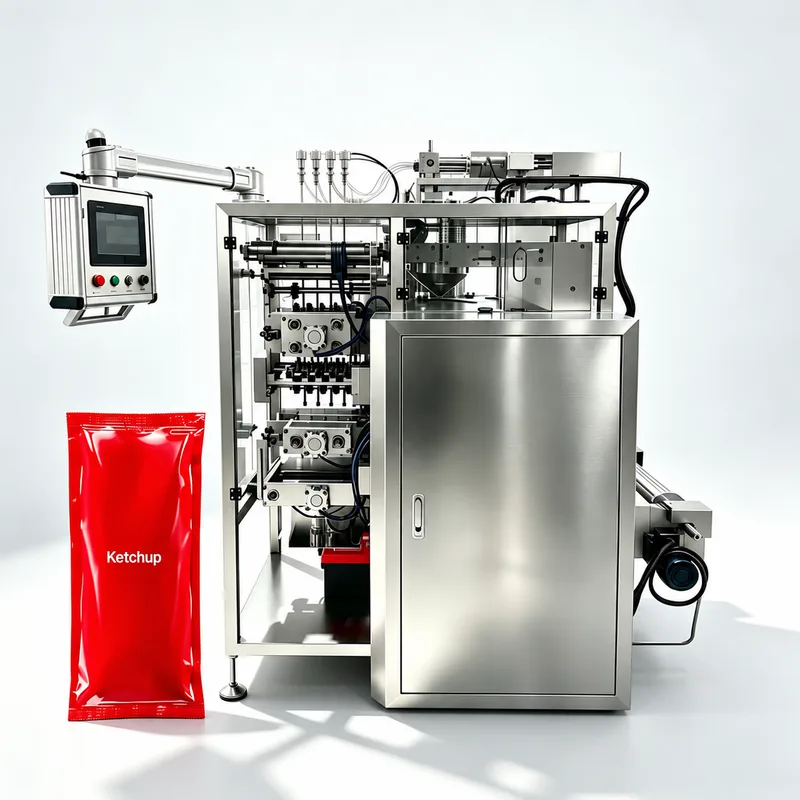
Sauce Sachets
Sauce Four-Side-Seal Sachet Machine
Sauce strings or drips can contaminate the seal area, leading to leaks and rejected sachets. Specify this piston-dosing four-side-seal machine from your sauce, portion, sachet drawing and film.