
Stick Pack vs Sachet: Film Width Calculation, Multi-Lane Slitting and Dosing Clearance
Compare stick pack vs sachet web strip width, multi-lane slitting pitch, forming-tube dosing clearance and small-package label area before ordering tooling.
On This Page
Stick pack vs sachet: tubular fin seal versus four-side perimeter seal
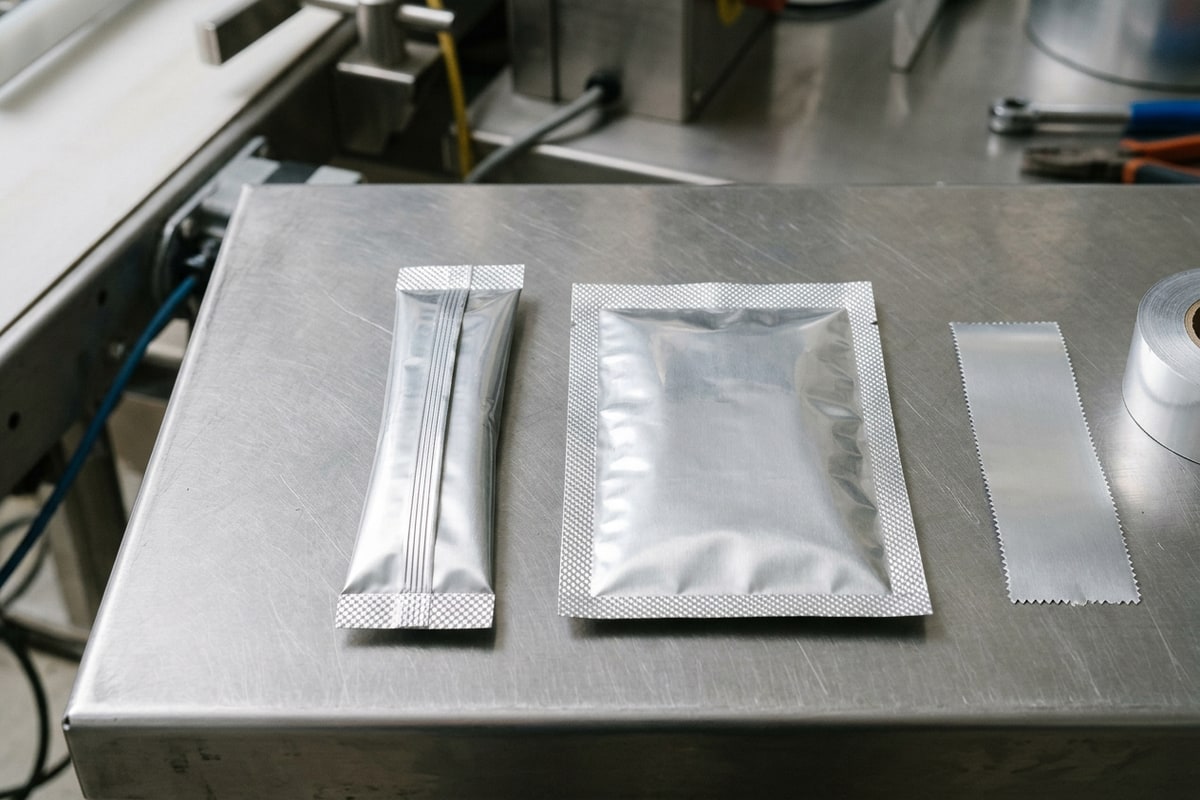
When comparing a stick pack vs sachet on a vertical form-fill-seal line, the core engineering distinction is how the flexible laminate wraps and seals around the product cavity. Understanding what is a stick pack starts with its cross-section: a stick pack is a narrow cylindrical tube formed around an individual vertical forming tube, closed along the back by a longitudinal fin or lap seam and sealed at top and bottom by horizontal cross jaws. By contrast, in a sachet vs pouch comparison, a flat four-side-seal sachet brings two opposing web faces together between heated perimeter sealing rollers or flat jaws, crimping every outer margin around a shallow rectangular cavity while a stand-up pouch adds a bottom gusset for upright shelf display.
Because a tubular stick pack expands radially as powder or liquid enters the sleeve, almost the entire width between its end crimps becomes usable internal volume. Single-serving stick packs are commonly used in the 2 to 20 gram portion range for uniform, repeatable servings at scale. In addition to stick packs, collagen can be packaged in four-side-seal sachets when larger fill volumes are required or when additional surface area is needed for branding, product information, and regulatory content. Compared to a traditional rectangular flat sachet, a tubular stick pack typically uses up to 40% less film material. Tubular stick pack geometry delivers 30%-40% film consumption savings over flat sachets for the same volume of powder.
Choosing between stick pack sizes and flat sachet sizes therefore locks in the forming hardware, the slitting pitch across the master film reel, the internal clearance available for auger screws or liquid nozzles, and the printable area available for regulatory text. Review the structural comparison below and connect your target portion drawing to the bag-style selection directory before requesting a multi-lane quotation.
- Compare single-serve and roll-film structures in the bag-style selection guide
- Review stick-pack dimensional inputs and lane-by-lane trial checks
- Evaluate four-side-seal sachet perimeter crimps and inner cavity volume
| Design dimension | Tubular stick pack | Four-side-seal flat sachet |
|---|---|---|
| Pouch cross-section and seal layout | Cylindrical sleeve with a longitudinal rear fin or lap seam and two transverse end crimps | Flat rectangular packet sealed along all outer edges between opposing web panels |
| Unfolded lane-strip width basis | Double the finished flat stick width plus the longitudinal back-seal allowance | Double the finished sachet width when folded or dual-panel width across opposing webs |
| Forming hardware per lane | Individual forming collar and narrow cylindrical vertical tube for each slit strip | Opposing web guides and heated vertical side-sealing rollers or flat perimeter dies |
| Primary dosing clearance constraint | Radial annular gap between the inner forming-tube wall and the auger screw or nozzle tip | Flat panel separation and clean product cutoff above the horizontal cross-seal band |
| Label and artwork panel geometry | Narrow vertical cylinder that may require small-package linear or tabular label formats | Broad flat front and back panels suited to wider graphics and multi-column regulatory tables |
Unfolded web strip geometry and film consumption arithmetic
Before ordering printed barrier laminate or sizing a master film reel, packaging engineers calculate the exact unfolded strip width required by a single lane. On a vertical form-fill-seal tube, a single slit strip must wrap completely around the forming shoulder so its inner sealant edges meet at the rear seam. For a tubular VFFS web, the back-seal allowance is A = 2 × fin height for a fin seal or A = lap overlap once for a lap seal. Confusing a fin-seal fold with a lap-seal overlap under-sizes the slit strip and leaves insufficient margin for the vertical sealing bar to bond the laminate.
To see how finished stick pack sizes translate into slit film strips and forming-tube diameters, consider our published collagen stick-pack profile. The catalog four-lane collagen stick-pack configuration covers a bag size range of 50–180 mm length and 15–30 mm stick width. For example, assume a fin height of 10 mm on a narrow tubular stick pack. With a 15 mm stick width and the assumed 10 mm fin height, doubling the 15 mm width plus 2 times the 10 mm fin height yields a 50 mm unfolded lane-strip width. Dividing 2 times a 15 mm flat stick width by pi gives a 9.55 mm theoretical forming-tube outer diameter.
At the upper end of that same catalog range, strip width increases with face width plus the fixed seal allowance; theoretical tube OD scales with face width. At a 30 mm stick width with the assumed 10 mm fin height, doubling the 30 mm width plus 2 times the 10 mm fin height yields a 80 mm unfolded lane-strip width. Dividing 2 times a 30 mm flat stick width by pi gives a 19.10 mm theoretical forming-tube outer diameter. By comparison, flat sachet sizes allocate outer width directly to two opposing side-seal margins plus the central product pocket. The catalog four-side-seal sauce sachet configuration has a published sachet range of 50–180 mm length, 30–140 mm width, and maximum film width of 320 mm.
Master reel width, multi-lane slitting pitch and frame scaling
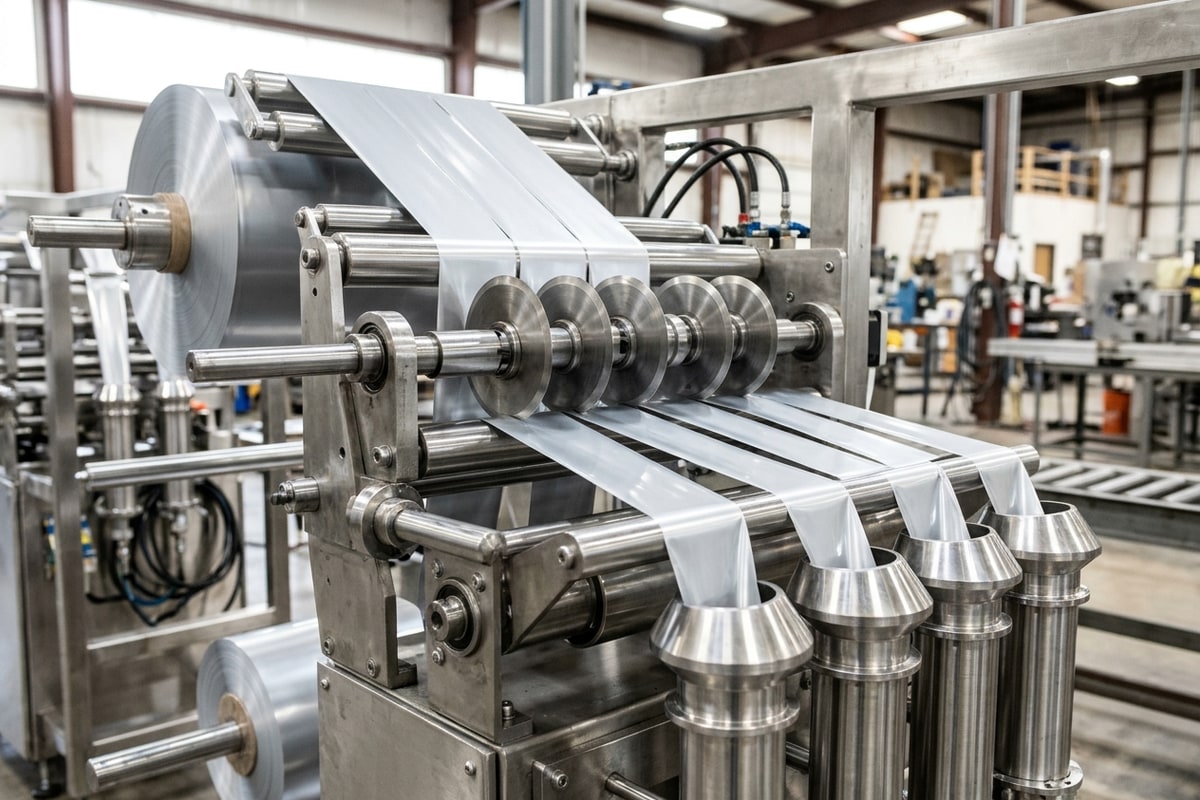
High-output single-serve lines do not unwind separate narrow bobbins for each tube; instead, a rotary slitting assembly divides one wide master reel into synchronized parallel strips immediately upstream of the forming collars. For a multi-lane layout that slits one master web into identical lane strips, master width = lane count × lane-strip width + total edge trim. Standard multi-lane VFFS configurations range from 2 to 20 lanes depending on pouch width and machine frame size, with narrow stick packs allowing higher lane counts.
Published multi-lane stick-pack machine series illustrate how frame width governs lane count and finished pouch dimensions. The compact multi-lane stick pack machine supports 2–10 lanes for different product types. Maximum film width and maximum roll diameter on the compact multi-lane stick pack frame is 400 mm (15.75"). Minimum stick pack bag size on the compact frame is 17 mm x 40 mm (0.67" x 1.57"). Maximum stick pack bag size on the compact frame is 40 mm x 200 mm (1.57" x 7.88").
Stepping up to wider frames increases either the number of parallel narrow sticks or the maximum pouch width per lane. The mid-frame multi-lane stick pack machine supports 2–14 lanes for multi-lane production. Maximum roll width on the mid-frame multi-lane stick pack machine is 600 mm (23.62"). The INVpack SP6 single-dose stickpack machine is a compact machine capable of working with film reels up to 600 mm wide. Maximum stick pack bag size on the mid-frame stick pack machine is 60 mm x 200 mm (2.38" x 7.88"). The high-volume stick pack machine handles 2–20 lanes for large-scale production. Maximum roll width on the high-volume multi-lane stick pack frame is 800 mm (31.49"). Compressed air supply required on the high-volume multi-lane stick pack frame is 6 bar (30 CFM at 90 PSI). Maximum stick pack bag size on the high-volume frame is 80 mm x 200 mm (3.15" x 7.88"). Maximum roll width on the ultra-wide multi-lane stick pack machine is 1200 mm (47.24"). Maximum stick pack bag size on the ultra-wide stick pack machine is 100 mm x 200 mm (3.94" x 7.88").
Within a fixed machine frame, adding lanes narrows the allowable pouch width per lane while multiplying total packs per minute. On the INVpack BY3 EVO multilane stickpack machine, output ranges from 210 stickpacks per minute for a three-lane operation to 490 per minute with seven lanes, with stick widths from 37 mm (three lanes) to 17 mm (seven lanes). The closed main-frame multilane stickpack series houses all elements including the film reel inside the cabinet, generating positive air pressure against dust entry and producing up to 1400 stickpacks per cycle. Four-side-seal flat sachet machines follow the same inverse relationship between sachet width and lane count at wider centerlines. On the compact four-side-seal flat sachet machine, output ranges from 70 sachets per minute for a one-lane operation to 350 per minute with five lanes, with sachet widths from 150 mm (one lane) to 40 mm (five lanes). On the wide multilane flat sachet machine, output ranges from 280 packs per minute for a four-lane operation to 700 per minute with ten lanes, with sachet widths from 100 mm (four lanes) to 40 mm (ten lanes).
| Frame class | Slitting and forming arrangement | Buyer verification focus |
|---|---|---|
| Compact stick-pack frame | Narrow master reel slit into parallel strips for nutraceutical, coffee, or beverage powder sticks | Confirm unfolded strip width times lane count fits inside the usable master web with edge trim |
| Mid-width and high-volume stick frames | Wider master reel supporting either higher lane counts of slim sticks or wider single-serve tubes | Verify outer lane film tracking, splicer alignment, and individual lane dosing calibration |
| Compact and wide flat-sachet frames | Wider lane centerlines accommodating dual-panel perimeter seals for liquids, gels, and wide powders | Check usable cavity inside the four perimeter seals and confirm shear or perforation cutter pitch |
Forming-tube internal bore, auger screws and liquid nozzle clearance
Once the film strip wraps around the forming collar, the internal bore of the vertical forming tube becomes the physical bottleneck for product delivery. After subtracting the wall thickness of the stainless-steel forming tube and the radial clearance needed to prevent mechanical rubbing, a narrow stick pack leaves only a tight circular passage for an auger screw or liquid filling lance. Unified Flex powder stick pack machines scale across 3–6 lanes with output up to 300 sticks/min, 5–9 lanes with output up to 400 sticks/min, and 9–16 lanes with output up to 800 sticks/min. Across the Unified Flex powder stick pack series, stick sizes for powders are 24–38 mm wide by 75–200 mm long or 50–200 mm long on the wider frames. On the high-lane Unified Flex powder stick pack configuration, independent servo-controlled auger screws allow individual filling control across up to 16 lanes.
Maintaining uniform portion weights across parallel narrow tubes requires precision machining and active powder conditioning. Rovema servo-controlled auger fillers provide auger revolution positioning accuracy of +/- 0.05%. Rovema auger screws are milled from a single piece of stainless steel with no welds for high fill accuracies and less product giveaway. A vacuum auger extracts air from powder to compact product volume so a shorter bag equates to film savings, while a clam-shell closure device prevents difficult free-flowing products from entering bag seals.
When cohesive powders bridge across a narrow funnel or when viscous sauces, pastes, and gels require larger nozzle diameters with positive shutoff valves, moving to a wider stick tube or a four-side-seal sachet prevents seal-zone contamination. Compare the collagen stick-pack configuration and the sauce four-side-seal sachet configuration below against your bulk density, viscosity, and target gram or milliliter dose.
- Inspect the four-lane collagen powder stick-pack machine configuration
- Inspect the sauce four-side-seal sachet machine configuration

Principal display panel area and federal small-package type-size rules
Package geometry also determines whether mandatory regulatory declarations fit legibly on an individual unit sold at retail or whether the unit must be sold inside a fully labeled outer carton. All information appearing on the principal display panel or information panel must be printed in letters and/or numbers no less than one-sixteenth inch in height unless exempted. Individual serving-size packages of food served with meals in restaurants, institutions, and on board passenger carriers, and not intended for sale at retail, are exempt from the one-sixteenth inch type-size requirement when the package has a total area of 3 square inches or less available to bear labeling and there is insufficient area to print all required information in a type size of 1 / 16 inch in height, provided the required information appears in a type size not less than 1 / 32 inch in height.
Net quantity of contents statements on the principal display panel follow strict aspect-ratio and area-based height thresholds under federal food and Fair Packaging and Labeling Act regulations. Net quantity declaration letters must have a height-to-width ratio not exceeding a differential of 3 units to 1 unit (no more than 3 times as high as wide). On food packages whose principal display panel has an area of 5 square inches or less, net quantity lettering must be not less than one-sixteenth inch in height. Under FPLA metric/inch rules, net quantity lettering must be not less than 1 / 16 inch (1.5 mm) in height on packages whose principal display panel has an area of 5 square inches (32.2 cm 2) or less. On food packages whose principal display panel has an area of more than 5 but not more than 25 square inches, net quantity lettering must be not less than one-eighth inch in height. Under FPLA metric/inch rules, net quantity lettering must be not less than 1 / 8 inch (3.1 mm) in height on packages whose principal display panel has an area of more than 5 (32.2 cm 2) but not more than 25 square inches (161 cm 2).
Total printable surface area also governs nutrition facts formatting and over-the-counter drug labeling on single-serve packets. Foods in small packages with a total surface area available to bear labeling of less than 12 square inches are exempt from mandatory nutrition labeling provided the labels bear no nutrition claims or other nutrition information on the label, labeling, or advertising. When small packages voluntarily or mandatorily bear nutrition labeling, all required nutrition information shall be in type size no smaller than 6 point or all upper-case type of 1 / 16 inches minimum height. Foods in packages with a total surface area available to bear labeling of less than 12 square inches, or of 40 or less square inches when the package shape or size cannot accommodate a standard vertical column or tabular display, may present required nutrition information in a tabular or linear (string) fashion; linear display is allowed only if the label will not accommodate a tabular display. In standard OTC Drug Facts labeling, the letter height or type size for subheadings and all other required body information shall be no smaller than 6-point type. When an individual retail portion requires full Drug Facts or nutrition columns that cannot fit on a narrow cylinder, a flat four-side-seal sachet provides the flat panel width needed to avoid crowded typography.
Changeover constraints and how to scope a stick pack or sachet RFQ
Unlike bag length—which operators adjust from the human-machine interface by changing film pull duration or draw length—pouch width and lane count are fixed by mechanical tooling. Changing pouch width or lane count on a multi-lane VFFS machine requires replacing forming tubes, slitting knives, and potentially sealing jaws, taking between two and six hours. Because every forming collar, vertical tube, dosing pitch, and longitudinal seal bar is machined to a specific strip centerline, buyers should lock finished width and seam geometry before releasing artwork or ordering forming sets.
When preparing a request for quotation, send a dimensioned pack drawing showing flat width, cut length, fin or lap seam width, perimeter seal margins, tear-notch position, and eye-mark layout. Include the laminate structure and thickness, bulk density or viscosity at filling temperature, target dose weight or volume, and required accepted packs per shift so our engineering team can match the slitting width, lane count, and dosing assembly to your production line.
Sources
Regulatory panel-area and minimum type-size thresholds are drawn from the United States Code of Federal Regulations rules on food information panels, net quantity declarations, small-package nutrition labeling, and over-the-counter drug facts labeling, together with Fair Packaging and Labeling Act rules on principal display panel area. Multi-lane stick-pack and flat four-side-seal sachet frame widths, lane counts, pouch dimensions, and output ranges are drawn from published technical specifications by Viking Masek, Matrix Packaging Machinery and INVpack, and Unified Flex Packaging Technologies. Stick-pack versus sachet format choice, film-consumption savings, and portion-range claims are drawn from published materials by OMAG, Suden Machines, TurPack, and CHLB Pack. Auger screw construction, servo positioning tolerances, vacuum compaction, and clam-shell closure device details are drawn from Rovema North America powder packaging technical documentation, alongside VerticalPackingMachine.com film-width formulas and published collagen stick-pack and sauce sachet equipment profiles.
Technical Reading
- United States eCFR: Food Information Panel and Type-Size Requirements — Federal minimum letter-height rules and small-package institutional exemptions for food information panels.
- United States eCFR: Declaration of Net Quantity of Contents — Principal display panel area calculation, letter aspect-ratio limits, and area-based minimum type heights.
- United States eCFR: Nutrition Labeling of Food and Small-Package Rules — Small-package surface-area exemptions and tabular or linear nutrition string formatting rules.
- United States eCFR: Over-the-Counter Drug Facts Labeling Format — Minimum point sizes for subheadings and body text on over-the-counter drug unit packages.
- United States eCFR: Fair Packaging and Labeling Act Principal Display Panel Rules — Metric and inch net-quantity minimum type heights by principal display panel surface area.
Explore the Equipment
Multi-Lane Stick Packs
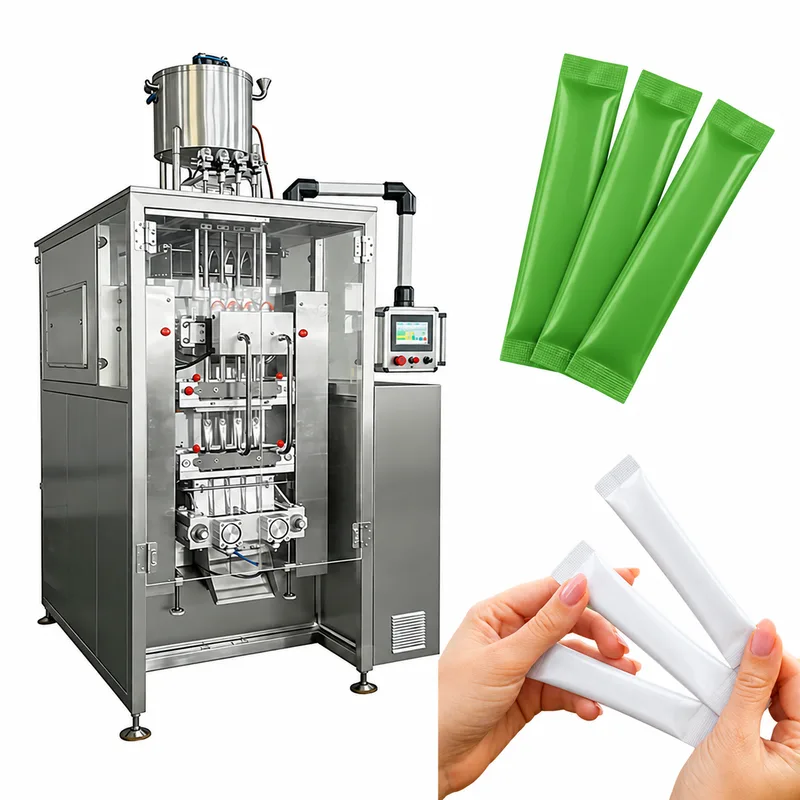
Four-Lane Collagen Stick-Pack Machine
Four lanes can hide one lane that under-doses. Specify this four-lane collagen stick-pack machine from your powder density, serving weight and stick size, and sample every lane.
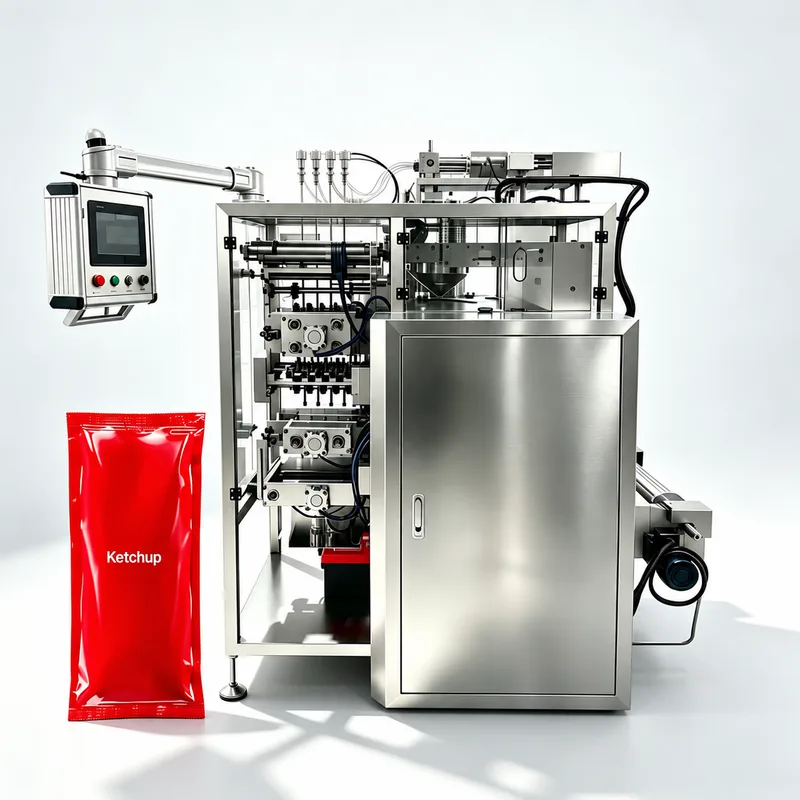
Sauce Sachets
Sauce Four-Side-Seal Sachet Machine
Sauce strings or drips can contaminate the seal area, leading to leaks and rejected sachets. Specify this piston-dosing four-side-seal machine from your sauce, portion, sachet drawing and film.