
Packaging Machines / Multi-Lane Stick Packs
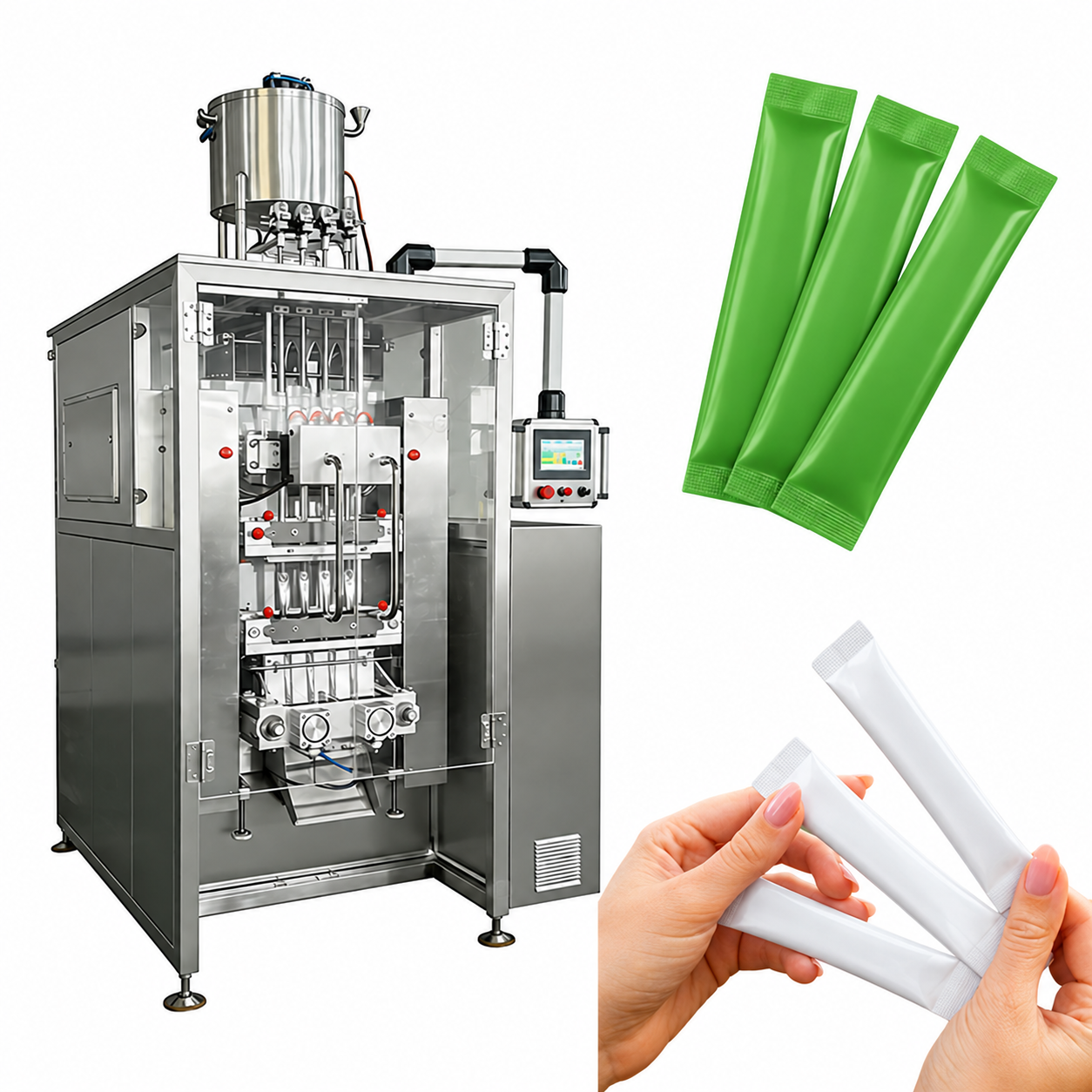
Four-Lane Collagen Stick-Pack Machine
Four lanes can hide one lane that under-doses. Specify this four-lane collagen stick-pack machine from your powder density, serving weight and stick size, and sample every lane.
- Lanes: 4 parallel forming and auger-dosing positions
- Published speed: 120–160 sticks/min, depending on powder density and dosing volume
- Published filling range: 1–30 g; stick length 50–180 mm, width 15–30 mm
- Counting basis of the speed figure: confirm whether four-lane total or per lane
We reply within 24 hours.
Published Configuration Data
| Number of Lanes | 4 Lanes |
|---|---|
| Packaging Speed | 120 - 160 sticks/min (depending on powder density and dosing volume) |
| Filling Range | 1 - 30g (customizable dosing screw tooling) |
| Bag Size Range | Length: 50-180mm | Stick Width: 15-30mm |
| Power Supply | AC 220V/380V, 50Hz/60Hz, 4.5 KW |
These values describe the listed configuration. Output depends on the product, fill quantity, bag and options. Confirm the final specification and trial conditions in your quotation.
Configuration & Selection
Choose the screw tooling and stick size from your actual blend's density and serving weight, then judge the line lane by lane. The published 120–160 sticks/min was listed without saying whether it counts all four lanes or one, so do not multiply it by four, and remember that a combined sample can hide one lane running light. Send powder bulk density, flowability and dose weight, and confirm screw tooling and sealing with the actual powder. Send details of your formula, density, serving range, stick drawing, film and a lane-labeling plan through the enquiry form or WhatsApp; physical samples are arranged separately.
On This Page
Four lanes for individual collagen portions
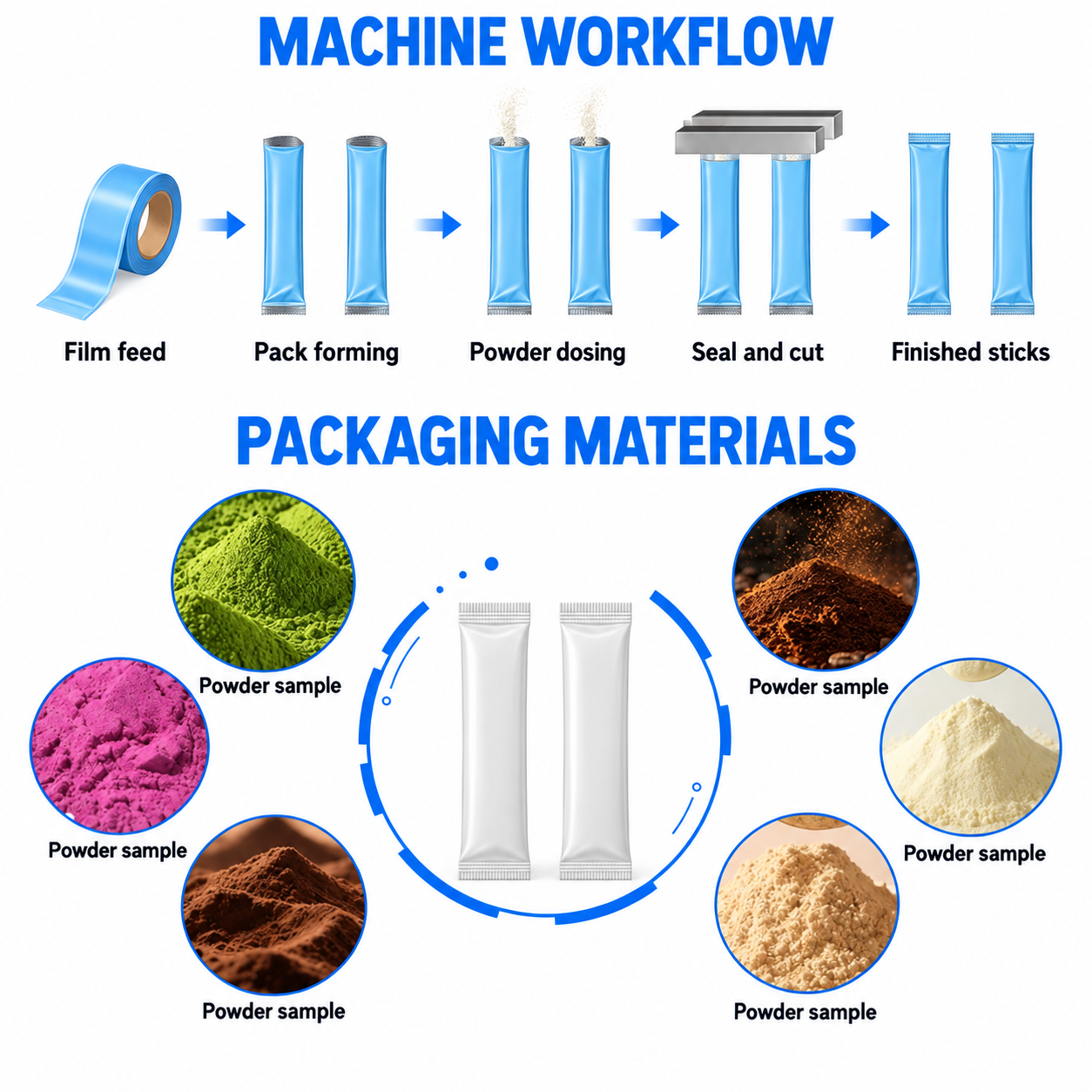
This configuration combines four parallel stick forming positions with auger dosing for collagen powder and similar powdered blends. A wide film roll supplies the packaging web, which is divided into narrow lanes before forming, filling and sealing. Rotating screw tooling measures the product. Nothing counts individual particles. So powder condition, screw geometry and the requested portion sit at the center of the choice.
Start with the finished serving and the actual blend. Pure collagen powder and a flavored formula with sweetener, acid or other ingredients may behave differently even at the same nominal serving weight. The catalog describes a family of configurations, so read the published filling range as a starting point for a sample review. Before the catalog values go into a purchase specification, confirm the screw set, stick dimensions and material-contact arrangement for your formula.
Takeaway: Confirm screw set, stick size and contact parts for your formula before using catalog values.
Powder delivery and independent dosing
The inspection path that tells you most starts at the bulk supply and follows the powder into the hopper, through the dosing screws and down the forming tubes. Check how the feeder keeps product available during sustained running. A machine can have four working lanes while one gets powder less consistently because the distribution or refill pattern is wrong. A combined output sample can hide that.
Ask for samples marked by lane and by time within the run. Note whether each group was collected before replenishment, right after it or following a pause, and that separates an unstable incoming powder condition from a dosing adjustment you can repeat. Review access around the screws and how residual blend is removed at the end of a batch. If a feeder is offered as an option, the quotation should state its connection, controls and cleaning responsibilities. The powder supply should not be left as an unspecified upstream task.
Common mistake: Weighing a mixed sample from all four lanes and missing the one lane that receives powder less consistently.
Takeaway: Label samples by lane and by run stage.
Stick dimensions and usable filling volume
The finished stick has to hold the serving and still leave room for powder to settle away from the end seal. Begin with an intended pack sample or a dimensioned drawing. Do not pick the width from the dose alone. Bulk density determines how much volume a given mass occupies, and powder may enter the tube in a more aerated state than it had in a storage container. Confirm it with the supplied sample.
The published size range does not mean one forming set can make every width and length combination. Ask which changes need new tubes, slit positions, sealing parts or cutting tools. The opening feature belongs in this discussion too. A tear notch and a rounded corner are different tooling requests. Neither follows from an attractive package photograph. Look at the usable seal left around the notch, and confirm that a consumer can open the sample without spilling a large part of the serving.
Takeaway: Size the stick from the serving's volume as it enters the tube, not from its weight.
Film routing and four-lane registration
Four neighboring graphics must stay aligned. That holds through splitting, forming, longitudinal sealing and cross sealing. Supply the laminate information, printed repeat and artwork layout. The packaging supplier and the machine supplier should check the sealant layer orientation and the registration mark position together. Calling it just a foil laminate leaves key dimensions open.
In a trial, compare the outer lanes with the middle ones. Look for different edge presentation, wandering artwork, uneven stick lengths, or a cut that comes close to the printed information on one side only. Keep samples taken after a roll change as well as during a settled run. A good result at one point in the roll says little. Splices, fresh rolls and normal material variation come later. If an automatic correction function is proposed, have it demonstrated on the selected configuration. The general control description is not proof.
Takeaway: Compare outer and middle lanes, including after a roll change.
Powder at the seal and normal stoppages
Fine collagen blends can reach the sealing region. This happens if the dose is still falling when the next closure begins. Inspect the top seal for trapped powder, wrinkles and visible channels, and compare what you see with an agreed package integrity method. A neat outside does not make a sound seal. When a trial shows contamination, review settling time, fill timing and tube arrangement together.
Build deliberate, controlled stops and restarts into the evaluation. Mark the first packages made after each pause so they do not vanish into the steady running sample. Decide which packs the operator should set aside after a refill, film adjustment or dosing interruption. These are operating decisions for the proposed line. A stop does not necessarily produce a defect. The point is to make the restart procedure visible and repeatable, with clear steps for checking fill weight and the sealing area before output goes to the next operation.
Takeaway: Mark the first packs after each stop and define what the operator sets aside.
Cleaning access for supplement blends
Plan cleaning around the formula. Consider the order of products that will share the equipment. A plain collagen batch followed by a flavored blend raises different residue questions from two batches of the same formulation. List the removable hopper parts, augers, discharge tubes and nearby surfaces where fine powder may settle. Then ask for a practical demonstration of removal and reassembly on the actual proposed design.
The cleaning method has to suit the ingredients and the equipment. Stainless steel on the visible surfaces says nothing about whether electrical, bearing or enclosed areas can be washed. Get the applicable instructions, and define how cleaned parts will be inspected, dried when relevant and released for use. During reassembly, watch how the operator confirms correct screw installation and lane identification. A documented sequence removes doubt when similar parts sit on a bench. Measure cleaning time from the agreed starting condition through to an acceptable first pack, not just the time spent wiping exposed panels.
Takeaway: Time cleaning to the first acceptable pack, not just the panel wipe-down.
- Compare fill samples from all four lanes before and after powder replenishment.
- Confirm serving volume, forming tooling and the usable seal around the opening notch.
- Demonstrate auger removal, lane identification and restart checks with the actual blend.
Acceptance samples and downstream handling
Build the trial around the portions and film you will actually order. Choose a normal production serving and any materially different endpoint in the proposed range. Collect lane-separated samples for mass checks, opening checks and package appearance. Link the sample labels to the powder lot, film roll and recorded settings. That way an adjustment can be understood later and is not reduced to a photograph of a finished stick.
Watch how four streams of finished sticks reach the takeaway conveyor and any counting or cartoning operation. One usable stick does not settle carton grouping. Define whether sticks should arrive loose, counted or in a specified orientation, and name the equipment responsible. Ask how rejected or startup packs are separated from acceptable output. If downstream equipment is outside the supply scope, agree the physical handover point and the conditions that stop packs piling up under the cutting area.
Takeaway: Decide loose, counted or oriented sticks at the downstream handover.
Information to prepare for a configuration review
Provide the collagen formulation category, target serving weights, bulk density information if you have it, and any observations about clumping or moisture sensitivity. Include enough powder and production film for setup and a meaningful run, with the quantity agreed before shipment. List the stick dimensions, cut style, notch, printed code and retail grouping you want. With these details, the auger, forming and packaging arrangement can be reviewed as one system.
The final configuration summary should separate included equipment from the optional feeder, coder and downstream modules. It should also name the tooling supplied for each approved size and the acceptance observations still to be demonstrated. Get the utility requirements and access needs for the selected arrangement, including replenishment and removal of the dosing components. Keep sample results and the machine quotation together. A broad catalog range, an edited catalog illustration and an attractive pack sample each have a use, but none replaces a documented agreement covering your own collagen powder and film.
Reading the speed figure and lane output
The Published Configuration Data table gives 120–160 sticks/min for this four-lane configuration, depending on powder density and dosing volume. It does not state whether that figure is the total for all four lanes or the rate of one lane. Ask the supplier to state the counting basis in the quotation, and do not multiply the figure by four or divide it yourself.
In the trial, keep two records separately: the count of accepted sticks from the whole machine over a stated period, and lane-labeled samples checked for fill and seal. The first answers the output question; the second shows whether all four lanes are dosing alike.
Takeaway: Compare quotes only once each supplier states whether its speed is per lane or per machine.
When this does not apply
The 1–30 g range, 50–180 mm by 15–30 mm stick range and 120–160 sticks/min speed describe the configuration family, not one tooling set or every formula. The speed's counting basis is not published. Washdown limits for electrical and enclosed areas come from the supplied instructions. A seal or stick format does not establish a shelf life.
Takeaway: Get tooling, counting basis and cleaning limits confirmed for your blend in writing.
Frequently asked questions
Is the 120–160 sticks/min figure for the whole machine or each lane?
The published data does not say. Ask the supplier to state the counting basis in the quotation, and measure accepted sticks for the whole machine separately from per-lane samples in the trial.
If I change powder, do I only need to change the settings?
Not necessarily. Screw tooling follows the serving mass and the powder's behavior, and a flavored formula can behave differently from pure collagen at the same nominal serving. Confirm the screw set and contact parts with the new blend.
Why should samples be taken lane by lane?
Because four lanes can each dose a little differently. Combining their output into one average can hide a lane running light or heavy; lane- and time-labeled samples show where a difference comes from.
What is stick pack packaging?
A narrow single-serve package formed from a strip of film, filled with one portion and sealed along its length and at both ends. On this configuration four sticks are formed in parallel from one divided film web.
Bag Format Selection
Review the pack requirements for your enquiry. Compatibility is confirmed for the selected equipment and sample.
Planning Guides for This Configuration
These pages cover the system type, trial preparation and project checks that apply to this configuration.
Request a Packaging Configuration
We reply within 24 hours. Tell us what you need to pack. Leave quantity and output blank if you are still deciding. When you continue, WhatsApp opens with your enquiry written out so you can review it and send it to our team.
Explore the application · Configuration and project support
Related Packaging Configurations
Multi-Lane Stick Packs
Four-Lane Coffee Powder Stick Packs
Instant, agglomerated, blended and ground coffee do not dose alike on one screw. Specify this four-lane coffee stick-pack line from your exact formula, serving and stick, and check every lane.
Multi-Lane Stick Packs
Four-Lane Creamer Stick-Pack Machine
Creamer that cakes in the hopper or dusts the seal can cause runs of rejected sticks. Specify this four-lane creamer stick-pack line from your formula, serving, moisture sensitivity and changeover order.
What to send us
| Item | Why we need it | Example format |
|---|---|---|
| Actual formula | Added ingredients can change how the powder flows and doses. | Formulation category and a sealed production sample. |
| Bulk density and flow notes | Decide screw tooling and the stick volume needed. | Density in g/ml if known, plus notes on clumping or moisture. |
| Serving range | Sets screw sets and whether one setup covers all servings. | List of servings in g. |
| Stick drawing and film | A width change can mean new forming and cutting parts; the film sets sealing. | Dimensioned stick drawing, laminate sheet and print repeat. |
| Lane sampling plan | Separates whole-machine accepted output from per-lane fill checks. | Two lines: accepted sticks per stated period for the machine; samples per lane (1–4) by run stage. |
We reply within 24 hours.