
Packaging Machines / Multi-Lane Stick Packs
Four-Lane Creamer Stick-Pack Machine
Creamer that cakes in the hopper or dusts the seal can cause runs of rejected sticks. Specify this four-lane creamer stick-pack line from your formula, serving, moisture sensitivity and changeover order.
- Lanes: 4, with auger dosing, longitudinal and cross sealing, cutting
- Products: creamer, milk powder and related beverage powders, assessed per formula
- Inputs that decide it: dose range, moisture sensitivity, stick size, film
- Speed: none published for this configuration; confirm it in the proposal
We reply within 24 hours.
| Product and configuration | Four-Lane Creamer Stick-Pack Machine |
|---|---|
| Published scope | Lanes: 4, with auger dosing, longitudinal and cross sealing, cutting; Products: creamer, milk powder and related beverage powders, assessed per formula; Inputs that decide it: dose range, moisture sensitivity, stick size, film; Speed: none published for this configuration; confirm it in the proposal |
| Inputs to provide | Compare each lane through a hopper refill using the actual creamer formulation. Review powder residue in end seals and demonstrate the agreed package integrity checks. Document ingredient-specific cleaning, component reassembly and the first acceptable stick. |
Configuration & Selection
Specify the line around your actual formula, not the word creamer. Fat content, particle structure and moisture sensitivity change how powder feeds and seals; a setup chosen for one formula can cake, short-fill or leave powder in the seal on another. Provide the formulation, dose range and moisture sensitivity so powder-contact parts and sealing can be reviewed. Send details of your formula, serving range, moisture notes, stick drawing, film and planned product sequence through the enquiry form or WhatsApp; physical samples are arranged separately.
On This Page
Four parallel portions for creamer and milk powder
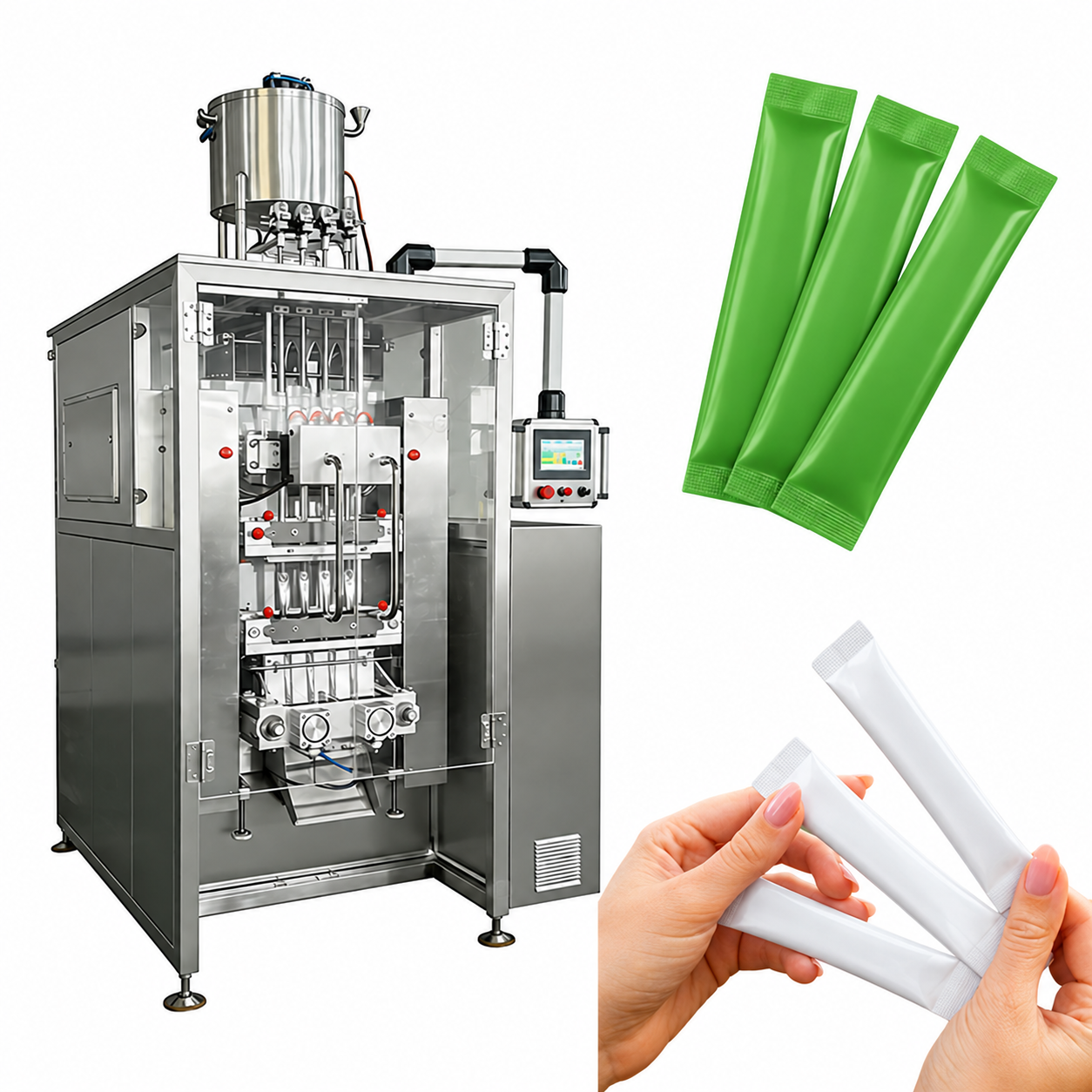
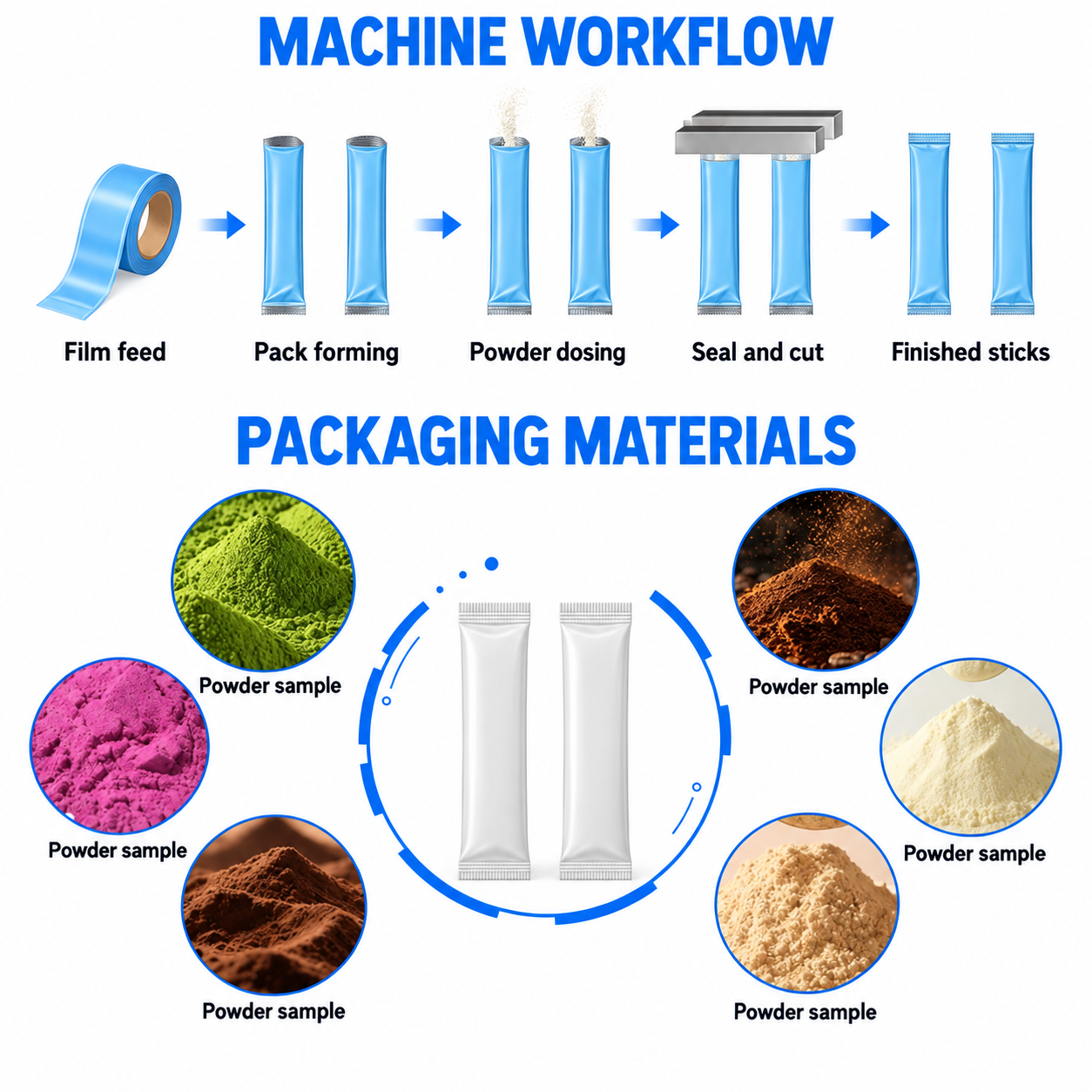
This machine family uses four stick-pack lanes with powder dosing, longitudinal sealing, cross sealing and cutting. The published configuration is meant for single portions of creamer, milk powder and related beverage ingredients. Each lane gets powder through an auger arrangement while the packaging web is divided and formed into narrow sticks. The result is a compact portion. Its practical size depends on the powder and the serving required.
Creamer is a category, not one material. Formulations differ in fat content, ingredients, particle structure and sensitivity to storage conditions. A configuration chosen for one formulation should not carry over to another just because both are called creamer. Start from your normal production material and the portion you intend to pack. The catalog layout gives a route for evaluation. Screw tooling, powder delivery, stick dimensions and film compatibility still have to be checked against your own material before the line is specified.
Takeaway: Evaluate each creamer formula separately, starting from normal production material.
Powder replenishment and lane balance
The powder must stay usable at the dosing screws. Review how the proposed hopper is replenished, and whether the feeder arrangement causes large swings in the amount or condition of material around the filling positions. A refill is a good moment to watch. It can show behavior that a short demonstration with a full hopper never will.
Keep the four output streams identifiable while you collect trial samples. Compare the average portion and its variation within each lane. Then see how both change over the run. Write down any visible caking, uneven powder movement or build-up around the discharge areas. Do not guess at the cause. These observations can guide a review of the feeder, hopper and auger arrangement. Ask how product left at the end of a batch is recovered or removed, and how the supplier proposes to avoid confusing old and new material during a formulation change. Those details affect everyday operation as directly as the filling mechanism does.
Takeaway: Watch a hopper refill and keep the four lanes identifiable in every sample.
Portion volume and stick tooling
A serving specified in grams has to fit comfortably inside the usable package volume. Judge the powder volume in the state it reaches the forming tube, not only after it has settled in a measuring container. Leave enough space for product to clear the closing region. Leave enough for the consumer to open the stick. A pack that looks full may be awkward to tear or empty.
Request a drawing of the proposed finished stick showing the longitudinal seam, end seals, code location and opening feature. Confirm which dimensions describe the finished package and which refer to film or tooling. Width changes generally call for a tooling discussion. Nobody should present one as a simple screen setting without confirmation. If the range spans both a small coffee creamer serving and a larger milk powder portion, assess each product and size combination. An endpoint inside a broad catalog range does not show that one setup handles every formulation and dose in between.
Takeaway: Assess each product and size combination; a broad range does not cover every point in between.
Sealing surfaces and powder control
Creamer dust near a seal deserves direct observation during the trial. Follow the powder from the dosing outlet to the forming tube and check whether material keeps falling into the closing region. Inspect samples from each lane for visible powder in the seal, distorted film or closures that look incomplete, then apply the agreed integrity checks. A smooth outer surface is not a check.
If a dust collection arrangement is proposed, discuss it with your actual formula and site requirements in mind. Find out where it sits, how it is cleaned and how it affects the surrounding product handling area. The phrase dust extraction is not a complete site solution, and it does not guarantee clean seals at every setting. Watch the result after normal refills and brief interruptions as well as during a stable run. If adjustment is needed, record the material condition and the changed settings together. That lets you compare the next sample fairly. It also stops every seal issue being blamed on temperature.
Common mistake: Raising seal temperature whenever powder shows in the seal, without checking dosing timing and refills first.
Takeaway: Record powder condition and changed settings together.
Moisture exposure and packaging material
Choose the film with the creamer formulation, the intended storage conditions and the package supplier all in the room. The machine must form and seal the chosen material, while the product and package evaluation shows whether it gives the protection you need. A list of compatible laminate families helps with initial screening, but it does not prove how a particular commercial film will perform.
Provide the actual roll specification, print repeat and sealant information. Check finished sticks for curl, seam presentation and opening behavior, especially when comparing alternative materials. Record the ambient and product conditions during the trial. Otherwise results from different sessions are hard to read. If moisture exposure during production worries you, review the whole path from opened bulk packaging through replenishment and filling. A higher barrier on the finished stick does nothing for powder that changed condition before it was packed. So review material handling as well as the final seal.
Takeaway: Review powder handling from opened bulk bag to filling, not only the stick barrier.
Cleaning and formulation segregation
A creamer project needs a cleaning plan matched to the ingredients and to the products scheduled before and after it. Describe the actual formulation to the quality team. A broad dairy or non-dairy label is not enough. Work out where residues can stay in the hopper, auger flights, dosing outlets, forming area and surrounding dust collection components. The supplier should show you the access provided on the proposed machine.
Have the removal and reinstallation of the relevant parts demonstrated, including any connections that must come off before the hopper or screws can be handled. Confirm the permitted cleaning method from the equipment instructions and decide how parts will be released for use afterward. Organize similar-looking lane components so reassembly is not guesswork. Record the complete changeover sequence, including film and code replacement and first-pack checks. A description of an easy-to-clean surface is no substitute for a practical method that the site's operators can carry out within their approved production routine.
Takeaway: Record the full changeover sequence through to the first acceptable stick.
- Compare each lane through a hopper refill using the actual creamer formulation.
- Review powder residue in end seals and demonstrate the agreed package integrity checks.
- Document ingredient-specific cleaning, component reassembly and the first acceptable stick.
Trial design for ordinary production conditions
Use the representative creamer or milk powder, not a substitute picked only because it flows easily. Include the serving you intend to pack. Add any portion that substantially changes package volume or auger operation. Collect labeled samples by lane and by stage of the run. Pair mass observations with seal appearance, package integrity and opening checks, so the evaluation covers the filled portion and the finished package together.
Plan a refill during the demonstration. Add a controlled stop and a restart. See which packages the operator pulls from normal output and what gets checked before production resumes. If the sticks will go into multipacks or cartons, look at how they leave the cutter and reach the next process. Define whether counting, orientation and collection belong in the proposed supply scope. A useful acceptance record states the materials, operating conditions, observations and remaining adjustments. A short demonstration or a catalog output figure is not a guarantee for an entire production shift.
Takeaway: Include a refill, a stop and a restart in the trial.
Specify the complete creamer packaging arrangement
Put together a brief. Include the formulation category, serving range, stick dimensions, expected changeover pattern and proposed film. Add details of the incoming powder container, the replenishment method and any relevant storage sensitivity. Include the date code, opening style, finished pack grouping and any downstream equipment you already have, and these inputs show whether the standard arrangement needs a different feeder, screw set, forming set or collection interface.
The quotation should name the components and tooling included for each evaluated product. Tie utility requirements, installation clearances and removal space for cleaning parts to the selected layout. Keep outstanding questions visible. This matters most where the milk powder and the creamer you want behave differently in trial conditions. Agree the sample checks and documentation required before acceptance. This profile exists to support that configuration review. Neither a workshop photograph nor a catalog description shows that an untested formulation or a particular sanitation process will suit the receiving factory.
Changeover and refill record
Keep one record line per event, so lane problems can be traced to a formula, a refill or residue from the last product. The headings follow the replenishment and cleaning sections above.
Formula: the product being run and the one before it.
Lane: which of the four lanes the sample came from.
Refill: whether the sample was taken before or after a hopper refill.
Residue: what was found in the hopper, auger flights, outlets and seal area at changeover.
First acceptable stick: when it was produced and which checks it passed.
Takeaway: A changeover is finished at the first acceptable stick, not when the recipe is selected.
When this does not apply
No speed is published for this configuration. A broad dose or size range does not show one setup handles every formula and serving in between. Dust extraction does not guarantee clean seals at every setting. Shelf life and moisture protection come from product and package testing, not from the machine trial.
Takeaway: Confirm tooling, sealing and changeover for each formula you will run.
Frequently asked questions
Can creamer and milk powder share the same tooling?
Not automatically. If a range spans a small creamer serving and a larger milk-powder portion, each product and size combination needs its own assessment of screw tooling, forming parts and sealing.
How should each lane be recorded after a refill?
Keep samples labeled by lane and by whether they came before or after the refill. Compare the average portion and its variation within each lane, and note caking or build-up rather than guessing at the cause.
What does a formula changeover include?
Cleaning the hopper, augers, outlets, forming area and dust collection points; reassembling parts without mixing up lanes; film and code replacement; and first-pack checks. Selecting a recipe on the screen is only one step.
Do packaged creamers go bad?
That depends on the formula, film, seals and storage, and needs product testing. A machine trial can show the line forms and seals the chosen film consistently; it cannot establish shelf life.
Bag Format Selection
Review the pack requirements for your enquiry. Compatibility is confirmed for the selected equipment and sample.
Planning Guides for This Configuration
These pages cover the system type, trial preparation and project checks that apply to this configuration.
Request a Packaging Configuration
We reply within 24 hours. Tell us what you need to pack. Leave quantity and output blank if you are still deciding. When you continue, WhatsApp opens with your enquiry written out so you can review it and send it to our team.
Explore the application · Configuration and project support
Related Packaging Configurations
Multi-Lane Stick Packs
Four-Lane Collagen Stick-Pack Machine
Four lanes can hide one lane that under-doses. Specify this four-lane collagen stick-pack machine from your powder density, serving weight and stick size, and sample every lane.
Multi-Lane Stick Packs
Four-Lane Coffee Powder Stick Packs
Instant, agglomerated, blended and ground coffee do not dose alike on one screw. Specify this four-lane coffee stick-pack line from your exact formula, serving and stick, and check every lane.
What to send us
| Item | Why we need it | Example format |
|---|---|---|
| Formula | Fat, particle structure and ingredients change feeding and sealing. | Formulation category and a sealed production sample. |
| Serving range | Sets screw sets and stick volume. | List of servings in g per product. |
| Moisture sensitivity | Decides powder handling from bulk bag to hopper. | Short note on caking behavior and storage conditions. |
| Stick drawing and film | Sets forming tooling, seals and opening. | Dimensioned stick drawing, laminate sheet and print repeat. |
| Product sequence | Drives cleaning and segregation between formulas. | Planned order of products across a typical week. |
We reply within 24 hours.