
Powder & Supplement Stick Packs
Reusing powder tooling by product name can leave dose and stick volume mismatched. Assess collagen, coffee and creamer formulas separately.
| Input or item | Typical value or source | Why it matters |
|---|---|---|
| Formula | Actual collagen, coffee or creamer recipe/sample | Keep material assessments separate |
| Bulk density and flow | Buyer observations with sample condition | Relate dose to occupied volume |
| Dose range | Product specification | Identify the dosing task |
| Stick and web drawing | Dimensioned pack and complete film layout | Separate forming geometry from powder tooling |
| Lane sample identity | Run record with lane and replenishment stage | Expose differences hidden by a combined average |
Choose the route before specifying the equipment
Keep one record for each formula, dose and stick drawing. The collagen, coffee and creamer configurations are separate starting points; collagen figures do not apply to the whole powder family.
On This Page
Follow the film and powder through four parallel sticks
The four-lane powder arrangement has two coordinated material paths. A wide roll of printed film is slit into separate strips, which pass through parallel forming assemblies. Powder travels from its supply hopper through auger dosing components into those formed sticks. Longitudinal and cross seals close the packages, and the cutting arrangement separates the finished portions. Seeing the two paths clearly makes the equipment easier to specify, because powder tooling and film tooling solve different parts of the job.
Before preparing printed film, get the supplier's approved web layout. It should show how the artwork repeats across the roll and along its travel direction, with registration marks and the areas reserved for sealing and cutting. An individual stick artwork file is fine for appearance, but it does not describe the whole roll feeding a multi-lane machine.
Keep one drawing for the film web and another record for the powder tooling. A change in flavor with the same portion may affect the dosing assessment. A change in stick width affects forming and web layout. Keeping the two apart gives purchasing and production a clearer basis for ordering both packaging materials and machine change parts.
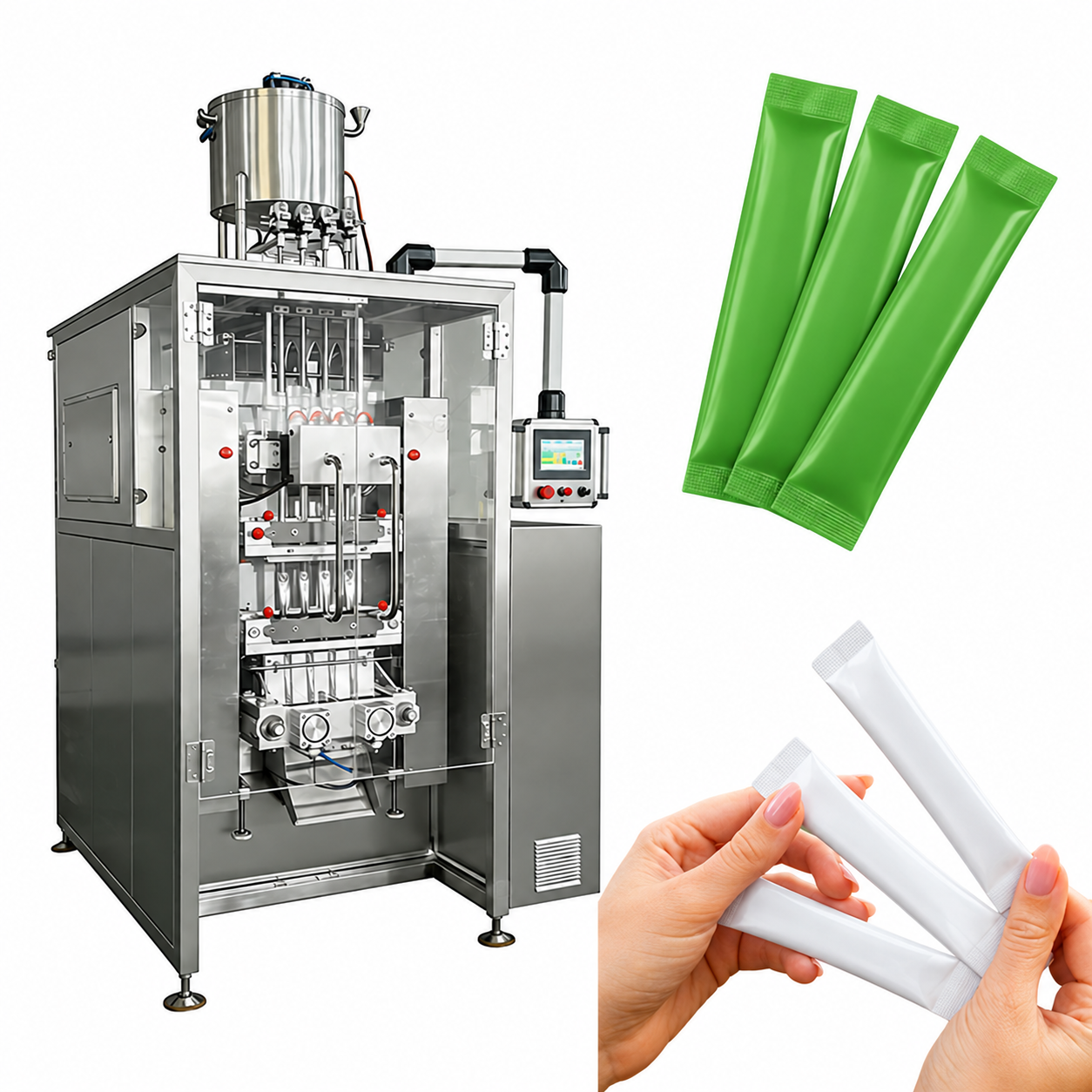
Auger dosing for powder stick packs
The four-lane range uses auger dosing for powder stick packs. Screw tooling, fill weight and powder density are linked. During configuration review, evaluate dust near the seal, powder settling, tear-notch position and cut style.
Powder sample and stick dimensions
Powder sample, bulk density, dose range, film structure and stick dimensions.
Build the powder brief around the actual formula
Powder is a physical form, not a complete filling specification. A supplement blend, a fine beverage powder and a granular instant product can behave differently in storage, feeding and dosing. Provide the actual formulation to be packed, or an agreed representative sample if formulation work is still in progress. Explain what is known about bulk density, flow, clumping and the material condition at the packaging point. Mark anything uncertain so it can be resolved during evaluation.
The catalog includes four-lane auger-based stick-pack configurations for powder applications. They give a practical starting architecture for single portions. That does not mean every formula uses the same screw, outlet or pack dimensions. The first purchasing decision is to connect each intended formulation and dose with a defined package and a proposed dosing arrangement that can be assessed together.
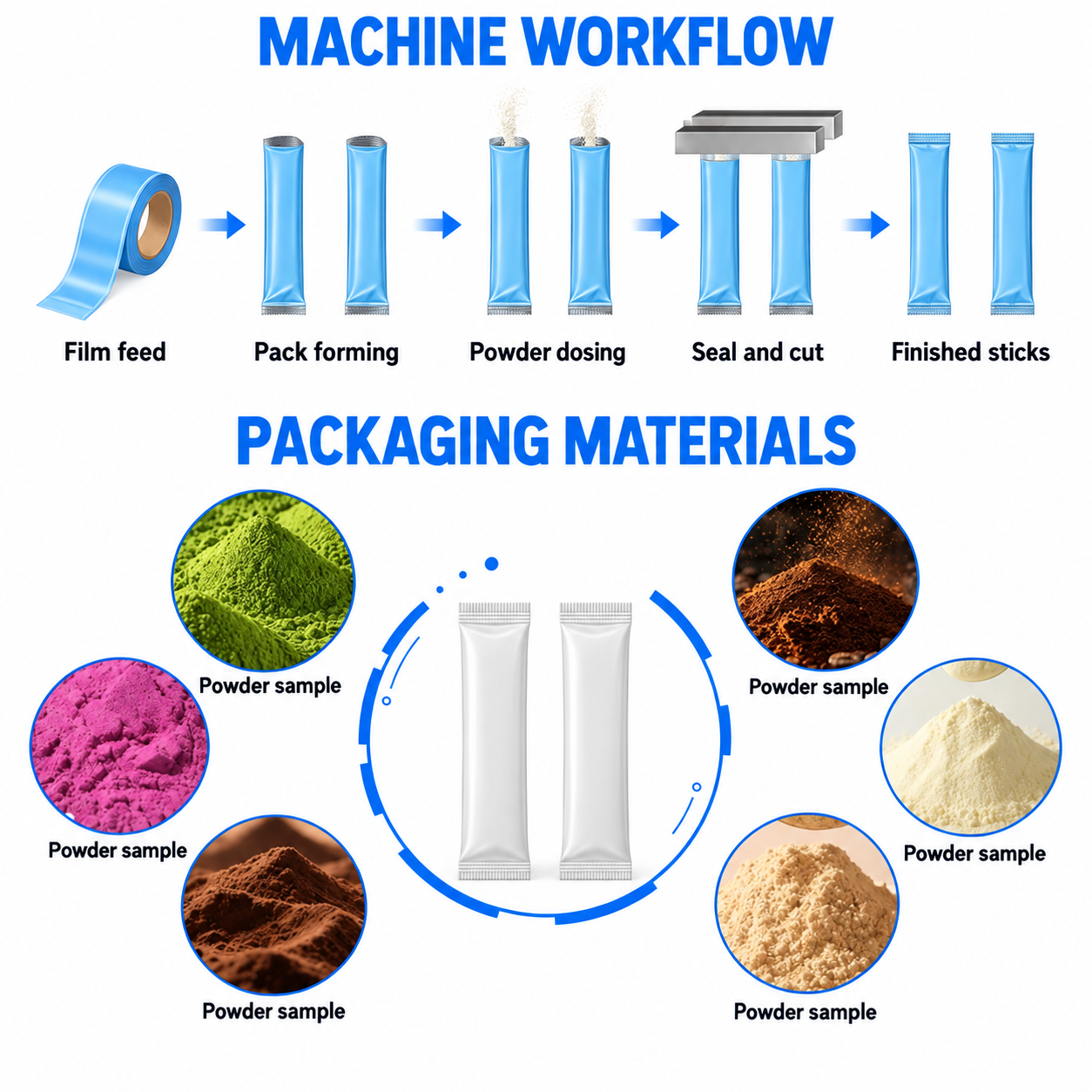
Translate the dose into available stick volume
A requested mass alone does not define the space needed inside a stick. The same nominal quantity of two different powders may occupy different volumes. Send the target dose range with a proposed stick drawing and a material sample. The supplier should explain how the filling arrangement and available pack space relate to your powder, including the clearance needed near the sealing area.
A hypothetical brand planning a fine collagen blend and a granular beverage mix should keep separate sample records even if both use similar artwork. A package size chosen for one material may need further review for the other. Before approving production film, confirm the usable width, length, seal margins, opening feature and coding area. This coordination is easier while the drawing can still change than after a large printed roll has been ordered.
Make lane-level observations visible
A four-lane arrangement makes several sticks in parallel, so the trial record should note which lane each sampled pack came from. An average across all collected sticks can hide a recurring issue at one position. Agree how samples will be labeled and kept before the demonstration begins. Find out how the supplied configuration supports adjustment and repeat setup for your products.
Watch dosing through startup, stable running and replenishment of the powder supply, and record changes in material condition and any interventions. The catalog describes independent auger dosing options. But the evidence that matters for a purchase is what the actual lanes do with the specified powder and film. Keep fill observations separate from package appearance and seal observations. A good result in one category should not hide a problem in another.
Look beyond the nominal screw size
Find out which screw and product-contact components are proposed for the formula and dose range. If several products must share the equipment, get a clear list of retained parts, change parts and adjustments. Understand the configuration that was demonstrated. Do not pick dosing hardware from an application article without material testing.
Pay attention to what happens between the dosing outlet and the formed stick. Watch whether powder stays around the outlet, arrives unevenly or reaches the sealing area. The supplier should explain any proposed dust-management feature and its scope. A named feature will not eliminate every powder-related issue. Record where and under what circumstances buildup occurs, so the proposed response can be evaluated repeatably with the same formulation and packaging material.
Review the consumer opening as part of production
The stick must be filled and sealed, and it must also have the opening feature the brand intends. Provide the cut style or tear-notch position you want and find out how it relates to the printed repeat and sealing area. Examine real finished samples, not just an artwork mockup. The opening assessment should reflect how the customer will handle and empty the portion.
Compare samples from different lanes and stages of the run for alignment and visible consistency. If the stick comes as a connected strip or another special presentation, describe that requirement explicitly and confirm whether it is included. Optional cutting arrangements should appear as named items in the quotation. A generic statement about stick packs does not define the exact opening experience or downstream presentation you intend to sell.
- Formula, bulk density and flow behaviour
- Dose records by lane and observations after replenishment
- Powder near seals and clearing between products
Plan formula changes and retained-powder checks
List the formulations in their likely production sequence and describe the cleaning method your process requires. Get access information for the hopper, auger and filling path, including the parts the operator needs to inspect. Confirm how components are identified when different dosing sets are supplied. Details like these give you a usable production plan, without unsupported claims about cleaning validation or product suitability.
If the trial includes a change between formulas, document its boundaries: the parts changed, the adjustments made and what the first acceptable packs of the next material looked like. A film-size change is different from a complete product-contact change. They are separate activities and should not be squeezed into one unexplained changeover time. The supplier's demonstration should help the buyer understand what work is involved for the specific powder range.
Turn the powder trial into a purchase record
Prepare a matrix of formulation, dose, film, stick dimensions and proposed tooling. Select representative combinations for the trial and state which remain open. Collect lane-labeled samples during the agreed events, then review fill quantity, sealing-area cleanliness, cut alignment and finished-pack appearance separately. Record interruptions and the amount of acceptable output over the observed period, and keep the conditions attached to any reported result.
Buyers often ask whether a four-lane machine is always the best choice. It depends on the required portions, batch pattern, format range and confirmed material behavior. Another common question is whether a formulation change can be handled through settings alone. Request a product-by-product answer based on the proposed tooling. A clear sample matrix and a documented trial are worth more than a broad promise covering every powder sold under the same commercial category.
Create a tooling matrix for future reorders
Request a matrix linking each confirmed powder and dose range to its supplied screw, forming parts and package drawing, with component identifiers and the revision of the trial record. Production then has a practical way to find the right parts, and purchasing has a reliable reference when ordering replacements.
Give an untested formula its own row instead of assigning it an existing setup by name alone. If a new film or serving quantity is proposed, the matrix shows which package and tooling assumptions need review. The benefit is traceability. The team can tell an established repeat order from a configuration change and send the supplier the relevant material information before buying additional components.
| Formula and dose | Screw and forming parts | Film revision and trial evidence |
|---|---|---|
| Formula code ___; dose/range ___ | Screw ID ___; forming-part ID ___ | Film drawing revision ___; sample/trial record ___; lane IDs ___ |
Method and limits of this comparison
Scope: Powder & Supplement Stick Packs. Configuration records: collagen-stick-pack, coffee-stick-pack, creamer-stick-pack. This October 2026 revision organizes the published configuration descriptions and the buyer checks discussed on this page. The configuration source links near the opening identify the records behind the comparison. This is a selection aid compiled from published information, not a report of our own trials.
For Powder & Supplement Stick Packs, use the stated parameters only for the named configuration and its original conditions. Missing values remain open; photographs and edited catalog illustrations do not qualify an untested material or establish a storage-life, cleaning or performance result. Keep project-specific evidence with the final quotation.
Frequently asked questions
Is a four-lane machine always the best choice?
Choose from the required portions, batch pattern, format range and assessed material behavior. The published four-lane arrangements describe particular configurations, not a universal lane-count recommendation.
Can changing powder be handled by settings alone?
Request a formula-by-formula account of screw tooling, outlets, contact checks and settings. Keep the new material open until the relevant dose and package assessment is complete.
What is needed to reorder tooling?
Send the formula code and dose, screw and forming-part identifiers, film drawing revision and trial-record reference, including lane identity. Distinguish a repeat order from a new powder or format request.
Explore the Equipment
Multi-Lane Stick Packs
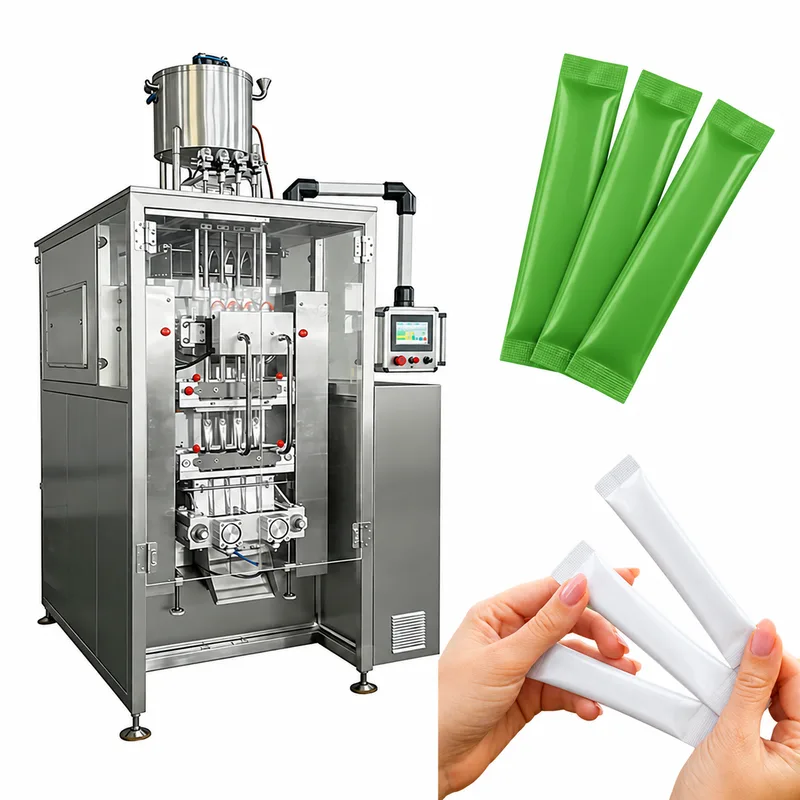
Four-Lane Collagen Stick-Pack Machine
Four lanes can hide one lane that under-doses. Specify this four-lane collagen stick-pack machine from your powder density, serving weight and stick size, and sample every lane.
Multi-Lane Stick Packs
Four-Lane Coffee Powder Stick Packs
Instant, agglomerated, blended and ground coffee do not dose alike on one screw. Specify this four-lane coffee stick-pack line from your exact formula, serving and stick, and check every lane.
Multi-Lane Stick Packs
Four-Lane Creamer Stick-Pack Machine
Creamer that cakes in the hopper or dusts the seal can cause runs of rejected sticks. Specify this four-lane creamer stick-pack line from your formula, serving, moisture sensitivity and changeover order.
What to send us
| Item | Why we need it | Example format |
|---|---|---|
| Formula and density | Identify the material and occupied-volume assumptions | Formula code with density/flow notes |
| Dose and stick dimensions | Connect quantity with usable package space | Dose specification and dimensioned stick drawing |
| Film layout and revision | Identify forming, print and cutting requirements | Full web drawing with revision code |
| Tooling and lane records | Distinguish repeat parts from new combinations | Component list and lane-labeled sample sheet |
We reply within 24 hours.