
Liquid Sachet Filling Machine: Pump or Piston for Viscosity
Compare peristaltic pump, rotary lobe pump and piston dosing on a liquid sachet filling machine by viscosity, oil compatibility, particulates and CIP access.
On This Page
How pump and piston dosing routes divide on a liquid sachet filling machine
Selecting a liquid sachet filling machine starts with separating the package closure sequence from the dosing mechanism that meters each portion into the pouch. Buyers should avoid treating a film sachet, an open-top drink pouch, and a spout pouch as one liquid filler merely because the nominal fill quantity is the same. Whether a project calls for a narrow liquid stick pack, a flat four-side-seal liquid sachet packing machine, or a multi-lane sachet liquid packing machine, the fluid path must match product viscosity at the filling point, oil or acid composition, suspended solids, and sanitation turnaround between batches.
Our Sauce Four-Side-Seal Sachet Machine operates at 30–60 bags/min depending on dosing volume and viscosity, covering sachet lengths of 50–180 mm, widths of 30–140 mm, and a maximum film width of 320 mm on a customizable 220V, 50/60Hz, 2.2 kW power supply. Standard volumetric piston dosing covers 5–100 ml with optional heated or agitated hoppers for sauces and pastes, while extended cylinder configurations up to 500 ml are matched to verified large-format sachet tooling.
Across single-lane and multi-lane liquid sachet builds, we configure servo-piston, gear-pump, rotary lobe, and peristaltic dosing assemblies according to fluid shear sensitivity, oil or acid content, particulate size, and cleaning turnaround. Use the comparison matrix below to review how peristaltic tube dispensers, rotary lobe and rotary positive displacement pumps, check-valve piston fillers, and rotary-valve piston fillers divide across fluid behavior and cleaning access before requesting a factory trial.
- Compare sauce sachet, premade pouch and spout pouch equipment routes
- Review the sauce four-side-seal sachet machine profile
- Examine flat four-side-seal sachet perimeter crimps and inner cavity geometry
- Examine narrow tubular stick-pack geometry and lane arrangements
| Dosing mechanism | Fluid path and metering arrangement | Primary buyer verification focus |
|---|---|---|
| Peristaltic tube or hose pump | Rollers or shoes compress a flexible elastomer tube or hose to displace liquid without internal valve contact | Confirm suction head, outfeed bore ratio, and elastomer resistance to oils, fats, or acids |
| Rotary lobe or rotary positive displacement pump | Meshing metallic lobes or circumferential rotors meter fluid through a rigid sanitary chamber | Confirm rotor clearance, inlet flange geometry, solid size passage, and manual teardown or CIP loop parameters |
| Check-valve volumetric piston filler | Reciprocating cylinder draws and discharges clean liquid through spring-loaded one-way poppet seats | Confirm fluid is free of seeds, fibers, or particulates that could foul or hold open poppet seats |
| Rotary-valve volumetric piston filler | Reciprocating cylinder cycles with a mechanically timed rotating valve port between hopper and nozzle | Confirm valve port opening, connecting pipe bore, and nozzle tip diameter against particulate dimensions |
Peristaltic pump dosing: tube containment, viscosity bore sizing and elastomer selection
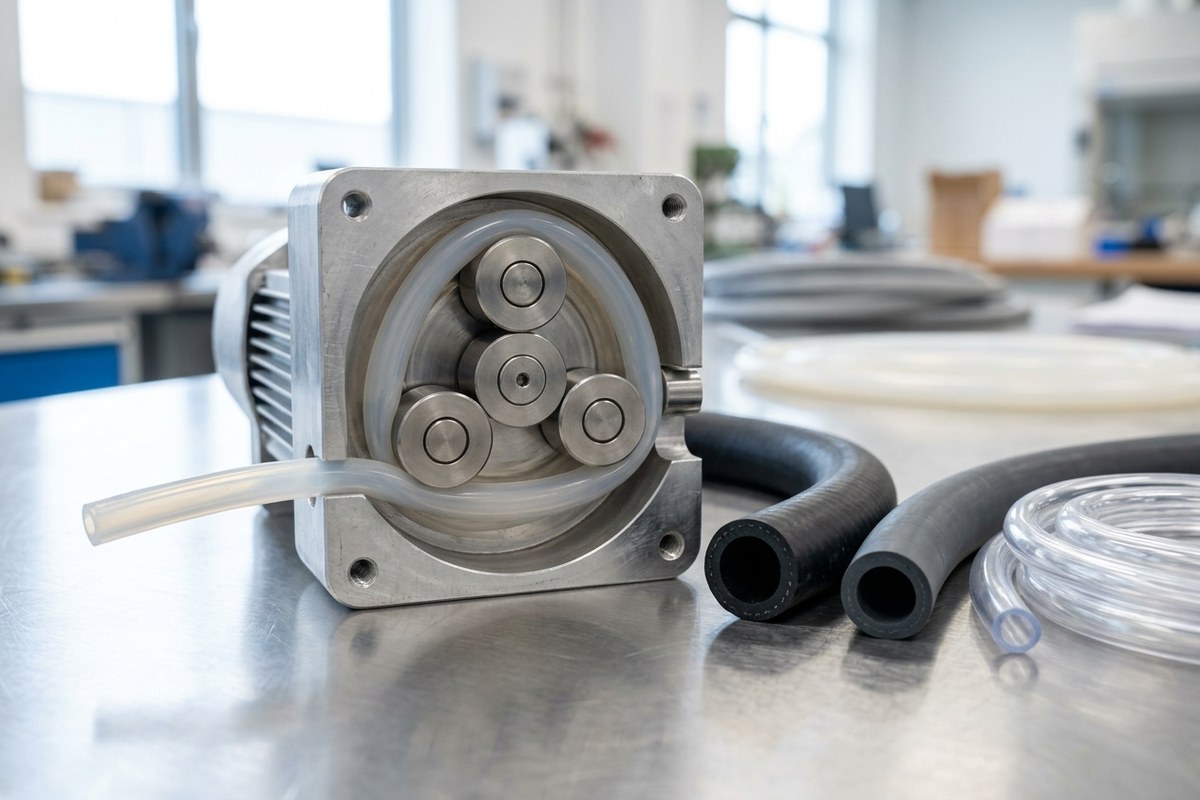
Peristaltic dispensers isolate the liquid product inside a continuous flexible tube so the fluid never touches rotors, cylinders, or mechanical seals. In a peristaltic pump, the fluid is contained entirely within the hose throughout the pumping cycle and never contacts the pump casing or any internal mechanism. The Watson-Marlow Flexicon PD12P peristaltic liquid filling head dispenses fill volumes from 0.1 ml to more than 250 ml. The Watson-Marlow Flexicon PD12P peristaltic liquid filling head achieves dispensing accuracy better than +/-0.5%. On the Watson-Marlow Flexicon PD12P peristaltic liquid filling head, product change takes less than 1 minute. The Watson-Marlow Flexicon PD12P peristaltic liquid filling head operates with no risk of cross contamination. For multi-lane integration, up to 16 Watson-Marlow Flexicon PD12P heads can be controlled by one MC12P controller.
Achieving repeatable micro-volume and single-serve fills in a peristaltic pumphead depends on matching the silicone tubing specification to the drive rollers. Watson-Marlow Flexicon Accusil platinum-cured silicone tubing provides dispensing accuracy of ± 0.5% on water-like viscosity. Watson-Marlow Flexicon Accusil platinum-cured silicone tubing carries full biopharmaceutical compliance with USP Class VI, Ph Eur 6.8 Chapter 3.1.9, ISO 10993 and FDA CFR 177.2600. Watson-Marlow Flexicon Accusil silicone tubing is cleanroom manufactured in an ISO 14644-1 Class 7 environment. In the Watson-Marlow Flexicon PF7 and PF7+ peristaltic filling machines, using tubing other than Accusil and Asepticsu can cause poor performance and undesirable results.
When liquid viscosity increases above water-like flow, suction geometry, discharge line bore, and pumphead settings must be configured together. In the Watson-Marlow Flexicon PF7 and PF7+ fluid path layout, the outfeed tube bore must be equal to or larger than the tubing in the pumphead, and when pumping viscous fluids operators should use tube with a bore several times larger than the pumphead tubing. Positioning the Watson-Marlow Flexicon PF7 or PF7+ pump at or just below the minimum level of the fluid to be pumped ensures flooded suction and maximum pumping efficiency. On the Watson-Marlow Flexicon PF7 and PF7+ recipe volume settings, the target fill volume or weight range has a minimum of 0.0100 millilitres or grams and a maximum of 9999.9 millilitres or grams. The maximum pump speed is 400 rpm on the standard Watson-Marlow Flexicon PF7 model and 600 rpm on the PF7+ plus model. On the Watson-Marlow Flexicon PF7 and PF7+, if dripping occurs after the fill has completed, increasing the anti-drip parameter creates suck back by momentarily reversing the direction of the pumphead across 0-10 reverse steps.
Beyond aqueous liquids, buyers evaluating peristaltic hose or tube pumps for edible oils, hot condiments, or acidic dressings must review both the compression mechanism and the elastomer chemistry. In Castle Pumps' comparison of roller-operated versus shoe-operated peristaltic pumps, roller-operated models offer lower power consumption with up to 30% energy savings compared to shoe-operated models and do not require lubrication. According to Castle Pumps' peristaltic hose material guide, Nitrile (NBR) hose is best used for fats, fuels and oils and is available in a food grade NBR-A version. According to Castle Pumps' peristaltic hose material guide, EPDM hose is best used for hot fluids, clean-in-place applications, acids and alkalis. According to Castle Pumps' peristaltic hose material guide, Tygon transparent tubing is used for low viscosity food and lab products where visual observation of the fluid is needed during operation, and its flow rate is 30% less than other tube types. On Tapflo peristaltic pumps, food grade hoses in EPDM FDA, NBR FDA and NR FDA meet EC 1935/2004 and FDA CFR21§177.2600 certifications.
Rotary lobe and positive displacement pumps for viscous sauces and delicate solids
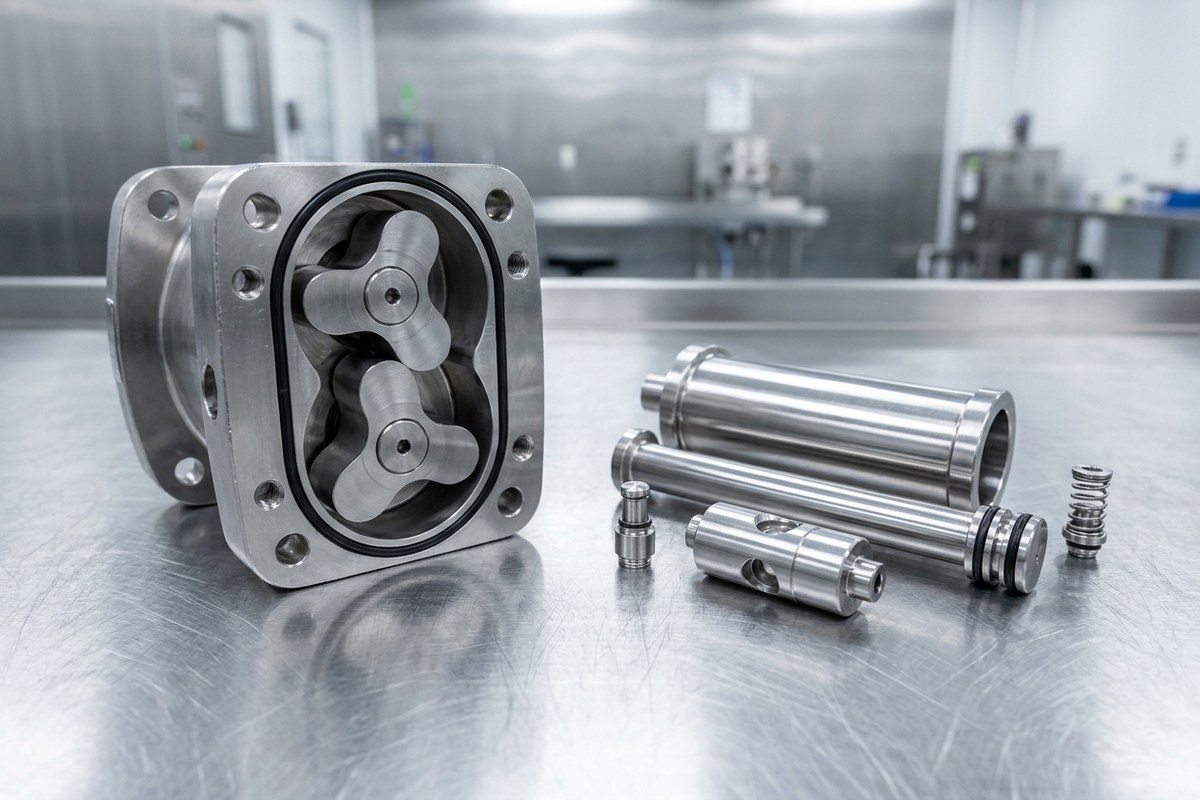
When a recipe combines elevated viscosity, backpressure across manifold piping, or soft food particulates, rotary lobe and external circumferential piston positive displacement pumps replace flexible tubing with machined metallic chambers. The Alfa Laval SRU Rotary Lobe Pump range uses modular pump heads and gearboxes to handle flow rates up to 106 m3/h and differential pressures up to 20 bar. On the Alfa Laval SRU Rotary Lobe Pump, all media-contacting steel components, including the rotor case, front cover, rotors and rotor nuts, are made of W 1.4404 (AISI 316L). The standard Alfa Laval SRU Rotary Lobe Pump has tri-lobe rotors, while optional bi-lobe rotors are available for handling fluids containing large delicate solids. Alfa Laval SRU rotors are available in three temperature ratings enabling the pump to be operated at maximum process temperatures of 70°C, 130°C and 200°C for both fluid pumped and CIP.
Sanitary rotary lobe series also provide defined pressure, temperature, and port envelopes for food and personal-care lines. Alfa Laval OptiLobe rotary lobe pumps conform to CE directives and EHEDG, 3-A and FDA hygienic standards. Alfa Laval OptiLobe rotary lobe pumps support differential pressures up to 8 bar, media temperatures up to 130°C and port sizes from 25 to 100 mm in diameter. The standard materials of construction for Alfa Laval OptiLobe pumps are 316L stainless steel for all wetted parts, an all stainless-steel exterior, and EPDM for all product-wetted elastomers.
External circumferential piston positive displacement pumps address high-viscosity infeed resistance and pressure spikes through specialized rotor metallurgy and inlet port options. The SPX FLOW Waukesha Cherry-Burrell Universal One Series rotary positive displacement pump features a 316L stainless steel body, cover and shaft, easy disassembly for COP cleaning, elastomers that comply with FDA requirements, and 3-A sanitary compliance. The SPX FLOW Waukesha Cherry-Burrell Universal One Series positive displacement pump provides pressure capability up to 200 psi / 13.8 bar. On the SPX FLOW Waukesha Cherry-Burrell Universal One Series pump, available options include single wing rotors for reduced damage of particulates, jacketed or vented covers, and a rectangular flange inlet for high viscosity products. On the SPX FLOW Waukesha Cherry-Burrell Universal One Series pump, rotors made of Waukesha "88" alloy can be run with close clearance to the 316L stainless steel fluid head without galling or seizing should inadvertent pressure surges cause contact.
Volumetric piston fillers: check valve versus rotary valve selection
In a rotary-valve volumetric piston filler, once the metering cylinder draws its target stroke from the supply hopper, the mechanically timed rotary valve shifts position so the piston discharges the portion cleanly through the nozzle into the sachet. As a practical shop-floor benchmark, any paste or condiment that extrudes smoothly through a manual pastry bag without phase separation can be metered reliably on a volumetric piston depositor.
Selecting the valve mechanism between the cylinder, hopper, and discharge nozzle is the decisive step when moving from free-flowing liquids to heavy pastes or condiments with seeds and diced vegetables. Spring-loaded poppet check valves open and close on pressure differential for clean, particulate-free liquids up to roughly 20,000 cP. For viscosities above 20,000 cP—such as thick culinary pastes, nut butters, or gels—or sauces containing suspended solids, a mechanically driven rotary valve aligns a full-bore port between the intake and outlet paths. With a hollowed-out rotary valve core, soft particulates up to 12 mm (0.5 in) pass through the dosing chamber without crushing or valve-seat hang-up.
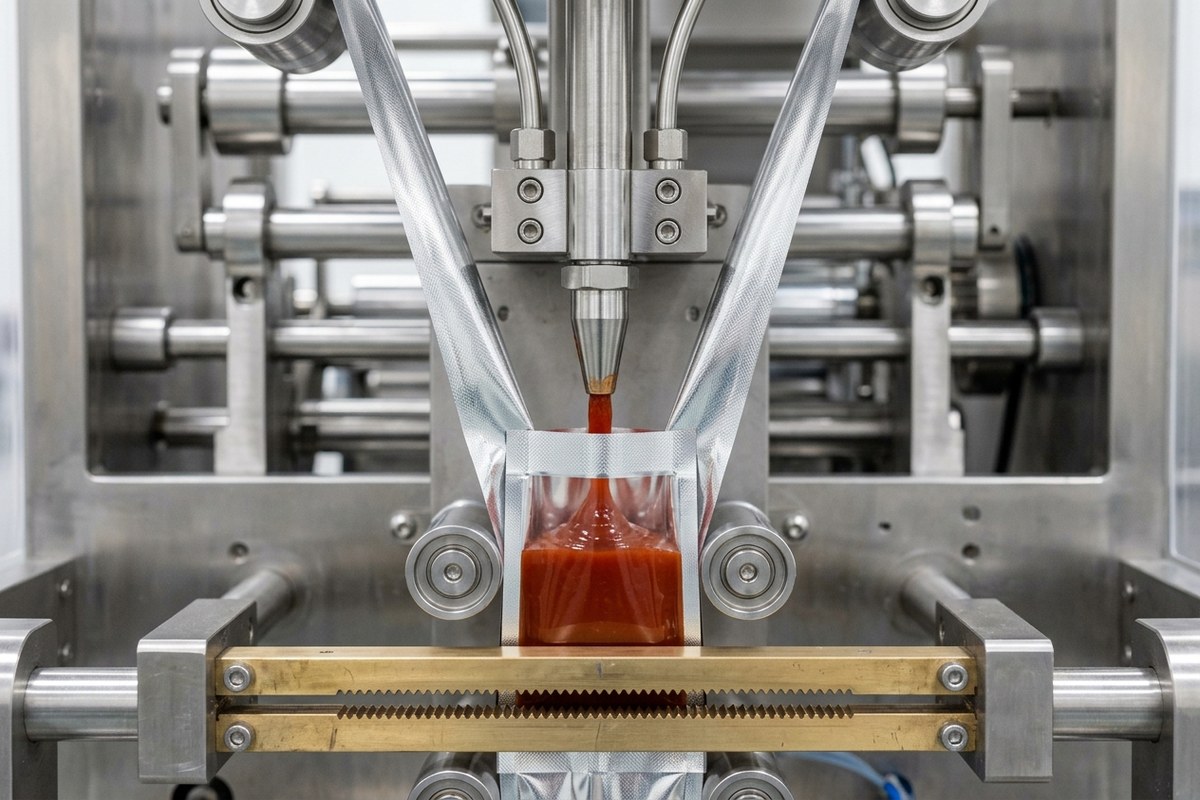
Even when the piston valve core passes particulates cleanly, packaging engineers must evaluate the complete downstream fluid path to the sachet seal area. On piston-filling sachet systems handling particles, fibers, or thick pastes, the delivery tube and nozzle tip geometry matter as much as the nominal cylinder displacement. Because a volumetric piston meters displacement volume while retail labels declare net mass, specific-gravity shifts at elevated filling temperatures must be reconciled during calibration. During sauce sachet filling, a trailing strand or drip can contaminate the horizontal cross-seal band even when portion weight is on target. Inspect pneumatic shutoff nozzle cutoff and cross-seal integrity together during sample trials, and review the related piston-filling system and sauce troubleshooting guides below.
- Review piston-filling sachet system integration and delivery-path checks
- Troubleshoot paste viscosity, nozzle tails and seal-zone contamination
- Explore portion ketchup sachet packaging and nozzle cutoff checks
| Fluidpath checkpoint | Check-valve piston arrangement | Rotary-valve piston arrangement |
|---|---|---|
| Valve actuation mechanism | Spring-loaded poppet lifts and reseats with pressure differential during intake and discharge strokes | Mechanically actuated rotating port alternates alignment between hopper intake and nozzle discharge |
| Particulate and fiber behavior | Suspended seeds, pulp, or herb fragments can lodge on poppet seats and disrupt shutoff | A hollowed rotating valve port passes soft particulates up to 12 mm (0.5 in) without crushing or seat fouling |
| Downstream nozzle and seal check | Verify anti-drip nozzle shutoff so low-viscosity drops do not splash onto the seal margin | Verify connecting tube bore and nozzle tip clearance so thick strands clear the closing jaws |
Sanitation engineering: single-use tube swap, manual COP teardown and automated CIP
Sanitation turnaround time and validation scope differ sharply between peristaltic tube replacement, manual Clean-Out-of-Place teardown, and automated Clean-In-Place circulation. On a peristaltic dispenser, operators replace the wetted elastomer tube between product batches rather than pumping caustic or acid wash solutions through mechanical housings. On a rotary positive displacement or piston dosing line designed for manual teardown, technicians remove the front cover, rotors, or piston cylinders for bench washing between runs. On our liquid sachet and pouch lines, we engineer manifolds and hopper assemblies around either tool-free manual COP disassembly or dedicated sanitary CIP return loops depending on your plant hygiene protocol.
When a food or personal-care plant requires automated Clean-In-Place circulation without removing pump internals, the pump body geometry, mounting orientation, mechanical seal selection, and loop hydraulics must be specified upfront. On the Alfa Laval SRU Rotary Lobe Pump, EHEDG compliance applies only for Hyclean type mechanical seals. On the SPX FLOW Waukesha Cherry-Burrell Universal Two Series pump, a flat body profile is the minimum requirement for standard CIP installations, allowing complete draining of the side-mounted pump and providing the CIP solution access to the entire cover O-ring groove. Under SPX FLOW Waukesha Cherry-Burrell Universal Two Series CIP guidelines, for most applications a CIP solution velocity of 5 ft/sec is sufficient and a 30 psi (2 bar) differential pressure across the pump is adequate.
Thermal and chemical limits during sanitation and hopper holding must also remain distinct from food preservation claims. On the SPX FLOW Waukesha Cherry-Burrell Universal Two Series positive displacement pump, the pump maximum temperature rating is 300°F (149°C). In the SPX FLOW Waukesha Cherry-Burrell Universal Two Series manual, Waukesha Alloy 88 carries ASTM designation A494 Grade CY5SnBiM (UNS N26055), and operators must not allow nitric acid based passivation chemicals to contact Alloy 88 rotors. Hopper heating manages product temperature at the hopper, whereas hot-fill, sterilization and preservation processes require separate specifications and validation. Product treatment and storage belong to the complete process, and you cannot infer them from the packaging equipment.
Pre-trial specification checklist before requesting a liquid sachet quotation
Before sending liquid or paste samples for a factory dosing trial or approving a liquid sachet filling machine quotation, compile a complete product and package brief that links rheological behavior at the filling point to the physical sachet drawing. State the product viscosity at the exact filling temperature, note whether shear thinning or oil separation occurs in the supply vessel, and list the dimensions and hardness of any suspended seeds, pulp, or spice particulates. Include both the target volumetric dose and the net mass declaration on the package label so the engineering team can reconcile specific gravity shifts with cylinder stroke or pumphead revolution settings.
Pair those fluid details with a dimensioned four-side-seal sachet or tubular stick-pack drawing showing outer width, cut length, perimeter or fin seal margins, and laminate structure. Specify whether production changeovers will rely on disposable peristaltic tubing, manual Clean-Out-of-Place disassembly, or an external Clean-In-Place supply skid with defined wash chemicals and flow velocities. Send your product and package brief through our contact page or the enquiry worksheet below to match the pump or piston dosing assembly to your sachet line.
Explore the Equipment
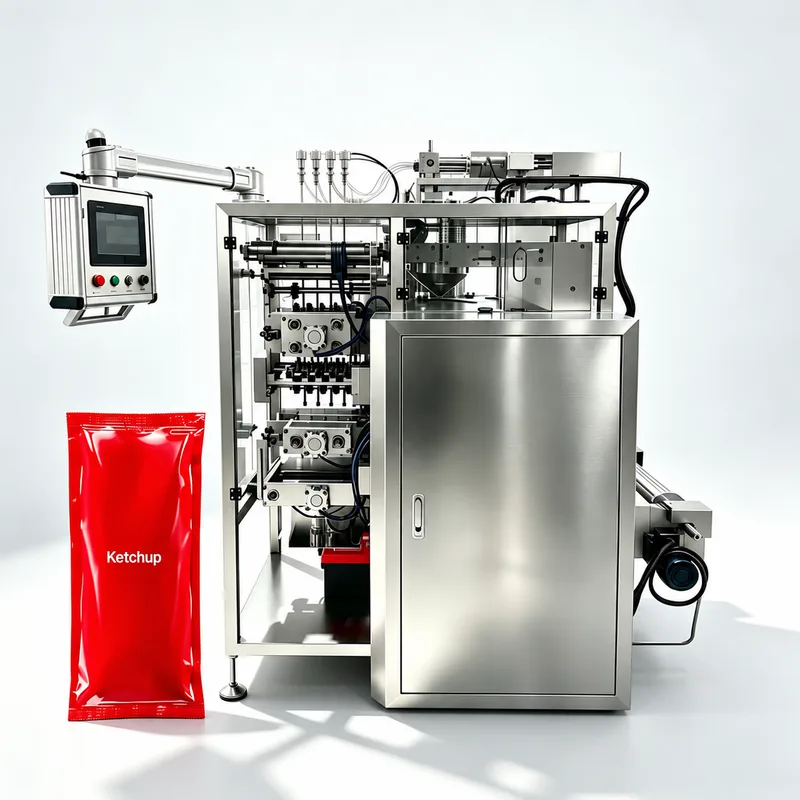
Sauce Sachets
Sauce Four-Side-Seal Sachet Machine
Sauce strings or drips can contaminate the seal area, leading to leaks and rejected sachets. Specify this piston-dosing four-side-seal machine from your sauce, portion, sachet drawing and film.