
Vertical Bagging Machine: Rollstock VFFS vs Open-Mouth Baggers
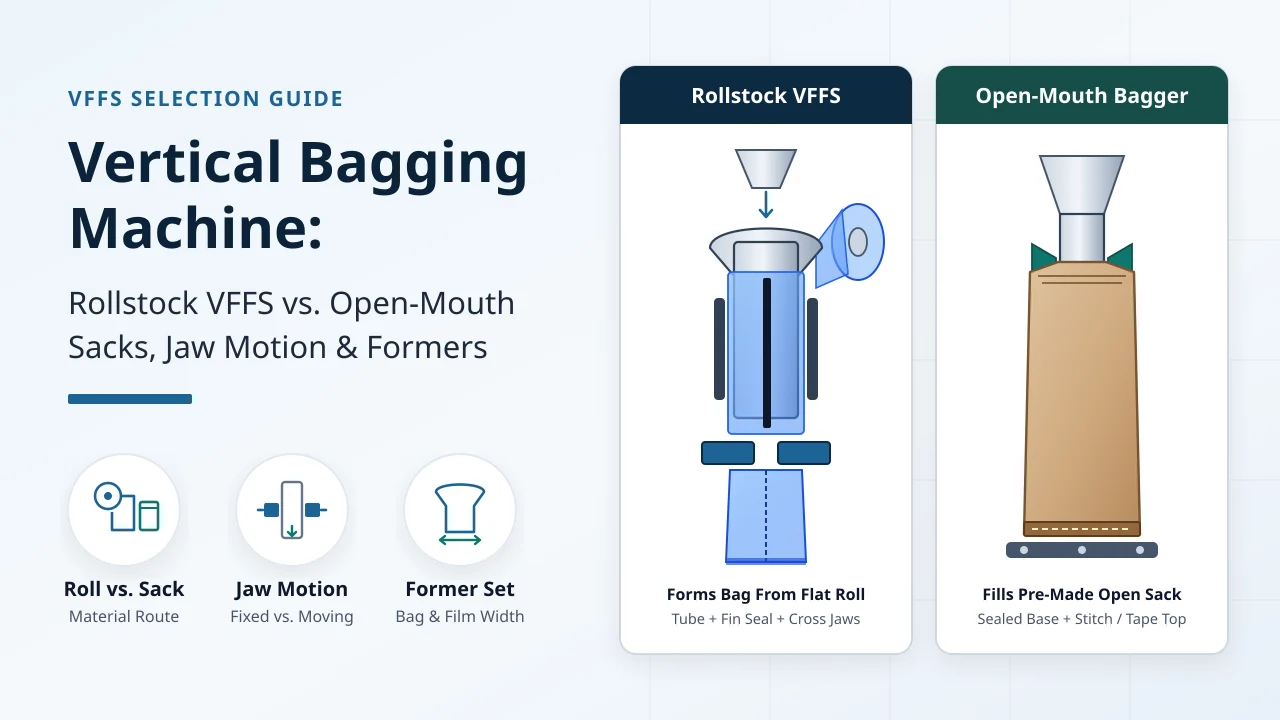
A rollstock vertical bagging machine forms, fills, and seals film around a tube, while an open-mouth bagger fills pre-made sacks supplied open at the top.
On This Page
How Does a Rollstock Vertical Bagger Differ From an Open-Mouth Bagger?
A rollstock vertical bagging machine, also called a vertical bagger or vertical form-fill-seal system, constructs plastic bags and stand-up pouches from a flat roll of film around a hollow forming tube, fills solids or liquids from above, and heat-seals each pack. By contrast, an open-mouth bagger fills a pre-made tube of paper plies supplied with the bottom already sealed and the top mouth open before closing that mouth by stitching, adhesive, or tape, whereas a valve sack such as a cement sack arrives closed at both ends and fills through a valve. Within roll-film vertical baggers, intermittent sealing holds the horizontal bar at a fixed height while the film stops, continuous sealing moves the horizontal bar down with the bag while sealing, and changing finished bag width usually means a different forming collar and tube. Because shorthand labels like FFS machine or form fill seal machine also cover horizontal equipment, ask the engineering team to confirm vertical orientation when reviewing packaging machine configurations and decision-grouped packaging guides.
Paper sacks are manufactured separately on converting lines consisting of a tuber and a bottomer, and kraft paper sacks can carry and protect products up to 50 kg while adapting to content and handling constraints. Use actual sack construction to identify when an enquiry needs a dedicated open-mouth review covering bag presentation, the filling spout, bag support, closing operations, and filled-sack handoff separately from retail roll-film bagging, as detailed in our rice VFFS dosing and bag trials guide and dry pet food VFFS format selection guide. Keep converter-made stand-up, reclosable zipper, and spout packs on their own handling route as well, because a premade-pouch machine handles finished pouches rather than making the package during the filling cycle, as compared in our VFFS or premade pouch guide.
| Packaging route | How the bag enters and forms | Filling and closing interface |
|---|---|---|
| Rollstock vertical bagger (VFFS system) | Flat film roll folds over a forming collar and hollow tube into a lengthwise vertical seal | Product drops through the tube between horizontal bottom and top heat seals |
| Open-mouth sack route (rice trial scope) | Pre-made tube of paper plies arrives with the bottom sealed and top mouth open | Product fills through an open spout on bag support before stitching, adhesive, or tape closure |
| Valve sack route | Pre-made paper sack arrives with both ends already closed, such as a cement sack | Product fills through a valve |
| Premade pouch route (pouch vs roll film) | Converter-made stand-up, zipper, or spout pouch enters as a finished empty pack | The machine handles a finished pouch a converter has already made rather than forming the package during the filling cycle |
How Do Intermittent and Continuous Jaw Motions Differ on a Vertical Bagger?
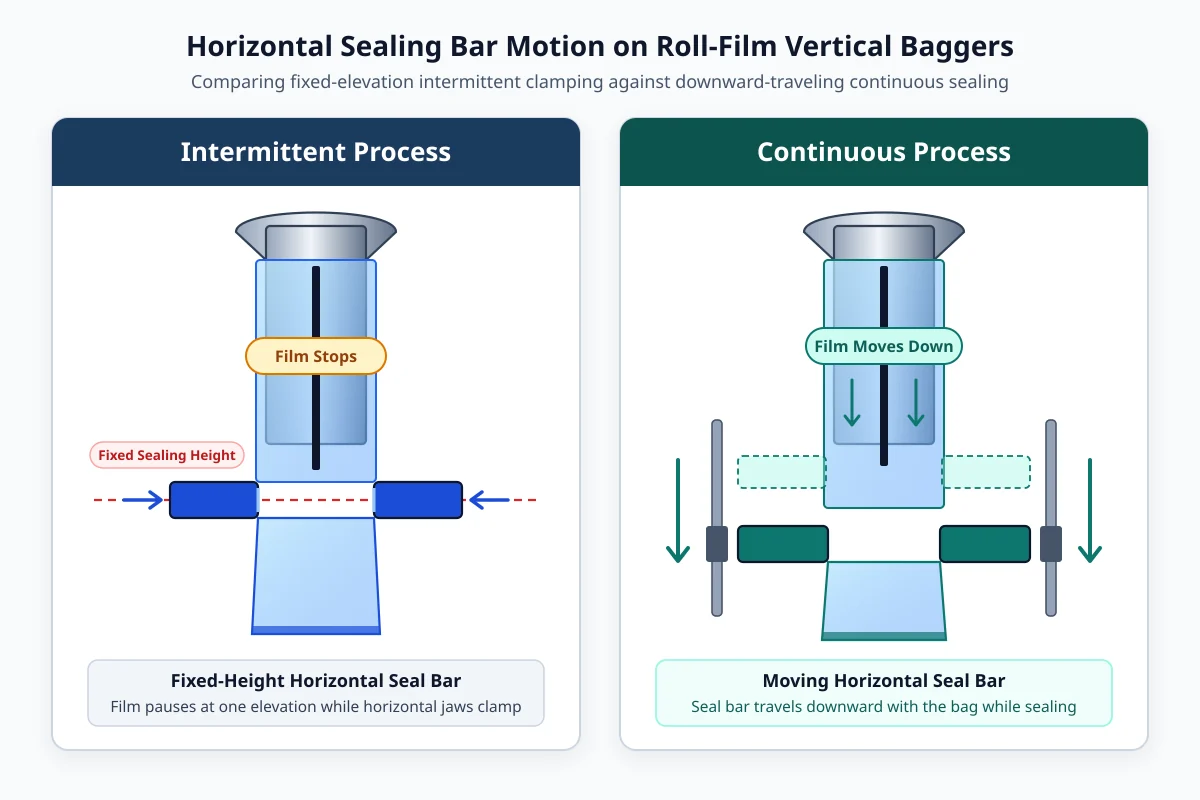
Intermittent-motion vertical baggers clamp a horizontal sealing bar at a fixed height while the film stops, whereas faster continuous-motion vertical baggers move the horizontal sealing bar downward with the bag while sealing. At the start of each cycle, the horizontal sealing bar clamps across the bottom edge of the tube to create the bottom seal, the product is either pre-measured by a multi-head weighing system or the sealed tube end is lowered onto a precision weighing table and the product is dispensed through the central tube until the gross weight of the product-filled bag is reached, and the horizontal sealing bar then seals the top of the bag, forms the bottom of the next bag, and cuts the finished bag free. Bag length is set either by a feed distance or by a visual sensor reading a printed photo-registration eyespot on the film, and during the final sealing process the bag may be filled with air from a blower or with an inert gas such as nitrogen to reduce crushing of fragile products such as potato chips, drive out oxygen, and retard the growth of bacteria that would spoil the product, extending shelf life without the use of chemicals.
Which horizontal sealing motion suits a project depends on the product, bag size, and required output, and speed figures from competing offers cannot be compared until each supplier states in writing whether the quoted configuration uses intermittent or continuous motion. Alongside jaw motion, confirm whether the bagger runs a single flat film roll, which has usually had labeling and artwork applied, pulled downward by drive belts with tension control and film tracking into a vertical fin seal, a single-web arrangement popular for food applications, or a dual-web system that feeds two rolls from opposite sides, heat-seals the bottom and sides, and loads the product from the top for four-side pouches or pouches that use different materials on each side, often used for IVD and medical device products. Pair that web-path check with the weigher, auger, or liquid filler mounted above the tube, and ask which seal type the quoted jaws make, which film structures they were trialled with, and how operators replace the jaws.
How Do Bag Width, Forming Collars, and Film Width Narrow Machine Choice?
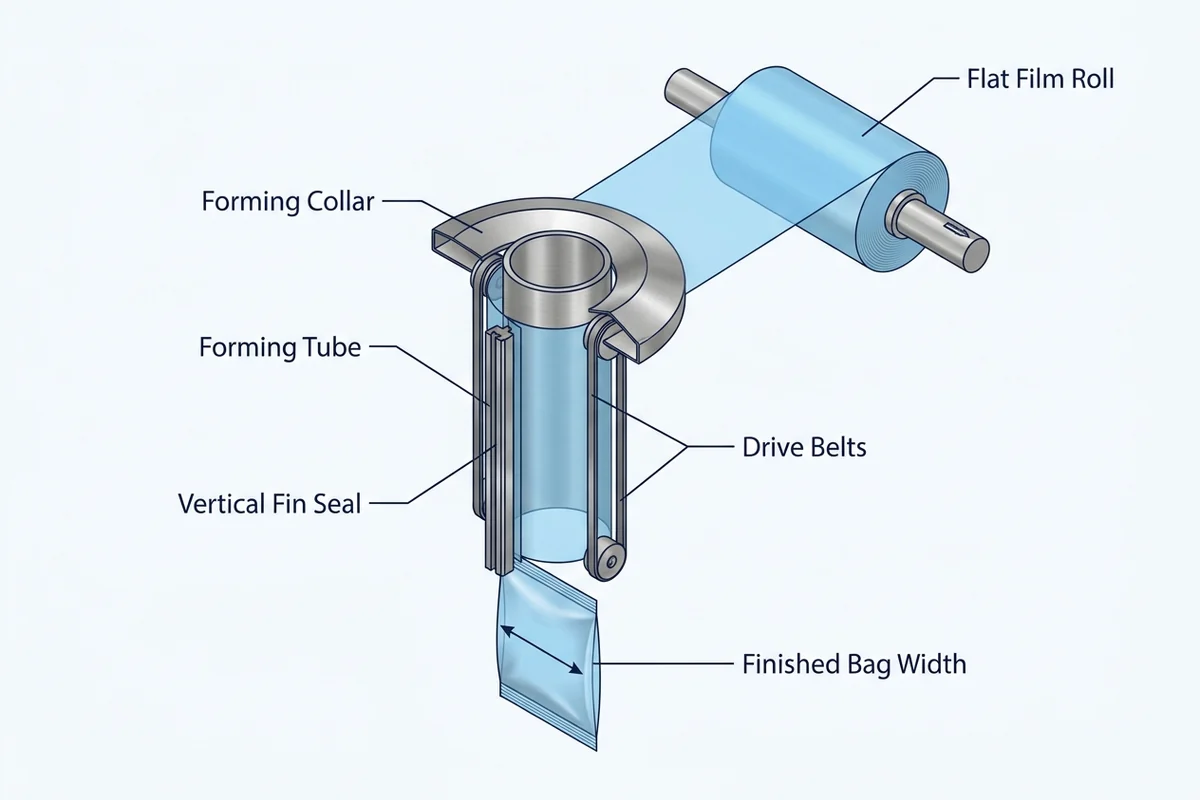
Changing finished bag width on a vertical bagger usually requires a different forming collar and tube assembly because those parts shape the film and set the bag width. Published packaging research describes the forming collar as a basic VFFS component over which flat film forms smoothly at high speed into a cylinder, and describes the collar geometry, including the seam along which the film is longitudinally sealed, as remarkably difficult to calculate. Because ordering rollstock from finished bag width alone risks an unusable reel, use our bag size and film width guide to state what every dimension on the format drawing describes, keeping finished width, open-mouth dimensions, gusset depth, and seal areas separate while recording the fin-seal or lap-seal choice beside the film allowance.
Heat sealing can use uniform thermoplastic monolayers or materials having several layers, at least one being thermoplastic, and changing the edge sealing or seaming methods lets this technology form continuous metallized foil or film, paper, and fabric containers. Calling a web simply plastic or foil leaves machine compatibility unanswered, so obtain the converter specification for film structure, thickness, sealing surfaces, and intended application with our packaging film requirements guide, and ask in writing which formers are included, how long a former changeover takes, and what maximum film width and jaw width apply when a bag approaches the edge of a range.
| Catalog VFFS configuration | Published bag length and width | Former and reel confirmation |
|---|---|---|
| Candy multihead VFFS | Length: 80–300 mm and Width: 60–200 mm, customizable for candy condition and bag type | Confirm dedicated former set, seam allowance, and maximum reel width for your candy pack |
| Chips nitrogen VFFS | Length: 150-400mm and Width: 100-280mm with customizable formers | Confirm former tube clearance, nitrogen gas interface, and maximum jaw width in writing |
| Frozen food VFFS | Length: 100-350mm and Width: 100-250mm, customizable | Confirm former sizing, cold-room film structure, and reel compatibility before ordering film |
| Nuts multihead VFFS | Length: 80-350mm and Width: 60-240mm with customizable formers | Confirm included formers, changeover duration, and gusset or fin-seal web width |
| Vegetable VFFS | Length: 100-450mm and Width: 80-300mm with customizable formers | Confirm former geometry and maximum film and jaw width when packs near upper range limits |
When Does a Vertical Bagger Fit Better Than Horizontal Flow Wrapping?
A vertical bagger suits loose or portionable products that fall by gravity into a bag formed from roll film, and both solids and liquids can be bagged. Although a flow wrapper and a VFFS machine both unwind roll film and can both finish with a pillow pack sealed along its length and at each end, a vertical bagger pulls film downward around a tube for gravity-fed items such as nuts, snacks, candy, frozen pieces, vegetables, and coffee, whereas single solid items laid flat such as bars or baked goods are usually wrapped on a horizontal form-fill-seal machine that generally uses more floor space than a vertical system; compare both routes in our flow wrap vs VFFS guide.
Before treating two quoted totals as equivalent, compare the required functions and open confirmations on every proposal. A lower quote may simply omit equipment or installation work, and one quotation may describe the bagger alone while another adds an elevator, dosing unit, support platform, printer, and discharge conveyor, so compare those boundaries with our VFFS machine cost and scope guide.
What Food-Contact Cleaning and Machine Guarding Rules Apply?
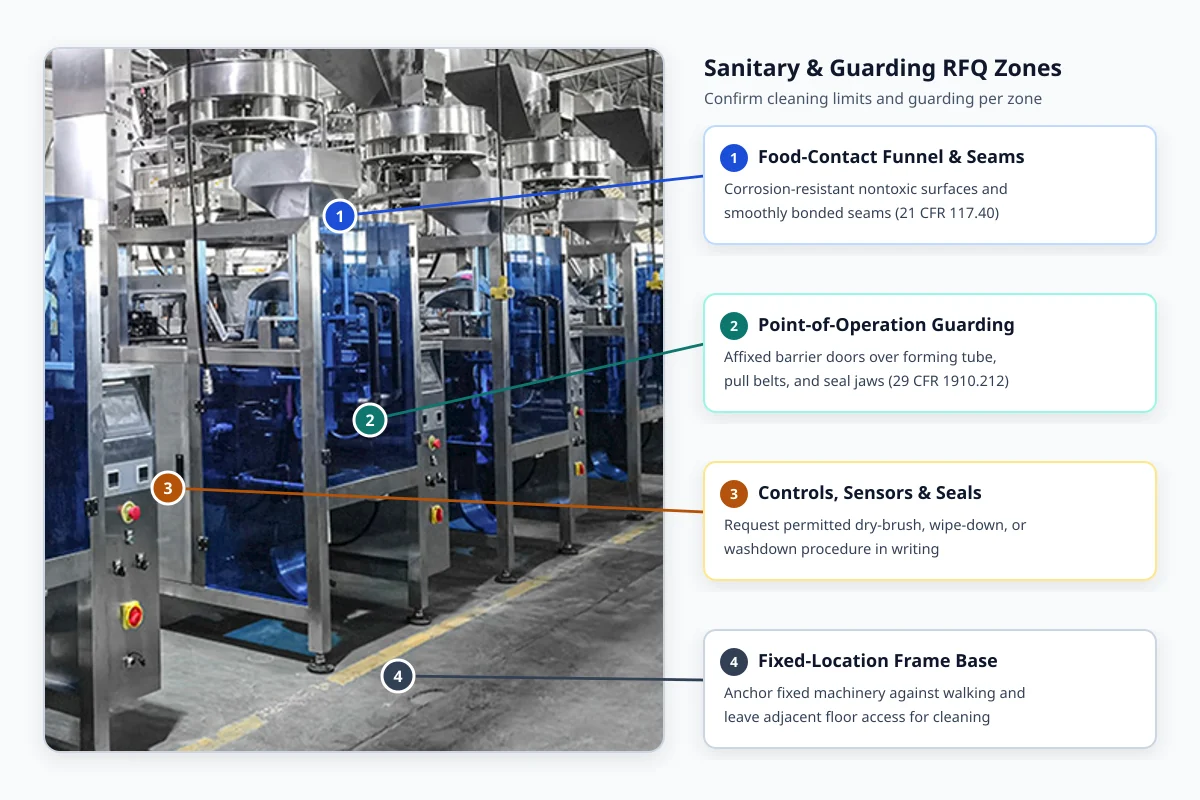
Food bagging systems protect food from chemical, biological, and physical alterations and, in U.S. food plants, must satisfy federal sanitary equipment rule CFR Part 117, § 117.40. Under CFR Part 117, § 117.40, packing equipment must be adequately cleanable and maintained to protect against allergen cross-contact and contamination, must be designed, constructed, and used to avoid adulterating food with lubricants, fuel, metal fragments, contaminated water, or any other contaminants, must be installed so as to facilitate the cleaning and maintenance of the equipment and of adjacent spaces, must use food-contact surfaces that are corrosion-resistant when in contact with food, made of nontoxic materials, and designed to withstand the action of food and, if applicable, cleaning compounds, sanitizing agents, and cleaning procedures, must keep food-contact seams smoothly bonded or maintained so as to minimize accumulation of food particles, dirt, and organic matter, must allow equipment that does not contact food to be kept in a clean and sanitary condition, must keep holding, conveying, and manufacturing systems, including gravimetric, pneumatic, closed, and automated systems, of a design that can be maintained in an appropriate clean and sanitary condition, and must treat compressed air or other gases mechanically introduced into food or used to clean food-contact surfaces or equipment so that food is not contaminated with unlawful indirect food additives. Where polyethylene or polypropylene components or films contact food, CFR Part 177, § 177.1520 permits basic ethylene and propylene olefin polymers subject to the conditions of that section.
Surface appearance alone does not establish washdown suitability or chemical compatibility, and the catalog profiles do not publish frame material, ingress protection, washdown rating, or sanitary design, so describe your own cleaning method, such as dry brushing, wipe-down, or washdown, and request the permitted cleaning method for seals, sensors, and electrical areas using our cleaning access review guide. For operator safety under OSHA CFR Part 1910, § 1910.212, one or more methods of machine guarding shall be provided to protect employees from hazards such as those created by the point of operation, ingoing nip points, and rotating parts, examples of guarding methods include barrier guards, two-hand tripping devices, and electronic safety devices, guards shall be affixed to the machine where possible, the point of operation is the area where work is actually performed upon the material being processed and shall be guarded, and machines designed for a fixed location shall be securely anchored to prevent walking or moving.
What Utilities, Customs Heading, and RFQ Details Should Buyers Verify?
Utility planning starts from the selected machine configuration and its written connection schedule, while import preparation requires checking customs heading language before shipment. Request electrical, compressed-air, and optional gas requirements in a single connection schedule through our utilities checklist, recording voltage, frequency, and other specified characteristics in writing rather than assuming an existing factory plug or supply matches. For U.S. customs classification reviews, Harmonized Tariff Schedule heading 8422.40 covers other packing or wrapping machinery including heat-shrink wrapping machinery, with specific breakouts for case and tray machines under 8422.40.91.50, shrink-film and heat-sealing machines under 8422.40.91.60, and residual Other provisions under 8422.40.91; because the published schedule text does not name a vertical bagger, verify the statistical suffix for the specific shipment on the customs entry rather than assuming a residual code.
| RFQ review area | What to specify in writing | Why it prevents a mismatch |
|---|---|---|
| Package route and presentation | State whether packs form from flat roll film, arrive as open-mouth paper sacks, or enter as converter-made pouches | Separates roll-film forming tubes from open-mouth filling spouts, bag supports, stitching closures, and pouch handlers |
| Horizontal jaw motion and web path | Require written confirmation of intermittent fixed-height or continuous downward-moving jaws plus single-web or dual-web feed | A speed figure cannot be compared until each supplier states in writing which motion the quoted configuration uses |
| Former, bag width, and film datasheet | Attach a dimensioned format drawing separating finished width, gussets, and fin or lap seam allowance plus converter film layers | Prevents ordering an unusable film reel and confirms included formers, changeover time, and maximum web and jaw width |
| Food-contact cleaning and machine guarding | Specify dry brushing, wipe-down, or washdown per zone alongside CFR Part 117, § 117.40 sanitary seams and CFR Part 1910, § 1910.212 barrier guarding | Verifies cleaning limits for seals, sensors, and cabinets plus point-of-operation guarding and floor anchoring |
| Utilities schedule and HTS 8422.40 check | Request a configuration-specific electrical, compressed-air, and optional gas schedule and review HTS heading 8422.40 without assigning a statistical suffix to this machine | Write down the voltage, frequency, and other specified characteristics, and do not assume the existing factory supply will suit |
Sources
- Vertical form fill sealing machine (Wikipedia)
- Paper bag: open-mouth and valve sacks (Wikipedia)
- Heat sealer: thermoplastic sealing principles (Wikipedia)
- Food packaging protection principles (Wikipedia)
- CFR Part 117, § 117.40 Equipment and utensils (Cornell Legal Information Institute)
- CFR Part 177, § 177.1520 Olefin polymers (Cornell Legal Information Institute)
- CFR Part 1910, § 1910.212 General requirements for all machines (Cornell Legal Information Institute)
- Harmonized Tariff Schedule Heading 8422.40 (U.S. International Trade Commission)
- Desoki, Morimura & Hagiwara (2010), Forming collar geometry on a VFFS packaging machine (Packaging Technology and Science)
Explore the Equipment
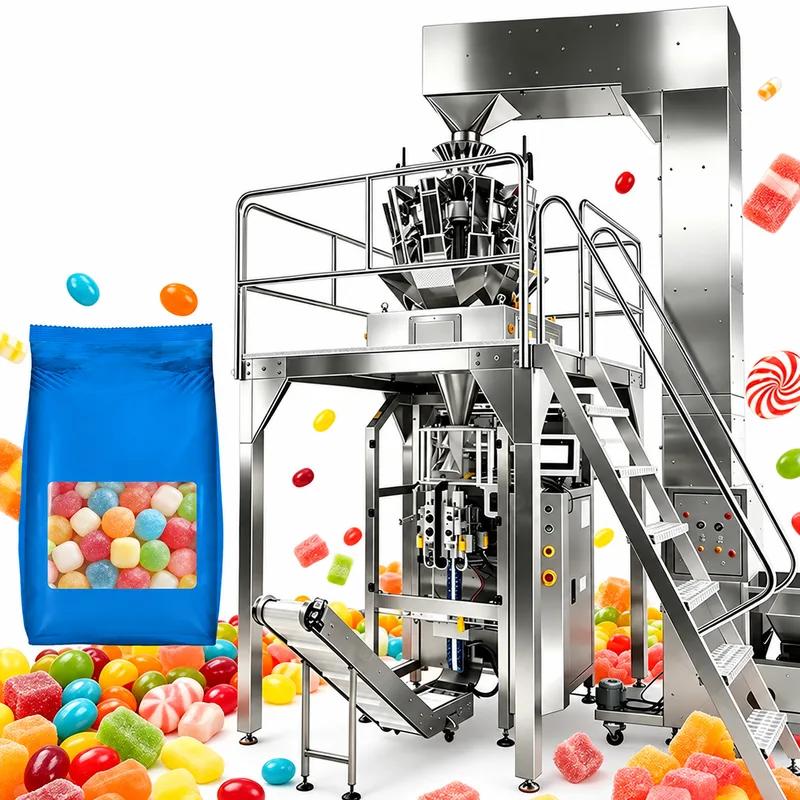
Vertical Form Fill Seal
Candy Multihead Weighing & Packaging
A correct bag weight can still hide broken, stuck or wrongly mixed sweets. Residue held on a contact surface can release into the next bag. This multihead weigher and VFFS line is set up around your candy's coating, size and pack.
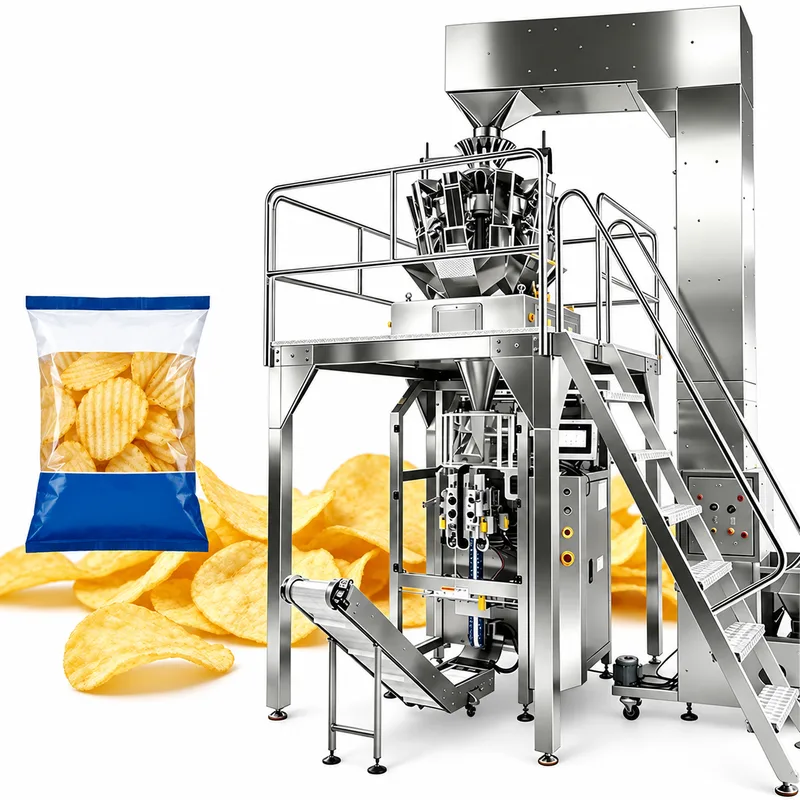
Vertical Form Fill Seal
Chips Packaging with Nitrogen Flushing
An inflated bag can hide broken chips, a short fill or a weak seal. Size this weigher, VFFS and nitrogen-flush line from your chip volume, breakage limit and gas supply.
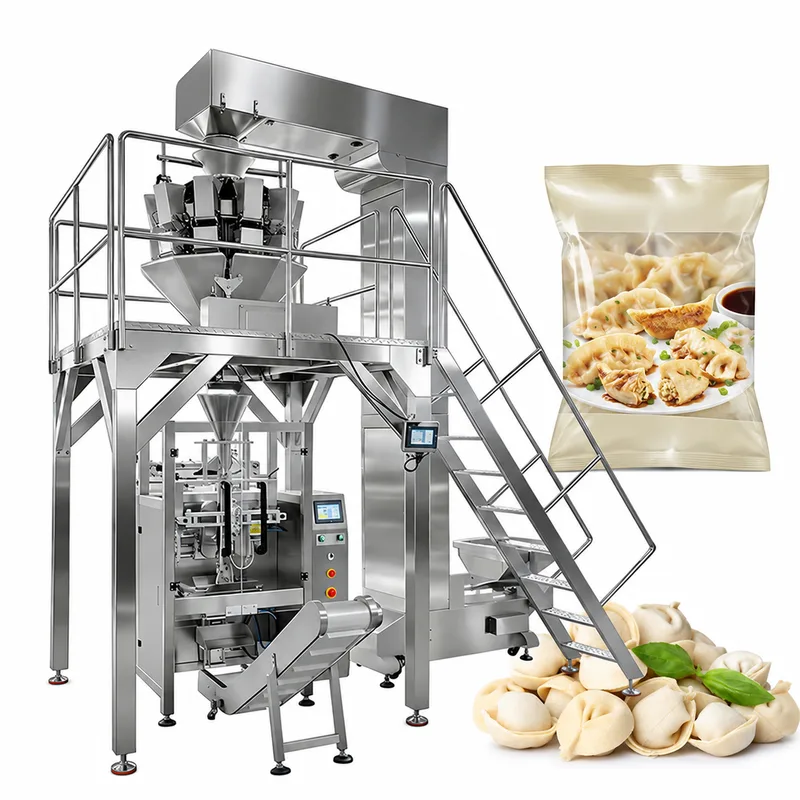
Vertical Form Fill Seal
Frozen Food Weighing & Packaging
Frosted pieces retained in a hopper can leave a bag underweight and turn up in later fills. Specify this frozen-food weigher and VFFS line from product temperature, frost, piece size and cleaning method.
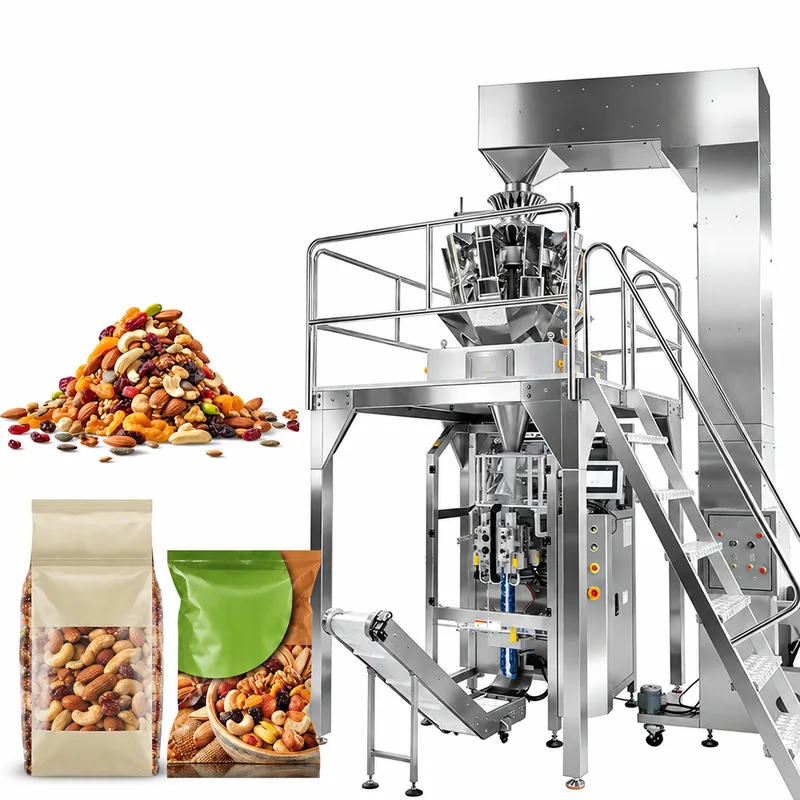
Vertical Form Fill Seal
Nuts & Dried Fruit Multihead VFFS
A nut-mix bag can be on weight and still hold the wrong ratio of ingredients. Configure this multihead VFFS line from your blend, coatings, target weight and bag size.
Vertical Form Fill Seal
Vegetable & Salad Weighing Packaging
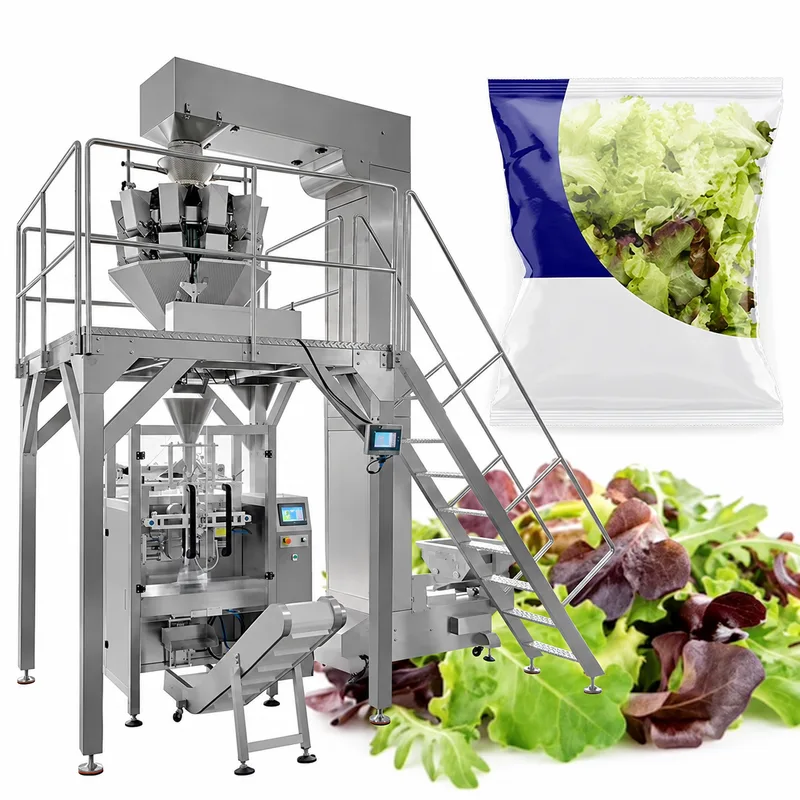
Fresh leaves and frozen vegetables need separate checks of hoppers, surfaces and cleaning; sharing an unproven setup can damage salad or hold up frosted pieces. Specify this weigher and VFFS line per product condition.