
Rice VFFS Packaging: Compare Dosing and Bag Trials
Ordering a vertical form-fill-seal line from the phrase rice production can waste the sample on the wrong dosing route. Compare a volumetric cup, a linear scale, and a multihead weigher against the grain, the labeled fill weight, and the retail bag, and record breakage, blend separation, and weight variation before you order.
Choose the next review by task
Use these pages to prepare the rice record. Each one covers a different question.
Scroll horizontally to read all columns, conditions and sources.
| Route | What a saved page states | What you record on your grain | Still open |
|---|---|---|---|
| Volumetric cup or dispenser | Wolf Packing (May 25, 2025) says volumetric dispensers. Unified Flex (December 22, 2023) describes volumetric fillers as a volume measurement for uniform-sized beans and grains. Neither page states a cup volume or a rice weight tolerance. | The cup or dispenser name from the supplier, then the weighed portion in the labeled unit. | Cup volume, the grain used to set it, and how far bag weight moved when the grain changed. |
| Linear scale | Finopack (April 22, 2021) describes a vertical form-fill-seal machine for a 1 to 5 kg rice bag, usually with a 2-head or 4-head linear scale, a granule bucket elevator, and a take-off conveyor. No model is named. | Whether your quotation uses a linear scale, and the model and head count written on that document. | Tolerance and bag style. Those are not stated for that 1 to 5 kg class. |
| Multihead weigher | Wolf Packing (May 25, 2025) lists multihead weighers for rice and pasta. Unified Flex (December 22, 2023) says multi-head combination weighers use multiple heads to dispense a portion. No head count or tolerance is stated. | Head count and combination rule from the supplier's specification, or a note that the document does not state them. | Whether a blend separates across heads, and whether broken grains collect in the discharge. |
On This Page
What should a retail rice VFFS trial compare?
A rice trial that starts from the product name can waste the run on a filler that never sees this grain. Compare a volumetric cup or other volumetric dispenser, a linear weigher, and a multihead weigher on the rice you will pack. Keep the labeled fill weight and the retail bag format in the same record, and leave breakage, blend separation, and weight variation empty until the trial writes them in.
Granulated sugar and powdered sugar have a separate trial guide. Powders that bridge, dust, or change density have the powder dosing guide. Use those pages for those products. This page stays with retail rice packs. A 25 kg or 50 kg open-mouth sack is a different packing route, and the sections below do not specify that equipment.
Three saved manufacturer pages supply the route descriptions. Wolf Packing's rice and pasta page, publication date May 25, 2025, says its lines can use multihead weighers, auger fillers, and volumetric dispensers, and it names white rice, jasmine rice, and brown rice among products. That page gives no model, no cup volume, and no weight tolerance. Unified Flex's pasta, beans, and rice page, publication date December 22, 2023, describes multi-head combination weighers, volumetric fillers, auger fillers, and checkweighers as portioning methods. It does not state which method ran on which rice. Finopack's rice packing machine page, publication date April 22, 2021, is the one that ties a rice bag weight class to a weigher: a vertical form-fill-seal machine for a 1 to 5 kg rice bag, usually with a 2-head or 4-head linear scale, a granule bucket elevator, and a take-off conveyor. No model name appears there. These are those companies' published descriptions. They are not a trial by this website, and they are not specifications of a machine in this catalog.
Which grain and blend have to be named first?
Write the rice the way the plant will feed it. White rice, jasmine rice, and brown rice are examples named on Wolf Packing's May 25, 2025 page. They are examples, not a closed list, and a result on one of them does not stand in for the others. Record the variety or grade, the lot, and whether the sample is milled head rice, a brokens grade, or parboiled rice. If the buyer already measured moisture or broken kernels, copy their method and their number. This page does not set a moisture limit.
Photograph the sample as it will enter the filler. Note clumps, dust, and the broken grains you can see. The photo identifies the sample. It does not choose the dosing route.
A blend is a different sample from a single rice. Unified Flex's December 22, 2023 page discusses pasta, beans, and rice as packaging applications. It does not publish a measurement of how a rice-and-bean mix separates in a cup or a weigher. If the pack is a blend, name every ingredient, the intended ratio, and the size difference you can see, such as a long rice grain beside a larger bean. Give that blend its own row. A plain-rice result does not fill the blend row.
How do cup, linear, and multihead routes differ on rice?
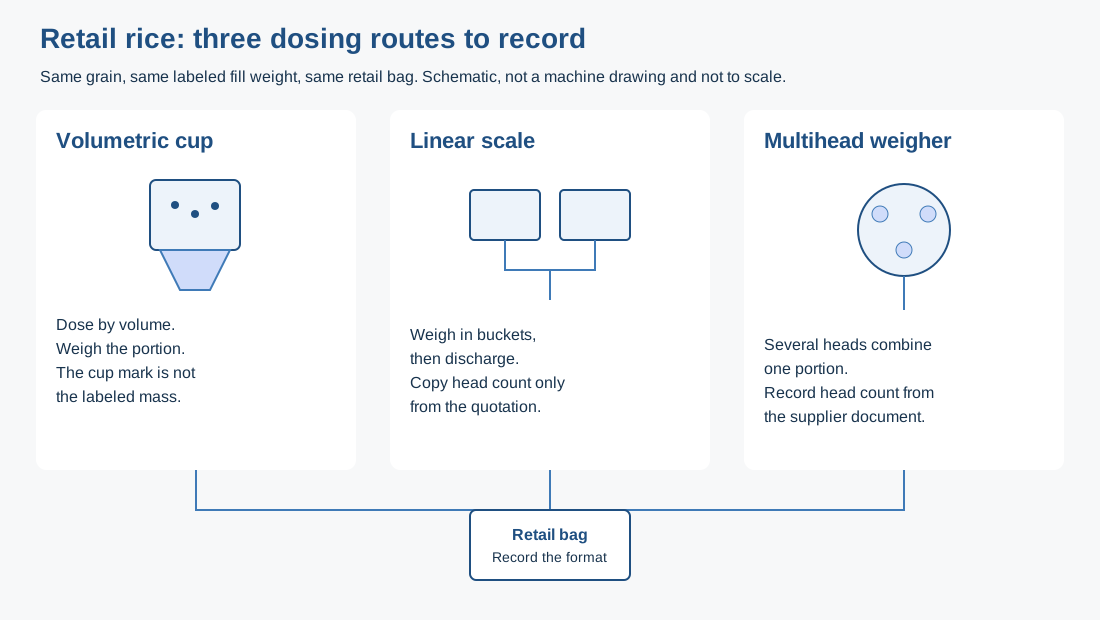
Use the comparison table for the three routes. Each row pairs a published description with a blank for your grain. A route stays a candidate until the bag trial record carries your product, your fill weight, and your bag.
Buyers often say cup for a volume dose. The saved rice pages say volumetric dispensers (Wolf Packing, May 25, 2025) and volumetric fillers (Unified Flex, December 22, 2023). Unified Flex describes volumetric filling as a volume measurement and associates it with uniform-sized beans and grains. Neither page states a cup volume, a rice variety, or how far the bag weight moved when the grain changed. A cup that looks full can still miss the labeled mass when the rice is more broken, drier, or more densely settled than the rice used to set the cup. Write the cup or dispenser name the supplier gives you, then weigh the discharged portion. The volume mark is not the fill weight.
Finopack's page of April 22, 2021 says a vertical form-fill-seal machine for a 1 to 5 kg rice bag is usually equipped with a 2-head or 4-head linear scale, together with a granule bucket elevator and a take-off conveyor. The page states those head counts and that weight class. It does not state a model, a tolerance, or a bag style reserved for that class. Treat 1 to 5 kg, 2-head, and 4-head as Finopack's published description. On the quotation in front of you, record whether the linear scale is the arrangement they are offering, and copy the model name from their document. Leave the model blank when the document does not name one. This catalog does not adopt those head counts as its own.
Wolf Packing lists multihead weighers among fillers for rice and pasta. Unified Flex says multi-head combination weighers use multiple weighing heads to dispense a portion before packaging. Neither page states a head count, a rice variety, or a tolerance for that sentence. The multihead system page on this site explains the machine family. This guide does not repeat that explanation. For this rice pack, write the head count and the combination rule from the supplier's specification, or write that the document does not state them. The open observations are the grain you drop, whether a blend separates across heads, and whether broken grains collect in the discharge.
Auger fillers appear on the Wolf Packing page and the Unified Flex page. Unified Flex says auger fillers suit powdered or fine-grain products. Whole-grain rice sits outside that description. If the product is rice flour, use the powder dosing guide. Do not paste a sugar trial or a powder trial onto whole-grain rice.
- Multihead weigher VFFS systems — the machine family, kept separate from this rice record
- Multihead or auger dosing — the general piece-versus-powder comparison
- Fill weight and bulk density — how to define the mass and volume basis
What do you record for breakage, separation, and weight?
Breakage, blend separation, and weight variation are blank fields. The saved pages name the problems and the filler types. They do not give you a broken-grain count, a separation percentage, or a tolerance to copy.
Wolf Packing's May 25, 2025 page says manual or outdated systems often produce product breakage, and it describes gentle transfer as part of its own equipment. That is the company's claim. It is not a broken-grain count, and it is not a result from this website. On your trial, take a small sample before the filler and another from a finished bag. Use the same words for every route, such as whole, broken, or dust. Keep the route and the bag number with the note. A cleaner drop on one route is an observation about that run.
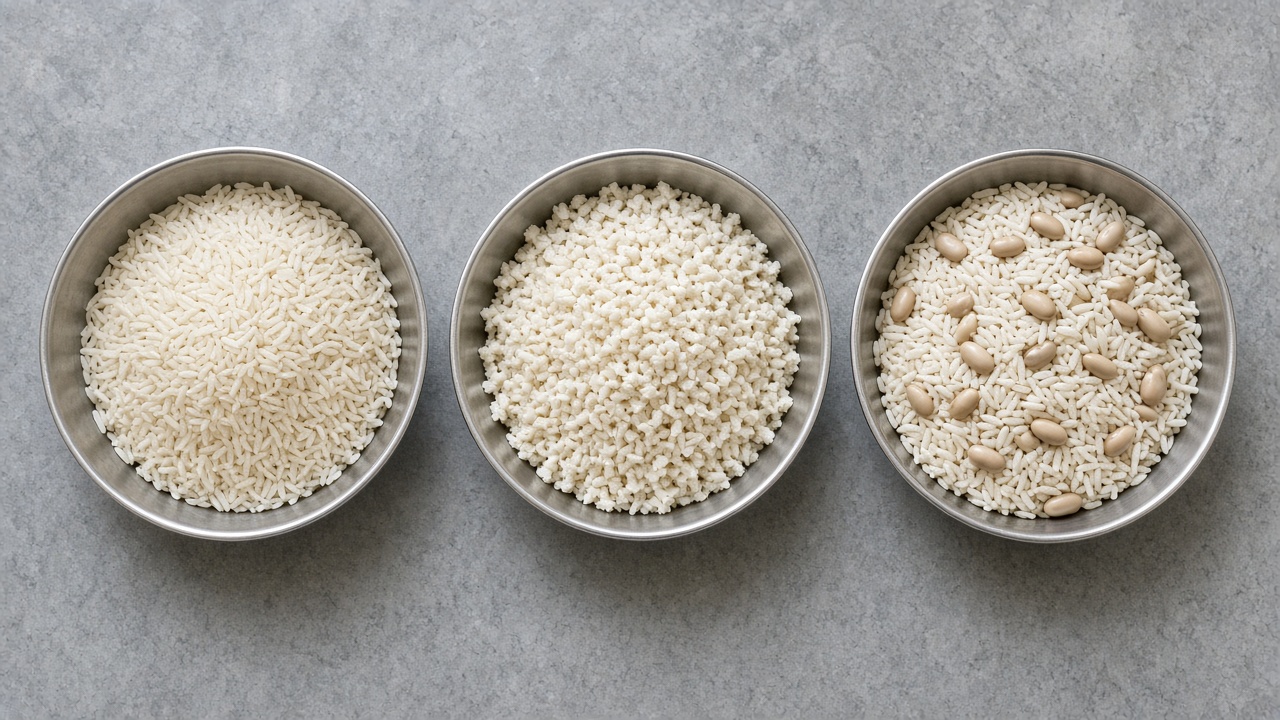
If the hopper shows beans or a second rice sitting apart from the main grain, write where you saw it: in the hopper, in a cup, in one linear bucket, or in one multihead bucket. Open the bag and compare the mix with the ratio you wrote before the run. An empty separation cell means the trial has not looked. It does not mean the blend held together. The three dishes in the illustration show the kind of difference to describe. They are not a measured breakage test and not a measured blend.
Agree the labeled fill weight, the unit, and the scale before the first bag. Finopack's 1 to 5 kg class is that company's published split for a vertical form-fill-seal rice bag. Your target is the weight printed on the retail pack you are specifying. Weigh the bags in order and keep every weight. An average alone hides the bag that followed a refill or a recipe change. Unified Flex's December 22, 2023 page says a checkweigher verifies weight after filling and rejects underfilled or overfilled packages. Record whether the quotation includes that device. Do not assume the device is in the scope.
- Fragile product handling — a general damage check, separate from this rice grain note
- Sample test report — how to keep conditions with the measurements
What goes on the bag trial record?
The table in this section is blank on purpose. Fill one set of rows for each route you actually run. Keep the product, the fill weight, the bag format, and the dosing route on the same line as the breakage, separation, and weight notes. A photo of a bag without those fields is not a trial record.
Unified Flex's rice answer, published December 22, 2023, names stand-up pouches, box pouches, block-bottom bags, pillow bags, pillow bags with side gussets, flat-bottom four-corner bags, quad-seal bags, and doy-rim bags as rice packaging styles. Finopack's April 22, 2021 page says its rice machines suit pillow bags, gusset bags, quad-seal bags, kraft paper bags, stand-up zipper bags, and paper bags with a PE inner film, and it also names woven bags. Woven sacks often belong with the bulk route. For this retail record, write the style and the drawing or sample you are matching, and say whether the bag is made on the machine from roll film or loaded as a premade pouch. The bag size guide turns finished dimensions into film width. Use that guide for the film-width calculation. This page does not repeat it.
When the team changes the bag or the film, start a new group in the record. A weight that was acceptable in a pillow bag does not describe the same rice in a gusseted bag or a stand-up pouch, because the drop and the seal area change with the format. Wolf Packing's May 25, 2025 page lists stand-up pouches, flat pouches, and gusseted bags for retail, plus larger sacks for foodservice or bulk. Put the retail style you are buying in the record, and move a larger sack to the scope check in the next section.
- Bag size and film width — turn the finished bag into a film width
- Packaging film requirements — identify the trial roll
| Field | Write before the run | Write from the run |
|---|---|---|
| Product and lot | Variety or blend, grade, and lot | The sample that was actually dosed |
| Fill weight | Labeled mass, unit, and scale | Each bag in order, not only the average |
| Bag format | Style, drawing or sample, roll film or premade | A new group if the bag or film changes |
| Dosing route | Cup, linear scale, or multihead | Model and head or cup note from the supplier document, or not stated |
| Breakage | The words you will use, such as whole, broken, or dust | What you see before the filler and in the opened bag |
| Blend separation | Ingredients and intended ratio, or single rice | Where the mix separated, or not a blend |
| Weight variation | Target and the buyer's acceptance rule | The spread across the sequence |
| Scope check | Retail pack, or stop for an open-mouth 25 kg or 50 kg bag | Whether the bag in the trial matches that choice |
When does an open-mouth bulk bag fall outside this record?
Stop this sheet when the target pack is an open-mouth bulk bag. Finopack's rice page of April 22, 2021 separates a vertical form-fill-seal machine for a 1 to 5 kg rice bag from an auto bagging machine for a 25 kg or 50 kg rice bag. The same page lists an open-mouth bagging machine among its rice packing machines. Those lines mark the boundary. They do not specify the sack closer, the spout, or the weigher for a 25 kg or 50 kg bag, and this page will not add that specification.
If the enquiry names a 25 kg sack that is still closed as an open-mouth bag, keep it outside this retail record until the bag construction is written down. Finopack also mentions packing small bags into a bigger bag with a secondary packaging machine. That second operation is its own record. Note it as outside this page, and do not fold its rate into the retail trial. Wolf Packing's May 25, 2025 page likewise separates retail pouches from larger sacks for foodservice or bulk distribution, without a kilogram class for the sacks.
What do you bring before ordering?
Bring the product, the fill weight, the bag format, the original specification, and the items that still need checking. Mark every missing line as still open. The product is the grain or the blend, with the lot. The fill weight is the mass printed for the retail pack, with the unit and the scale you will use. The bag format is a drawing or a retained sample, including roll film or a premade pouch. The original specification is the supplier's document: model if it names one, cup or head description, any tolerance in their words, and the date on that document. The open items are breakage, blend separation, and weight variation when the trial has not recorded them, plus any performance line on the quotation that these saved pages do not support.
A quotation that says rice and then a speed, without the grain, the fill weight, and the bag, is not ready to set beside another offer. Ask for those missing lines in the supplier's own document. This website has not run the trial.
Method and sources
The route comparison and the blank trial record use three saved manufacturer pages, read as text. They are not test data from this catalog.
Wolf Packing, Rice & Pasta Packaging Machine Solutions, https://wolf-packing.com/industries/rice-pasta/, JSON-LD publication date May 25, 2025, fetched October 6, 2026. The fetched text describes volume and weight filling, multihead weighers, auger fillers, volumetric dispensers, white, jasmine, and brown rice, breakage and inconsistent fill weights, and retail pouches plus larger sacks. It names no model and no numeric tolerance.
Finopack, Rice Packing Machine, https://finopack.com/rice-packing-machine/, JSON-LD publication date April 22, 2021, fetched October 8, 2026. The fetched text describes a vertical form-fill-seal machine for a 1 to 5 kg rice bag, usually a 2-head or 4-head linear scale, a granule bucket elevator, and a take-off conveyor, plus a separate auto bagging machine for a 25 kg or 50 kg rice bag and a link to open-mouth bagging. Bag styles are those named above. The same page lists 10 to 50 bags per minute inside a feature block whose applications include detergent powder, rice, soy beans, sugar, salt, seeds, corn, and other products. That range has no rice-only bag, film, or fill weight attached, so this guide does not use it as a rice speed. No model number appears in the fetched text.
Unified Flex, Pasta, Beans & Rice Packaging, https://unifiedflex.com/markets/pasta-beans-rice-packaging/, JSON-LD publication date December 22, 2023, fetched October 8, 2026. Portioning methods and rice bag styles are used as described above. The page also states bags-per-minute bands for sachet, vertical form-fill-seal, and stand-up pouch machine groups, and it names machine models. Those bands do not state the rice, the bag size, or the film they were measured on, so this guide does not quote them as a rice production rate and does not treat the model names as equipment in this catalog.
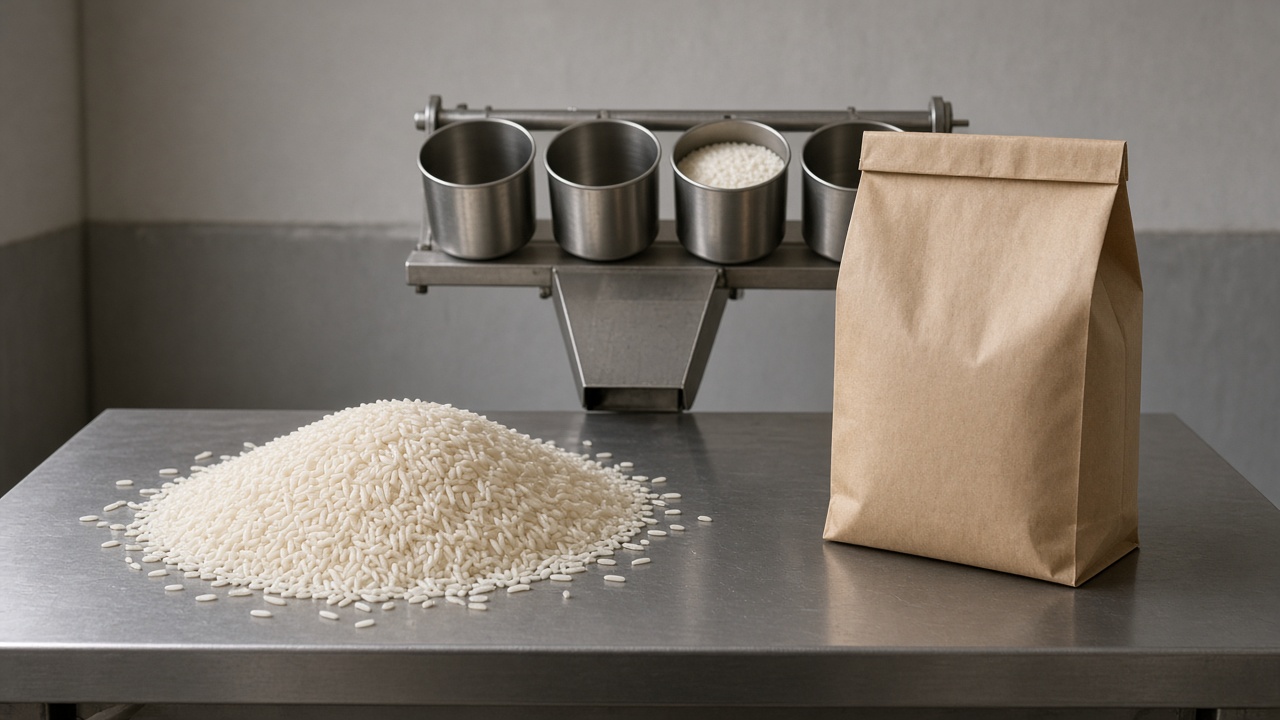
The cost question in the FAQ is a People Also Ask item from the US English desktop results for vffs machine for rice production, fetched October 11, 2026. The answer stays inside this page's scope. Pages that failed to load in that review were not used as sources. The photographs are illustrations of rice, a retail bag, dosing cups, and three sample dishes. The route drawing is a schematic. None of them is a named factory, a catalog photograph of a specific model, or a measured trial. Updated October 12, 2026.
Frequently asked questions
How much does a 25 kg rice packing machine cost?
This guide has no price for a 25 kg rice packing machine. Finopack's rice page of April 22, 2021 lists an auto bagging machine for a 25 kg or 50 kg rice bag apart from a 1 to 5 kg vertical form-fill-seal bag, and it lists an open-mouth bagging machine on the same page. That bulk route is outside the retail trial record here. Identify the bag construction in writing before a quotation is compared.
What to send us
| Item | Why we need it | Example format |
|---|---|---|
| Product and lot | Names the grain or blend this trial is about | Variety, grade, lot, and blend ratio if there is one |
| Fill weight | Sets the mass the dosing route is checked against | Labeled weight, unit, and the scale name |
| Bag format | Keeps the pack inside the retail record | Drawing or sample, roll film or premade pouch |
| Original specification | Shows the model and dose description the supplier wrote | Document title, model if named, date, and any tolerance in their words |
| Items still to check | Stops an order while breakage, separation, or weight variation is blank | Empty cells listed by route |
We reply within 24 hours.