
Dry Pet Food VFFS: Record the Format Before Choosing a Machine
Before choosing a VFFS machine for dry pet food, record kibble or treat, the bag sold, and whether it is roll film, flow wrap, or a premade pouch.
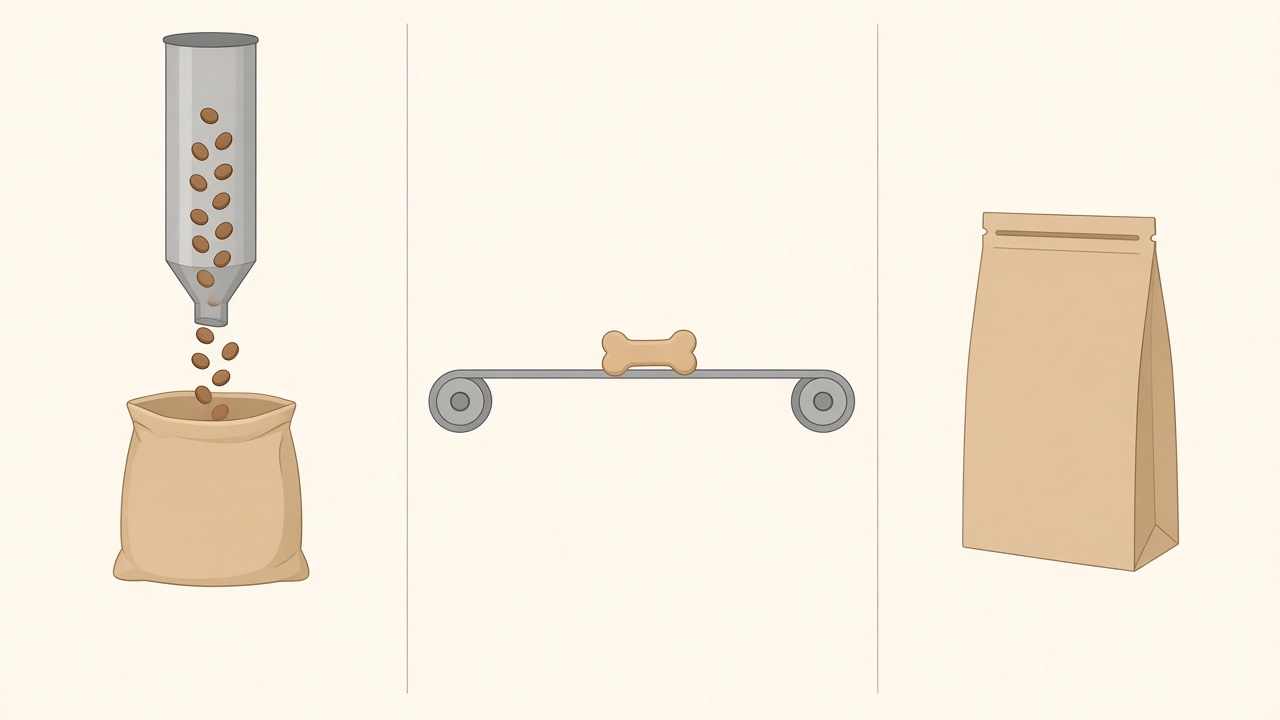
| Input | What to write | Why it matters |
|---|---|---|
| Product form | Blank until the spec or the sample names it | Loose kibble and a discrete treat do not enter the pack the same way |
| Fill amount | Blank until the spec or the sample names it | The portion is what the route has to measure |
| Bag type | Blank until the spec or the sample names it | The sample separates roll film, flow wrap, and a premade pouch |
| Original specification | Blank until the spec or the sample names it | A drawing and a nickname are different |
| Entry route | Blank until the spec or the sample names it | A dropped portion, a placed item, and an existing bag are different machine classes |
Take the record to the next review
Use these pages after the route record is written. Each one starts from the cells that are still blank.
Scroll horizontally to read all columns, conditions and sources.
| Check | What to write | Still to verify |
|---|---|---|
| Product | "Loose dry kibble" or "discrete treat / freeze-dried piece," plus the condition you can see (whole, dusty, oily, brittle), or "not chosen." Wet, paste, and retorted products: mark out of scope. | |
| Fill amount | The labeled fill the buyer already uses, in their unit, or "not on the spec." | |
| Bag type | Pillow, gusset, flat-bottom four-edge, zip, premade pouch, or "not chosen." No length or width. | |
| Original specification | The drawing, film specification, or pouch specification, named as a file, or "not chosen." | |
| How the product has to enter | Dropped as a measured portion, placed as an item, or filled into a bag that already exists, or "not chosen." | |
| Closure and discharge | The seal made after the product is inside, whether a zip is on the sample, and where the finished pack goes, or "not on the sample." | |
| Fragile check (discrete piece only) | "Incoming baseline not yet defined," or a pointer to the damage record. No percentage. |
On This Page
Why start a dry pet-food format from the product instead of the bag?
Choosing a VFFS machine for pet food production from the finished bag can select the wrong route, because the same pillow pack can be made by a horizontal wrapper or by a vertical bagger, and a treat that has to stay whole can break in a free drop. Record the product, the fill, the bag, and the original specification, and leave every unknown cell blank.
This page records the format for dry pet food before a machine is named. It covers loose kibble sold by weight, and discrete treats or freeze-dried pieces handled as whole items. The record asks whether the product is loose or a piece that has to stay whole, whether the pack is formed on the machine, wrapped on a conveyor, or already made, and which closure is on the sample the buyer already sells. Those answers sit in the blank route record. Bag size, speed, and model stay off that record.
A photograph of the shelf bag shows a pillow, a flat bottom, or a zip. It leaves out the motion: a portion dropped through a tube, an item set on a conveyor, or a fill into a pouch that already exists. That motion separates one machine class from another. Write the product and the entry before the discussion moves to a machine.
Is this loose kibble or a piece that has to stay whole?
Loose dry kibble sold by weight is the kind of product a vertical line is built around. A weigher or filler releases one portion, and that portion drops through a forming tube into the bag being made below it. A discrete treat or a freeze-dried piece is a different case. The flow-wrap and VFFS comparison on this site says a free drop should not be assumed to hold position or to protect a piece that breaks. Write which of those two the sample is before anyone names a machine.
Describe the product the way the buyer can see it today. For kibble, note whether the sample is whole, dusty, or oily on the surface. For a treat, note whether it is brittle, whether it is sold as a single piece or as a group, and whether its position in the pack matters to the buyer. If none of that has been decided, write "not chosen." A record that says "not chosen" is more useful than a guessed adjective, because it tells the reviewer what still has to be asked.
When the product is a discrete piece, open a separate damage record before anyone discusses machines. The fragile product guide asks you to define the defect, keep the damage already present in the incoming product apart from damage added later, and name the transfer points from the hopper through the forming tube to the takeaway. It also says a larger bag is not automatically gentler. This page adds nothing to that method and sets no damage allowance. In the route record, the fragile row reads "incoming baseline not yet defined" until that work exists.
Wet food, paste, gravy, and retorted products are outside this page. If the sample is one of those, mark it out of scope in the product row and stop the record there. Giving it a route on a dry-food sheet would only hide the question it actually needs.
Is the pack formed on the machine or already made?
Name the entry on the record, and leave the model off it. Our comparison of flow wrapping and VFFS separates the ways the product can meet the package. On a horizontal flow wrapper, the item travels on a conveyor, spaced as an item or a group, and the film is wrapped around it. On a vertical form-fill-seal line, a measured portion drops through a forming tube into a bag the machine makes from roll film. On a premade-pouch line, the product is filled into a bag a converter has already made.
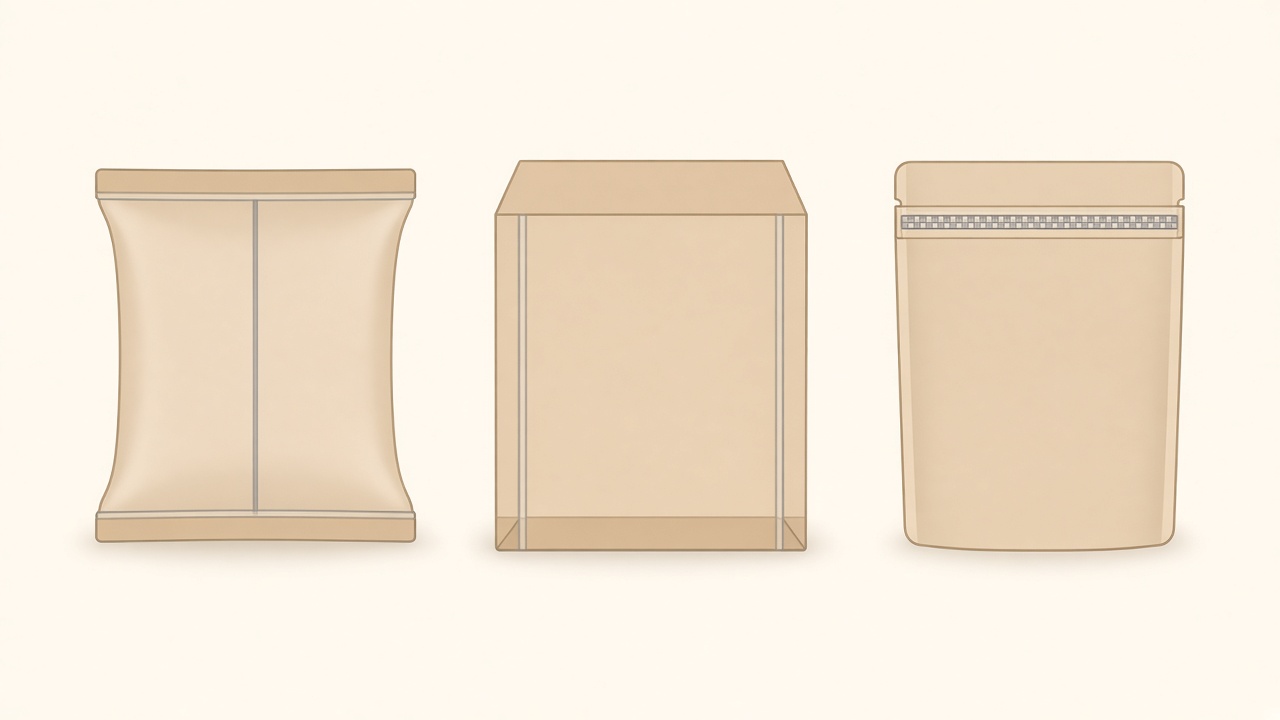
The same comparison says a flow wrapper and a VFFS machine can both end as a pillow pack with one long seal and a seal at each end. That is why the bag on the shelf is a poor place to start. Two pillow packs can look alike and still come from different machine classes, because one was wrapped around a placed item and the other was formed around a falling portion.
Roll film and a premade pouch are also different purchasing jobs. Our roll-film and premade comparison says the roll-film machine makes the package during the filling cycle, while the premade machine handles a package that a converter has already made. A flat drawing can hide a zipper or a bottom gusset, and two packs with the same outside dimensions can hold different usable fill volumes. Ask which of those two jobs the buyer's sample actually is. If the sample arrived from a pouch converter, the job is handling a finished bag. If it was cut from a reel on a forming line, the job is forming.
This catalog offers a vertical form-fill-seal route and a premade-pouch route. It does not cover horizontal flow wrappers. If the record ends with "placed as an item on a conveyor," the format question is still answered, but the machine discussion belongs with a flow-wrap supplier. Write that in the still-to-verify column instead of forcing the product onto a vertical line.
A pillow bag and a resealable pouch do not have to share one machine either. A buyer selling loose kibble in a plain pillow and treats in a resealable pouch can keep two records, one for each product, and let each record choose its own entry.
Which closure is on the sample?
Write the closure that is on the sample. A published pet-food packaging catalog lists more than one pack route on the same index. Its headings name pet-food packets in a flow-pack wrapper, pet food in a vertical roll-film pack with modified atmosphere, flat-bottom packs with a four-edge seal, and a flat-bottom vertical pack with four-edge seals and a reclosable zip. The same index lists birdseed packs and a thermoformed ham bone. Those headings are that publisher's pack names. They do not say which dry product uses which route, and they are not a kibble answer.
A published flow-pack page describes a three-seal pillow made around an irregular piece that is hard to drag, and it describes modified atmosphere as optional. That sentence belongs to that page. It is useful here only because it shows the pillow is a horizontal option as well as a vertical one, which is the point the entry question already made.
Write down what the sample has: a pillow with one long seam and a seal at each end, a flat bottom with four edge seals, a zip, or a gusset. Note which seal is made after the product is inside, because that is the step the machine has to perform at the end of the fill. Note whether a zip is present on the sample and whether it arrived already fitted to a finished bag. Note where the finished pack has to go after it is sealed. If the sample does not show one of those things, write "not on the sample."
A published open-mouth bagging case is about filling premade bags, including bags with a zip, on a bagging machine. That is a different machine class. It is not evidence that a roll-film vertical bagger can make the same pack, so a premade zip bag should not be written down as a VFFS format until the record shows the bag is formed from film on the line.
Modified atmosphere is a separate gas question. If the buyer's specification names a gas, keep it in the still-to-verify column and handle it with its own checklist. It does not choose the pack format, and this page says nothing about what it does to the product.
- Pillow bags — one long seam and a seal at each end
- Nitrogen flushing checklist — the gas question, kept apart from the format
What goes on the blank route record?
The route record is the deliverable on this page, and it is blank on purpose. Each row names one check and gives the instruction for what to write. The still-to-verify column stays empty until the buyer or the reviewer fills it in, and that empty cell stays an open check.
The product row takes "loose dry kibble" or "discrete treat / freeze-dried piece," plus the condition you can see, or "not chosen." Wet, paste, and retorted products are marked out of scope in that row. The fill amount row takes the labeled fill the buyer already uses, in the unit they already use, or "not on the spec." Do not add a sample weight to make the row look complete. The bag type row takes the name of the pack the buyer sells or wants. The original specification row takes the file name of the drawing, film specification, or pouch specification that already exists.
The entry row takes one of three phrases: dropped as a measured portion, placed as an item, or filled into a bag that already exists. The closure and discharge row takes the seal made after filling, the zip if the sample has one, and where the finished pack goes. The fragile row only applies when the product row names a discrete piece.
Leave length and width out of this record. Dimensions belong in a separate film-width calculation once the route is known, and this page does not calculate a film width. A bag size written in here would make the record look decided while the entry question is still open.
Fill one record per product. A plant selling kibble in one pack and treats in another should not share a row, because the two products may not share an entry.
What does this page not decide?
This page does not choose a machine for dry pet food. It does not state a speed, a bag size, a fill weight, or an accuracy, and it does not claim that this catalog has a validated pet-food machine. No product in this catalog is a pet-food model. The vertical and premade-pouch systems linked here are general route descriptions.
It does not cover wet food, retorted food, paste, gravy, or liquid nutrition. It does not discuss shelf life or freshness, and it does not say that one pack keeps a product better than another. Birdseed and a ham bone appear on the published catalog index only as other packs on that index. They are not answers for kibble or treats.
It also does not say that a premade pouch or a vertical bag is gentler on a treat. Breakage belongs on the damage record, with its own incoming baseline, and stays open until that record is filled.
What should you send before asking for a machine?
Send five items: the product, the fill amount, the bag type, the original specification, and the items still to verify. The product is loose kibble or a discrete piece, with the condition you can see. The fill amount is the labeled fill and its unit, or "not on the spec." The bag type is the pack name on the sample, or "not chosen." The original specification is the drawing or pouch file name, or "not chosen." The items still to verify are the blank cells, written as a list, for example "entry route not chosen; fragile baseline not defined."
Put those five items in a WhatsApp message using the WhatsApp link below this section, which opens a draft through /go/whatsapp. Opening the draft does not create an order. The reply reads which cells are filled and which are blank, and says which rows belong on a configuration review and which need a sample trial. It does not confirm that a vertical bagger fits the product, and it does not promise a clearance, a speed, a price, or a response time.
A configuration review discusses product characteristics, fill quantity, bag format, required output, and destination, and the service page asks you to mark anything undecided. It does not guarantee the outcome. A sample trial starts by naming the decision, such as a choice between a roll-film bag and a premade pouch, or whether fragile pieces can travel a proposed weighing route. A trial of one portion in one film does not cover every later product, and its result is a later record of its own. Confirm sample arrangements before shipping any material.
Method and sources
The pack names in this guide come from the index headings of a published pet-food packaging catalog. They are that catalog's headings, not a route recommendation. The pillow sentence is a published flow-pack page's own description. The open-mouth case describes a premade-bag bagging machine, a different class from roll-film VFFS, and none of its figures are used here. The entry, roll-film, fragile, configuration-review, and sample-testing statements come from this site's own route and service pages. Those are route pages, not pet-food results. The route record is blank. No machine was run for this guide, and no cell holds a measured value. Reviewed 13 October 2026.
What to send us
| Item | Why we need it | Example format |
|---|---|---|
| Product | Loose kibble and a brittle treat do not enter the pack the same way | Dry kibble, piece size not measured; or freeze-dried pieces, breaks easily |
| Fill amount | The portion is what the route has to measure | Labeled fill not on the spec |
| Bag type | The sample decides roll film, flow wrap, or a premade pouch | Flat-bottom zip, or not chosen |
| Original specification | A drawing and a nickname are different | Drawing file name, or not chosen |
| Items still to verify | The blank cells are the review | Entry route not chosen; fragile baseline not defined |
We reply within 24 hours.