
Gusset Bag vs Pillow Bag: VFFS Forming Guide
Ordering the wrong former wastes film. A gusset bag adds expandable folds; compare it with a pillow bag through VFFS forming, tucker timing and seal checks.
| Input or item | Typical value or source | Why it matters |
|---|---|---|
| Bag structure | Approved fold-and-seal drawing | Separates a side gusset, flat bottom and quad seal |
| F, D and g, in mm | Converter drawing; full side depth D = 2g | Avoids confusing a full side panel with a half tuck |
| Film and seam allowance S | Material specification and seam drawing | Sets the perimeter allowance and sealing review |
| Dose and output | Product sample; accepted bags per stated shift | Connects product arrival, headspace and total cost |
| Format | Forming decision | Dominant Failure Mode & Prevention |
|---|---|---|
| Plain pillow bag | Back seam and two end seals; no deliberate side tuck | Product caught in an end seal: review product arrival and headspace after checking empty bags |
| Side-gusseted pillow bag | Back seam and end seals plus two inward side folds; identify matched forming and gusseting parts | Asymmetric folds or a wrinkled fold-to-seal transition: verify tracking, fold symmetry and coordination with jaw contact |
| Specified flat-bottom gusseted bag | A defined base-shaping requirement in addition to side folds; confirm full tooling scope | A pack that does not meet the required standing presentation: evaluate the filled base against the approved sample |
On This Page
What is a gusset bag on a VFFS line?
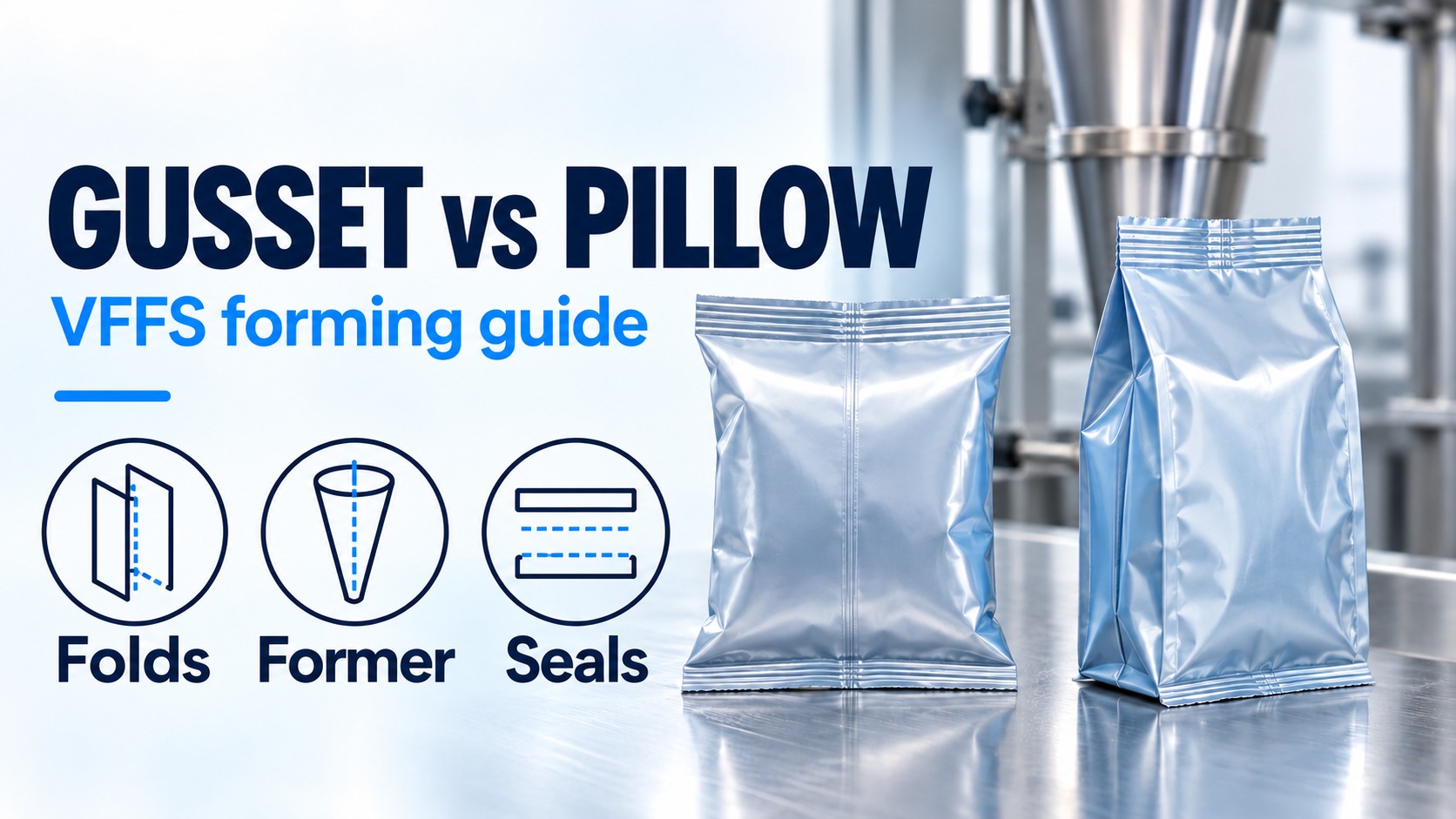
A gusset bag has an inward-folded panel that opens as the bag fills. In this VFFS forming guide, a side-gusseted pillow bag has two side folds, a longitudinal back seam and transverse end seals. A plain pillow bag has the same basic seal arrangement without the deliberate side folds. The fold describes geometry; it does not establish a flat bottom, a zipper or a particular machine configuration. Choose from a complete fold-and-seal drawing before ordering a forming set.
A side gusset changes how film gathers into the end seal and how the filled bag occupies a carton. It can also change the filling passage required for the intended dose. Those are reasons to compare samples with your actual product rather than selecting by an empty bag's face width. A narrow-looking empty pack may open into a much deeper shape. Conversely, a pack that looks square in a photograph may rely on additional bottom shaping or edge seals.
Flat-bottom and quad-seal requests therefore need their own marked features. A flat-bottom requirement concerns the finished base; quad seal identifies additional sealed vertical edges. Neither follows automatically from the word gusset. If standing on a shelf is mandatory, include a filled-pack standing check in the trial brief and show the intended base construction. Use the bag-style directory to compare these structures before deciding which one your forming enquiry actually needs.
Which dimensions change the film and former?
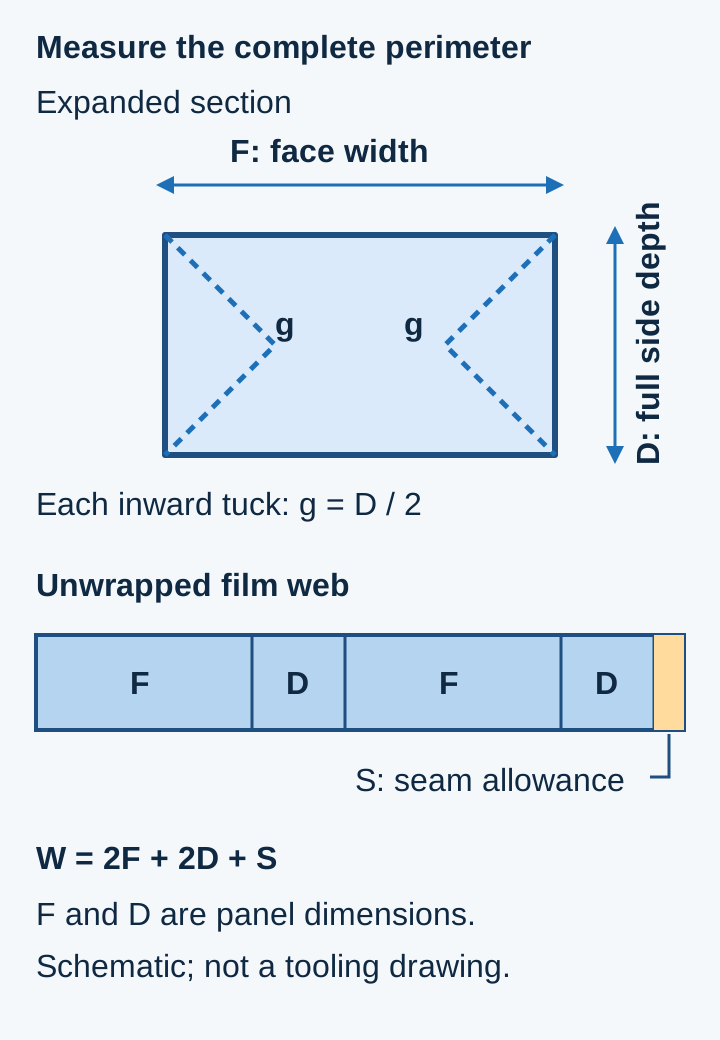
Define the full side depth before comparing reel widths. Let F be the front-panel width between corner folds, D the full opened side-panel depth, g the inward tuck depth of one symmetric side fold, and S the total film allowance consumed by the chosen longitudinal seam construction. With that convention, D = 2g. Ask the converter to label these dimensions, because a drawing that says only gusset 30 mm leaves open whether that means a half fold or a full side panel.
For an ideal rectangular expanded section, film width W = 2F + 2D + S = 2F + 4g + S. This is a perimeter check: two faces, two complete sides and the seam allowance. S must include the complete allowance for the selected fin or lap seal. It is not automatically the same number for both constructions. Real tooling, film thickness, corner shape and the converter's drawing determine the final reel width and print layout.
Worked example with assumed dimensions: F = 140 mm, D = 60 mm, g = 30 mm and S = 20 mm give W = 2 × 140 + 2 × 60 + 20 = 420 mm. The corresponding no-side-depth envelope is 2 × 140 + 20 = 300 mm. These are different geometries, not equal-capacity packs; the difference cannot be called a material saving. Bag length, headspace, product density and the filled shape must also be considered before comparing capacity.
Rules of thumb: if the specified side depth D = 0, the drawing calls for no deliberate side gusset; if D > 0, the proposal needs an identified fold-forming arrangement. If calculated W exceeds the documented maximum film width of the quoted machine, that candidate cannot satisfy the drawing unchanged. Check the minimum width, forming-set range and jaw envelope too. Passing a maximum-width check alone does not prove compatibility.
How do the collar and tucker fingers work together?
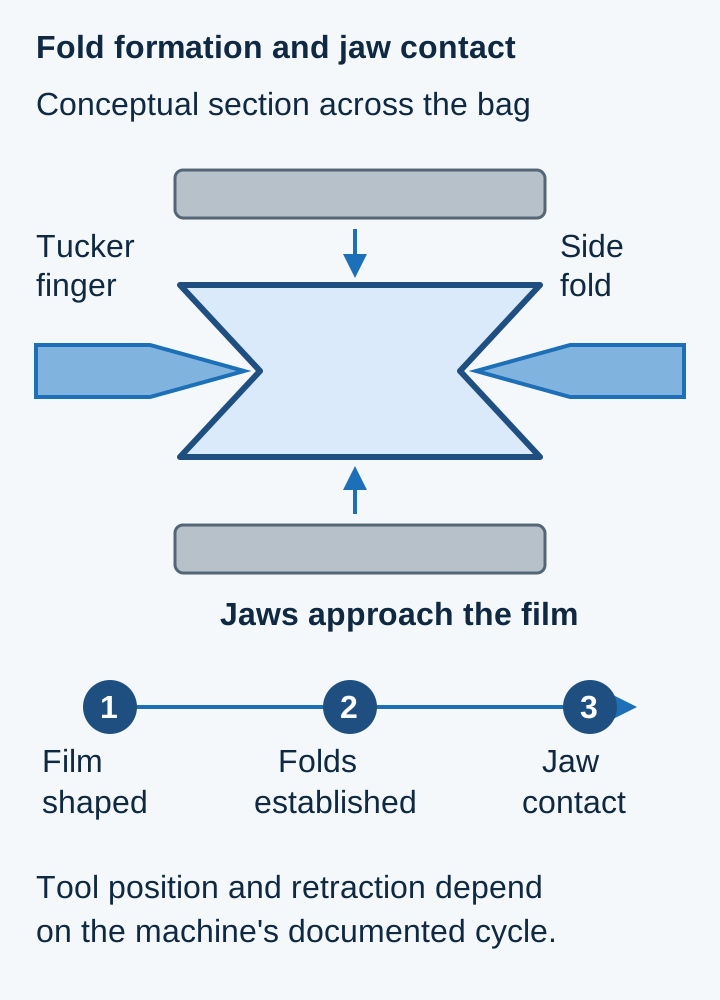
The collar forms the film around the filling tube; the gusseting arrangement controls the inward folds in relation to the end seal. Treat them as coordinated parts of a forming set. A collar angle is not a bag-style setting that can be copied between machines. The documented relationship is between the film approach and the collar geometry: a mismatched approach can make the film bind at the shoulder. Film construction and the particular former remain part of the review.
Gusseting hardware can use mechanical or pneumatic actuation. In a documented plow-and-finger arrangement, plows form folds at one end of the bag and fingers form folds at the other. The controlling requirement is that the folds exist when the jaws contact the film. The sketch shows that relationship without assigning cam degrees, an air pressure, an engagement distance or a universal component location. Actual finger placement, stroke, retraction and clearance belong to the machine's documented cycle.
For a gusset bag packaging machine enquiry, request the forming-set identification and a sequence description for the intended bag. Ask which parts change with F, D and bag length, which fold settings are recorded in the recipe, and which mechanical references must be restored after a changeover. A pneumatic option still needs a verified mechanical envelope; a screen setting cannot correct a mismatched former or a finger that is physically out of position.
During a demonstration, ask qualified staff to show the film path and capture the fold sequence from outside the safeguarded area. Tool inspection and adjustment must follow the equipment's operating and isolation procedures. The useful record is a marked bag sample plus the corresponding film, forming set and recipe revision. It lets a later shift reproduce an approved setup without treating an internet timing value as a machine instruction.
How do you separate crooked folds from product in seals?
Compare empty and filled bags before changing several settings together. Uneven folds on empty bags point the review toward film tracking, tension, the matched forming set and the gusseting arrangement. A repeatable empty shape followed by product trapped in a filled bag's transverse seal points toward product arrival and settling as well as the available headspace. Keep the observations separate so that a dosing problem is not hidden by a forming adjustment.
Record which side is displaced, whether the back seam wanders, and whether a wrinkle repeats at the fold-to-seal transition. Preserve examples with their sequence and identify the film roll and bag drawing. Ask the supplier to review the fold depth and symmetry against the approved sample. For filled packs, record dose quantity, material condition and where particles appear in the seal. Adjustments should follow the machine's documented process, with a new sample set after each controlled change.
The side folds create a different layer stack where they enter the transverse seal. Review that transition as well as the unobstructed middle of the seal. Adding heat alone does not remove a product particle or establish the correct fold. Ask the film supplier and equipment team to agree the material-dependent sealing window, then verify the finished pack under the intended fill conditions. Do not substitute a universal temperature or dwell time for that review.
ASTM F88/F88M-23 provides a method for measuring seal-strip separation and recording specimen failure. Its public scope does not supply a universal acceptance force for your bag. Keep the selected specimen support method consistent when comparing results, and agree acceptance criteria for the actual film and use. A seal-strength result concerns the sampled seal area; separately specify the package-integrity check needed for the finished pack. Upstream weighing and discharge should be included when product arrival is the issue.
Compare film loss and changeover in the same shift
Compare the formats against the same accepted-pack requirement and accounting period. Record film consumption, rejected product, startup film, format-change labour and downtime, utilities and replacement tooling. A comparison of empty bag prices misses the cost of repeated setup or rejected filled packs. Separate fixed tooling purchases from recurring shift costs and state how the tooling cost will be allocated over the proposed order volume.
For proportional running rejects, film area A = [N / (1 − r)] × W × P, where N is required accepted bags, r is rejected bags divided by all bags made, W is reel width in metres and P is cut pitch in metres. Add startup, splice and other uncounted film separately. Film cost is A multiplied by your quoted cost per square metre; compare identical film structures or show the construction difference explicitly.
Hypothetical same-period example: N = 10,000 accepted bags, W = 0.420 m and P = 0.200 m give A = 10,000 / 0.99 × 0.420 × 0.200 = 848.48 m² at an assumed 1% running reject rate. At an assumed 3%, A = 10,000 / 0.97 × 0.420 × 0.200 = 865.98 m². The 17.50 m² difference illustrates sensitivity to rejects, not an expected result for either bag style. Rejected product cost and additional startup film remain separate ledger entries.
Changeover time per shift = number of changes × observed time per change. With hypothetical inputs of four changes at 12 minutes versus four at 20 minutes, the totals are 48 versus 80 minutes, a 32-minute difference in the same shift. Replace those assumptions with measured changeovers from the actual forming sets. Time from stopping the previous format to stable accepted bags is more useful than a tooling-swap time that excludes setup scrap.
Use accepted output over scheduled time to compare the full shift, and keep running speed as a separate observation. Do not subtract the same changeover stop twice when valuing lost output. A workable total-cost worksheet lists film cost, unrecovered rejected product, labour, utilities and allocated maintenance/tooling for that period; any lost-contribution estimate needs its own stated assumptions. Feed these records into the changeover plan rather than assuming a gusset always makes a line slower or faster.
What to send for a forming-set discussion
Send a dimensioned bag drawing and product details to make the configuration discussion specific. The drawing should identify F, full D, tuck g, cut pitch, seam construction and all seal widths. Include front, back and side photographs of the filled pack. For a requested flat base or sealed vertical edges, mark those features explicitly instead of relying on the sample name.
Add the film supplier's construction and gauge specification, fill quantity, product dimensions or flow condition, and required accepted bags over a stated shift. If you have an existing machine, include its model and forming-set identification rather than asking whether a generic tucker will fit. Where a value is undecided, mark it open and send the candidate sample. Use the contact page to discuss the product, bag geometry, film and output requirement with the team; the agreed proposal should identify which forming parts and trial checks are included.
Method, sources and update
Updated October 19, 2026. The bag definitions and mechanism explanation draw on public OEM bag-style descriptions and an OEM operating manual's film-guide, gusset-device and bag-inspection sections. The manual supports the fold-and-jaw relationship; its machine-specific settings are not transferred to another forming set. ASTM F88/F88M-23 is referenced only for the publicly described seal-strength method and scope. Full test execution requires the applicable method and an agreed project specification.
The dimensional equation is a rectangular-perimeter approximation with explicitly defined panels and total seam allowance. Both cost examples use assumed inputs to show the arithmetic. Final film width, base construction, tooling fit and acceptance criteria follow the approved drawing, actual material and sample evaluation. Keep those revisions together when comparing proposals or repeating a format change.
Technical Reading
- ASTM F88/F88M-23: public scope and significance — Seal-strength test scope, checked October 19, 2026; no universal bag acceptance value is supplied here.
Explore the Equipment
Vertical Form Fill Seal
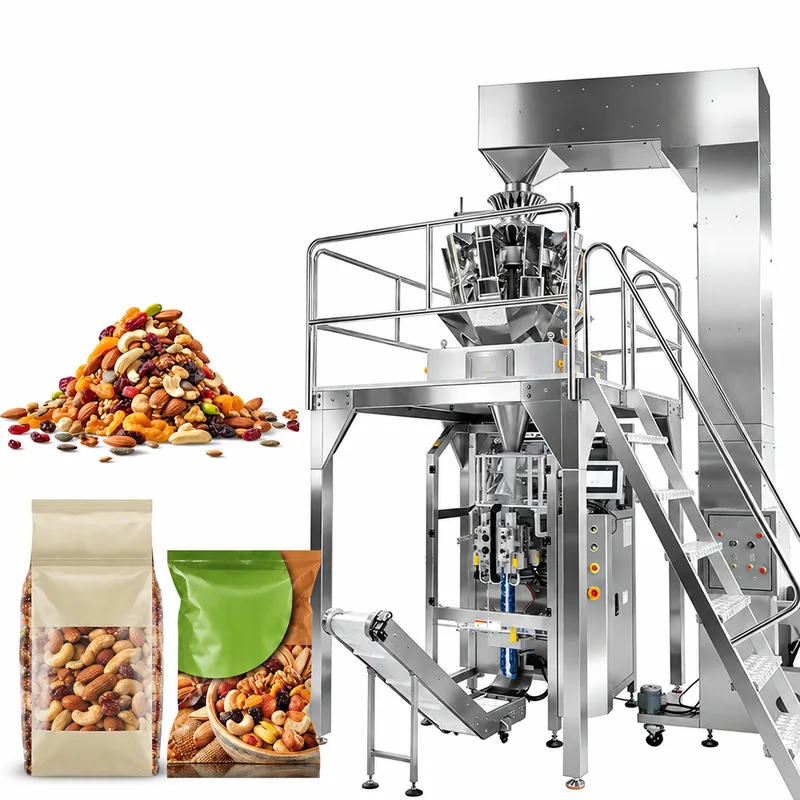
Nuts & Dried Fruit Multihead VFFS
A nut-mix bag can be on weight and still hold the wrong ratio of ingredients. Configure this multihead VFFS line from your blend, coatings, target weight and bag size.
What to send us
| Item | Why we need it | Example format |
|---|---|---|
| Fold-and-seal drawing | Define F, full D, tuck g, pitch and total seam allowance; identify the base | Dimensioned PDF plus front/back/side filled-pack photos |
| Film construction and gauge | Review the former and seal requirements for the actual material | Converter specification and revision |
| Product and fill quantity | Review filling passage, arrival and available headspace | Product description, dose and material sample details |
| Accepted output and changeovers | Keep the shift requirement and cost comparison on one basis | Required accepted bags per shift and format list |
We reply within 24 hours.