
Forming Collar: How VFFS Bag Formers Work & Sizing Guide
How a VFFS forming collar folds flat rollstock around a forming tube, and how to specify bag width, film friction, seam type, and roller alignment.
Scroll horizontally to read all columns, conditions and sources.
| Selection criterion | Mirror-polished stainless steel (SUS304) | PTFE low-friction coated collar | Sand-blasted stainless finish |
|---|---|---|---|
| Surface friction characteristic | Smooth low-drag metallic surface minimizing scratches on printed film | Non-stick fluoropolymer layer with 0.05 to 0.10 coefficient of friction against polished steel | Controlled moderate-friction micro-texture that stabilizes slick webs |
| Best-fit rollstock materials | Standard OPP/PE laminates and printed plastic films from 0.02 mm to 0.12 mm thick | Tacky films, thin polyethylene webs, and higher-drag coated paper laminates | High-slip polyethylene films whose bloomed slip additives cause web drift |
| Back-seam compatibility | Supports both fin-seal and flat lap-seal tube configurations | Supports fin-seal and lap-seal layouts while lowering wrap pull tension | Supports fin-seal and lap-seal layouts where controlled lateral grip is required |
| Hygienic and cleaning considerations | Corrosion-resistant bare stainless steel compatible with food washdowns under 21 CFR 117.40 | Widely used non-stick food-contact coating for chutes and rollers; inspect periodically for wear | Corrosion-resistant stainless finish; requires smooth food-contact tube seams under 21 CFR 117.40(b) |
| Primary operating failure risk | High-drag paper or tacky films can elevate tube friction and cause transport failure | Damaged or worn coating on the collar lip exposes higher-drag metal spots | Excessive texture on high-COF or stiff webs amplifies pull-belt drag and frictional heating |
On This Page
How Does a VFFS Forming Collar Fold Flat Film Into a Tube?
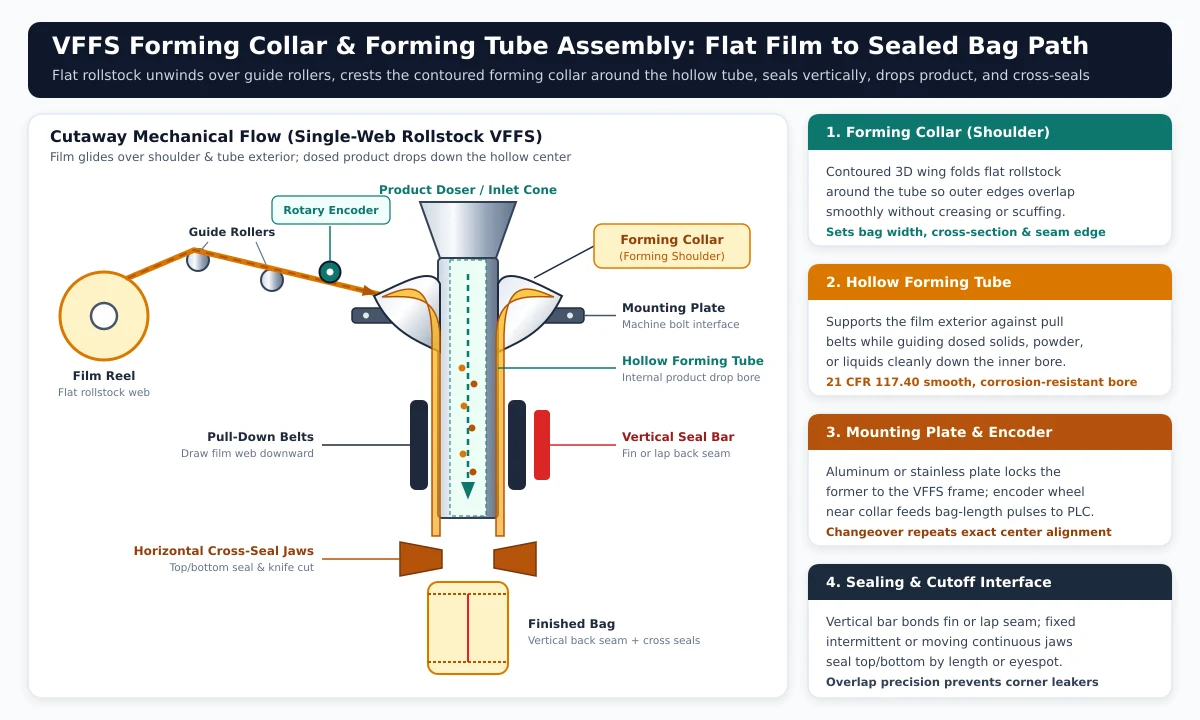
A forming collar is the contoured stainless-steel transition wing mounted atop a vertical form-fill-seal (VFFS) forming tube that continuously folds flat rollstock packaging film into a cylindrical or shaped tube. As the web crests the shoulder curve, its two outer edges wrap around the tube and overlap so vertical and horizontal sealers can form and cut individual bags.
Continuous Film Wrapping Around the Hollow Forming Tube
As documented in the peer-reviewed VFFS runnability study by Merabtene et al. (2022) in BioResources, every VFFS machine integrates a film handling unit, a forming shoulder and forming tube, longitudinal and horizontal sealers, and a filling doser. Flat rollstock unwinds from the reel across a bank of guide rollers and approaches the back of the hollow conical forming tube. As detailed in Wikipedia's overview of vertical form fill sealing machines, when the center of the web meets the tube, its outer edges turn into flaps that wrap around the outside of the forming tube.
Pull-down transport belts grip the film along the exterior of the forming tube and draw the wrapped web downward. Where the two outer edges meet along the front of the tube, a vertical heat-sealing bar clamps and melts the overlap into a continuous longitudinal seam. While the forming collar shapes flexible plastic films across most food lines, the same single-web forming principle also handles continuous metallized foil laminates, coated paper webs, and fabrics once the edge-seaming method matches the substrate (covered step by step in our vertical form fill seal process guide).
Synchronizing Product Drop, Encoder Pulses, and Horizontal Jaws
While the film travels down the outside of the forming tube, pre-measured product from an overhead multihead weigher or precision weighing table drops freely down the hollow inner bore into the bottom-sealed pouch. Immediately after the dose settles, horizontal cross-seal jaws clamp across the tube to bond the top of the filled bag, simultaneously form the bottom seal of the next bag above, and sever the completed pouch with an integrated knife.
Accurate cutoff length depends on coordinated feedback between the forming collar and the machine controller. A rotary encoder wheel positioned near the forming collar contacts the moving film and sends a length pulse to the programmable logic controller (PLC) for every increment of web advance. Depending on whether the rollstock is plain or printed, bag advance and cutting are governed either by programmed pouch length or by photo-sensor indexing to a printed eyespot registration mark. Fixed-height horizontal bars run an intermittent sealing cycle that pauses film advance during clamping, whereas faster continuous-motion machines move the cross-seal jaws downward with the bag without halting web travel.
What Is the Difference Between a Forming Shoulder, a Forming Collar, and a Bag Former Assembly?
In packaging machinery engineering, forming collar and forming shoulder refer to the same three-dimensional curved wing that redirects flat film onto the forming tube. A complete bag former assembly pairs that contoured forming collar with a product-matched hollow forming tube and a machined mounting plate engineered to bolt directly onto a specific VFFS machine frame.
Three Core Parts of a Complete Bag Former Assembly
Separating the individual wear and sizing components helps buyers specify change parts accurately across multiple VFFS machine configurations. First, the contoured forming collar (or shoulder) executes the geometric transition from a flat web to a closed cross-section; hand-polishing its bending lip allows film to glide evenly without creasing or scuffing printed graphics. Second, the hollow forming tube supports the wrapped film against pull-down belt pressure on the outside while channeling product cleanly down the inside.
Third, the mounting plate anchors the collar and tube to the packaging machine's frame using the manufacturer's exact bolt pattern and positioning holes. Mounting plates are typically fabricated in stainless steel for washdown durability or aluminum when weight reduction speeds up manual format changeovers. Because all three parts work as one rigid geometric unit, even slight distortion in the mounting plate shifts the tube relative to the pull belts and vertical sealing bar.
Mathematical Shoulder Geometry and Real Tube-to-Collar Proportions
A forming collar is never a generic bent sheet of steel. As noted by Merabtene et al. (2022), the complexity of the forming shoulder governs how pull-belt tension distributes across the web and directly determines final pouch quality. Packaging researchers design next-generation forming shoulders using complex mathematical modeling—including finite element methods to analyze web stress and Euler's belt-friction theory to predict material tracking around the tube.
Concrete machine measurements show why shoulder width and tube diameter are locked to a specific finished bag size. In the Merabtene et al. (2022) trials on an industrial GKS-Compack CP350 Plus bagger, the forming tube measured 87 mm in diameter paired with a 140 mm forming shoulder width. Attempting to run a much wider or narrower rollstock reel on that fixed collar alters edge overlap at the vertical sealer and introduces immediate creasing at the shoulder wings.
What Parameters Drive Forming Collar Design for Bag Width, Film Friction, and Seam Type?
Forming collar design is driven by four coupled engineering parameters: finished bag cross-section and film width, back-seam overlap style (fin seal versus lap seal), rollstock thickness and stiffness, and the static and kinetic friction between the film surface and the collar finish. Mis-specifying any single parameter produces drag, wrinkles, or misaligned back seams.
Bag Width, Film Thickness, and Fin Seal Versus Lap Seal Geometry
Custom VFFS forming collars span wide industrial ranges, accommodating rollstock widths from 35 mm to 800 mm and film thicknesses from 0.02 mm to 0.12 mm across round, square, oval, side-gusseted, and quad-seal bag profiles. Before ordering a collar, engineering teams verify unfolded flat web width against finished bag width and seam allowance (detailed in our bag size and film width guide).
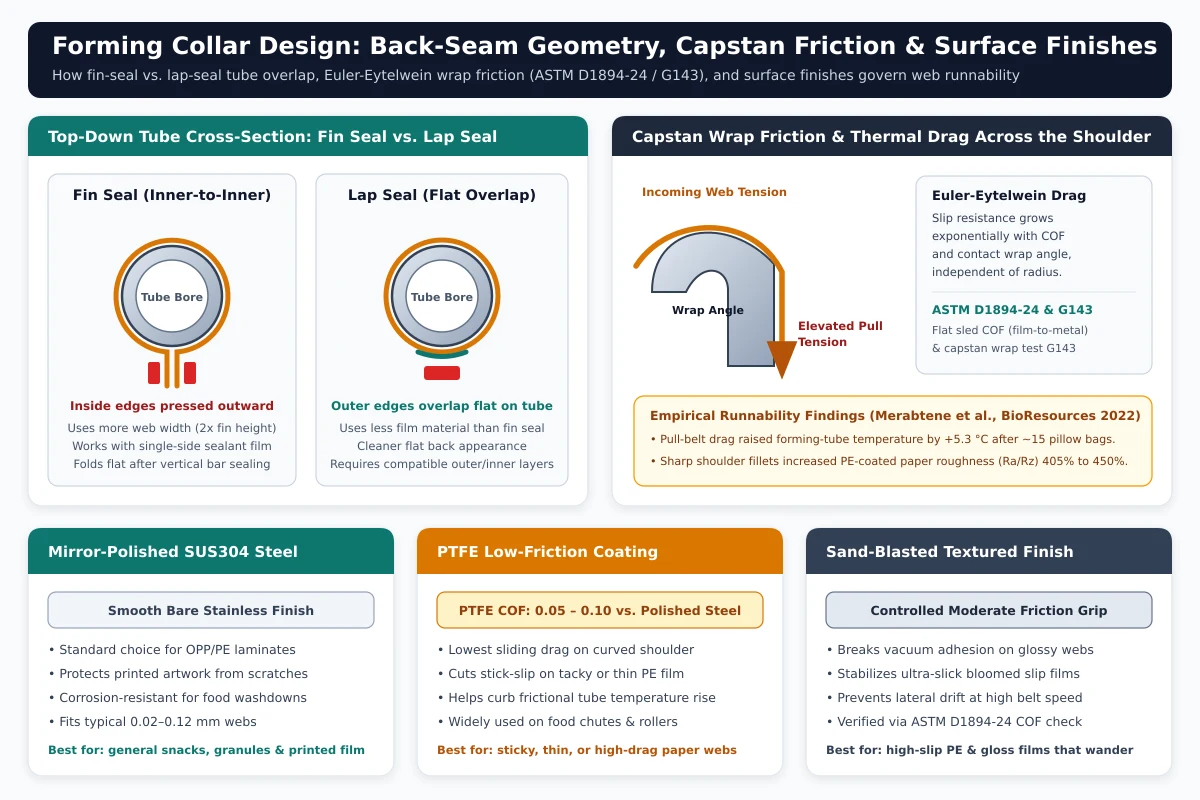
Back-seal style directly changes how the forming tube presents the two outer film edges to the vertical heat-sealing bar. A fin seal brings the inner sealant faces of both film edges together so the bonded seam projects outward like a fin, which works reliably when only the inside layer of a laminate is heat-sealable. A lap seal overlaps the two outer film edges flat against the forming tube, producing a flatter rear appearance while consuming less rollstock material than a fin seal.
Film Coefficient of Friction, Slip Additives, and Capstan Wrap Drag
Film-to-metal friction across the forming shoulder controls how much pull-belt force is required to fold the web without stretching or snapping. ASTM D1894-24 standardizes measuring both starting (static) and sliding (kinetic) coefficients of friction for plastic film sliding over itself or over another surface such as stainless steel. The standard highlights a critical production trap: slip additives in polyethylene films bloom to the surface over time, meaning friction behavior depends heavily on film age and surface condition. ASTM D1894-24 also supports optional thermal testing away from 23 °C by heating or cooling the plane alone, and Note 1 refers engineers to ASTM Test Method G143 (under Subcommittee G02.50) when evaluating plastic films partially wrapped around a cylinder or capstan.
That curved-surface wrap physics is governed by the Euler-Eytelwein belt friction relationship documented in Wikipedia's capstan equation reference. Across a curved forming lip, slip resistance grows exponentially with both the coefficient of friction and the contact wrap angle, independent of cylinder radius. Consequently, even a modest jump in film-to-metal friction sharply multiplies downstream pull-belt tension.
Surface Finishes, Shoulder Sharpness, and Frictional Tube Heating
Matching collar surface finish to web friction keeps pull tension inside a stable window (see our packaging film requirements guide). Mirror-polished SUS304 stainless steel minimizes drag and protects printed inks on standard laminates. When tacky or thin films cling to bare steel, a low-friction PTFE coating—whose coefficient of friction against polished steel is 0.05 to 0.10 according to Wikipedia's polytetrafluoroethylene data—cuts sliding resistance and is widely used on food-processing chutes and rollers. Conversely, ultra-slick films with heavy slip-additive bloom may require a sand-blasted stainless finish that adds moderate friction grip to stop lateral web wander.
Empirical runnability measurements show how rapidly poor collar geometry and friction degrade bag quality. In Merabtene et al. (2022), sharp forming-shoulder fillet edges and steep run-in angles cut coated paper webs and raised 3D-profilometer pouch roughness (Ra and Rz) by 405% on Paper 70 + 15 PE and 450% on stiffer Paper 90 + 30 PE compared with raw unformed stock. Furthermore, pull-belt friction against the forming tube elevated tube temperature adjacent to the belts by 5.3 °C after producing roughly 15 pillow bags, creating a feedback loop that raised surface friction even further.
| Design parameter | Engineering specification range or standard | Impact on VFFS web runnability |
|---|---|---|
| Rollstock width & thickness | 35 mm to 800 mm web width; 0.02 mm to 0.12 mm film thickness | Fixes collar wing span, tube circumference, and bend fillet tolerance |
| Back-seal configuration | Fin seal (inner faces pressed outward) vs. lap seal (flat outer overlap) | Lap seal saves film and lies flatter; fin seal suits single-side sealant laminates |
| Film friction measurement | ASTM D1894-24 flat sled COF (optional plane temperatures other than 23 °C); ASTM G143 capstan wrap | Tracks slip-additive blooming and age shifts that multiply Euler capstan drag |
| Collar finish options | Mirror-polished SUS304, PTFE coating (0.05–0.10 COF), or sand-blasted texture | Balances smooth low-scratch travel against lateral grip and frictional tube heating |
How Does Forming Tube Geometry Affect Product Drop, Sanitation, and Changeover?
The hollow forming tube governs both product discharge flow and sanitary compliance because every dose falls directly through its interior bore before the horizontal jaws close. Tube cross-section, integral-cone staggering, smoothly bonded corrosion-resistant seams, and repeatable mounting-plate changeover steps determine whether a line runs clean without bridging or trapped-product leakers.
Preventing Product Bridging and Seal Contamination Inside the Tube
Product flow bottlenecks occur most frequently when individual pieces are large relative to finished bag width, inconsistent in shape, lightweight, odd-shaped, or rough-surfaced. As a dose narrows from the inlet hopper into the forming tube, elongated product strings can bridge across the bore, slow line speed, or drop late into the closing horizontal jaws where trapped pieces break seal integrity. Forming tubes built with integral cones slightly stagger the incoming charge so product passes through the narrow transition faster and lands in a tighter, more compact slug inside the bag.
Food-Contact Material and Smooth-Seam Requirements Under 21 CFR 117.40
Because the inner bore of a VFFS forming tube is a direct food-contact surface on food packaging lines, its metallurgy and weld quality fall under federal Good Manufacturing Practice rules. Under 21 CFR 117.40(a)(4)–(5), food-contact surfaces must be corrosion-resistant and fabricated from nontoxic materials capable of withstanding intended food contact, cleaning compounds, sanitizing agents, and washdown procedures.
Weld integrity inside the tube is equally critical. Under 21 CFR 117.40(b), seams on food-contact surfaces must be smoothly bonded or maintained to minimize accumulation of food particles, dirt, and organic matter—reducing both microbial growth harborage and allergen cross-contact between runs. Specifying seamless forming or ground-and-polished food-grade stainless steel bores keeps powders, crumbs, and sticky residues from clinging inside tube joints.
Repeatable Bag Former Changeover Without Alignment Drift
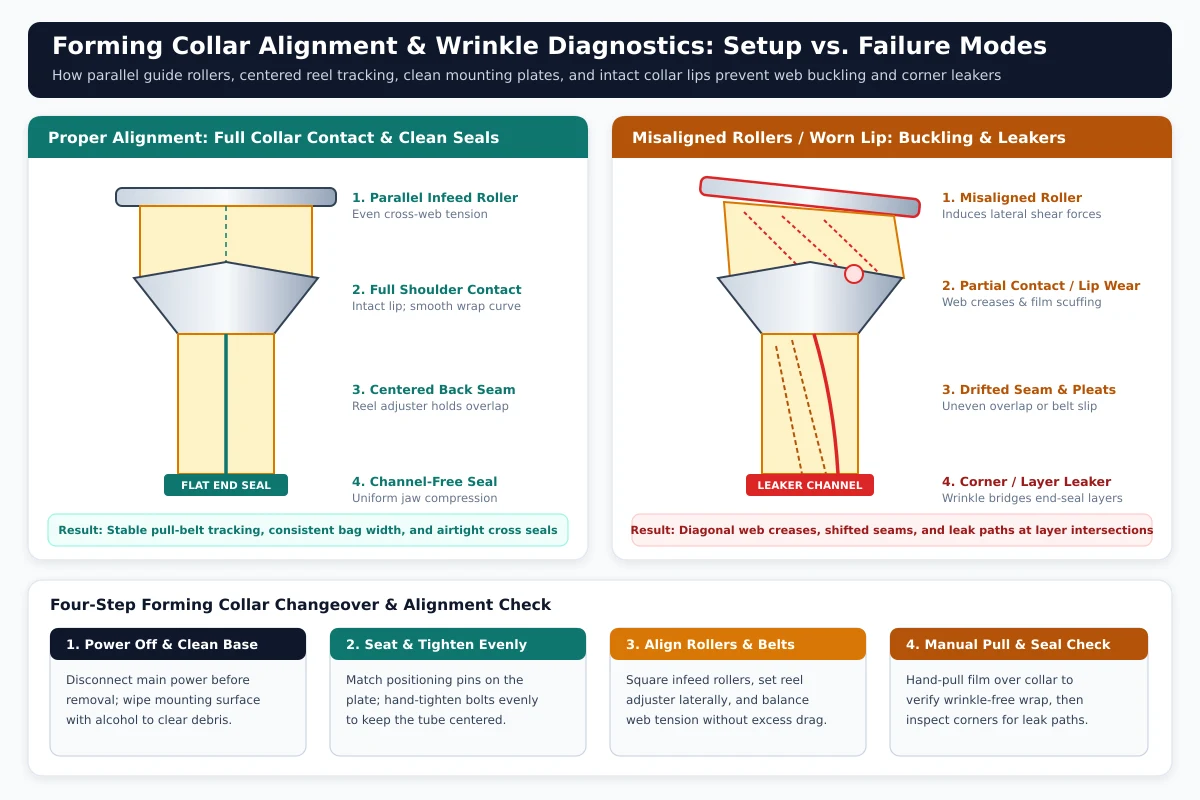
Format changeovers between bag widths introduce alignment errors if operators skip mounting-plate cleaning or uneven torque steps (covered alongside shift scheduling in our changeover planning guide). Safe bag former replacement follows four disciplined steps: first, stop the bagger and disconnect main electrical power before loosening the existing assembly. Second, wipe the machine's mounting surface thoroughly with a clean cloth and alcohol to remove film debris, product dust, or grease that would cock the new plate out of square.
Third, align the replacement forming collar assembly with the frame's positioning holes, seat it smoothly, and evenly hand-tighten all mounting bolts so the tube hangs plumb between the pull belts. Finally, manually pull a length of film over the forming shoulder and down the tube, fine-tuning assembly position until the web runs centered, smooth, and completely free of diagonal wrinkles before powering up production.
How Do You Align Rollers on a Forming Collar Packaging Machine to Prevent Film Wrinkles?
Preventing film wrinkles requires keeping every upstream infeed roller parallel to the forming collar centerline so the web maintains full, even contact across both shoulder wings. Misaligned rollers induce lateral shear buckling, uneven edge overlap, and creases that travel down the forming tube into multi-layer horizontal seal intersections where leakers form.
Diagnosing Roller Misalignment, Web Buckling, and Tension Trade-Offs
When film guide rollers drift out of parallel, the flat web enters the forming collar unevenly and fails to make full contact along the shoulder contour. That partial contact immediately generates longitudinal creases, diagonal wrinkles, and distorted bag faces that degrade shelf appearance and weaken end seals. In the Merabtene et al. (2022) VFFS trials, web buckling across rollers was traced directly to shear forces caused by web tensioning and misalignment.
Operators control lateral film position using the reel adjuster so the two outer edges overlap squarely on the forming tube for vertical back sealing. However, tension adjustment involves an engineering trade-off: Merabtene et al. (2022) observed that tightening web tension via pneumatic pressure control valves noticeably reduced web wander and buckling, whereas over-tensioning generated excessive frictional forces between the rollers and the film web—and simply changing transport speed failed to eliminate buckling caused by misalignment.
Inspecting Pull Belts, Collar Lip Wear, and Multi-Layer Corner Leakers
Even when infeed rollers sit perfectly square, downstream wear or drive imbalance can still twist the formed film tube. Uneven pull-down belt pressure or poor forming-tube alignment skews the web as it exits the collar, while nicks, burrs, or abrasion wear on the forming collar lip or wing scratch printed graphics and permanently crease the film.
Those upstream creases rarely stay cosmetic. Because VFFS end seals step across changing film-layer counts—two layers across the flat bag face meeting three or four layers at the back-seam overlap and side gussets—unintended pleats and wrinkles open capillary channels. Leakers consistently follow those wrinkle channels at multi-layer intersections and bag corners, which cannot be fixed reliably by simply cranking up cross-seal jaw temperature because overheating creates hot spots that distort the pouch.
| Observed web or bag symptom | Likely mechanical root cause | Corrective verification step |
|---|---|---|
| Diagonal creases across collar wings | Misaligned infeed film rollers preventing full shoulder contact | Square guide rollers to frame centerline and verify flat web entry |
| Web buckling and lateral wander | Shear forces from roller misalignment or under-tensioned reel path | Center overlap with reel adjuster; balance pneumatic tension without excess roller drag |
| Shifted vertical back-seam overlap | Off-center mounting plate, uneven pull-belt grip, or tube misalignment | Clean mounting base with alcohol, re-seat on locating pins, and check pull belts |
| Film scuffing, cuts, or rough paper surface | Worn or damaged collar lip/wing, or overly sharp shoulder fillet radius | Inspect collar lip for burrs/wear; verify low-friction PTFE finish or gentle fillet contour |
| End-seal corner or back-seam leakers | Wrinkle channels bridging two-to-multi-layer film intersections | Eliminate upstream collar pleats rather than overheating cross-seal jaws |
What Specifications Should You Send a Forming Collar Manufacturer When Ordering Change Parts?
When ordering replacement or additional-width forming collars, provide six verified specifications so the manufacturer replicates your optimal geometry accurately: VFFS machine model and mounting-plate interface, finished bag style, back-seal type (fin or lap), flat film width and thickness, laminate friction and surface-finish needs, and product drop characteristics.
Machine Interface, Bag Style, and Seam Replication
Every forming set must be built around the exact interaction of product, package design, machine frame, and film specification. When ordering replacement collars or standardizing change parts across multiple VFFS lines or plant locations, replicating a proven forming-set design prevents lengthy post-changeover debugging. Start your specification sheet with the exact VFFS machine brand and model, mounting-plate bolt pattern and positioning pin dimensions, and preference for stainless steel or weight-reduced aluminum plate construction.
Pair the machine interface with an approved package drawing specifying finished bag style (pillow, side-gusseted, quad-seal, three-side seal, or four-side seal), tube cross-section (round, square, or oval), and whether the vertical sealer runs a fin seal or flat lap seal. Confirming exact film width (within the 35 mm to 800 mm custom range) and film gauge (0.02 mm to 0.12 mm) ensures the collar folds the web without excess slack or edge stretch.
Film Friction Data and Product-Specific Tube Options
Send a representative rollstock sample along with its substrate structure—such as transparent PE/CPP/OPP, barrier composite laminate, metallized foil, or PE-coated kraft paper—plus ASTM D1894-24 coefficient-of-friction data if available so the collar builder can specify mirror-polished SUS304, low-friction PTFE coating, or a sand-blasted moderate-grip finish. Finally, describe the product drop profile—piece size, flowability, dusting, or stickiness—so the forming tube incorporates the right bore clearance, integral cone staggering for odd-shaped solids, and 21 CFR 117.40 smoothly bonded corrosion-resistant food-contact construction.
Sources
All forming-shoulder runnability measurements, film friction test methods, capstan wrap mechanics, fluoropolymer friction values, and food-contact equipment sanitation rules in this guide are grounded in the following public reference documents:
- Merabtene et al. (2022) — Heat Sealing Evaluation and Runnability Issues of Flexible Paper Materials in a Vertical Form Fill Seal Packaging Machine (BioResources 17(1), 223–242, NCSU)
- ASTM D1894-24 — Standard Test Method for Static and Kinetic Coefficients of Friction of Plastic Film and Sheeting (ASTM International)
- 21 CFR 117.40 — Equipment and utensils (Electronic Code of Federal Regulations)
- Vertical form fill sealing machine — single-web forming tube, fin seal, and intermittent vs. continuous sealing (Wikipedia)
- Capstan equation — Euler–Eytelwein belt friction over curved surfaces (Wikipedia)
- Polytetrafluoroethylene — coefficient of friction and food-processing non-stick coatings (Wikipedia)
Frequently asked questions
Is a VFFS forming collar the same thing as a forming shoulder?
Yes. Forming collar and forming shoulder are interchangeable industry terms for the contoured transition wing atop a VFFS forming tube that folds flat rollstock into a tube so its outer edges overlap for vertical sealing. Together with the hollow forming tube and machine-specific mounting plate, they form a complete bag former assembly.
Can one forming collar run multiple bag widths on a VFFS machine?
No. Each forming collar and forming tube pair is engineered for one specific bag width, cross-section, and back-seal overlap—such as the 87 mm tube and 140 mm shoulder tested on an industrial VFFS bagger in Merabtene et al. (2022). Changing finished bag width requires swapping in a dedicated bag former assembly matched to the new flat film width.
When should you choose a PTFE-coated or sand-blasted forming collar instead of bare polished steel?
Mirror-polished SUS304 stainless steel works well for standard printed laminates, while PTFE coatings (0.05 to 0.10 coefficient of friction against polished steel) reduce drag on thin, tacky, or higher-friction webs. A sand-blasted stainless finish adds controlled moderate friction grip when ultra-slick slip-additive films wander laterally across polished metal.
Why do misaligned film rollers cause bag leakers even when cross-seal jaw temperatures are high?
Misaligned rollers prevent flat film from making full contact across the forming collar, producing shear buckling and diagonal creases that carry down into the horizontal end seal. Leakers follow these wrinkle channels where two film layers meet multi-layer seam intersections and corners, and raising jaw heat further only risks overheating and distorting the pouch.
How does a fin-seal forming collar differ from a lap-seal forming collar?
A fin-seal setup folds the film edges outward so the inner heat-sealable surfaces bond together into a projecting fin, whereas a lap-seal setup overlaps the two outer film edges flat against the forming tube. Lap seals lie flatter and use less film material, while fin seals support laminates whose outer layer cannot seal directly to the inner layer.
Explore the Equipment
Vertical Form Fill Seal
Candy Multihead Weighing & Packaging
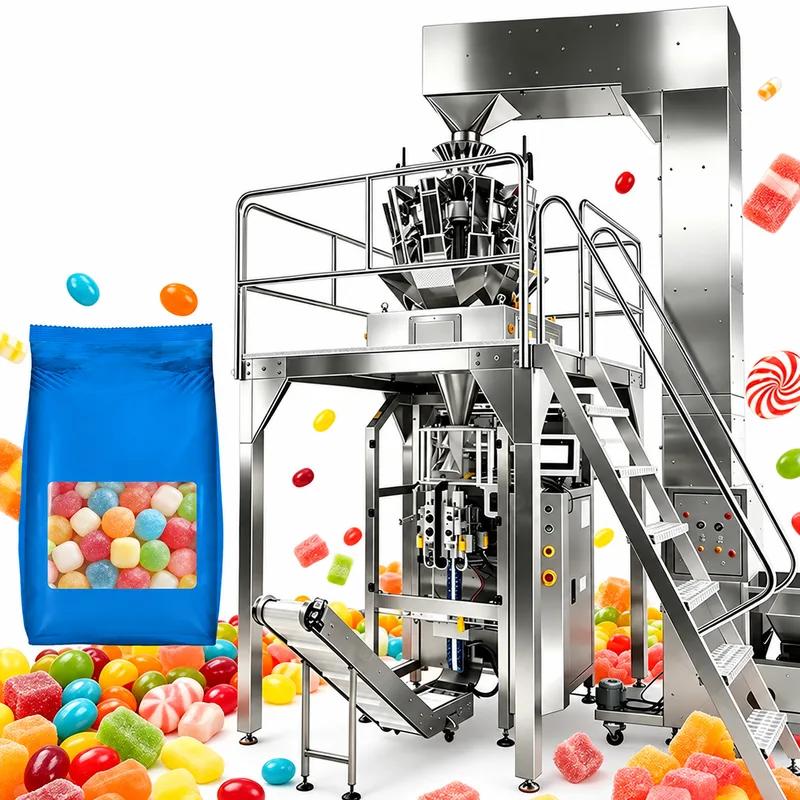
A correct bag weight can still hide broken, stuck or wrongly mixed sweets. Residue held on a contact surface can release into the next bag. This multihead weigher and VFFS line is set up around your candy's coating, size and pack.
Vertical Form Fill Seal
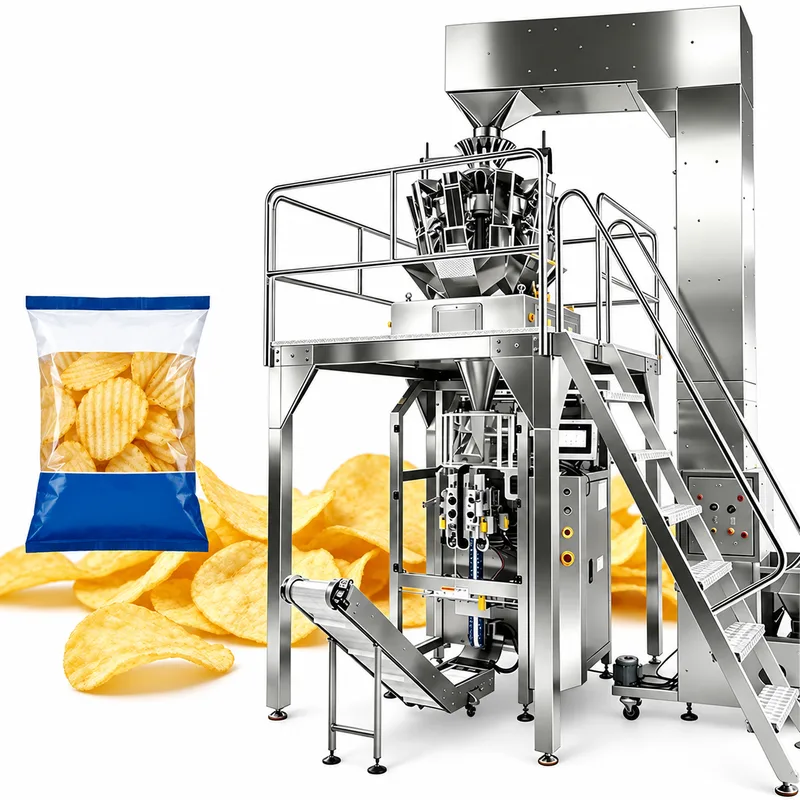
Chips Packaging with Nitrogen Flushing
An inflated bag can hide broken chips, a short fill or a weak seal. Size this weigher, VFFS and nitrogen-flush line from your chip volume, breakage limit and gas supply.
Vertical Form Fill Seal
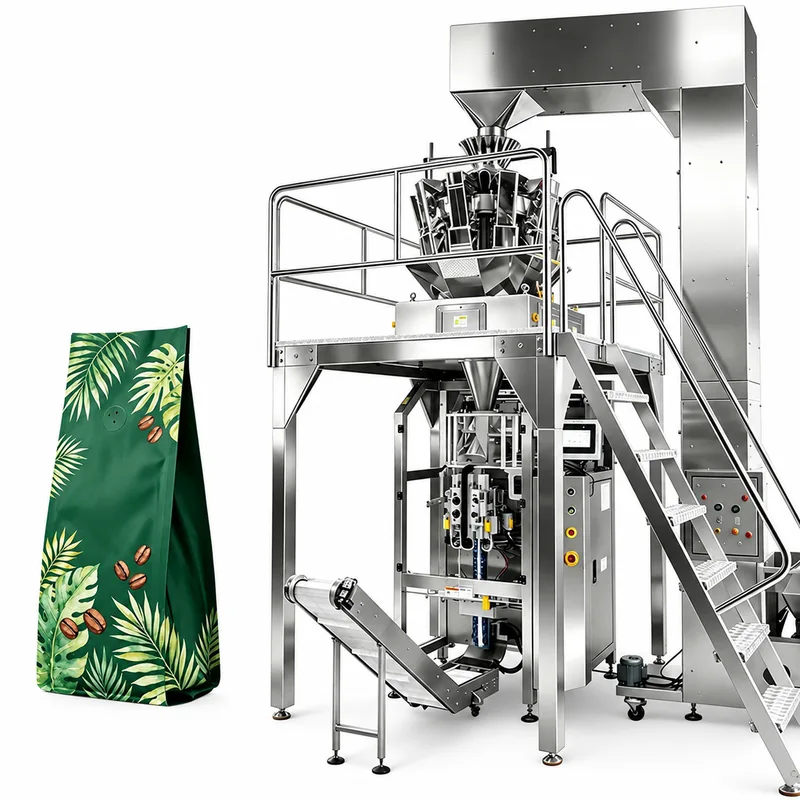
Coffee Bean Valve-Pouch Packaging
A misplaced or poorly attached degassing valve can spoil a run of coffee bags. Specify this weigher and VFFS valve line from your valve drawing, film, roast and weight.
Vertical Form Fill Seal
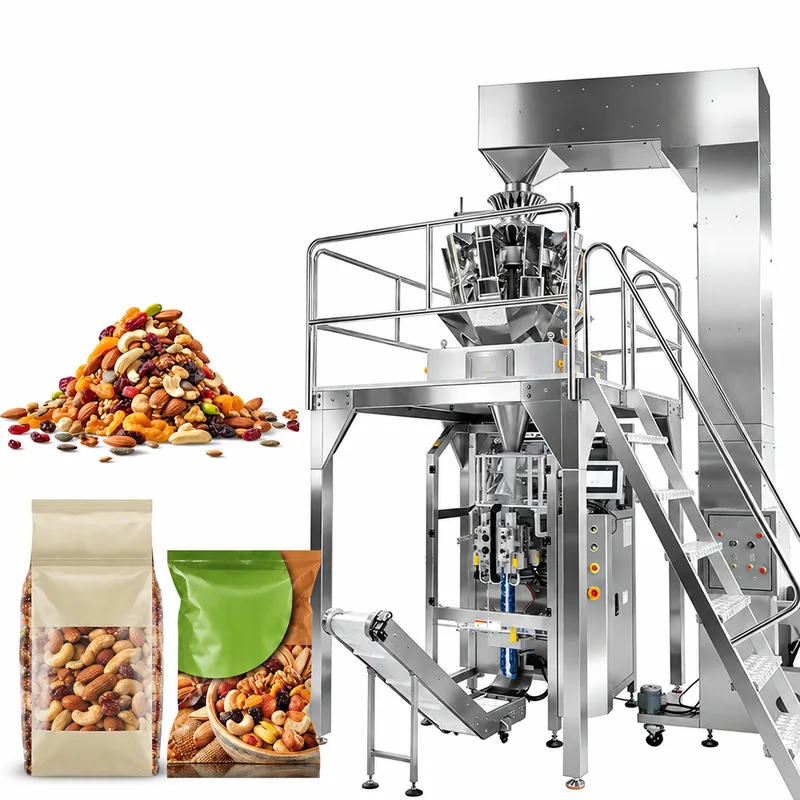
Nuts & Dried Fruit Multihead VFFS
A nut-mix bag can be on weight and still hold the wrong ratio of ingredients. Configure this multihead VFFS line from your blend, coatings, target weight and bag size.