
Vertical Form Fill Seal: Film Path, Forming & Seal Cycle
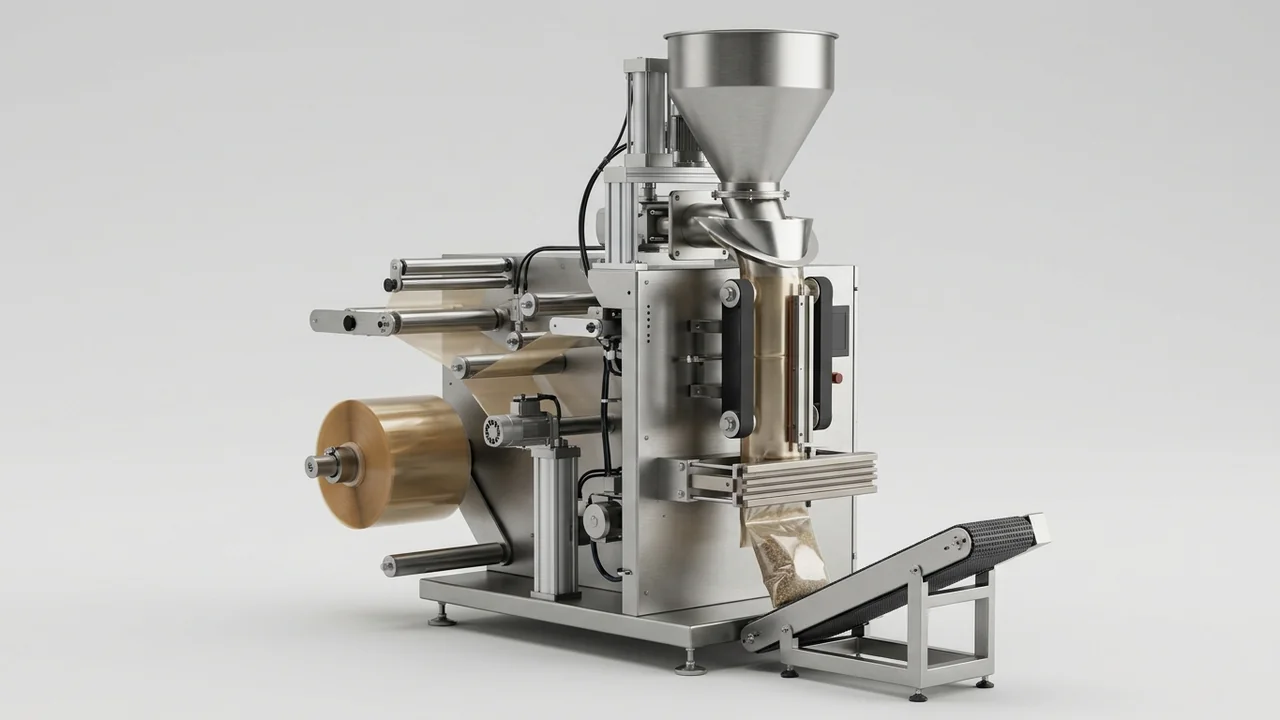
A vertical form fill seal machine folds flat rollstock over a forming shoulder around a hollow tube, seals a vertical seam, drops a dose, and cross-seals.
Scroll horizontally to read all columns, conditions and sources.
| Process attribute | Rollstock vertical form fill seal (VFFS) | Horizontal flow wrap (HFFS) | Premade pouch filler | Aseptic Blow-Fill-Seal (BFS) |
|---|---|---|---|---|
| Incoming packaging feedstock | Flat roll of plastic film, metallized foil/film, coated paper, or fabric | Flat flexible rollstock web folded around horizontal items | Finished stand-up, zipper, or spout pouches supplied by a converter | Polyolefin resin pellets (LDPE, HDPE, or PP) melted above 160 °C at 35 MPa |
| Package forming action | Cold folding over a contoured forming shoulder around a hollow vertical tube | Horizontal film folding around spaced items with long-edge seam and end crimps | Mechanical pickup and mouth opening of pre-converted pouches | Tubular parison extrusion into a two-part mold inflated by sterile air or vacuum |
| Product entry path | Gravity drop down the center of the hollow vertical forming tube | Horizontal conveyor carrying spaced discrete items or groups | Top filling into an open converter-supplied pouch mouth | Enclosed filling mandrel dosing sterile liquid or semiliquid unit volumes |
| Floor vs. ceiling layout | Uses less floor space than HFFS; needs ceiling height for overhead weigher gantry | Uses more floor space than vertical systems due to horizontal infeed conveyor | Compact filler frame paired with a reloadable empty-pouch magazine | Enclosed Grade-A cleanroom shroud with automatic CIP and SIP sterilization |
| Finished container structures | Pillow bags, side-gusseted bags, and quad-seal bags (plus dual-web 4-side sachets) | Horizontal pillow flow packs around individual bars, trays, or grouped solids | Shaped stand-up pouches, reclosable zipper pouches, and corner or top spout packs | Hermetically head-sealed sterile plastic bottles and unit-dose ampoules |
On This Page
How Does a Vertical Form Fill Seal Machine Form and Seal a Bag?
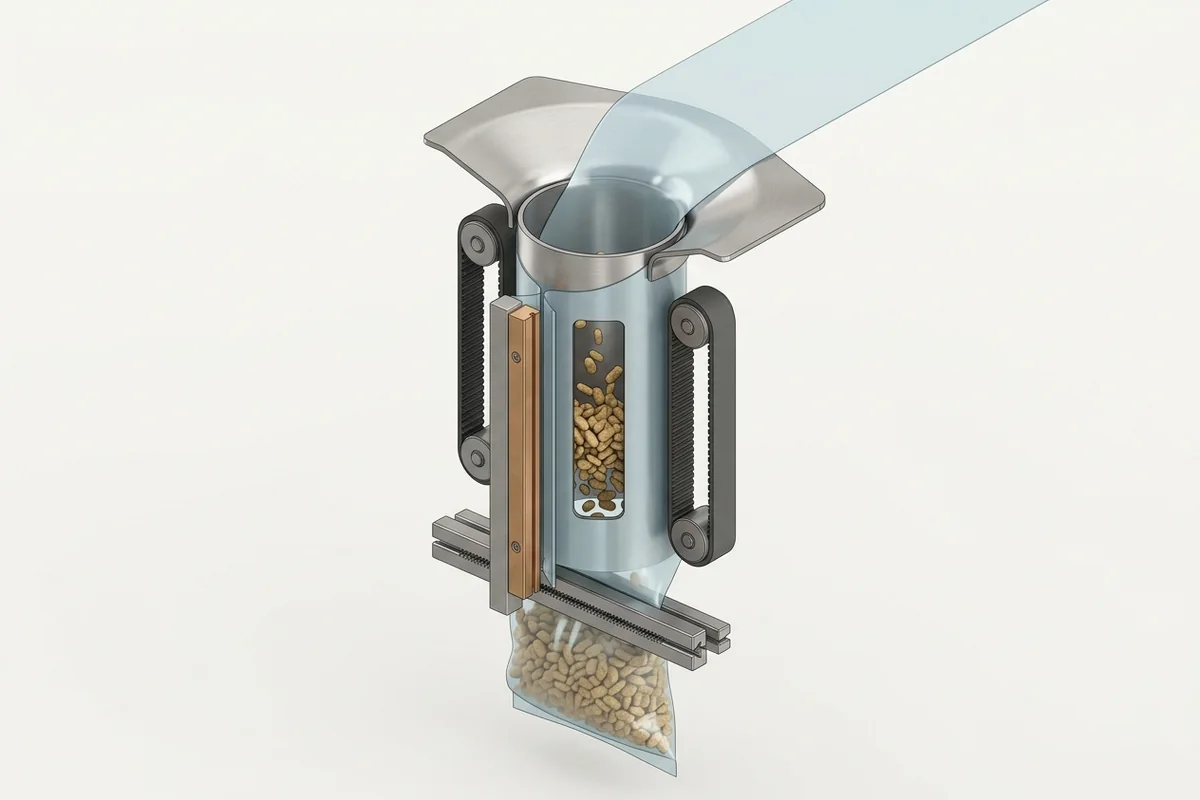
A vertical form fill seal (VFFS) machine pulls flat rollstock film from an unwind reel across tension rollers, wraps the web over a contoured forming shoulder around a hollow vertical forming tube, heat-seals the meeting vertical edges into a longitudinal seam, drops a measured solid or liquid dose down the tube, and cross-seals and cuts each bag.
Fin Seal Versus Overlap Seam and Intermittent Versus Continuous Jaws
Walter Zwoyer patented the VFFS packaging concept in 1936 while working with the Henry Heide Candy Company, establishing the vertical tube architecture documented in Wikipedia's overview of vertical form fill sealing machines. As flat film approaches the back of the hollow conical or cylindrical forming tube, its outer edges wrap around the outside of the tube as flaps. In unfolded bag drawings, total web width combines flat face width W, full unfolded side-gusset depth G, and back-seal allowance A (detailed in our bag size and film width guide). When the vertical heat-sealing bar clamps onto two outward face-to-face allowances and melts the inner sealant surfaces together, it creates a fin seal using twice the fin height; laying one film edge directly over the other creates an overlap (lap) seam using the overlap once.
To start bagging, horizontal cross-sealing jaws clamp across the bottom edge of the tube, bonding the film into a bottom seal and cutting off excess film below. Pre-measured product from an overhead multihead weigher, or material dispensed onto a precision weighing table until target gross weight is reached, falls down the hollow center of the forming tube into the bottom-sealed tube end. Filling then pauses while the horizontal sealing bar clamps above the product charge, sealing the top of the filled bag and simultaneously forming the bottom seal of the next bag above before a cutoff knife separates the finished pack. Fixed-height horizontal bars stop film motion briefly during each clamp in an intermittent sealing process, whereas faster continuous-motion VFFS machines move the horizontal sealing bar downward with the advancing bag while sealing. Single-web rollstock VFFS configurations form pillow bags, side-gusseted bags, and quad-seal coffee bags for food lines (see packaging bag styles), while dual-web vertical systems feed two rolls from opposite sides, heat-seal the bottom and sides for top loading, punch an optional tear notch, and seal the top to form four-side-seal pouches used for IVD and medical device products.
- Translate finished face, gusset, and fin-seal dimensions into rollstock film width
- Compare pillow, side-gusseted, quad-seal, and converter pouch structures
Which Stations Appear on a VFFS Machine Diagram From Reel to Discharge?
From web entry to finished pack exit, a single-web VFFS machine sequences seven functional stations: a rear unwind reel with lateral edge adjustment, web tensioning rollers, an overhead product dozer, a contoured forming shoulder and hollow vertical tube, pull-down transport belts with a vertical longitudinal sealer, gas or punch tooling, and horizontal cross-sealing cutoff jaws.
Matching Overhead Dosing and Finishing Stations to Product Behavior
Continuous flat rolls of pre-printed plastic laminate are the predominant food-packaging feedstock, yet changing edge-sealing or seaming methods allows VFFS equipment to form continuous metallized foil or film, coated paper, and fabric containers. Specialized hygiene lines can also feed incoming rollstock through a sterilizing chemical bath and dryer upstream of the forming collar.
Above the forming tube, the filling dozer matches how the product moves rather than its commercial label (compare packaging machine configurations and our multihead weighing versus auger dosing guide). Discrete pieces such as roasted nuts, potato chips, candy, and frozen dumplings use a radial multihead combination weigher that combines partial hopper weights close to target. Fine and aerated powders such as coffee mixes, creamer, and collagen use a volumetric auger screw, while viscous sauces are metered through a nozzle by a piston filler.
At the lower tube and cross-seal zone, optional finishing modules act right before or during final closure on roll-film vertical form-fill-seal systems. Introducing blower air inflates the headspace to cushion fragile snacks such as potato chips against crushing during cartoning, whereas flushing with an inert gas such as nitrogen displaces oxygen to slow bacterial spoilage. Mechanical hole-punching attachments for retail hanging display racks act concurrently with or right after the top cross-seal before the severed bag drops onto the takeaway conveyor.
How Does Vertical Form Fill Seal Differ From Blow-Fill-Seal Molding?
Vertical form fill seal folds converted flat flexible rollstock cold over a forming shoulder into heat-sealed bags and pouches, whereas aseptic Blow-Fill-Seal (BFS) melts thermoplastic polyolefin resin above 160 °C at 35 MPa to extrude, blow-mold or vacuum-form, fill, and hermetically head-seal sterile plastic bottles or ampoules inside one enclosed machine.
As documented in Wikipedia's technical summary of Blow-Fill-Seal processing, BFS operates like enclosed extrusion blow molding for sterile pharmaceutical or non-pharmaceutical liquid and semiliquid unit-dosage forms without human intervention. Polyolefin resin pellets, mainly low-density polyethylene (LDPE), high-density polyethylene (HDPE), and polypropylene (PP) chosen for chemical inertness, tightness, and shelf-life sterility, are heated above 160 °C and compressed to 35 MPa to extrude a tubular parison into an open two-part mold. Closing the main mold welds the container bottom; a filling mandrel then seals the neck and inflates the container with sterile compressed air, or smaller ampoules are shaped by vacuum forming instead. After liquid dosing through the mandrel, the mandrel retracts and a vacuum head mold hermetically seals and contours the container top before mold opening. Rotary and shuttle BFS machines maintain aseptic conditions using Grade-A-compliant overpressure sterilized-air cleanroom shrouds, automatic CIP and SIP sterilization cycles, and continuous particle and microbiological monitoring.
Within flexible packaging itself, VFFS also differs from two neighboring machinery families. Multi-lane stick-pack machines start from wide flat rollstock like VFFS, but slit the web into multiple narrow parallel lanes running side by side. Premade-pouch filling machines do not form roll film at all: they pick up finished stand-up, reclosable zipper, or spout pouches manufactured by a converter, open the mouth, fill the dose, and seal the top.
Why Does Gravity-Drop VFFS Use Less Floor Space Than Horizontal Flow Wrap?
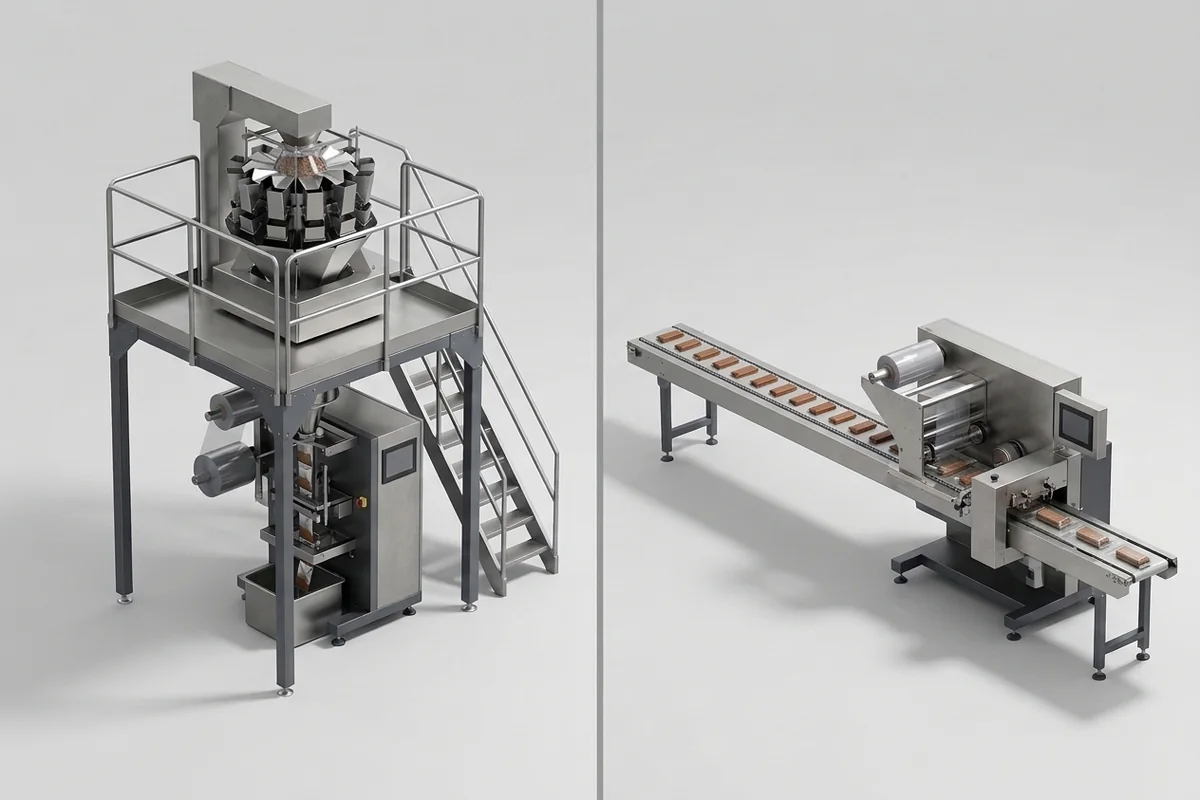
Gravity-drop VFFS machines use less horizontal floor space than horizontal form-fill-seal flow wrappers because the weigher or volumetric filler stacks vertically above the forming tube rather than needing an extended horizontal infeed conveyor to space and carry solid items into a horizontal film folding box.
The mechanical split begins where product meets film (detailed in our flow wrap versus VFFS comparison). On a horizontal flow wrapper, single solid items or grouped trays lie spaced apart on a horizontal lugged or belt conveyor while flat film folds around them horizontally before long-edge sealing and rotary end crimping. On a VFFS line, the film tube hangs vertically and an overhead weigher or volumetric filler drops each measured portion straight down through the hollow tube bore by gravity before the horizontal jaws close the top seam and form the next bag bottom.
Stacking the dosing station above the bagger trades horizontal floor footprint for vertical ceiling height clearance. Discrete-product VFFS installations combine an inclined or bucket feed elevator, an elevated platform with operator access stairs supporting the multihead combination weigher, the vertical bagmaker beneath, and an outfeed discharge conveyor (covered in our VFFS packaging line layout checklist). Room height and tube sizing also depend on fill weight and bulk density: an identical net weight of airy potato chips and dense roasted nuts calls for markedly different bag lengths, hopper volumes, and forming-tube diameters.
- Decide between horizontal flow wrapping and gravity-drop VFFS by product entry
- Check ceiling height, weigher platform stairs, and conveyor interfaces before layout sign-off
How Do Photo-Registration Eyespots and Pull Belts Control Cutoff Length?
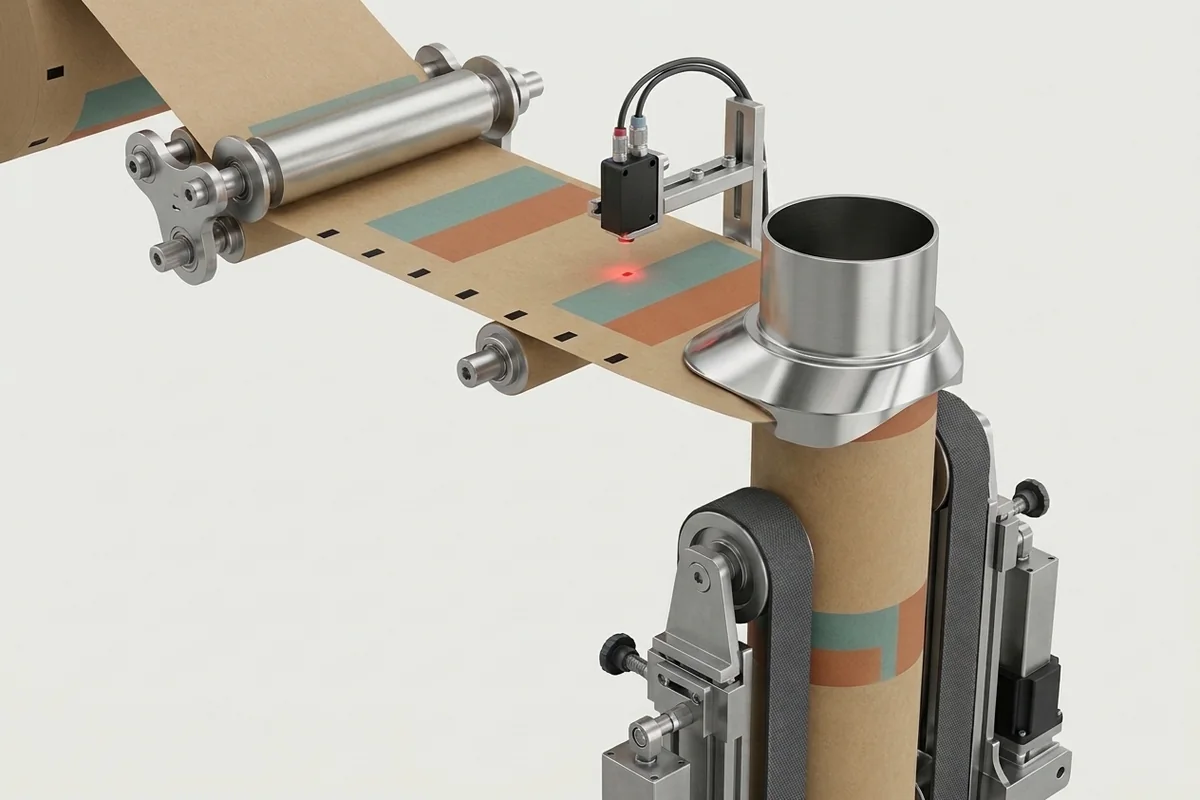
Motorized pull-down transport belts grip the film against the outside of the forming tube to draw one bag length downward per cycle, indexing cutoff either by programmed pouch length on unprinted film or by a visual photo-sensor detecting a printed registration eyespot while a lateral reel adjuster centers seam overlap.
Consistent bag length depends on keeping belt traction higher than upstream web drag across the rollers and forming collar. As shown in Matthews et al. at the University of Bath, the forming shoulder manipulates flat packaging web into a round tube without creasing or tearing, and Euler's theory for material flow around cylinders establishes an inequality relation between the packaging material's measured coefficient of friction and the forming-shoulder geometry parameters.
Downstream on the vertical tube, sliding contact under the transport belts generates frictional heat. In industrial trials pulling paper-based packaging material with transport belts, forming-tube temperature adjacent to the belt transport rose by 5.3 °C after producing approximately 15 pillow bags, a thermal rise that can elevate tube surface friction further. When recording web-path behavior on a running line, operators log whether a change starts near the unwind roll, develops along the roller path, or appears only on the finished seam, keeping sideways web drift separate from a printed eyespot landing out of position along the bag length (see our VFFS troubleshooting fault record).
What Web-Buckling and Tube-Friction Limits Affect Paper Laminates on VFFS?
In industrial VFFS runs at a 2 s dwell time, polyethylene-coated paper sealed across a 90 °C to 220 °C window compared with 100 °C first seal and 140 °C shrinkage on oriented polypropylene/polyethylene film, yet paper exhibited roller web buckling, shoulder wrinkling, forming-tube friction, and incomplete pouch airtightness.
Heat-Seal Windows, ASTM F88 T-Peel Setup, and Shoulder Roughness Data
Industrial-scale experiments reported by Merabtene et al. in BioResources at NC State University tested flexible polyethylene-coated paper laminates against thermoplastic OPP/PE film on a VFFS GKS-Compack machine equipped with an 87 mm diameter forming tube, a 140 mm wide forming shoulder producing 140 mm wide pillow bags, and 11 mm wide flat (3.1 bar) and serrated (3.8 bar) sealing jaws. Seal strength strips cut 25 mm wide by 35 mm long were evaluated under ASTM F88 (2015) using a 180° T-peel geometry.
| Runnability or seal metric | OPP/PE thermoplastic film | Paper 70 + 15 PE laminate | Paper 90 + 30 PE laminate |
|---|---|---|---|
| Heat-seal window at 2 s dwell | First seal at 100 °C; heat shrinkage at 140 °C | First seal at 90 °C; window up to 220 °C before browning | First seal at 90 °C; window up to 220 °C before browning |
| Minimum jaw pressure check | Tested on 11 mm flat (3.1 bar) and serrated (3.8 bar) jaws | Required 3 bar at 80 °C minimum for polymer chain entanglement | Required 3 bar at 80 °C minimum; zero entanglement below 3 bar |
| Shoulder surface roughness Rz (50 to 90 µm raw) | Smooth flexible bend over 140 mm forming shoulder | Rz increased by 405% after passing over forming shoulder | Rz increased by 450% due to thicker, stiffer paper web |
| Pouch compression and jaw profile result | ASTM F88 (2015) 180° T-peel on 25 mm by 35 mm strips | ~500 N compression at 110 °C; not 100% airtight; flat beat serrated | ~500 N compression at 110 °C; serrated shear caused minor surface damage |
Across the roller section, paper web buckling stemmed from shear forces produced by web tensioning and misalignment. Regulating transport speed made no considerable difference to buckling, whereas tightening web tension via adjustable pneumatic pressure control valves noticeably reduced web wander and major buckling at the cost of higher roller-to-web friction. At the forming collar, sharp edges, the run-in angle, and a narrow shoulder fillet distorted stiff paper along the bending curve, causing surface wrinkling and minor edge cuts. Before ordering coated paper or mono-material laminates for an existing VFFS former, include friction coefficients, thickness, and minimum jaw pressure data in your packaging film requirements specification.
Sources
- Merabtene, Tanninen, Varis and Leminen: Heat sealing evaluation and runnability issues of flexible paper materials in a vertical form fill seal packaging process (BioResources, NC State University)
- Matthews, Hicks, Mullineux, Goodwin and Burke: Modelling the material flow and web tension in the vertical form-fill-seal packaging process (University of Bath / Packaging Technology and Science)
- Vertical form fill sealing machine (Wikipedia)
- Blow fill seal aseptic container molding process (Wikipedia)
Frequently asked questions
How does one horizontal jaw stroke seal two bags at once on a VFFS machine?
After a pre-measured product dose drops through the hollow forming tube into the bottom-sealed film tube, the horizontal cross-sealing bar clamps above the product pile to seal the top of the filled lower bag while simultaneously forming the bottom seal of the next bag above before the knife cuts the finished package free.
When does a VFFS line use intermittent jaws versus continuous-motion jaws?
Intermittent VFFS machines clamp horizontal cross-sealing jaws at a fixed height while film transport pauses briefly during each dwell. Faster continuous-motion VFFS systems move the horizontal sealing bar downward along with the advancing film tube so heat sealing happens without stopping web motion.
What is the difference between a fin back seal and an overlap back seal?
In unfolded roll-film geometry combining face width W, side-gusset depth G, and back-seal allowance A, a fin seal folds both outer allowances outward face-to-face so two inner sealant surfaces melt together using twice the fin height, whereas a lap seal lays one outer edge over the other using the overlap allowance once.
When are dual-web four-side-seal vertical machines used instead of single-web VFFS?
Single-web VFFS systems fold one continuous roll around a forming tube to make pillow, gusseted, and quad-seal food bags, whereas dual-web vertical systems feed two rolls from opposite sides, seal the bottom and sides for top loading, optionally punch a tear notch, and seal four-side pouches often chosen for IVD and medical device products.
Why did flat sealing jaws outperform serrated jaws on PE-coated paper pouches?
In industrial VFFS trials using 11 mm wide flat jaws at 3.1 bar and serrated jaws at 3.8 bar on polyethylene-coated paper laminates, serrated jaws produced slightly lower seal and compression strength than flat jaws because localized dynamic shear stresses caused minor surface damage to the paper substrate.
Explore the Equipment
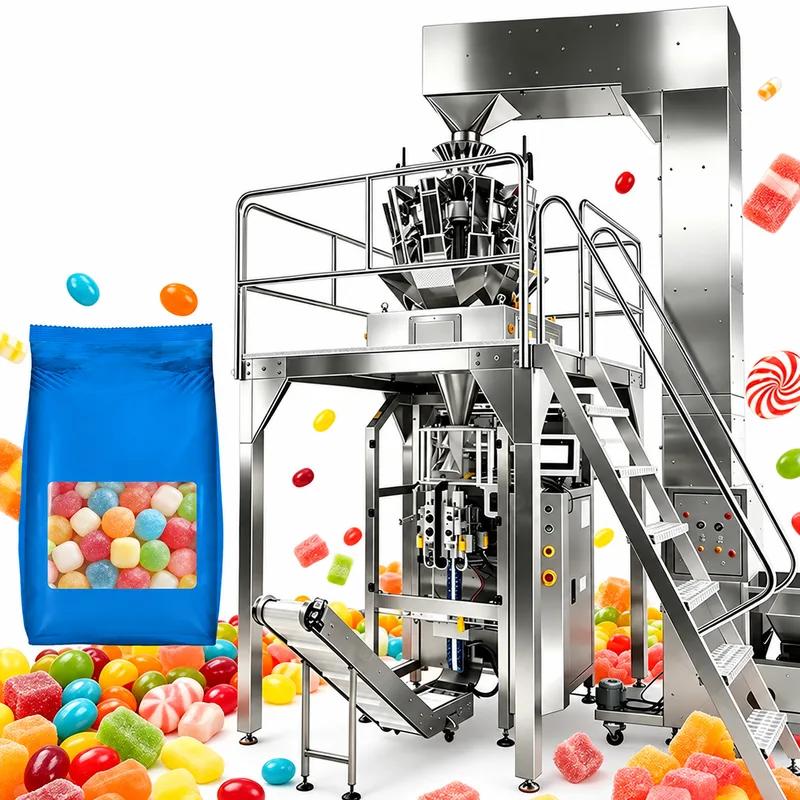
Vertical Form Fill Seal
Candy Multihead Weighing & Packaging
A correct bag weight can still hide broken, stuck or wrongly mixed sweets. Residue held on a contact surface can release into the next bag. This multihead weigher and VFFS line is set up around your candy's coating, size and pack.
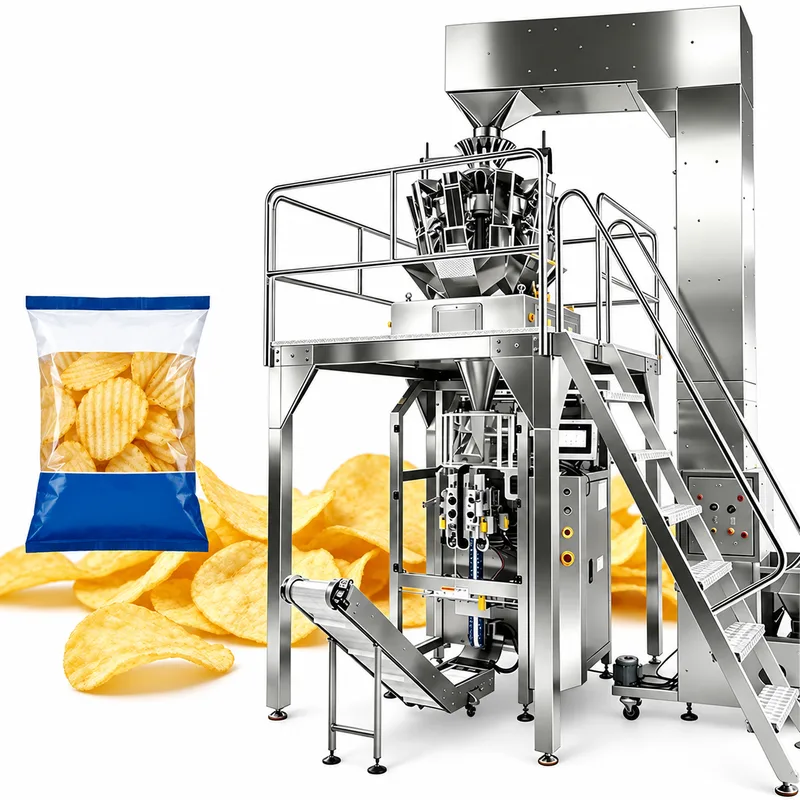
Vertical Form Fill Seal
Chips Packaging with Nitrogen Flushing
An inflated bag can hide broken chips, a short fill or a weak seal. Size this weigher, VFFS and nitrogen-flush line from your chip volume, breakage limit and gas supply.
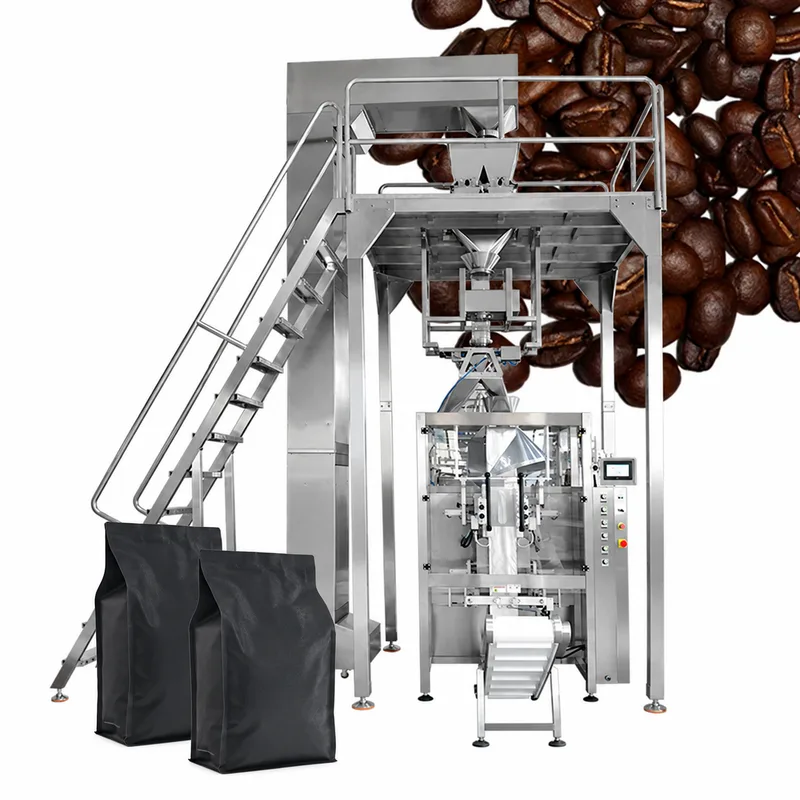
Vertical Form Fill Seal
Quad-Seal Coffee Packaging
A quad-seal coffee bag that will not stand, or skews at the corners, wastes film and coffee. Specify the corners, gussets, base, valve and dosing method from your bag drawing.