
Detergent Powder Packing Machine: Dosing, Dust & Seals
A detergent powder packing machine pairs flow-matched dosing, 316L steel, tube dust extraction, and PE cross seals to prevent weight drift and leaks.
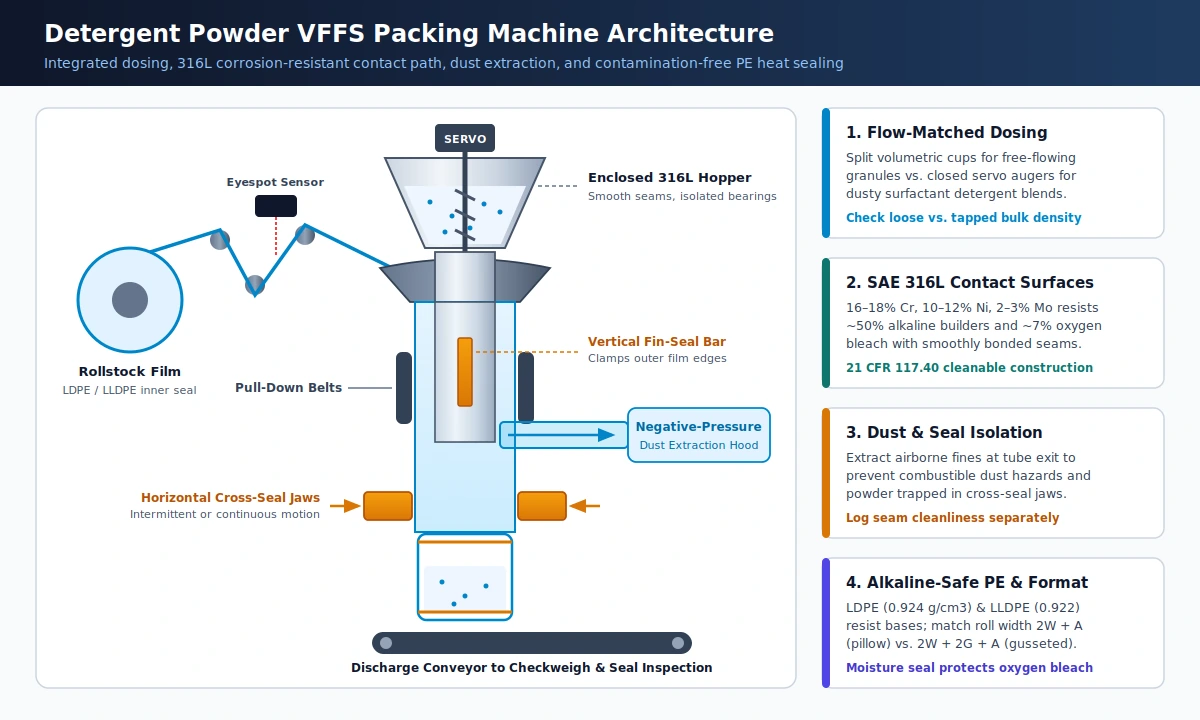
Scroll horizontally to read all columns, conditions and sources.
| Configuration factor | Free-flowing spray-dried laundry granules | Fine, dusty concentrated surfactant blends |
|---|---|---|
| Primary dosing mechanism | Volumetric cup filler or linear weigher paired with working cup-volume and emptying logs | Closed servo auger filler with documented screw identity, commanded movement, and positive cutoff arrangement |
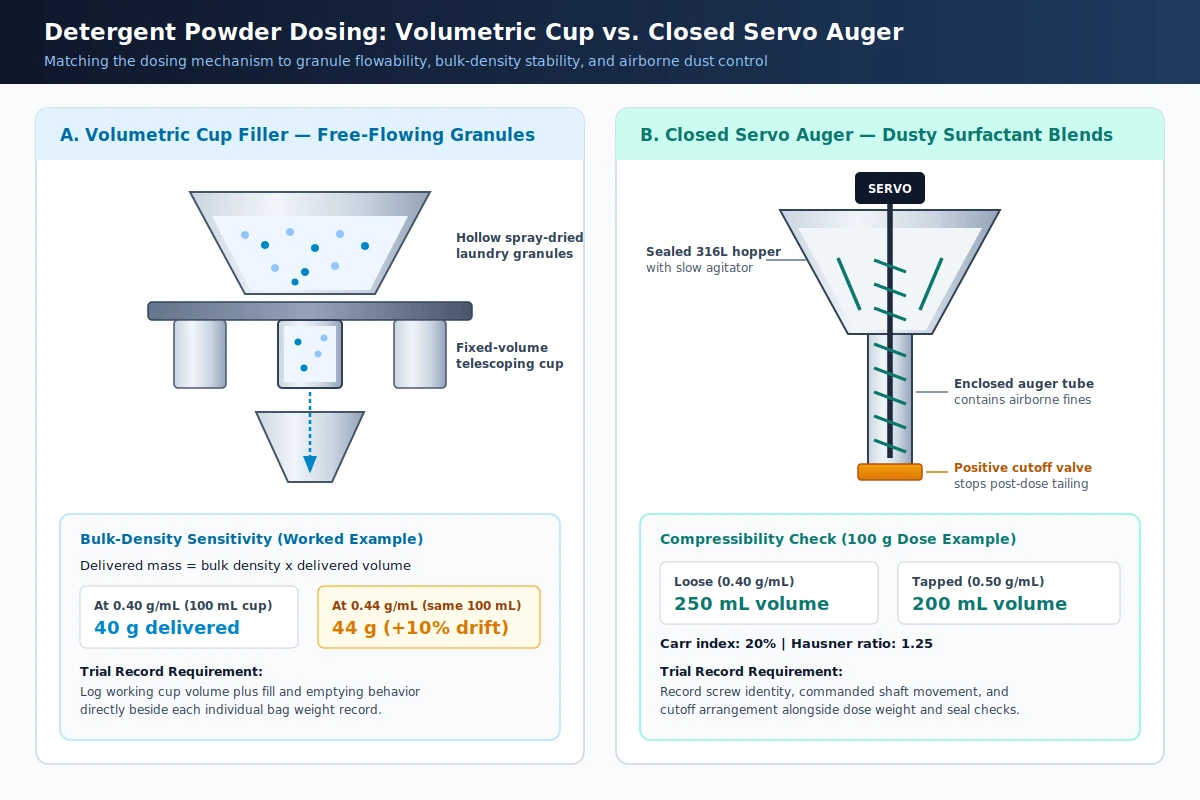
| Bulk-density sensitivity | Fixed 100 mL cup delivers 40 g at 0.40 g/mL versus 44 g at 0.44 g/mL if bulk density shifts | Loose versus tapped volume (250 mL vs. 200 mL per 100 g; Carr index 20%, Hausner ratio 1.25) governs hopper agitation and headspace |
| Product-contact metallurgy | SAE 316L stainless steel (16-18% Cr, 10-12% Ni, 2-3% Mo) with smoothly bonded seams for ~50% alkaline builders | SAE 316L closed conveying and sealed drive assemblies built to prevent lubricant or particle accumulation around ~7% oxygen bleach |
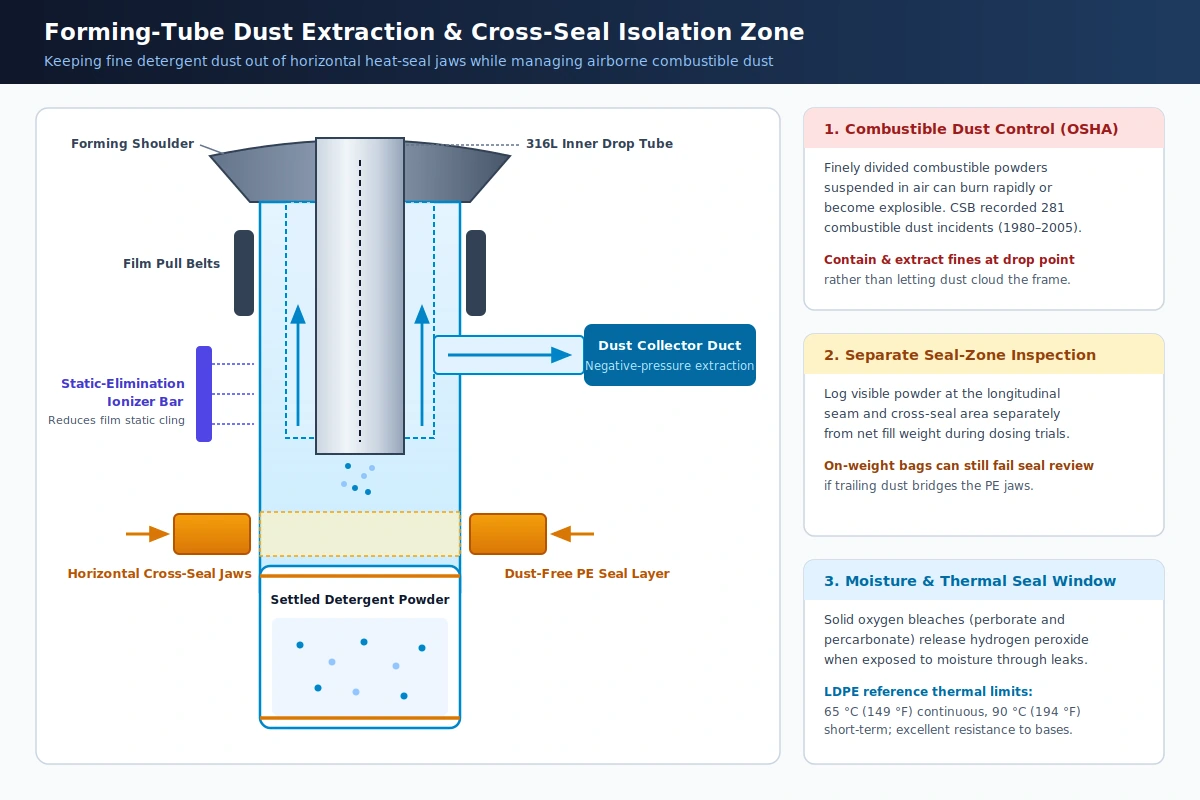
| Dust and heat-seal control | Forming-tube exhaust collar and separate longitudinal and cross-seal visual inspection beside net mass checks | Annular negative-pressure dust extraction, static-elimination bar, and strict combustible-dust containment away from PE jaws |
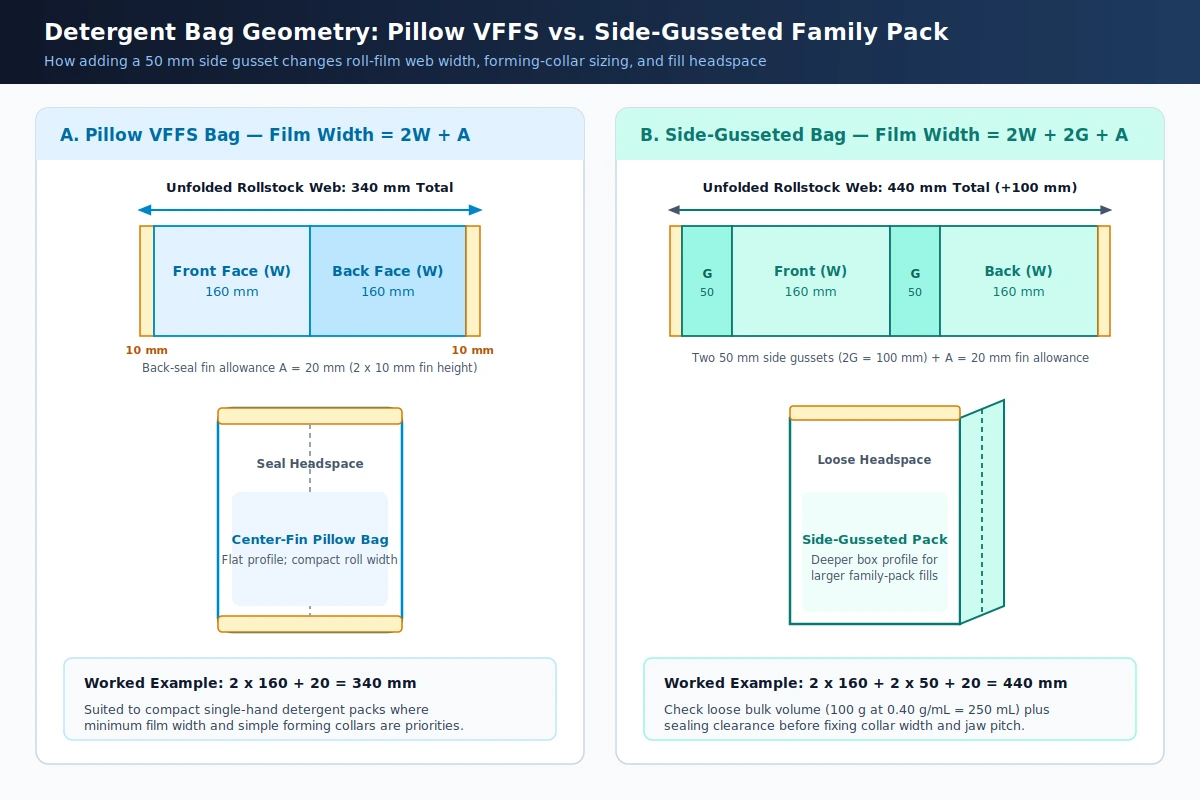
| Roll-film structure and width | LDPE (0.924 g/cm3) or LLDPE (0.922 g/cm3) alkaline-resistant inner seal; pillow width 2W + A (340 mm at W = 160 mm, A = 20 mm) | Moisture-tight laminate over LDPE/LLDPE inner seal (65 °C continuous / 90 °C short-term); side-gusset width 2W + 2G + A (440 mm with G = 50 mm) |
On This Page
When Should Spray-Dried Laundry Detergent Run on Volumetric Cups Versus a Closed Servo Auger?
A detergent powder packing machine runs free-flowing spray-dried granules on volumetric cups or linear weighers and dusty surfactant blends on a closed servo auger, while using molybdenum-bearing SAE 316L stainless steel, forming-tube dust extraction, and alkaline-resistant polyethylene cross-seal jaws so pouches avoid weight drift, chemical corrosion, and dust-contaminated seals.
How Bulk-Density Drift Controls Volumetric Cup Repeatability
For any volumetric dosing mechanism, delivered mass equals bulk density multiplied by delivered volume under the same material condition. Because spray-dried laundry granules can shift in aeration between storage hoppers and surge bins, even a modest density shift changes net weight on a fixed cup. As a worked arithmetic illustration from our powder packaging engineering reference, a 100 mL delivered volume yields 40 g at an assumed bulk density of 0.40 g/mL, but rises to 44 g at 0.44 g/mL if the delivered volume stays unchanged. Free-flowing hollow granules with tight density control can run cleanly on volumetric cups or linear scales, provided operators log working cup volume alongside fill and emptying behavior directly beside each bag weight record.
When Dusty Surfactant Blends Require a Closed Servo Auger
Fine, cohesive, or surfactant-heavy detergent blends aerate during filling and settle under vibration, which widens the gap between loose and tapped density. In a reference 100 g dose example, a powder at an assumed loose density of 0.40 g/mL occupies 250 mL before package clearance, whereas the same 100 g at an assumed tapped density of 0.50 g/mL occupies 200 mL, corresponding to a Carr index of 20% and a Hausner ratio of 1.25. When compressibility and airborne dust climb, a closed servo auger inside an enclosed drop tube contains fines far better than an open cup plate. During paired auger evaluations (detailed in our auger versus volumetric cup VFFS trial record), record screw identity, commanded movement, and the bottom cutoff arrangement beside individual pouch weights so dosing stability can be verified across hopper refills.
Which Polythene and Laminated Pouch Structures Prevent Moisture Caking and Chemical Pinholing?
Detergent pouches rely on low-density polyethylene (LDPE) or linear low-density polyethylene (LLDPE) inner sealant layers for alkaline chemical resistance, paired with moisture-barrier outer laminates that keep water vapor away from solid oxygen bleaches so the powder neither cakes nor releases hydrogen peroxide inside the pack.
Modern powdered laundry bleaches are typically stable solid adducts of hydrogen peroxide, such as sodium perborate and sodium percarbonate, as documented in Wikipedia's overview of laundry detergent chemistry. These compounds remain inactive as dry solids, yet they release hydrogen peroxide upon exposure to water. Any pinhole, micro-channel, or moisture-permeable seam admits ambient humidity, triggering caking and active-oxygen degradation during storage.
Polyethylene sealant layers address the alkaline side of the formula directly. According to Wikipedia's reference data on low-density polyethylene, LDPE has a listed density of 0.924 g/cm3 with a highly branched structure and some cross-links, while LLDPE has a listed density of 0.922 g/cm3 with short branches. LDPE delivers excellent chemical resistance—meaning no attack or chemical reaction—to dilute and concentrated acids, alcohols, bases, and esters. At room temperature, however, LDPE is reactive to strong oxidizers and exhibits only limited resistance (moderate attack suitable for short-term use only) to aliphatic and aromatic hydrocarbons, mineral oils, and oxidizing agents. LDPE also carries a continuous temperature rating of 65 °C (149 °F) and a short-term thermal limit of 90 °C (194 °F), so heat-seal jaw temperature and dwell profiles should fuse the inner sealant reliably without overheating or thinning the barrier laminate.
How Do Corrosion-Resistant Stainless Surfaces and Sealed Assemblies Survive Alkaline Detergent Powders?
Detergent packing machines resist alkaline and oxidative wear by building hoppers, augers, and forming tubes from molybdenum-bearing SAE 316L stainless steel with smoothly bonded seams and enclosed drive assemblies that keep corrosive powder out of bearings and prevent lubricant contamination.
Why Laundry Detergent Formulations Attack Standard Metal Surfaces
A typical powdered laundry detergent formulation combines approximately 50% builders by weight, 15% surfactants, 7% bleach, and 2% enzymes, alongside corrosion inhibitors, fillers, and formulation aids (Wikipedia: Laundry detergent). Early builders such as sodium carbonate (washing soda) and sodium silicate (waterglass), followed in the 1930s by sodium phosphates, polyphosphates, and phosphonates, operate as alkali builders that raise wash pH to boost cleaning performance. Surfactants in laundry powders are mostly anionic and non-ionic, while cationic surfactants are normally incompatible with anionic detergents and are reserved for special effects such as fabric softeners or antistatic agents. Combined with solid oxygen bleaches that react when damp, airborne alkaline dust settles into unsealed crevices and accelerates corrosion during washdown or humid ambient swings.
SAE 316L Metallurgy and Sanitary Construction Principles
Sanitary equipment design rules codified in 21 CFR 117.40 Equipment and utensils provide a proven engineering benchmark for chemical-powder machinery as well. Contact surfaces must be corrosion-resistant, built from nontoxic materials capable of withstanding the intended environment, cleaning compounds, sanitizing agents, and cleaning procedures, and constructed to avoid adulteration with lubricants, fuel, metal fragments, or contaminated water. Seams on contact surfaces must be smoothly bonded or maintained to minimize particle and dirt accumulation, and gravimetric, pneumatic, closed, and automated conveying systems must be designed so they can be maintained in a clean condition.
To meet these durability demands in alkaline and bleach-bearing lines, engineers step up from standard SAE 304 to SAE 316L stainless steel. As summarized in Wikipedia's SAE 316L stainless steel specification, SAE 316L is an austenitic stainless steel and the second most common grade after SAE 304. Its primary alloying constituents after iron are 16–18% chromium, 10–12% nickel, and 2–3% molybdenum, plus up to 2% manganese—an alloy balance widely selected across chemical, petrochemical, food-processing, pharmaceutical, and wastewater-treatment equipment.
How Do Dust-Extraction Collars and Seal-Zone Controls Keep Fine Powder Out of Horizontal Jaws?
Annular negative-pressure extraction collars around the forming-tube exit, enclosed dosing transitions, static-elimination bars, and separate longitudinal and cross-seal inspections keep fine detergent dust from settling into vertical and horizontal heat-sealing jaws while controlling airborne combustible-dust hazards around the VFFS bagger frame.
Combustible dust management is a primary safety discipline on any fine chemical or organic powder line. According to OSHA's Combustible Dust guidance, any combustible material can burn rapidly when in a finely divided form, and if suspended in air at the right concentration under certain conditions, it can become explosible. Even materials that do not burn in larger pieces, such as aluminum or iron, can be explosible in dust form under proper conditions. The U.S. Chemical Safety and Hazard Investigation Board (CSB) identified 281 combustible dust incidents between 1980 and 2005, underscoring why airborne fines must be captured at the drop point rather than allowed to cloud the machine enclosure.
On a vertical form-fill-seal machine, flat roll film wraps around a hollow conical forming tube while a vertical heat-sealing bar clamps onto the outer edges of the film (Wikipedia: Vertical form fill sealing machine). A horizontal sealing bar then clamps across the bottom edge of the tube to form the bottom seal and cut off film below, operating either as a fixed-height intermittent process or as a faster continuous process where the jaws move downward with the bag. Film feeding and bag cutting are governed either by fixed pouch length or by indexing an optical sensor to a printed eyespot registration mark.
Because trailing powder falls through the exact film zone the horizontal jaws clamp moments later, net-weight verification alone never confirms package integrity. During powder dosing trials (structured in our powder dosing trial guide), visible powder at the longitudinal seam or cross-seal area must be recorded separately from dose weight, because a pouch hitting its expected net mass can still fail seal review if fines bridge the sealant layer.
- Plan a powder dosing trial with separate refill and seal-zone logs
- Review VFFS film path, forming shoulder, and seal cycle fundamentals
When Should Larger Family-Pack Detergent Bags Shift From Pillow VFFS to Side-Gusseted Formats?
Shift from a standard pillow VFFS bag to a side-gusseted format when larger family-pack detergent weights need a deeper upright shelf footprint and wider headspace clearance, keeping in mind that adding side gussets expands unfolded roll-film width and requires a matching forming collar.
Powdered laundry detergent remains a massive high-volume global category: worldwide sales of powdered detergent reached 14 million metric tons in 2018, double the volume of liquid detergents (Wikipedia: Laundry detergent). Across retail tiers, smaller single-hand packs often stay on compact center-fin pillow bags, whereas multi-kilogram family packs move to side-gusseted or stand-up pouch formats for easier shelf stacking and pouring stability.
Format selection directly changes rollstock width and forming tooling. Geometric roll-film width follows 2W + A for a pillow bag and 2W + 2G + A for a side-gusseted bag, where W is flat face width, G is full unfolded side-gusset depth, and A is the back-seal allowance (detailed in our bag size and film width guide). Using assumed inputs of W = 160 mm and a 10 mm fin height (giving A = 20 mm), the pillow bag film width estimate is 340 mm. Adding a 50 mm side gusset (G = 50 mm) raises the side-gusseted film width estimate to 440 mm—an extra 100 mm of web width that must fit the VFFS frame, unwind reel, and jaw width. Before finalizing bag length, check loose bulk volume (such as 250 mL for 100 g at 0.40 g/mL loose density) plus vertical drop clearance so settled powder stays well below the horizontal cross-seal bar.
- Calculate unfolded rollstock film width for pillow and side-gusseted bags
- Compare roll-film VFFS systems against premade stand-up pouch machines
What Dosing, Metallurgy, and Dust-Control Options Drive Machine Configuration Scope?
Four engineering choices define the build scope of a detergent powder packing machine: matching the dosing head to loose and tapped bulk-density behavior, specifying molybdenum-bearing SAE 316L contact metallurgy and closed conveying, sizing roll-film width and forming-collar tooling, and integrating forming-tube dust extraction with separate seal-zone verification.
First, confirm whether the product runs as a free-flowing spray-dried granule suited to volumetric cup metering (with working cup volume and emptying logs) or a fine, compressible surfactant blend needing a closed servo auger with documented screw identity, commanded shaft movement, and positive cutoff tooling. Second, lock in SAE 316L stainless steel (16–18% chromium, 10–12% nickel, 2–3% molybdenum) with smoothly bonded seams and isolated drive assemblies so alkaline builders and moisture-sensitive oxygen bleaches do not corrode contact zones or foul bearings.
Third, size the forming tube, collar, and horizontal jaws—intermittent fixed-height or continuous moving—against unfolded web width (2W + A for pillow bags versus 2W + 2G + A for side-gusseted packs) and loose-density headspace. Fourth, specify an annular negative-pressure dust-extraction collar, eyespot registration sensor, and a pre-shipment trial sheet that tracks longitudinal and cross-seal cleanliness separately from dose weight.
Sources
All safety, sanitary-design, chemical, metallurgical, polymer, and VFFS engineering data in this guide is grounded in the following public reference documents:
- OSHA Combustible Dust Overview (U.S. Department of Labor)
- 21 CFR 117.40 — Equipment and utensils (Electronic Code of Federal Regulations)
- Laundry detergent formulation, builders, surfactants, and oxygen bleaches (Wikipedia)
- SAE 316L stainless steel alloy composition and industrial uses (Wikipedia)
- Low-density polyethylene density, chemical resistance, and thermal limits (Wikipedia)
- Vertical form fill sealing machine forming tube, jaw motion, and eyespot indexing (Wikipedia)
Frequently asked questions
Why does a bulk-density shift cause weight drift on a volumetric cup detergent filler?
Volumetric dosing delivers a fixed volume, so delivered mass equals bulk density multiplied by delivered volume under the same material condition. For example, a 100 mL cup delivers 40 g at 0.40 g/mL bulk density but rises to 44 g at 0.44 g/mL if delivered volume is unchanged.
Why is SAE 316L stainless steel preferred over SAE 304 for alkaline detergent powders?
Laundry detergent powders typically contain around 50% alkaline builders such as sodium carbonate or sodium silicate plus roughly 7% oxygen bleach. SAE 316L adds 2–3% molybdenum alongside 16–18% chromium and 10–12% nickel, making it a standard chemical-industry alloy when paired with smoothly bonded, cleanable seams.
Can LDPE or LLDPE inner film layers resist both alkaline detergent builders and oxygen bleach?
LDPE (0.924 g/cm3) and LLDPE (0.922 g/cm3) offer excellent chemical resistance with no attack against alkaline bases. However, LDPE has only limited resistance to strong oxidizing agents and a 65 °C continuous (90 °C short-term) thermal limit, so moisture-barrier laminates and tight seals are essential to keep solid perborate or percarbonate bleaches dry.
Why must powder VFFS trials log seal-zone dust separately from bag net weight?
A detergent bag can hit its exact target net weight while fine trailing powder settles onto the longitudinal seam or horizontal cross-seal area. Logging visible seal-zone material separately from dose mass ensures dust-contaminated seals are caught before approving a filler or film setup.
How much wider is roll film for a side-gusseted detergent bag compared to a pillow bag?
Geometric film width is 2W + A for a pillow bag and 2W + 2G + A for a side-gusseted bag. At a 160 mm face width (W) and 20 mm back-seal allowance (A), a pillow bag uses 340 mm film width, whereas adding a 50 mm side gusset (G) increases the roll width to 440 mm.
Explore the Equipment
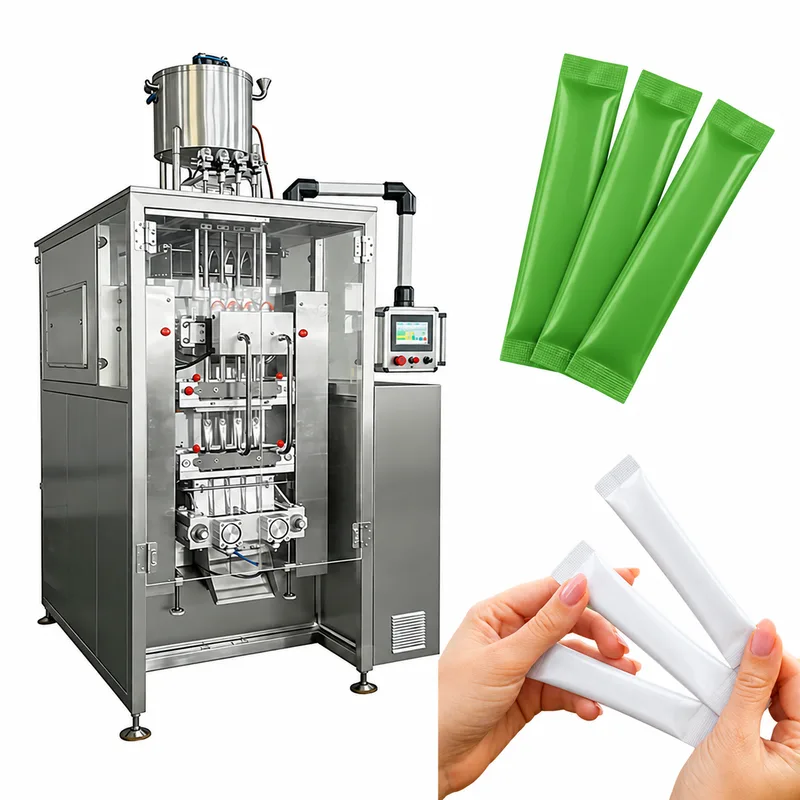
Multi-Lane Stick Packs
Four-Lane Collagen Stick-Pack Machine
Four lanes can hide one lane that under-doses. Specify this four-lane collagen stick-pack machine from your powder density, serving weight and stick size, and sample every lane.
Multi-Lane Stick Packs
Four-Lane Coffee Powder Stick Packs
Instant, agglomerated, blended and ground coffee do not dose alike on one screw. Specify this four-lane coffee stick-pack line from your exact formula, serving and stick, and check every lane.
Multi-Lane Stick Packs
Four-Lane Creamer Stick-Pack Machine
Creamer that cakes in the hopper or dusts the seal can cause runs of rejected sticks. Specify this four-lane creamer stick-pack line from your formula, serving, moisture sensitivity and changeover order.