
Small Vertical Form Fill Seal Machine: Compact VFFS Guide
How to specify a small vertical form fill seal machine for low ceilings, narrow doors, single-phase 220 V or 240 V power, shop air, and industrial servo reliability.
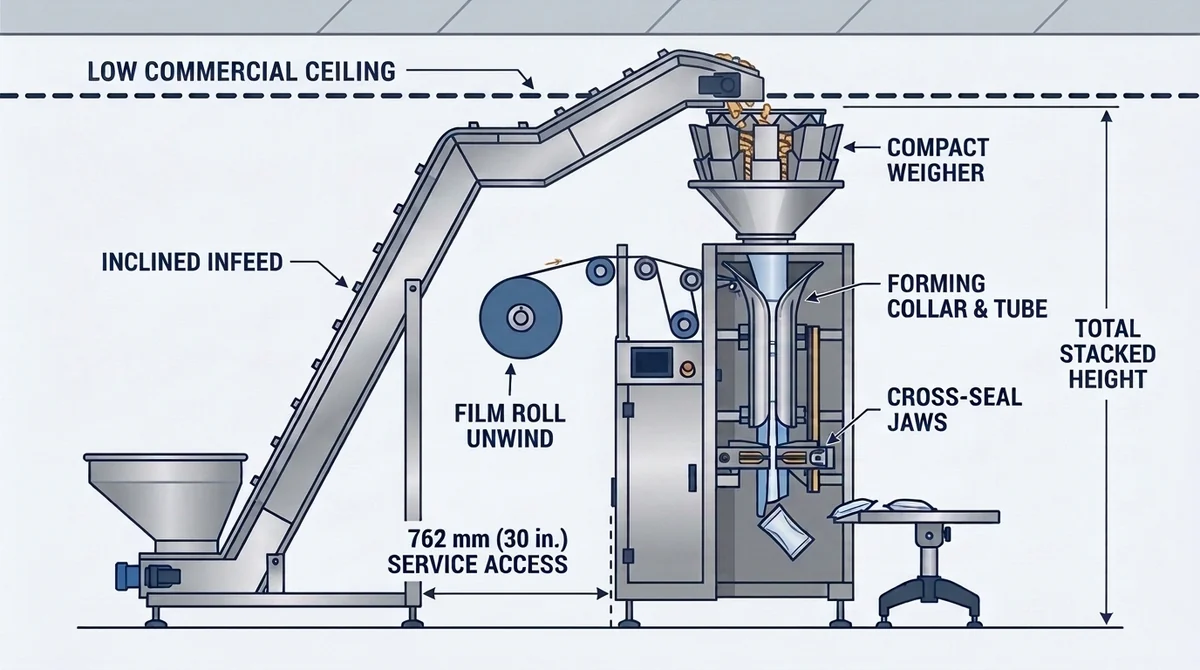
Scroll horizontally to read all columns, conditions and sources.
| Machine tier | Bag length and width range | Published speed and power | Dosing and headroom profile |
|---|---|---|---|
| Compact four-side-seal sachet VFFS | Four-side-seal sachet bag range: 50–180 mm length and 30–140 mm width (max 320 mm film width) | 30–60 bags/min; 2.2 kW at 220 V (50/60Hz) | Integrated liquid or compact volumetric doser; lowest stacked height |
| Mid-size candy multihead VFFS | Candy multihead VFFS bag range: 80–300 mm length and 60–200 mm width (customizable) | 30–70 bags/min; 3.5 kW at 220 V / 380 V (50 Hz / 60 Hz) | Compact combination weigher or linear doser; check overhead clearance |
| Frozen-food multihead VFFS | Frozen-food multihead VFFS bag range: 100–350 mm length and 100–250 mm width (customizable) | 25–70 bags/min; 4.5 kW at 220 V/380 V (50 Hz/60 Hz) | 10-, 14-, or 20-head combination weigher; elevated platform required |
| Full-size vegetable multihead VFFS | Vegetable multihead VFFS bag range: 100–450 mm length and 80–300 mm width (customizable) | 20–55 bags/min; 4.5 kW at 220 V/380 V (50 Hz/60 Hz) | High-volume multihead weigher tower and tall bucket elevator |
On This Page
What Bag-Width, Drop-Height, and Frame-Footprint Trade-Offs Define a Small VFFS Machine for Startups?
Specifying a small vertical form fill seal machine starts with total stacked height—combining the bagger frame, transition funnel, overhead doser, and infeed discharge—rather than floor footprint alone. Although vertical pouch forming systems occupy less floor area than horizontal flow wrappers, narrower bag widths, shorter drop heights, and cleanable perimeter clearances govern what fits inside a commercial room.
Roll-Film Forming Mechanics and Floor-Space Efficiency
As documented in Wikipedia's overview of vertical form fill sealing machines, a vertical form-fill-seal system constructs plastic bags and stand-up pouches from a flat roll of film, fills them with solids or liquids, and seals them along longitudinal and transverse seams. Because product drops vertically through the hollow conical forming tube rather than traveling along an extended horizontal conveyor, a horizontal form-fill-seal machine generally uses more floor space than a vertical system, while modern pouch forming advances have enabled progressively smaller vertical pouch forming systems.
Small startup lines keep frame size compact by pairing intermittent-motion sealing—where the horizontal sealing bar stays at a fixed height while clamping—with narrow rollstock webs. Material advance and cutting are controlled either by programmed pouch length or by indexing to a printed eyespot registration mark detected by a visual sensor. While plastic film dominates food packaging, changing the edge-seaming method lets vertical baggers handle continuous metallized foil/film, coated paper, and fabric containers.
Comparing Published Compact and Full-Size Envelopes
Stepping down in frame size trades maximum pouch dimensions and hourly throughput for doorway maneuverability and lower connected electrical load. Across our published vertical packaging machine configurations, a compact four-side-seal sachet machine handles bags from 50–180 mm in length and 30–140 mm in width on a maximum 320 mm film web at 30–60 bags/min and 2.2 kW (220 V, 50/60Hz). Moving up to a mid-size candy multihead VFFS expands the envelope to 80–300 mm length and 60–200 mm width at 30–70 bags/min and 3.5 kW (220 V / 380 V, 50 Hz / 60 Hz).
By contrast, full-size industrial towers for bulky frozen food or produce grow to 100–350 mm length by 100–250 mm width (with 10-, 14-, or 20-head combination weighers at 25–70 bags/min) or 100–450 mm length by 80–300 mm width (at 20–55 bags/min), both drawing 4.5 kW at 220 V/380 V. Choosing the right compact tier requires verifying your largest retail pouch width first, because a small frame cannot simply bolt on an oversized forming collar later without exceeding jaw width and pull-belt geometry.
Perimeter Clearance Beyond the Base Frame
Startups frequently measure only the machine's steel base outline against a room corner or doorway width. Under 21 CFR 117.40, food packaging equipment must be installed so as to facilitate cleaning and maintenance of both the equipment and adjacent spaces. Leaving room around the rear unwind spindle, electrical cabinet, and forming tube prevents a compact bagger from becoming an uncleanable bottleneck on inspection day (mapped alongside full-room material flow in our packaging line layout checklist).
How Do Low-Profile Weigher Mounts and Inclined Feeders Fit a Small Vertical Bagging Machine Under Standard Commercial Ceilings?
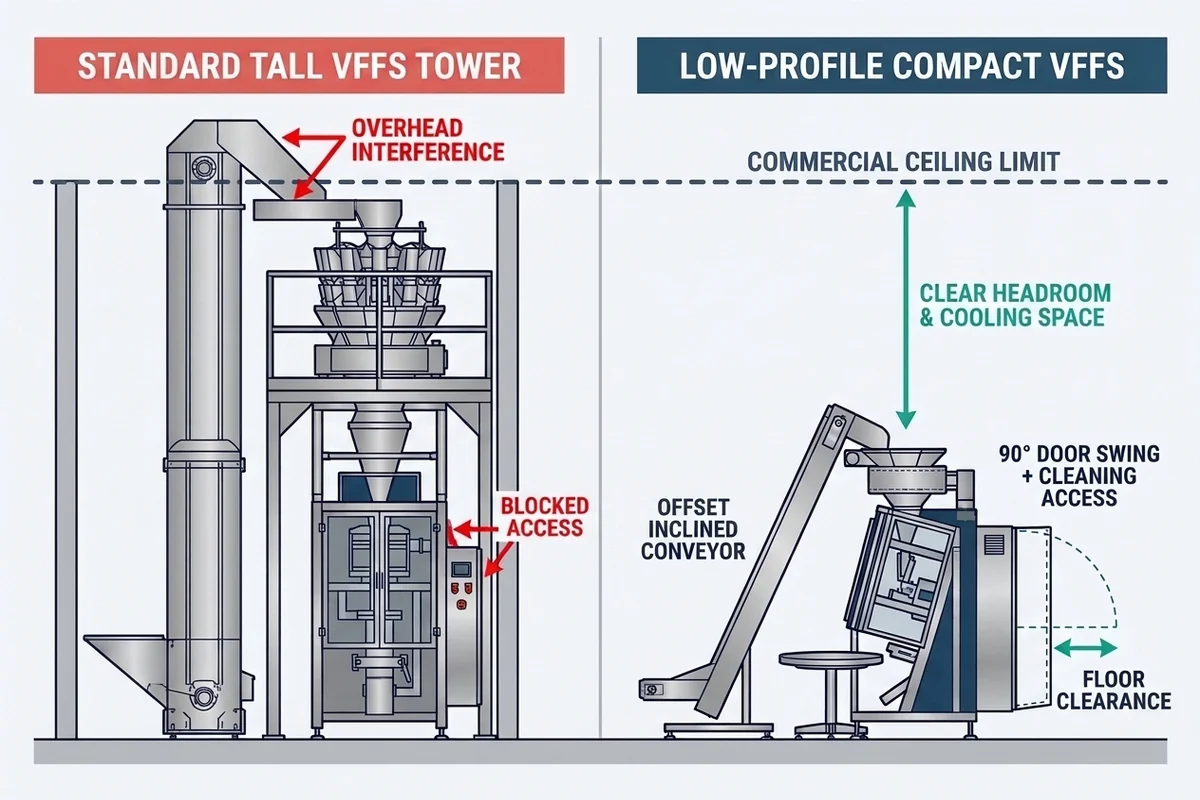
Fitting a small vertical bagging machine beneath a standard commercial ceiling requires breaking the tall vertical tower by pairing a low-profile weigher mount or inclined VFFS frame with an offset inclined feeder. Buyers must verify stacked elevation against OSHA electrical headroom, cabinet door swing, convection cooling space, and sanitary cleaning access before ordering.
Breaking the Vertical Stack With Inclined Frames and Offset Feeders
A standard VFFS tower stacks a floor-standing bagger, transition funnel, multihead weigher, mezzanine platform, and overhead elevator discharge into one vertical column. As noted in Wikipedia's multihead weigher reference, product enters the top of the weigher, disperses into pool hoppers, drops into weigh hoppers, and falls via a discharge chute into the bagmaker—and adding booster hoppers inserts an extra vertical layer of hoppers that pushes overall height even higher.
Low-ceiling commercial facilities avoid structural roof interference in three ways. First, an inclined vertical form-fill-seal machine tilts the forming tube and pairs with a multihead weigher, simple conveyor, and rotary catching table to lower overall discharge height and cushion fragile pieces. Second, dispensing product through the conical forming tube onto a precision weighing table eliminates an elevated overhead multihead mezzanine altogether for modest batch outputs. Third, replacing a tall vertical bucket elevator with an offset inclined cleated conveyor keeps the bulk loading hopper at waist height while feeding the weigher inlet cleanly below ceiling trusses.
Mandatory Electrical Headroom, Door Swing, and Cooling Clearances
Even when the steel frame barely clears ceiling sprinklers, statutory electrical working clearances often reject cramped corners. Under OSHA 1910.303 for equipment operating at 600 volts nominal or less, installations built on or after August 13, 2007 require minimum electrical working-space headroom of 1.98 m (6.5 ft), or the full height of the equipment if it exceeds 1.98 m. Front panel working space must be at least 762 mm (30 in.) wide—or the full width of the equipment—and permit at least a 90-degree opening of hinged doors or electrical panels.
Where technicians must service deenergized components at the back of enclosed electrical equipment, OSHA 1910.303 requires at least 762 mm (30 in.) of horizontal rear clearance. In addition, floor-mounted electric equipment relying on natural air convection must preserve open clearance between top cabinet surfaces and adjacent structures so rising warm air can dissipate without overheating drives or solid-state relays.
Sanitary Access Around Conveying and Gravimetric Units
Tightening vertical headroom cannot compromise food hygiene. Under 21 CFR 117.40, holding, conveying, and manufacturing systems—including gravimetric, pneumatic, closed, and automated systems—must be designed and constructed so they can be maintained in a clean and sanitary condition. Before approving a low-profile weigher bracket, confirm that operators can safely remove hoppers, wipe chutes, and inspect ceiling-adjacent transitions without disassembling structural framing.
| Clearance or layout check | Regulatory or engineering requirement | Low-ceiling compact VFFS verification step |
|---|---|---|
| Electrical working-space headroom | Minimum 1.98 m (6.5 ft) or equipment height for post-August 13, 2007 installations (OSHA 1910.303) | Measure finished ceiling beams, lighting, and sprinkler heads above the panel and weigher top |
| Front electrical panel width and door swing | At least 762 mm (30 in.) width and minimum 90-degree hinged door opening (OSHA 1910.303) | Confirm offset inclined conveyor legs do not block cabinet doors from swinging open |
| Rear deenergized servicing clearance | Minimum 762 mm (30 in.) horizontal rear working space where rear access is required (OSHA 1910.303) | Keep rear unwind spindles and back electrical access clear of perimeter walls |
| Cabinet top cooling clearance | Unobstructed space between top surfaces and adjacent structures for natural air convection (OSHA 1910.303) | Avoid mounting transition hoppers or shelving directly atop ventilated control cabinets |
| Sanitary cleaning and maintenance access | Installation must facilitate cleaning and maintenance of equipment and adjacent spaces (21 CFR 117.40) | Verify removable weigher hoppers and inclined conveyor belts clear ceiling fixtures during teardown |
Can Compact Vertical Form Fill Seal Machines Run on Single-Phase Electrical Supply and Small Shop Compressors?
Yes—many compact vertical form fill seal machines draw 2.2 kW to 3.5 kW at 220 V or 240 V single-phase, staying well below typical commercial single-phase limits. However, wiring 240 V jaw heaters to a 208 V commercial supply cuts heat output to 75%, and small shop air compressors require proper cooling, piping slope, and food-grade filtration.
Single-Phase Power Limits and the 208 V Heater Derating Trap
As summarized in Wikipedia's single-phase electric power reference, small commercial buildings in North America with services up to about 100 kVA (417 amperes at 240 volts) usually have three-wire single-phase distribution. Because single-phase AC does not naturally produce a rotating magnetic field, single-phase motors require extra starting components and rarely exceed 10 kW. Our published compact bagger ratings—such as 2.2 kW at 220 V (50/60Hz) for four-side-seal sachets and 3.5 kW at 220 V / 380 V for candy multihead VFFS—sit comfortably inside small-shop branch capacity, and facilities lacking three-phase utility service can use a phase converter when running three-phase motors.
One costly electrical trap catches startups moving into commercial business parks fed by 208 V three-phase panels: heating equipment designed for a 240-volt system connected across two phases of a 208-volt supply produces only 75% of its rated heating effect. On a VFFS machine, losing a quarter of cross-seal and vertical-seal heater wattage slows warmup, drags down temperature recovery during continuous bagging, and causes intermittent cold seals on thicker barrier laminates. Under OSHA 1910.303, every bagger must carry durable nameplate markings listing voltage, current, and wattage ratings alongside a lockable disconnecting means—items you should verify against measured site voltage using our packing machine utilities checklist.
Sizing and Treating Compressed Air for Pneumatic Jaws and Food Safety
Pneumatic cross-seal jaws, knife actuators, and optional bag-gusseting cylinders make compressed air a critical hidden load on compact VFFS installations. As detailed in Wikipedia's compressed air engineering reference, generating compressed air requires roughly 8 kW of electrical power for every 1 kW of pneumatic power produced, and energy accounts for 70–75% of a compressed air system's total lifecycle cost. Undersized shop compressors run continuously, overheat, and starve pneumatic jaw pressure during peak cycles.
Moisture and oil carryover pose an equally serious risk. Cooling compressed air to 40 °C (104 °F) in an aftercooler or receiver tank condenses two-thirds of its water vapor into liquid before entering distribution piping. Piping headers must maintain a downward slope with drain valves and take equipment branch taps from the tops of pipes so liquid condensate does not wash into VFFS solenoid valves. For food lines, 21 CFR 117.40 requires that compressed air or other gases mechanically introduced into food or used to clean food-contact surfaces be treated so food is not contaminated with unlawful indirect food additives, and that equipment prevent adulteration from lubricants or contaminated water.
What Separates an Industrial Compact Servo VFFS Frame From Light-Duty Tabletop Volumetric Baggers?
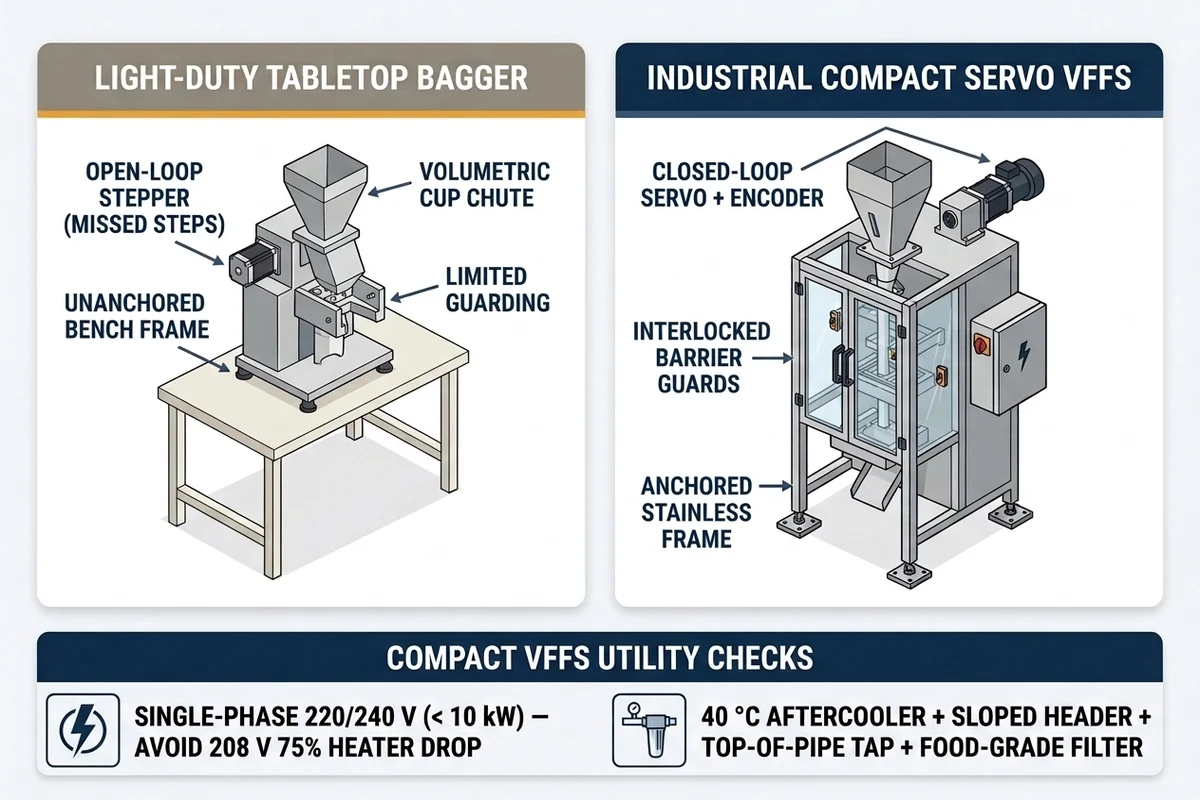
An industrial compact servo VFFS machine separates itself from light-duty tabletop volumetric baggers through closed-loop rotary-encoder motion control, standardized NEMA ICS 16 drive mountings, floor-anchored stainless frames, and sanitary food-contact seams. Tabletop units minimize upfront footprint but frequently struggle with open-loop stepper drift, unanchored vibration, and food-audit compliance.
Closed-Loop Servo Feedback Versus Open-Loop Stepper Drift
The core mechanical divide lies in how the machine pulls film and closes sealing jaws. As explained in Wikipedia's servomotor reference, modern industrial servomotor systems pair a motor with an encoder and digital servo drive that continuously regulates current, velocity, and position through closed-loop feedback over industrial fieldbuses such as EtherCAT, CANopen, and POWERLINK. Built-in torque and stall monitoring keep film pull length and jaw dwell consistent across shifting rollstock weights and bag lengths.
Light-duty tabletop baggers commonly cut hardware cost by using open-loop stepper motors without position feedback. Because an open-loop stepper cannot detect actual shaft position, any load exceeding motor capacity—such as a heavy film reel drag, high-friction laminate, or momentary jam—causes missed steps and cumulative positioning errors that force operators to stop, restart, or recalibrate the machine mid-run.
Frame Anchoring, Food-Contact Metallurgy, and Dosing Architecture
Structural rigidity and regulatory compliance widen the gap further. Under OSHA 1910.212, machines designed for a fixed location must be securely anchored to prevent walking or moving—a hazard when lightweight unbolted tabletop units vibrate across benches during rapid jaw cycling. On food lines, 21 CFR 117.40 mandates corrosion-resistant, nontoxic food-contact surfaces capable of withstanding cleaning compounds and sanitizing agents, with smoothly bonded seams that minimize accumulation of food particles, dirt, and organic matter to reduce microbial growth and allergen cross-contact.
Dosing choice also separates entry-level units from industrial compact systems. While free-flowing, fine-grained powders can be weighed more economically by volumetric feeders, cut-gate mechanisms, or linear weighers, irregular solids, coffee granules, loose tea, sticky foods, and multi-ingredient blends require industrial gravimetric weighers paired with rigid bagger frames rather than light sheet-metal tabletop housings.
| Evaluation criterion | Light-duty tabletop volumetric bagger | Industrial compact servo VFFS machine |
|---|---|---|
| Film-pull and jaw drive control | Open-loop stepper motor; overload causes missed steps requiring restart or recalibration | Closed-loop servomotor with digital drive feedback over EtherCAT, CANopen, or POWERLINK |
| Motor and gearbox mounting | Proprietary compact brackets with limited drop-in replacement interchangeability | Standardized NEMA ICS 16 flange mounting patterns and bolt circles |
| Frame stability and anchoring | Benchtop placement prone to vibration if left unanchored | Floor-anchored stainless frame satisfying OSHA 1910.212 fixed-machine anchoring rules |
| Food-contact sanitation | Check seam finish and washdown resistance closely before food-plant use | Corrosion-resistant nontoxic surfaces with smoothly bonded seams under 21 CFR 117.40 |
| Dosing compatibility | Best limited to free-flowing fine powders or uniform small granules | Supports linear weighers, auger fillers, or multihead weighers for broader SKUs |
What Spare-Parts Availability, Forming-Collar Swap Time, and Safety Guarding Checks Matter Before Ordering a Compact VFFS?
Before signing a purchase order for a compact VFFS machine, verify OSHA 1910.212 point-of-operation and nip-point guarding, lockable electrical disconnects under OSHA 1910.303, standardized servo mounting hardware, and a timed end-to-end forming-collar changeover demonstration. Skipping these checks turns a space-saving bagger into a safety liability or changeover bottleneck.
Point-of-Operation Guarding, Nip Points, and Lockout Compliance
Compact machines pack moving belts, heated sealing jaws, cutting knives, and unwind rollers closer to the operator's hands than sprawling lines, making guarding non-negotiable. Under OSHA 1910.212, one or more methods of machine guarding—such as barrier guards, two-hand tripping devices, or electronic safety devices—must protect operators from point-of-operation, ingoing nip-point, and rotating-part hazards. Point-of-operation guards must be designed and constructed so the operator cannot place any part of the body in the danger zone during the operating cycle, and any cooling or exhaust fan blades positioned less than 7 feet above the floor or working level must carry guards with openings no larger than one-half inch.
Inspect the electrical disconnect at the same time. OSHA 1910.303 requires electrical disconnecting means to be capable of being locked in the open position for safe lockout during film threading, jaw cleaning, and knife replacement, alongside durable voltage, current, and wattage nameplates.
Standardized Servo Components and Repeatable Changeover Timing
Downtime on a startup line hits hard when a single custom motor fails or a bag-width swap stalls an entire shift. Specifying industrial servomotors built to NEMA ICS 16 standardized flange mounting patterns and bolt circles makes sourcing replacement motors and gearboxes faster than relying on unlabelled proprietary actuators. Keep wear items—such as heater cartridges, sealing bands, pull belts, and cutting knives—separated from format parts like forming collars using clear machine identity and component markings (detailed in our spare parts identification guide).
When evaluating forming-collar swap time, never accept a bare bolt-unfastening claim. Ask the supplier to demonstrate a complete transition from the last accepted old-format bag through cleaning, collar installation, film threading, eyespot registration mark alignment, and release of the first accepted new-format pack—following the stopped-line boundaries laid out in our changeover planning guide.
How Do You Plan Future Capacity Scaling When Starting With a Compact Vertical Pouch Packing Machine?
Planning future capacity on a compact vertical pouch packing machine means treating the bagger as a modular stage inside a staged growth path. Reserve electrical, headroom, and downstream floor space so you can upgrade from volumetric or linear dosing to multihead weighing, add nitrogen flushing, and integrate checkweighers without replacing the room layout.
Upgrading Dosing Heads, Sealing Motion, and Gas Flushing
Most growing brands start by automating one clear manual bottleneck on a representative pilot SKU rather than over-buying a high-speed tower on day one (outlined in our buying your first packaging machine guide). On the dosing side, free-flowing fine powders can begin on an economical volumetric feeder or linear weigher, then scale into a 10-, 14-, or 20-head combination weigher—or add booster hoppers as an extra hopper layer to expand combination options for higher speed and tighter weight accuracy.
When shelf-life or throughput demands outgrow an entry-level intermittent-motion bagger whose fixed-height horizontal sealing bar pauses film travel on each cycle, continuous-motion sealing systems move the horizontal jaws downward with the bag to raise cycle rate. Similarly, if retail distribution requires extended freshness without chemical preservatives, leaving space for inert nitrogen flushing—often supplied via on-demand nitrogen generators—protects fragile snacks from crushing while displacing oxygen.
Integrating Downstream Inspection Without Rebuilding the Room
A compact bagger that outpaces manual case packing simply moves the bottleneck downstream. Because complete packaging lines integrate vertical form-fill-seal bagmakers with rotary catching tables, simple discharge conveyors, checkweighers, and X-ray inspection systems, reserve linear floor length past the discharge chute from day one. Confirming electrical branch spare capacity and overhead headroom for future feeders on your initial layout drawing lets your first compact VFFS line scale cleanly into multi-shift production.
Sources
All vertical bagger mechanics, low-ceiling electrical clearances, food-contact sanitation rules, machine guarding standards, single-phase power behavior, compressed-air conditioning figures, and industrial servo motion specifications in this guide are grounded in the following public reference documents:
- Wikipedia — Vertical form fill sealing machine
- eCFR — 21 CFR 117.40 Equipment and utensils
- OSHA 1910.212 — General requirements for all machines
- OSHA 1910.303 — General electrical requirements
- Wikipedia — Single-phase electric power
- Wikipedia — Compressed air
- Wikipedia — Servomotor
- Wikipedia — Multihead weigher
Frequently asked questions
What is the biggest layout mistake when specifying a small vertical form fill seal machine?
Measuring only the base footprint of the bagger frame and ignoring stacked vertical height—including the overhead weigher, transition funnel, and infeed discharge—along with required clearances. Under OSHA 1910.303, electrical working spaces need at least 1.98 m (6.5 ft) of headroom and 762 mm (30 in.) of width with 90-degree door swing, while 21 CFR 117.40 requires installation access for cleaning and maintaining both the machine and adjacent spaces.
Can a compact VFFS machine operate on single-phase 220 V or 240 V power?
Yes. Compact baggers drawing 2.2 kW to 3.5 kW at 220 V or 240 V fit standard small-commercial services. Single-phase motors rarely exceed 10 kW. Check actual site supply voltage first, because running 240-volt sealing heaters on a 208-volt commercial supply reduces heating output to 75%.
What compressed air treatment does a small food VFFS line need from a shop compressor?
Cool the discharge air to 40 °C (104 °F) in an aftercooler or receiver tank to condense two-thirds of water vapor before piping, slope distribution headers with drain valves, and pull branch lines from the tops of pipes. Under 21 CFR 117.40, any compressed air contacting food or food-contact surfaces must also be treated so it cannot introduce unlawful indirect food additives or lubricants.
Why choose an industrial compact servo VFFS instead of a light-duty tabletop volumetric bagger?
Industrial compact servo frames use closed-loop rotary-encoder feedback and digital drives that prevent the missed steps and recalibration stops common on open-loop stepper machines under variable film load. They also provide floor-anchored stability under OSHA 1910.212, standardized NEMA ICS 16 motor flanges, interlocked point-of-operation guards, and 21 CFR 117.40 smoothly bonded corrosion-resistant food-contact surfaces.
How can a startup scale output later without outgrowing its first compact VFFS room?
Reserve ceiling clearance, electrical capacity, and outfeed floor length on the initial drawing so you can transition from a volumetric or linear feeder to a 10-, 14-, or 20-head combination weigher, add booster hoppers or on-demand nitrogen flushing, and place checkweighers or X-ray inspection downstream of the discharge conveyor.
Explore the Equipment
Vertical Form Fill Seal
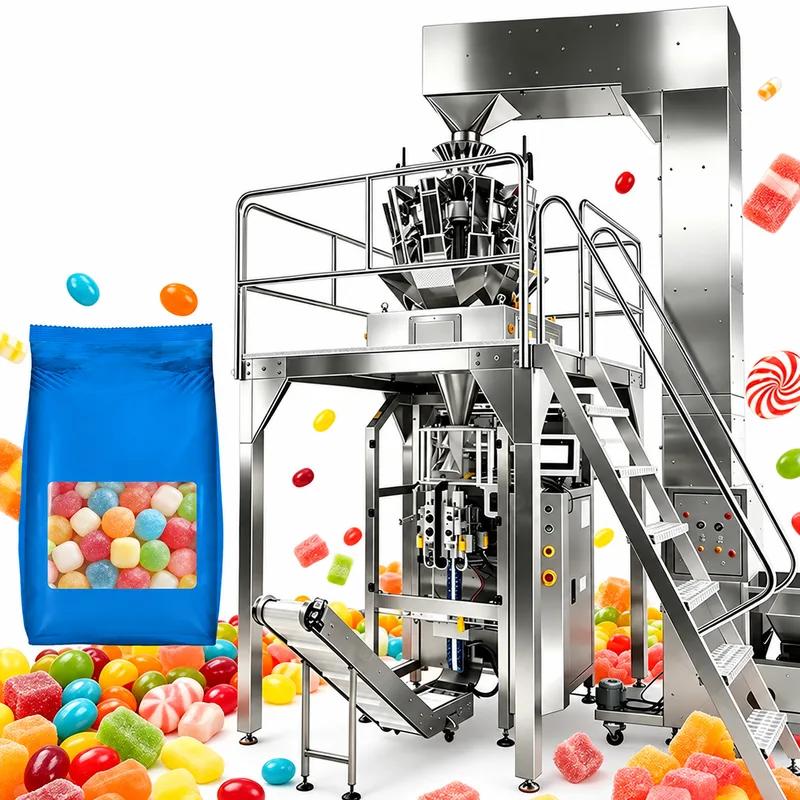
Candy Multihead Weighing & Packaging
A correct bag weight can still hide broken, stuck or wrongly mixed sweets. Residue held on a contact surface can release into the next bag. This multihead weigher and VFFS line is set up around your candy's coating, size and pack.
Vertical Form Fill Seal
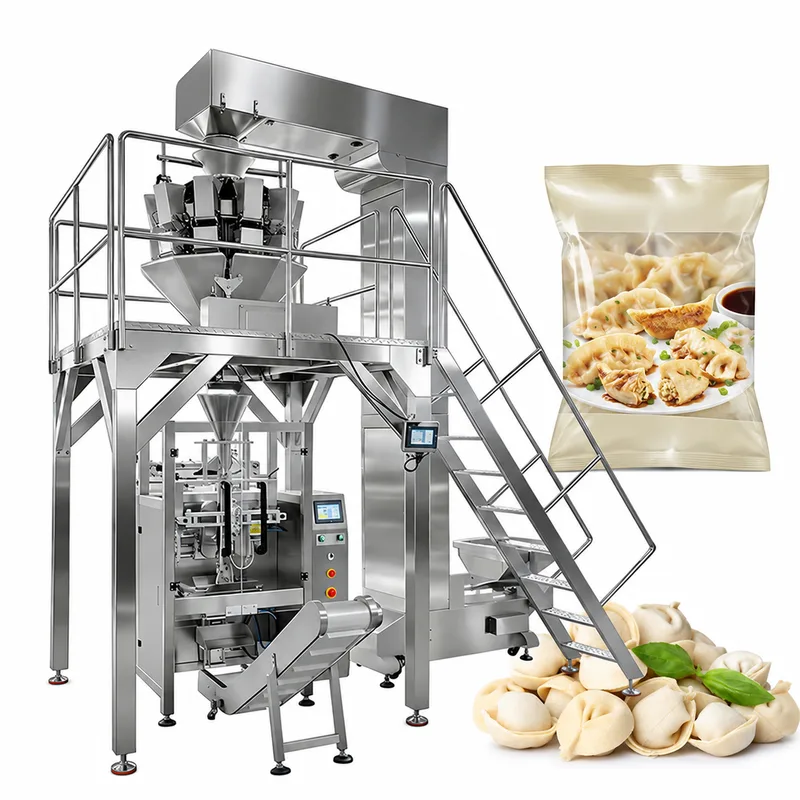
Frozen Food Weighing & Packaging
Frosted pieces retained in a hopper can leave a bag underweight and turn up in later fills. Specify this frozen-food weigher and VFFS line from product temperature, frost, piece size and cleaning method.
Vertical Form Fill Seal
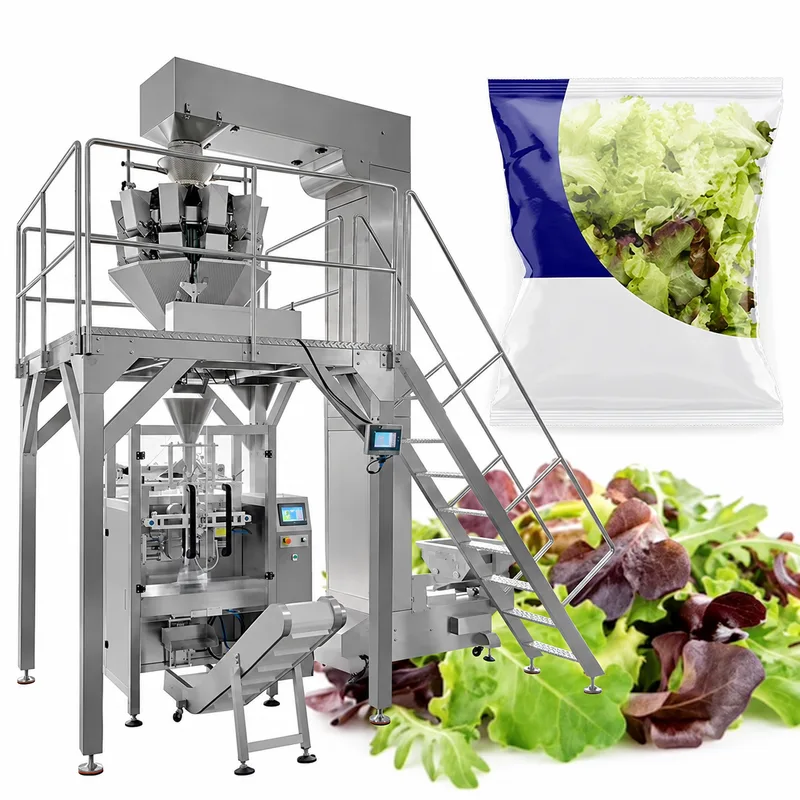
Vegetable & Salad Weighing Packaging
Fresh leaves and frozen vegetables need separate checks of hoppers, surfaces and cleaning; sharing an unproven setup can damage salad or hold up frosted pieces. Specify this weigher and VFFS line per product condition.
Sauce Sachets
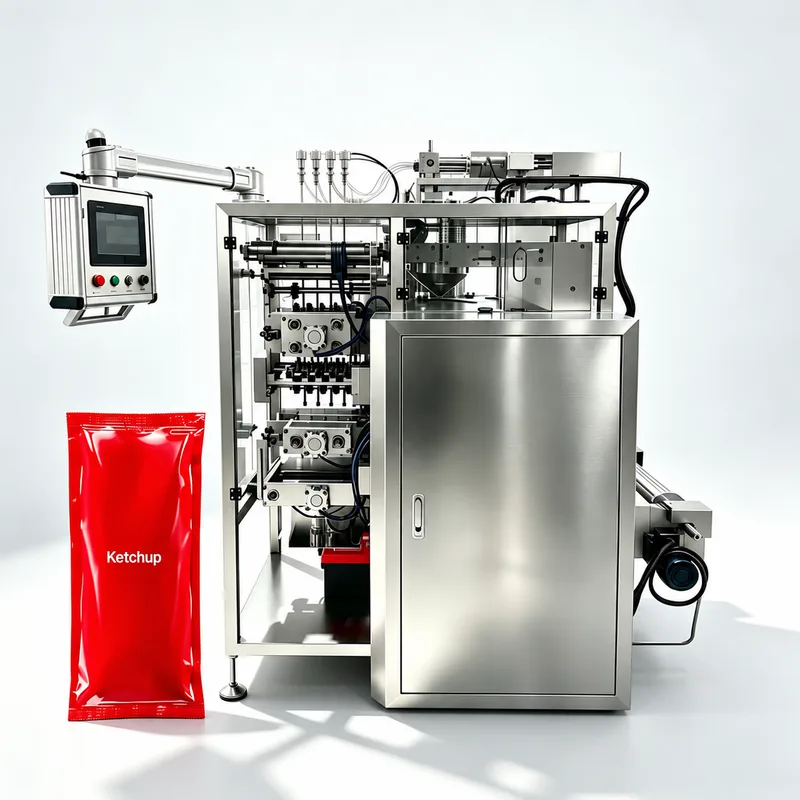
Sauce Four-Side-Seal Sachet Machine
Sauce strings or drips can contaminate the seal area, leading to leaks and rejected sachets. Specify this piston-dosing four-side-seal machine from your sauce, portion, sachet drawing and film.