
Linear Weigher: Bulk-Dribble Feeding & VFFS Selection
How a vibratory linear weigher meters bulk-dribble feeds with in-flight cutoff, and when one-to-four-lane linear weighing fits VFFS lines better than multihead or cup dosing.
Scroll horizontally to read all columns, conditions and sources.
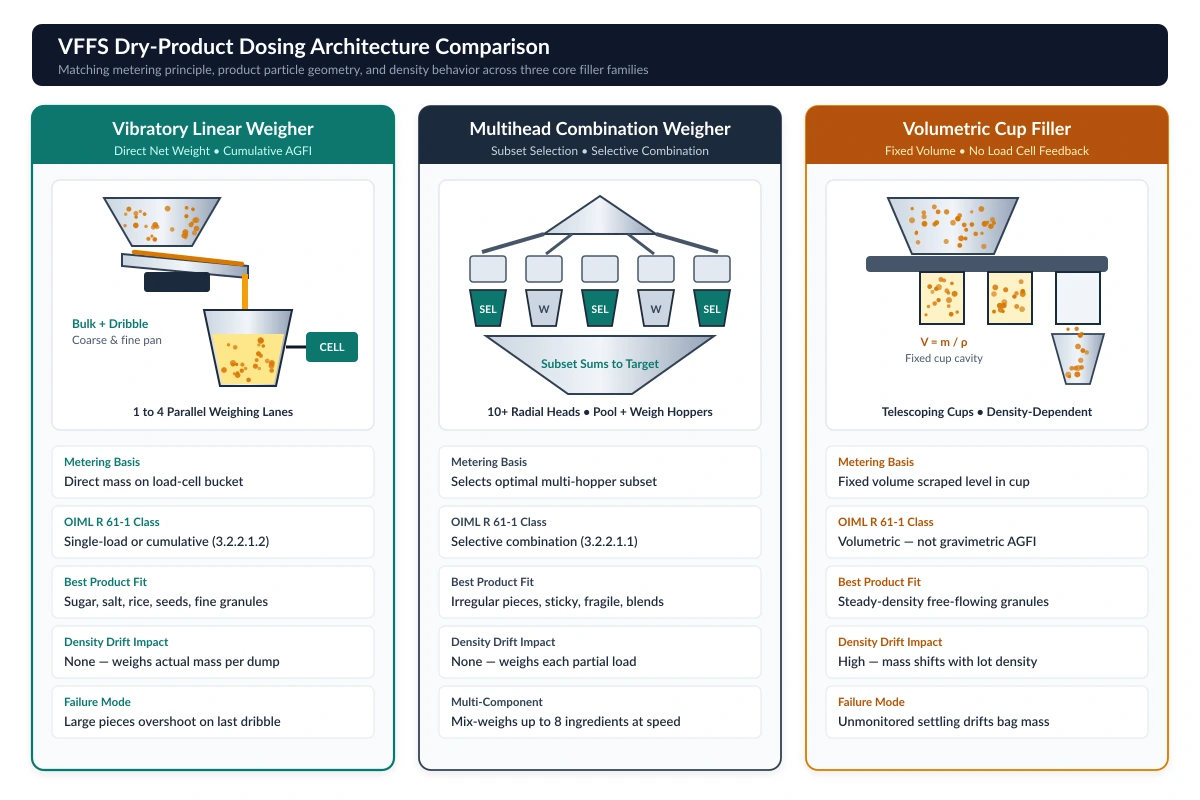
| Selection criterion | Vibratory linear weigher | Selective combination multihead weigher | Volumetric cup filler |
|---|---|---|---|
| Weighing principle & OIML R 61-1 class | Direct net-weight bucket; single-load or cumulative weighing instrument (clause 3.2.2.1.2) | Computes and combines optimal subset across multiple weighing modules (clause 3.2.2.1.1) | Fixed-volume measuring cup scraped level; volumetric rather than gravimetric AGFI |
| Feed & target-weight mechanism | Gravity-assisted vibratory pan with coarse bulk stage, fine dribble stage, and in-flight final feed cut-off | Dispersion cone feeding radial pool and weigh hoppers; computer picks hopper subset closest to target | Overhead hopper fills rotating fixed-cavity cups without load-cell feedback |
| Best-fit dry products | Free-flowing uniform fine granules such as granulated sugar, salt, whole-grain rice, seeds, and loose tea | Irregular discrete pieces, fragile snacks, sticky foods via belts or screws, and blends up to eight components | Free-flowing granules whose lot-to-lot bulk density stays consistent across runs |
| Bulk-density shift sensitivity | Compensated automatically because load cells measure actual mass on every cycle | Compensated automatically because each partial hopper load is weighed before combination | Direct weight drift: delivered mass shifts proportionally whenever bulk density changes under V = m / ρ |
| Primary engineering failure mode | Large or irregular pieces cause overshoot when the final dribble piece lands; uncompensated in-flight tail | Over-specified footprint and capital complexity when packing simple uniform free-flowing granules | Unmonitored settling, aeration, or lot density shifts cause systematic underfill or giveaway |
On This Page
How Does a Vibratory Linear Weigher Use Coarse Bulk and Fine Dribble Pans to Hit Target Weight?
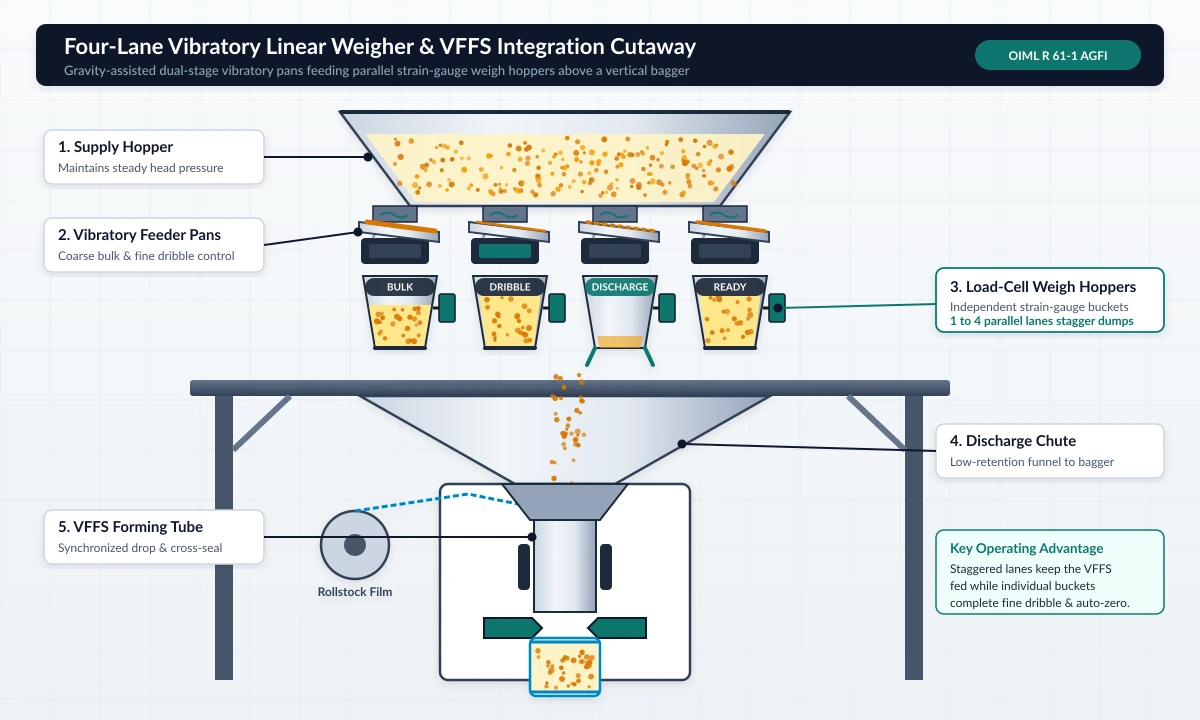
A linear weigher is an automatic gravimetric filling instrument that uses gravity and vibratory feeder pans in coarse bulk and fine dribble stages to load a strain-gauge weigh hopper directly to net target weight, stopping vibration ahead of target to compensate for falling in-flight granules and offering an economical alternative to multihead or volumetric dosing for uniform free-flowing products.
Dual-Stage Bulk-to-Dribble Feeding and Final Feed Cut-Off
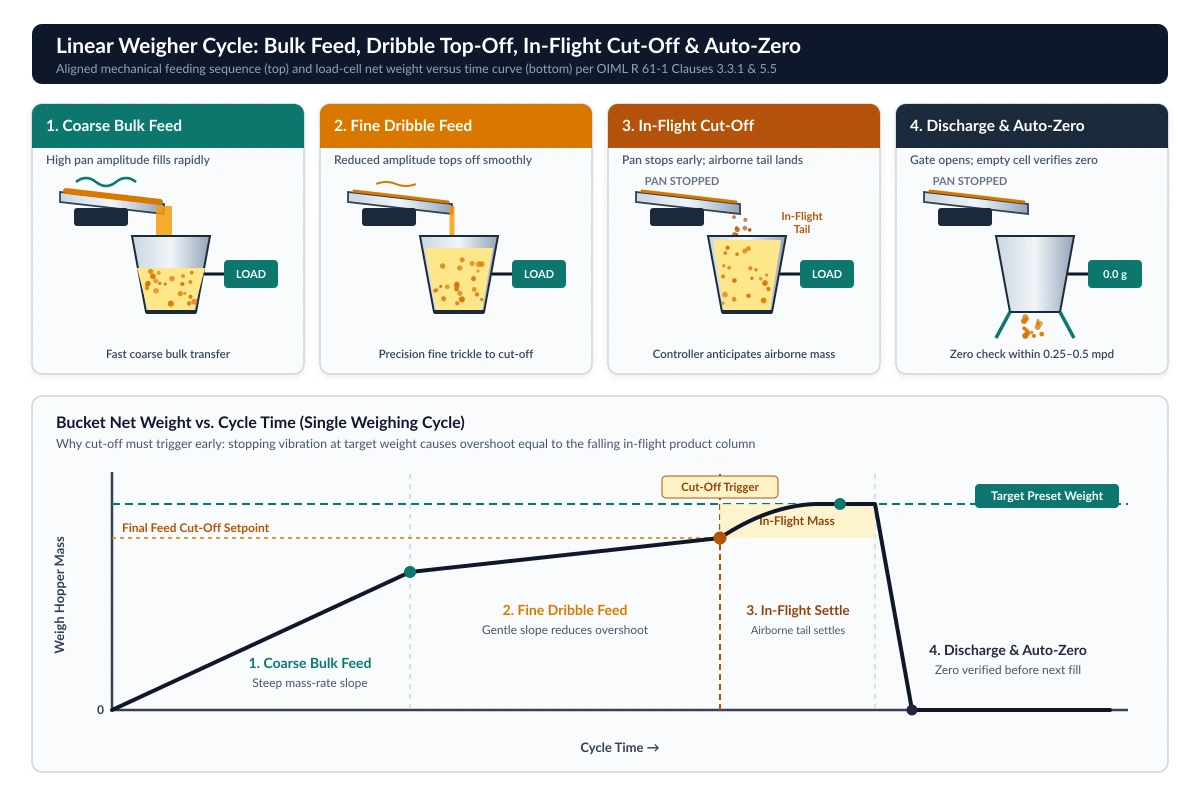
As documented in Wikipedia's overview of vibrating feeders, vibratory feeders combine gravity and mechanical vibration to transport dry material along a sloped trough: gravity sets the downward travel direction while electromagnetic vibration controls forward flow velocity. Under OIML R 61-1:2017 clause 3.3.1.2, a feeding device supplies bulk product to the weighing module in one or more stages, while a clause 3.3.1.3.1 feed control device regulates the flow rate during each stage. During the initial coarse bulk stage, higher pan amplitude moves the majority of the charge into the weigh hopper quickly so cycle time stays short. Once the load-cell signal approaches the preset mass, the controller steps vibration amplitude down into a slow fine dribble stream so individual granules enter smoothly without momentum surges.
Stopping the pan exactly at the displayed target weight would cause every bag to overshoot by the mass of granules still suspended mid-air between the pan lip and the weigh bucket. OIML R 61-1 clause 3.3.1.3.3 defines a final feed cut-off device that halts the final feed so the average fill mass aligns with the preset value, and clause 5.5 explicitly provides for a correction device that compensates for residual material entering the weighing module after cut-off. Because clause 5.6 requires regular flowrates from the feeding device, keeping a steady product head inside the overhead supply hopper is critical: if hopper head pressure drops or surges, the airborne column mass changes and cut-off timing must adapt.
Cumulative Multi-Dump Cycles for Heavier Bags
When a target bag weight exceeds the safe volume of a single weigh bucket, a linear weigher switches into cumulative operation rather than requiring an oversized hopper. OIML R 61-1 clause 3.2.2.1.2 classifies this mode as a cumulative weighing instrument—an automatic gravimetric filling instrument comprising one weighing module with the facility to apply more than one weighing cycle to compose a single desired fill. The controller records each partial dump and trims the final sub-load so the combined net mass lands on target. Under OIML R 61-1 cumulative fault rules, the permissible fault limit for a cumulative instrument equals 0.25 mpd in-service at the rated minimum fill divided by the square root of the minimum number of loads per fill, keeping multi-dump accuracy mathematically bounded.
Which Free-Flowing Granular Foods and Non-Food Products Fit a Linear Weigher Packing Machine?
A linear weigher packing machine excels on free-flowing, uniform small granules and seeds whose individual particle mass is tiny compared to the target pack weight, allowing the fine dribble stream to stop cleanly near target without single-piece overshoot. Suitable applications span food processing, pharmaceutical, FMCG, packaging, and plastics production lines running consistent dry bulk materials.
Uniform Small-Granule Foods and Industrial Pellets
In Wikipedia's multihead weigher reference, free-flowing fine-grained materials are explicitly identified as products that can be weighed more economically on cut-gate or linear weighers or volumetric feeders than on radial multihead scales. Typical linear-weigher candidates include granulated white sugar, table salt, whole-grain milled rice, agricultural seeds, coffee granules, loose tea, dry seasoning crystals, laundry granules, and uniform plastic pellets. Because each individual grain or seed carries minimal mass, reducing pan vibration to a slow trickle gives the load cell fine resolution right up to the final feed cut-off point. On granular sugar lines (detailed in our sugar VFFS dosing trial guide), matching chute geometry and separating filler weight readings from finished-bag checks confirm that free-flowing crystals land inside the forming tube cleanly without bridging or trailing into cross seals.
Why Large or Irregular Pieces Break Linear Dribble Accuracy
Single-channel bulk-and-dribble weighing breaks down when piece mass becomes large relative to package tolerance or when pieces interlock on a vibratory pan. If heavy chunks, oversized biscuits, or tangled frozen vegetables travel down a linear dribble pan, a single late piece rolling off the lip after cut-off immediately pushes the weigh bucket past the upper tolerance limit. Sticky or clumping products—such as moist dried fruit, fresh meat, or grated cheese—similarly defeat open vibratory troughs by adhering to pan walls and violating the regular flowrate requirement of OIML R 61-1 clause 5.6. Those geometries belong on a radial combination weigher equipped with belt or screw feeders rather than a vibratory linear trough.
When Should a VFFS Buyer Choose a Linear Weigher Over a Combination Weigher or Volumetric Cup?
Choose a linear weigher over a volumetric cup filler whenever lot-to-lot bulk density varies enough to drift net bag mass, and choose a linear weigher over a multihead combination weigher when packing uniform free-flowing granules at moderate VFFS speeds without multi-ingredient mixing or irregular-piece handling.
Linear Weigher Versus Selective Combination Multihead Weigher
Under OIML R 61-1 clause 3.2.2.1.1, a selective combination weighing instrument uses multiple independent weighing modules to compute and combine an optimal subset of partial loads into one fill, whereas a linear weigher meters the full dose (or cumulative sub-dumps) sequentially in one lane. As documented in Wikipedia's multihead weigher overview, a multihead controller evaluates every weigh hopper to pick the subset closest to a target weight such as 100 g, can mix-weigh up to eight separate components at high speed, and handles sticky items with belt or screw feeders or fragile pieces with shallow descent angles and cushioned inserts. Stepping up to a radial multihead architecture (covered in our combination weigher sizing guide) pays off when piece weights vary widely, products stick or break easily, or sustained high-speed VFFS cadence requires subset math. When packing uniform sugar, salt, seeds, or milled rice, a linear weigher achieves compliant gravimetric accuracy with simpler mechanics, smaller overhead footprint, and faster pan removal.
Linear Weigher Versus Volumetric Cup Filler and Subtractive Feeders
Volumetric cup fillers meter a fixed pocket volume rather than weighing mass. As shown in our fill weight and bulk density guide, bulk volume relates to mass and bulk density through V = m / ρ: a 100 g dose at a bulk density of 0.4 g/mL occupies 250 mL before package clearance. If incoming grain moisture, settling, or lot variation shifts bulk density, a fixed volumetric cup immediately delivers underfilled or overfilled bags unless an operator catches the shift and re-adjusts cup height. A linear weigher eliminates density-driven mass drift because its strain-gauge load cell weighs every fill directly. On retail grain lines (see our rice VFFS dosing and bag trials guide), testing a volumetric cup, a linear weigher, and a multihead weigher on the same rice lot isolates density variation, breakage, and blend separation before committing capital. By contrast, OIML R 61-1 clause 3.2.2.2 subtractive (loss-in-weight) instruments control output feed out of a continuously weighed hopper and are used mainly for continuous dosing or poor-flowing bulk materials rather than discrete VFFS bag drops.
| Operating condition | Recommended filler route | Engineering basis |
|---|---|---|
| Uniform free-flowing granules with variable lot bulk density | Vibratory linear weigher (one to four lanes) | Direct load-cell mass control prevents V = m / ρ density drift while keeping mechanics simple |
| Irregular pieces, sticky foods, fragile snacks, or blends up to eight ingredients | Selective combination multihead weigher | OIML R 61-1 clause 3.2.2.1.1 subset math and specialized belt, screw, or cushioned feeders |
| Steady-density free-flowing granules needing basic fixed-volume metering | Volumetric cup filler with lot density checks | Lowest mechanical complexity when incoming bulk density remains stable across shifts |
| Continuous output metering from a weighed supply hopper | Subtractive weighing instrument (loss-in-weight) | OIML R 61-1 clause 3.2.2.2 controls discharge flow directly out of the weighed hopper |
How Do Single-Head, Two-Head, and Four-Head Linear Weighers Match Granule and Seed Applications?
Adding parallel lanes—moving from a single-head unit to a two-head or four-head linear weigher—scales VFFS discharge cadence by staggering coarse bulk, fine dribble, and discharge stages across independent weigh buckets so one ready bucket drops into the forming tube while neighboring lanes continue topping off.
Matching Lane Count to VFFS Bag Cadence and Product Mix
On a single-head linear weigher, the VFFS bagmaker must wait through the full bulk fill, fine dribble, settle, and discharge cycle before the next bag forms. Splitting the overhead supply hopper across two or four parallel vibratory lanes decouples individual bucket settling time from bagger cycle time: while one lane discharges through the collection chute and verifies empty zero, adjacent lanes are already completing coarse bulk or fine dribble stages. Two-head and four-head configurations are standard across retail pillow and gusseted VFFS bags for white sugar, sea salt, long-grain rice, vegetable and grass seeds, whole roasted coffee beans, and dry detergent granules. Review how dosing interfaces with film forming and sealing across all line families on our packaging systems overview.
Separating Retail VFFS Bags from Cumulative Heavy Fills and Bulk Sacks
When a single line runs both lighter retail pouches and heavier catering or food-service bags, a two-head or four-head linear weigher can either discharge multiple lanes simultaneously into one bag or execute cumulative multi-dump cycles per OIML R 61-1 clause 3.2.2.1.2. Keeping retail VFFS pouches distinct from large open-mouth bulk sacks remains essential during trials (as noted in our rice VFFS dosing and bag trials guide), because open-mouth sacks require dedicated bag clamping, spout support, and sewing or heat-sealing stations outside a roll-film VFFS frame. Confirming bucket volume against bulk density via V = m / ρ prevents a single-dump retail bucket from overflowing on lighter, bulky seed or tea grades.
How Do You Clean Vibratory Feeder Pans and Weigh Hoppers Quickly During Allergen or Flavor Changeovers?
Rapid, compliant allergen and flavor changeovers on a linear weigher depend on tool-free removable vibratory pans and weigh hoppers built with corrosion-resistant metals, smoothly bonded food-contact seams, and low-retention chutes that meet 21 CFR 117.40 cleanability rules and OIML R 61-1 clause 5.7 discharge requirements.
Sanitary Design and Allergen Cross-Contact Prevention Under 21 CFR 117.40
Under 21 CFR 117.40, all food manufacturing, packing, and holding equipment must be designed and constructed so it is adequately cleanable and maintained to protect against allergen cross-contact and contamination. Paragraph (a)(3) requires food-contact surfaces to be corrosion-resistant, paragraph (b) requires seams on food-contact surfaces to be smoothly bonded or maintained to minimize particle accumulation and microbial growth, and paragraph (d) explicitly extends clean and sanitary construction requirements to holding, conveying, and automated gravimetric systems. Because a one-to-four-lane linear weigher has far fewer pans, hinges, and buckets than a multihead weigher, operators can unlatch straight vibratory troughs and net-weight buckets rapidly for dry brushing, vacuuming, or washdown inspection when switching between spiced blends, seeds, or allergen-bearing food lots.
Controlling Product Retention and Seal-Zone Dust
OIML R 61-1 clause 5.7 reinforces hygienic changeover by requiring the load receptor, feed device, and discharge gates to retain negligible residual material after each dump. Any crystals or seasoning fines hanging inside bucket corners or collection funnels degrade both weight repeatability and allergen clearance. During VFFS commissioning trials (outlined in our sugar VFFS dosing trial guide and auger versus volumetric cup VFFS trial record), keep filler weigh-bucket readings strictly separate from finished-bag net weights and visual seal-zone dust inspections. A weigh bucket can display an accurate net dose while trailing dust coats the VFFS cross-seal area or product bridges inside the forming funnel.
How Are In-Flight Cutoffs, OIML Tolerances, and Load-Cell Zero Drifts Calibrated?
Calibrating an industrial linear weigher requires three coordinated controls: adjusting final feed cut-off compensation so average fill mass stays within 0.25 mpd of target, verifying static linearity with certified test weights up to Max on each load receptor, and enforcing automatic zero-setting limits to prevent thermal or residue zero drift.
OIML R 61-1 Class X(1) Tolerances, NIST MAV Limits, and 21 CFR 101.7 Labeling
For packaged solid foods, 21 CFR 101.7 mandates a principal-display-panel declaration of net quantity of contents by weight, exclusive of wrappers and packaging material, prohibiting unreasonably large variations from stated weight. On the equipment side, OIML R 61-1:2017 Table 2 defines reference Class X(1) maximum permissible deviation (mpd) of each fill from the test-sequence average, scaled for Class X(x) instruments by a class designation factor x ≤ 2 in the form 1, 2, or 5 times a power of ten. Simultaneously, maximum permissible preset value error (mpse) limits the offset between the preset fill value and the average mass of all fills in a test sequence to 0.25 mpd in-service. In U.S. commercial verification under NIST Handbook 44 Section 2.24, which covers automatic gravimetric filling machines weighing discrete or single loads of loose materials, automatic field-test standard deviation must not exceed one-ninth (1/9) of the NIST Handbook 133 MAV—ensuring three standard deviations stay within one-third (1/3) of MAV.
Static Load-Cell Calibration, Automatic Zero-Setting, and Environmental Drift
Industrial linear weighers rely on strain-gauge load cells built from sturdy, minimally elastic aluminum, alloy-steel, or stainless-steel spring bodies (documented in Wikipedia's load cell reference). Four strain gauges form a balanced Wheatstone bridge—typically 350 Ω resistors (sometimes 120 Ω or 1,000 Ω) kept in close mutual thermal contact—excited by a stabilized voltage such as 10 V (ranging from 5 V to 20 V, with typical maximum excitation around 15 volts) producing typical full-scale sensitivity of 1 to 3 mV/V. Four mechanical and electrical hazards corrupt calibration: improper mounting friction induces offset or hysteresis; overloading above maximum rating plastically deforms the spring element and destroys linearity; corroded wires or moisture ingress shift zero balance; and load cells exhibit nonlinearity at the low end of their scale if oversized for small fills.
To verify accuracy safely, OIML R 61-1 clause 5.7 requires safe physical access on the load receptor for placing static test weights up to maximum capacity and forbids manual load-receptor discharge during automatic operation. For zero control, clause 5.8 requires non-automatic and semi-automatic zero-setting devices to set within 0.25 mpd in-service for Min, operate only in stable equilibrium, and lock out during automatic operation. Clause 5.8.4.2 specifies that automatic zero-setting runs either on every automatic weighing cycle (where it cannot be disabled) or on a programmable time interval sized under Annex A so zero stays within 0.5 mpd in-service across a maximum steady ambient temperature rate of 5 °C per hour. The AGFI standard further requires metrological stability at 85 % non-condensing or 93 % condensing relative humidity and across AC supply voltage variations from 0.85 to 1.10 times nominal voltage. Under NIST Handbook 44 Section 2.24, automatic zero-tracking under normal operation is capped at 1.0 scale division (S.2.1.1), while initial zero-setting is capped at 20 % of maximum capacity unless verification proves tolerances across the compensated range (S.2.1.2).
| Mass of fill F (g) | Initial verification mpd for Class X(1) | In-service mpd for Class X(1) |
|---|---|---|
| F ≤ 50 g | 7.2 % of F | 9 % of F |
| 50 g < F ≤ 100 g | 3.6 g | 4.5 g |
| 100 g < F ≤ 200 g | 3.6 % of F | 4.5 % of F |
| 200 g < F ≤ 300 g | 7.2 g | 9 g |
| 300 g < F ≤ 500 g | 2.4 % of F | 3 % of F |
| 500 g < F ≤ 1 000 g | 12 g | 15 g |
| 1 000 g < F ≤ 10 000 g | 1.2 % of F | 1.5 % of F |
| F > 15 000 g | 0.8 % of F | 1 % of F |
Sources
All metrological tolerances, net-content labeling rules, sanitary-design requirements, and weighing engineering mechanics in this guide are grounded in the following public reference documents:
- OIML R 61-1:2017 — Automatic gravimetric filling instruments, Part 1: Metrological and technical requirements (OIML)
- 21 CFR 101.7 — Declaration of net quantity of contents (Electronic Code of Federal Regulations)
- 21 CFR 117.40 — Equipment and utensils (Electronic Code of Federal Regulations)
- NIST Handbook 44 (2024) Section 2.24 — Automatic Weighing Systems (NIST)
- Vibrating feeder — gravity and vibration material transport (Wikipedia)
- Load cell — strain-gauge Wheatstone bridge, calibration, and failure modes (Wikipedia)
- Multihead weigher — subset combination weighing versus linear and volumetric dosing (Wikipedia)
Frequently asked questions
What is the difference between a linear weigher and a combination weigher?
A linear weigher meters the full fill (or sequential cumulative sub-dumps under OIML R 61-1 clause 3.2.2.1.2) through a single coarse-and-fine vibratory lane into one net-weight bucket, making it economical for uniform free-flowing granules. A selective combination weigher (clause 3.2.2.1.1) distributes partial loads across radial weigh hoppers and combines the mathematical subset closest to target weight, which is better suited to irregular pieces, sticky or fragile foods, and multi-component blends up to eight ingredients.
Why does a linear weigher stop vibrating before reaching target weight?
When the vibratory feeder pan shuts off, a column of granules is still falling mid-air into the weigh bucket. OIML R 61-1 clause 5.5 provides for a final feed cut-off correction device that accounts for this residual post-cutoff material so the settled net mass matches the preset value within 0.25 mpd in-service.
Why does a linear weigher outperform a volumetric cup filler when bulk density fluctuates?
A volumetric cup filler delivers a fixed volume, so bag mass changes directly whenever bulk density varies across lots under V = m / ρ (for example, 100 g at 0.4 g/mL occupies 250 mL). A linear weigher measures mass directly on strain-gauge load cells on every dump, eliminating density-induced weight drift.
Can a single linear weigher fill heavy bags larger than one bucket load?
Yes. In cumulative weighing mode (OIML R 61-1 clause 3.2.2.1.2), one weighing module executes multiple sequential weighing cycles to compose a larger desired fill, governed by the cumulative fault limit of 0.25 mpd in-service at Minfill divided by the square root of the minimum number of loads per fill.
How often should load-cell zero be checked during automatic linear weighing?
Under OIML R 61-1 clause 5.8.4.2, automatic zero-setting runs either on every weighing cycle (non-disableable) or on a timed interval sized to maintain zero within 0.5 mpd in-service across a 5 °C per hour ambient temperature drift rate, while NIST Handbook 44 Section 2.24 S.2.1.1 caps automatic zero-tracking at 1.0 scale division.
Explore the Equipment
Vertical Form Fill Seal
Candy Multihead Weighing & Packaging
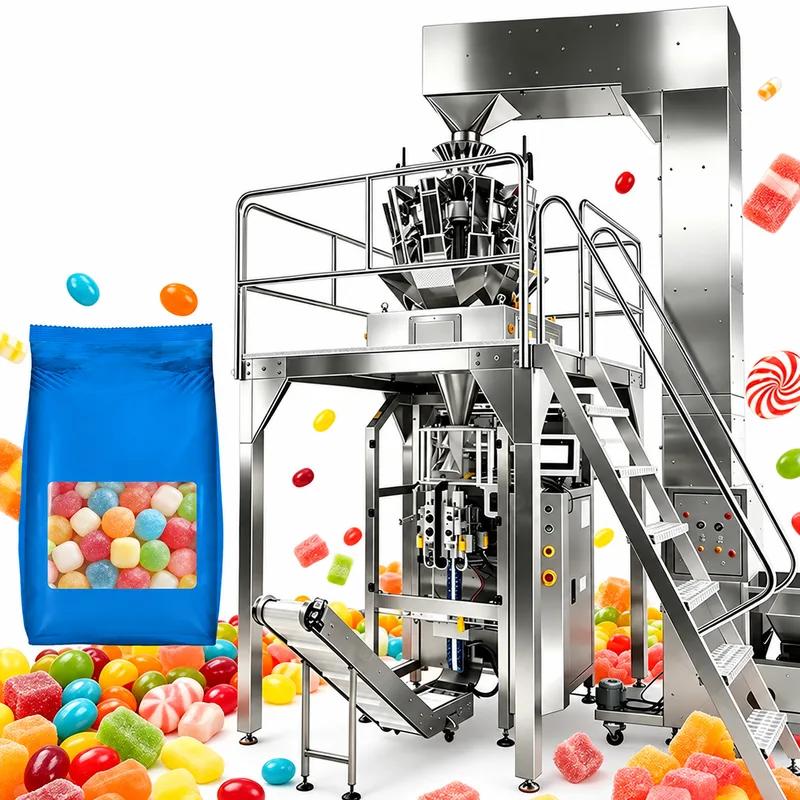
A correct bag weight can still hide broken, stuck or wrongly mixed sweets. Residue held on a contact surface can release into the next bag. This multihead weigher and VFFS line is set up around your candy's coating, size and pack.
Vertical Form Fill Seal
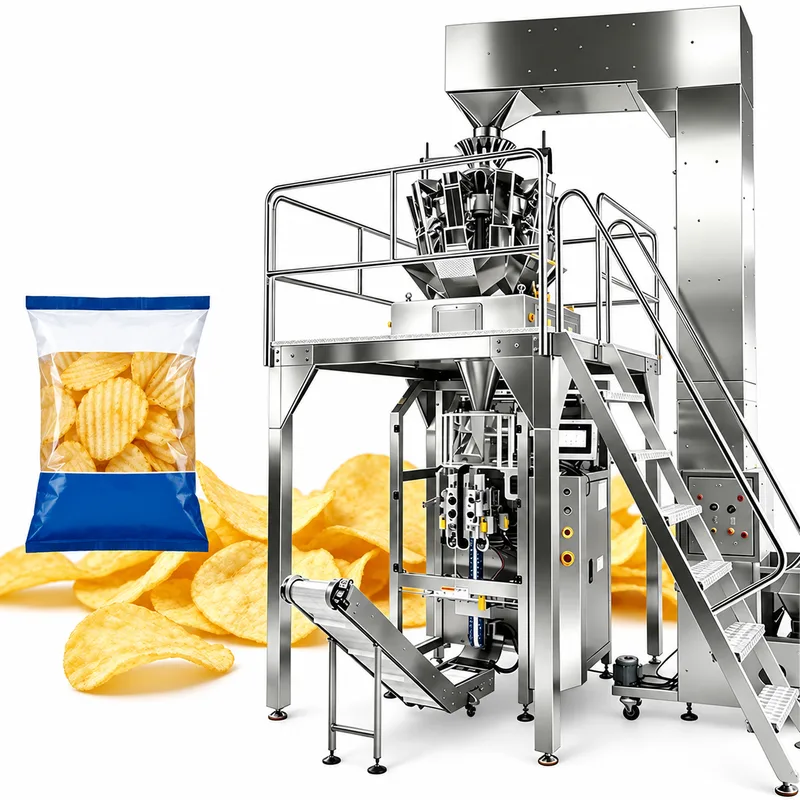
Chips Packaging with Nitrogen Flushing
An inflated bag can hide broken chips, a short fill or a weak seal. Size this weigher, VFFS and nitrogen-flush line from your chip volume, breakage limit and gas supply.
Vertical Form Fill Seal
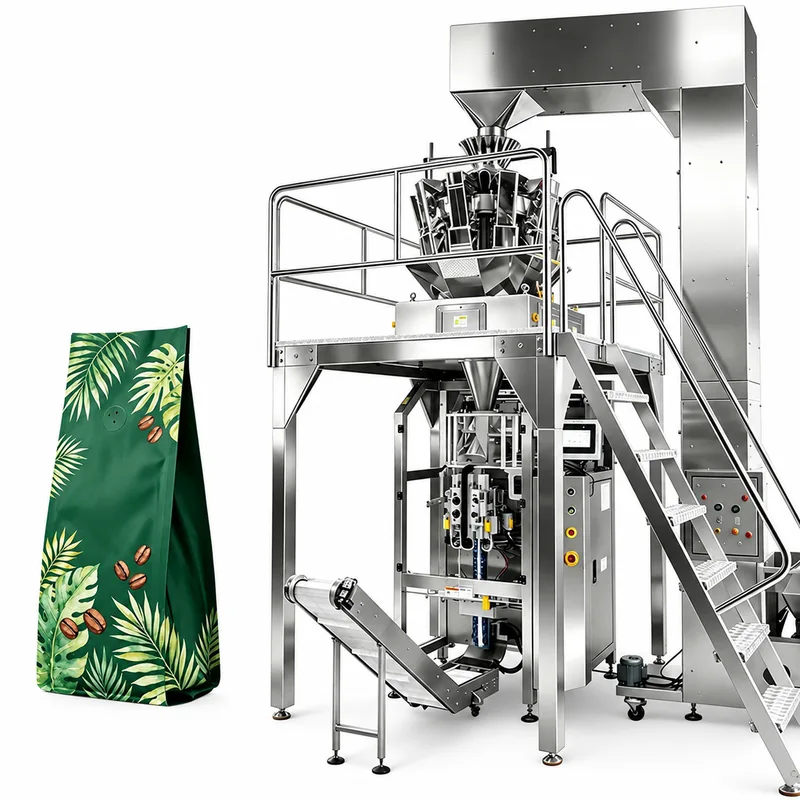
Coffee Bean Valve-Pouch Packaging
A misplaced or poorly attached degassing valve can spoil a run of coffee bags. Specify this weigher and VFFS valve line from your valve drawing, film, roast and weight.
Vertical Form Fill Seal
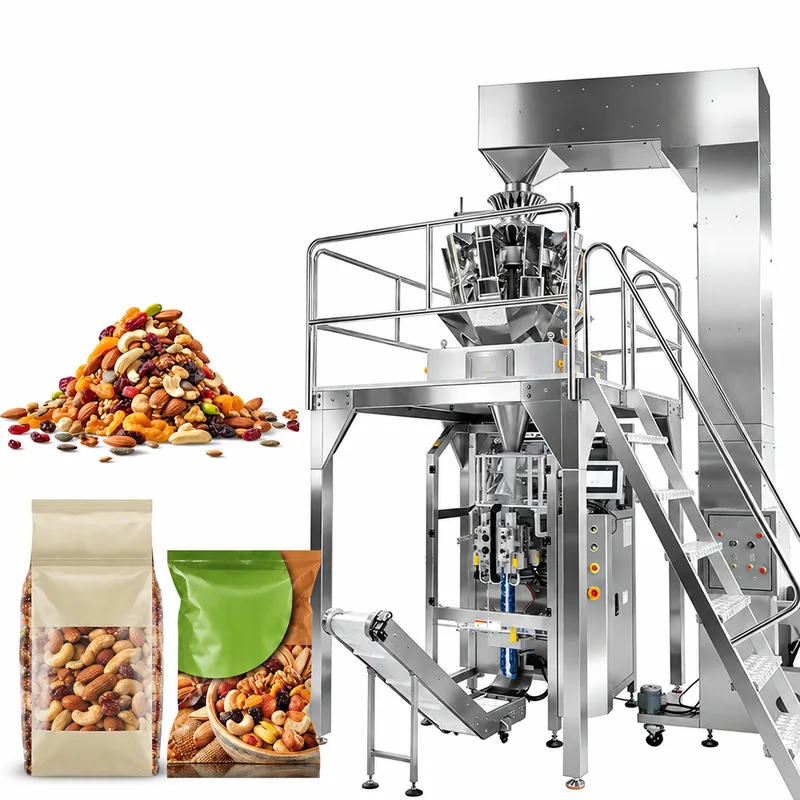
Nuts & Dried Fruit Multihead VFFS
A nut-mix bag can be on weight and still hold the wrong ratio of ingredients. Configure this multihead VFFS line from your blend, coatings, target weight and bag size.