
Combination Weigher: Subset Weighing, Head Count & Sizing
Learn how radial combination weighers select 3–5 hopper subsets, how 10, 14, 16, and 24-head models scale speed and bucket volume, and how to cut giveaway.
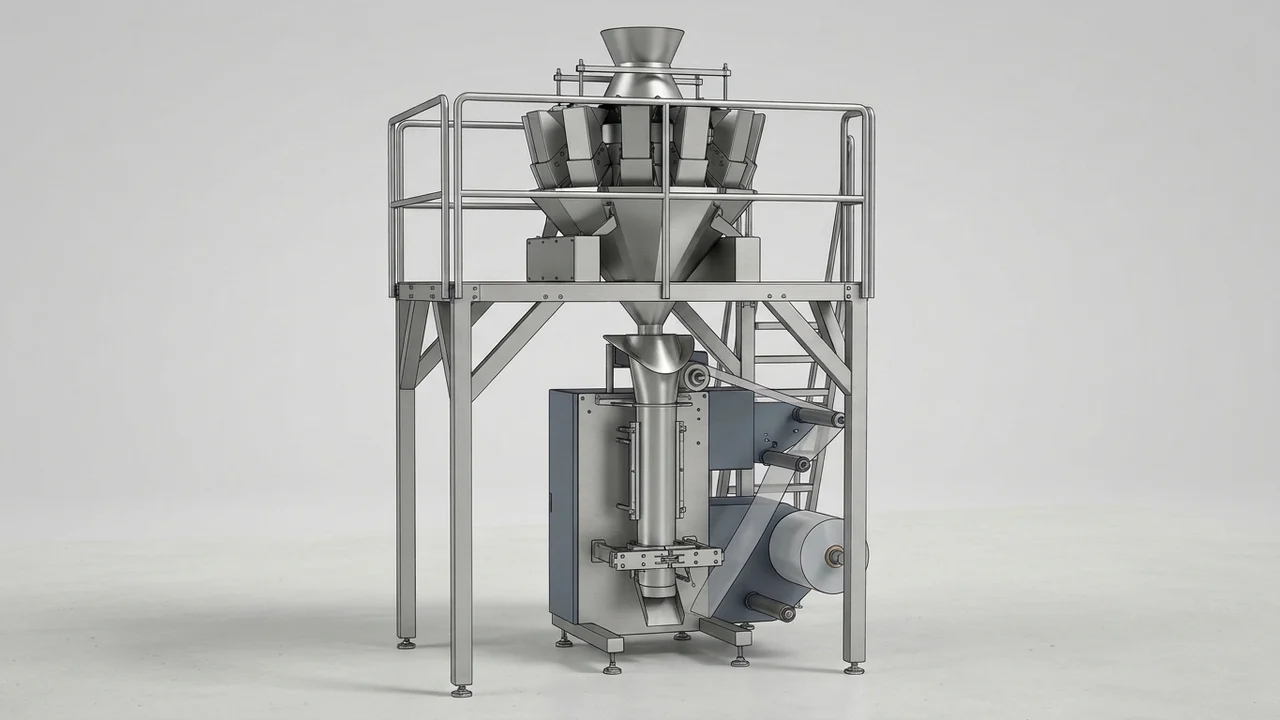
Scroll horizontally to read all columns, conditions and sources.
| Control point | Selective combination weigher | OIML R61-1 filling-instrument check | Downstream inline checkweigher |
|---|---|---|---|
| What is weighed | Discrete partial loads held across 10–24+ weigh hoppers and combined into one target dose | Consecutive automatic test fills and static calibration weights up to Max on an empty zeroed receptor | Finished sealed pouches or cartons weighed in motion against nominal label mass |
| Where it acts on the line | On a mezzanine above the VFFS forming collar, premade pouch filler, or tray indexer | During factory acceptance testing, initial legal verification, and periodic in-service audits | Downstream of the bagmaker discharge conveyor before case packing |
| What passing means | Controller opens the 3-to-5-hopper subset whose combined weight lands closest at or just above target | Individual fills stay within class X(x) mpd around the test mean and preset offset stays within 0.25 × in-service mpd | Conforming packs continue downstream while underfilled or over-tolerance packs divert to a locked reject bin |
On This Page
What Is a Selective Combination Weigher and How Does It Pick Subsets?
A selective combination weigher—commonly called a multihead weigher on vertical bagging lines—portions discrete solid products by dividing bulk feed across multiple independent load-cell hoppers and combining a mathematical subset into each bag. Instead of metering 100% of a pack into one bucket and dribbling slow top-off pieces at the end of the cycle, the controller charges each weigh hopper to roughly one-fifth to one-third of the target fill weight and evaluates all valid combinations in milliseconds. On a 100 g snack or confectionery pouch, for instance, individual weigh hoppers might hold random partial loads between 20 g and 35 g; the processor scans every 3-to-5-hopper combination, selects the subset summing to 100.2 g rather than 99.4 g or 103.5 g, and opens those gates simultaneously into the discharge chute.
In international legal metrology, OIML R61-1 (2017) clause 3.2.2.1.1 classifies this architecture as a selective combination automatic gravimetric filling instrument, distinguishing it from single-receptor cumulative fillers (clause 3.2.2.1.2, which stack sequential dumps on one scale) and subtractive loss-in-weight feeders (clause 3.2.2.2, which meter out of a weighed hopper). That structural difference explains why radial combination weighers dominate irregular piece goods such as roasted nuts, gummies, potato chips, and IQF dumplings: when individual pieces weigh 2 g to 15 g, parallel subset math achieves sub-gram to 1.5 g precision at 30 to 200+ weighments per minute without slowing down for dribble feed. When scoping a line, buyers still evaluate three separate controls independently: how the weigher CPU sets its target subset offset, how the filler satisfies OIML R61-1 dynamic class X(x) dispersion limits, and how finished bags pass lot-average and Maximum Allowable Variation checks under NIST Handbook 133.
How Do Dispersion, Pool, Weigh, and Booster Hoppers Work Together?
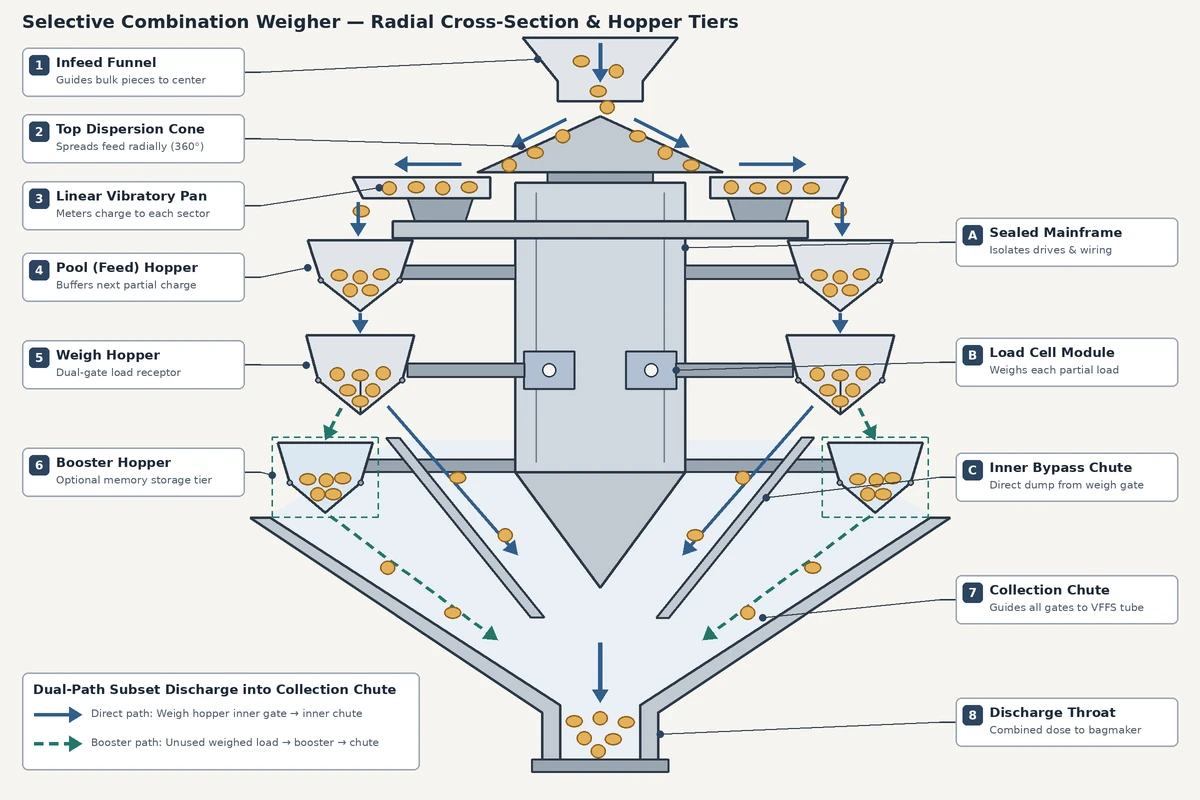
Product flow inside a radial combination weigher moves through concentric vertical stages designed to isolate load-cell settling time from upstream feeding surges. Bulk product enters through a central infeed funnel onto a vibratory or rotary top dispersion cone, which spreads material 360 degrees into shallow radial linear vibratory pans (or radial screw and belt troughs for cohesive foods). Each linear pan meters a partial charge into an upper pool hopper—also called a feed hopper—stationed around the perimeter. Because the pool hopper buffers the next partial load right above the weigh hopper, it drops that charge the instant the weigh hopper empties, allowing the linear pan to refill while the load cell beneath stabilizes.
Directly below each pool hopper sits a weigh hopper coupled through a rigid arm to an individual strain-gauge or electromagnetic load cell enclosed inside the sealed central mainframe. On standard two-tier weighers, selected weigh hoppers open single bottom flaps onto the steep concentric collection chute leading to the VFFS forming collar or timing hopper. On three-tier configurations equipped with optional booster hoppers (memory hoppers), each weigh hopper uses a dual-direction gate: loads chosen immediately discharge down an inner bypass chute, while already-weighed loads not needed in the current cycle drop into the booster hopper directly below, freeing the weigh hopper to measure a fresh charge. Both the inner bypass channel and the outer booster gates discharge cleanly inside the same wide collection cone, nearly doubling the number of known partial weights available to the combination algorithm without widening the upper radial feeder ring.
Head Count Configuration, Hopper Volume Rules, and Giveaway Reduction
Combinatorial resolution scales exponentially with head count (2ⁿ − 1 theoretical non-empty subsets: 1,023 on 10 heads, 16,383 on 14 heads, 65,535 on 16 heads, and over 16.7 million on 24 heads). Across typical industrial VFFS and multihead catalog configurations—where actual output always depends on piece geometry, film pull time, and vertical drop clearance—10-head weighers (commonly fitted with 1.6 L or 2.5 L buckets) cover 10–1,500 g fills at 30–65 weighments/min with typical average giveaway around 0.8%–1.5%. Stepping up to a 14-head weigher (0.5 L micro-buckets for 5–200 g packs, 1.6–2.5 L standard buckets for snacks and candies, or 3.0–5.0 L buckets for bulky chips and produce) raises weigher capability to 60–120 weighments/min—matching sustained single-tube intermittent VFFS rates of 35–80 bags/min—while tightening typical giveaway to 0.5%–1.0% (often ±0.3–1.0 g on uniform pieces). Sixteen- to 20-head units (such as our 10/14/20-head frozen-food VFFS options) extend fill capacity to 10–3,000 g at 80–130+ weighments/min and 0.4%–0.8% giveaway, whereas 24-head and 32-head frames either drive twin-tube VFFS baggers at 120–200+ weighments/min, hold giveaway to 0.3%–0.5% on high-cost nuts and coffee, or split the radial ring into 2 to 8 isolated infeed sectors (for example, dedicating 8 heads each to expensive nuts and dried fruit and 4 heads each to base cereal grains).
Selecting bucket volume and feeder amplitude around the 3-to-5-hopper subset rule is the most direct engineering lever for cutting product giveaway. Linear pan vibration should charge each weigh hopper to roughly 20%–33% (one-fifth to one-third, averaging about one-quarter) of the target bag weight while filling 40%–60% of bucket volume so pieces neither bridge at the gate nor starve the scale. If pans overfeed hoppers past 50% of target pack mass, the CPU can only pair two buckets, collapsing combination density and spiking overfill; conversely, if partial loads fall below the load receptor's rated minimum capacity (Min under OIML R61-1, where multi-load rated minimum fill Minfill exceeds Min), weighing uncertainty rises and simultaneous 7-hopper dumps elongate the product slug entering the forming tube.
Beyond head count and bucket sizing, four shop-floor practices hold average giveaway down in daily production. First, add a booster-hopper tier when large piece weights (such as 8–12 g whole walnuts or dumplings) restrict valid 4-hopper combinations on a compact 10- or 14-head footprint. Second, match target weight offset to your legal regime: under average-weight rules (OIML R61-1 / NIST Handbook 133 lot-average compliance), set target mass roughly 0.5 to 1.5 standard deviations above label weight so negative errors clear the Maximum Allowable Variation without padding every bag as a strict minimum-weight floor requires. Third, avoid running a weigher at 100% of its mechanical cycle ceiling on expensive ingredients—backing line speed down 10%–15% lets two or three extra hoppers finish settling before each bagger request, frequently cutting overfill from ~1.5 g to ~0.5 g per pouch. Fourth, enable automatic empty-hopper re-zeroing every few dozen cycles so seasoning, sugar, or frost buildup never subtracts from true delivered net weight.
| Head Count & Typical Bucket Volume | Typical Fill Range & Cycle Speed | Typical Giveaway & Primary Line Fit |
|---|---|---|
| 10-Head (0.5 L / 1.6 L / 2.5 L; up to 5.0 L) | 10–1,500 g; 30–65 weighments/min | 0.8%–1.5% giveaway; entry-to-mid-speed single-tube VFFS |
| 14-Head (0.5 L micro; 1.6–2.5 L std; 3.0–5.0 L bulk) | 10–1,500 g; 60–120 weighments/min (35–80 bpm VFFS) | 0.5%–1.0% (±0.3–1.0 g); mainstream snack, nut & candy VFFS |
| 16- to 20-Head (1.6 L / 2.5 L / 5.0 L) | 10–3,000 g; 80–130+ weighments/min | 0.4%–0.8%; heavy IQF pieces, high-speed VFFS, 2-way mixes |
| 24- to 32-Head (0.5 L / 1.6 L / 2.5 L) | 5–2,000 g; 120–200+ weighments/min (dual outlet) | 0.3%–0.5%; twin-tube VFFS, thermoformers, 4–8 ingredient mixes |
Handling Sticky Confectionery, Frozen Goods, and Fragile Pieces
Surface friction, moisture, and piece fragility govern every contact part between the infeed cone and the VFFS forming tube. Free-flowing dry snacks, roasted nuts, whole coffee beans, and hard-pan candies travel predictably across standard smooth or lightly textured SUS304 stainless steel vibratory pans. Once sugar syrups, oil coatings, surface condensation, or cheese fat enter the line—as with pectin gummies, dried cranberries, shredded mozzarella, or marinated meat and poultry—flat stainless pans stall and bridge. For cohesive confectionery and IQF frozen foods, specify dimpled (embossed) stainless or fluoropolymer-lined hoppers paired with steeper 55–65 degree discharge chutes so residual material retained after each dump stays negligible, as OIML R61-1 requires; for wet pickles, fresh meat, or sauced portions that absorb vibration, replace electromagnetic pans with rotating radial screw feeders or polyurethane belt channels.
Brittle products such as kettle chips, gourmet biscuits, and moulded chocolates fail through impact breakage rather than sticking. Gentle-slope weighers lower transfer energy by reducing dispersion-cone and collection-chute angles, shortening vertical free-fall between pool and weigh tiers, lining impact zones with food-grade silicone or polyurethane cushions, and programming staggered hopper dump delays (typically 30–80 ms apart) so heavy charges neither smash at the throat nor bridge above the VFFS cross-seal jaws. Particle geometry also defines when combination weighing is the wrong tool: uniform free-flowing fine powders and table salt are metered more economically and dust-tightly by servo auger fillers, cut-gate weighers, or volumetric cup systems, whereas irregular granules, loose-leaf tea, and multi-piece foods belong on a combination weigher.
Empty-Hopper Zeroing, Static Calibration, and Net-Contents Compliance
Maintaining weighing accuracy across a production shift requires separating load-cell zero stability and static span checks from finished-package net-contents law. Because individual load cells (governed as components under OIML R60-1:2021) output proportional electrical signals rather than direct legal mass readings, product fines or sugar film clinging to a bucket shift its unloaded baseline. To keep drift from corrupting subset math, OIML R61-1 (2017) requires automatic gravimetric filling instruments to include zero-setting or tare functions that hold residual zero error within 0.25 of the in-service maximum permissible deviation (mpd) at Min, caps routine automatic zero-setting adjustment at 4% of Max (20% of Max for initial zero-setting at power-up), and mandates that manual or semi-automatic zero and tare controls lock out during automatic cycling. During commissioning and routine QA, each weigh hopper must also provide safe physical hanger or bracket access for static calibration up to Max using OIML R111 verification weights (which span nominal masses from 1 mg to 5,000 kg) or purpose-designed test weights.
Passing an OIML R61-1 instrument test is not identical to passing a retail shelf audit in the United States or European Union. OIML R61-1 verifies the filling machine's dynamic consistency around its own test-run mean under accuracy class X(x) (where x ≤ 2 in 1, 2, or 5 decimal-power steps): in Table 2 for class X(1), each fill may deviate from the test average by up to 7.2% of fill mass F at initial verification and 9% in service when F ≤ 50 g, or 3.6 g initial and 4.5 g in service when 50 g < F ≤ 100 g, while preset-to-average offset cannot exceed 0.25 of in-service mpd. By contrast, NIST Handbook 133 (2023) and FDA 21 CFR 101.7 inspect lots of sealed retail packages exclusive of wrapper tare (21 CFR 101.7(g)), allowing reasonable distribution moisture and good-manufacturing-practice variations (21 CFR 101.7(q)) only when two strict conditions hold: the lot average must at least equal the declared label weight, and individual negative errors cannot exceed the Maximum Allowable Variation—10% of labeled weight below 36 g (0.08 lb / 1.28 oz) and 3.6 g from 36 g to 54 g under Table 2-5 (with USDA meat and poultry governed by Table 2-9 instead). In practice, plant engineers bridge both rules by using OIML R61-1 tests to prove tight hopper-to-hopper repeatability at FAT, then setting the operational target weight slightly above declared label mass so lot averages stay positive with minimal giveaway.
How Combination Weighing Coordinates With Downstream Inline Checkweighing
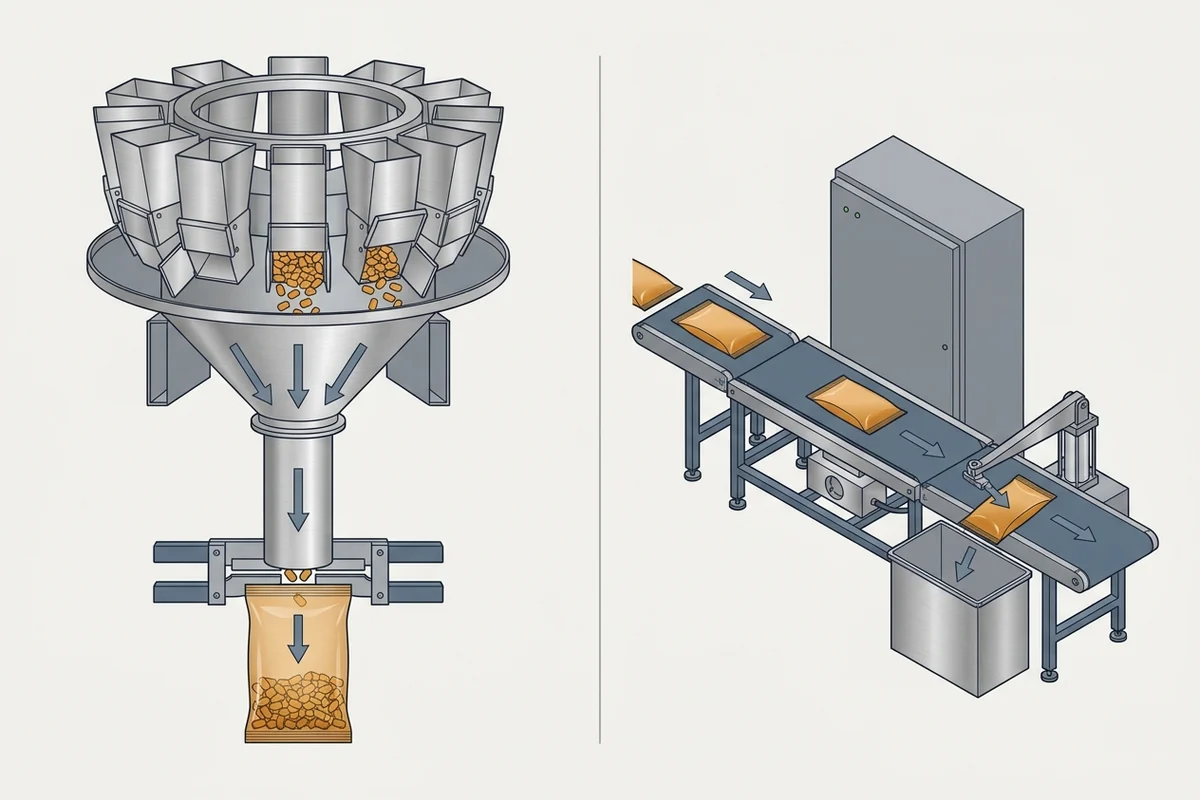
An upstream combination weigher and a downstream inline checkweigher perform complementary jobs under separate legal standards. While the selective combination weigher (OIML R61-1) builds each dose from bulk before film sealing, an inline checkweigher—classified under OIML R51-1 (2006) as an automatic catchweighing instrument that subdivides prepackages by mass difference from a nominal set point—weighs every finished, sealed bag on a transport belt at the exit of the VFFS machine. Because high-speed belt checkweighers can inspect 100 to 500+ packs per minute depending on pouch pitch and required resolution, a single checkweigher easily keeps pace with intermittent, continuous-motion, or twin-tube VFFS outputs.
Pairing both instruments protects against failure modes neither machine can catch alone. Even when a combination weigher calculates a 100.3 g subset accurately, a gummy bridging in the forming collar or a chip caught in the cross-seal can leave one bag at 88 g and the next at 112 g; the downstream checkweigher diverts both out-of-tolerance packs into a locked reject bin under whichever tolerance mode the plant runs—strict minimum-weight rejection, European Average Weight (Packers' Rules), or NIST Handbook 133 MAV thresholds. When connected via PLC feedback, rolling average weight trends measured at the checkweigher can also trim the combination weigher's target offset or radial pan amplitude automatically as bulk density or moisture shifts across a production run. Use the inquiry checklist below to specify head count, bucket volume, booster staging, contact-surface finish, static calibration access, and downstream checkweighing together when requesting VFFS line proposals.
Technical Reading
- OIML R61-1 (2017) (E) Automatic gravimetric filling instruments, Part 1 — Defines selective combination, cumulative, and subtractive filling instruments, Min, Max, Minfill, zero-setting locks, static test-weight access, and class X(1) Table 2 limits.
- NIST Handbook 133 (2023) Checking the Net Contents of Packaged Goods — Specifies the lot-average requirement, individual-package Maximum Allowable Variation, Table 2-5 weight rows, USDA Table 2-9 scope, and distribution moisture allowance.
- 21 CFR 101.7 Declaration of net quantity of contents (2024 annual CFR on GovInfo) — Sets US food-label net-quantity rules excluding wrappers under paragraph (g) and recognizing reasonable moisture and good-manufacturing-practice variations under paragraph (q).
- OIML R51-1 (2006) (E) Automatic catchweighing instruments, Part 1 — Defines automatic catchweighing instruments and inline checkweighers that subdivide finished prepackages by mass difference from a nominal set point.
Explore the Equipment
Vertical Form Fill Seal
Candy Multihead Weighing & Packaging
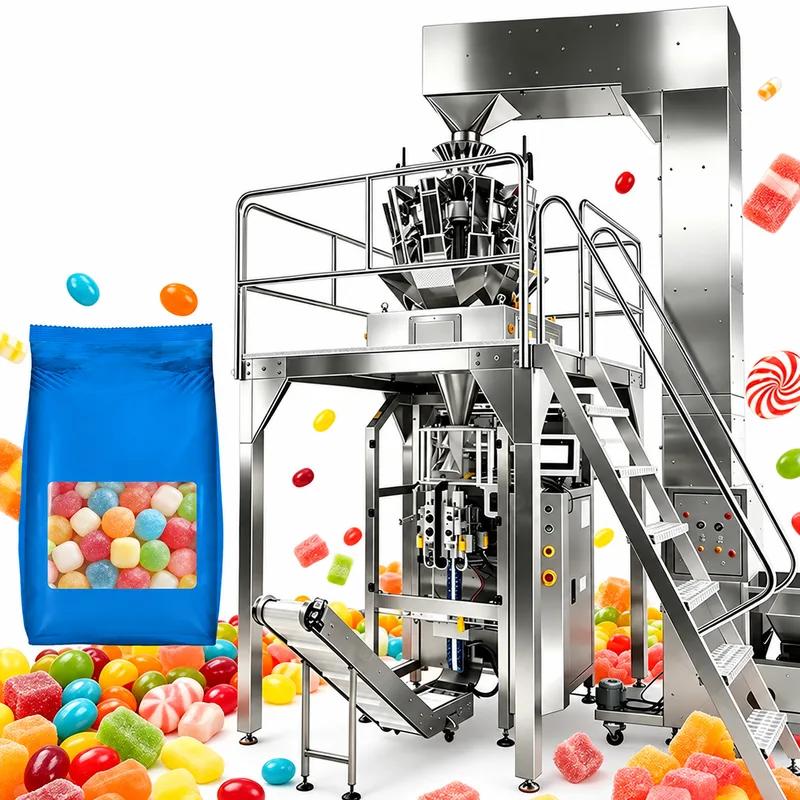
A correct bag weight can still hide broken, stuck or wrongly mixed sweets. Residue held on a contact surface can release into the next bag. This multihead weigher and VFFS line is set up around your candy's coating, size and pack.
Vertical Form Fill Seal
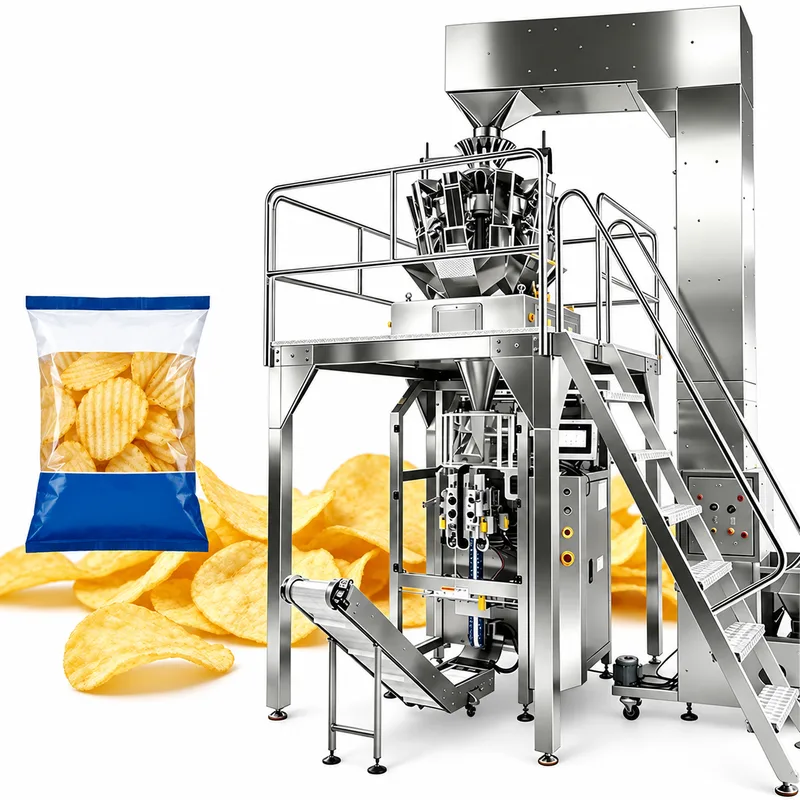
Chips Packaging with Nitrogen Flushing
An inflated bag can hide broken chips, a short fill or a weak seal. Size this weigher, VFFS and nitrogen-flush line from your chip volume, breakage limit and gas supply.
Vertical Form Fill Seal
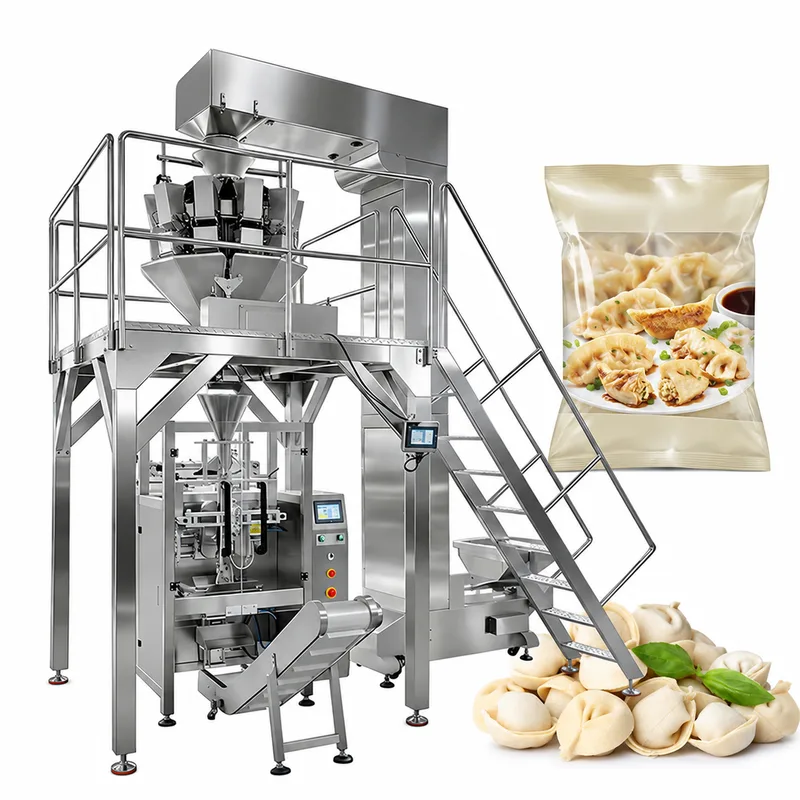
Frozen Food Weighing & Packaging
Frosted pieces retained in a hopper can leave a bag underweight and turn up in later fills. Specify this frozen-food weigher and VFFS line from product temperature, frost, piece size and cleaning method.
Vertical Form Fill Seal
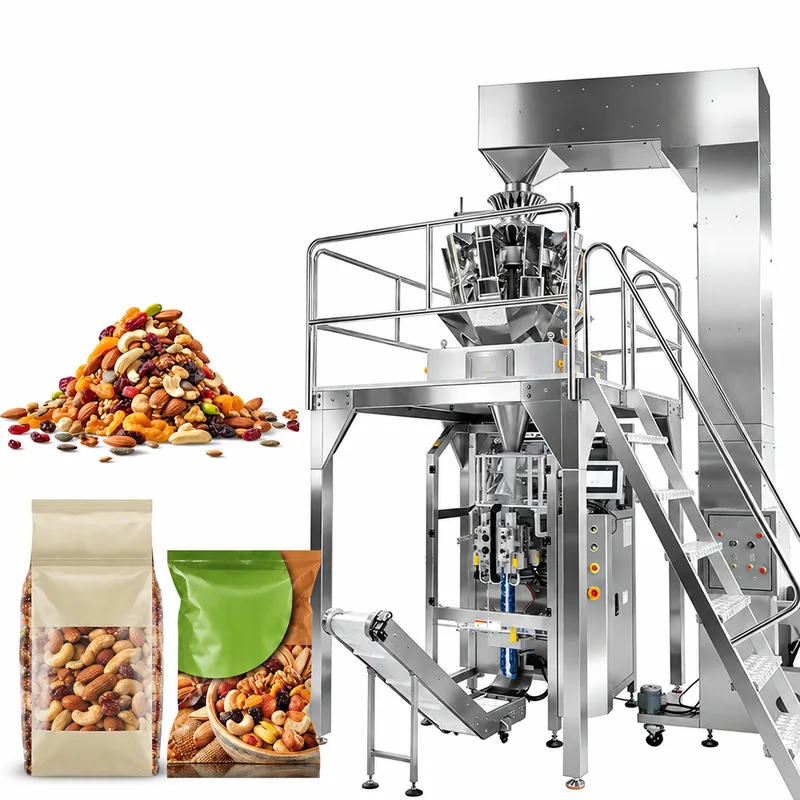
Nuts & Dried Fruit Multihead VFFS
A nut-mix bag can be on weight and still hold the wrong ratio of ingredients. Configure this multihead VFFS line from your blend, coatings, target weight and bag size.