
Static Eliminator: VFFS Film Static & Powder Seal Control
How an industrial static eliminator neutralizes VFFS film cling and powder seal contamination, comparing AC, pulsed DC, and passive bars with mounting distances.
Scroll horizontally to read all columns, conditions and sources.
| Selection criterion | Passive induction (brush, 32 mm tinsel, string) | Active AC ionizing bar | Active pulsed DC ionizing bar |
|---|---|---|---|
| Power source and ionization method | No external power; self-energizes by induction from the web static field and drains to bare-metal earth ground | High-voltage AC power splits surrounding air into alternating positive and negative ions | High-voltage pulsed DC power emits balanced positive cations and negative anions with longer ion life |
| Effective mounting distance | Very close non-contact drape for string or tinsel; contact brushes touch the surface directly | Near-field range of 20 mm to 100 mm (0.79 in to 3.9 in); six times stronger at 25 mm than at 50 mm | Extended range up to 1000 mm (3.28 ft); nearly 3 times stronger at 200 mm than at 300 mm; keep long-range bars at least 250 mm out for full coverage |
| Residual static floor | Reduces high surface fields down to roughly 2000 V; cannot fully eliminate fine powder cling alone | Neutralizes insulating webs to near-zero residual charge within close free-air spans | Neutralizes heavy charges and offers a partial exception where surfaces sit close to grounded metal frames |
| Web-speed suitability | No web-speed restriction; handles very high speeds as an upstream knock-down stage | Rapid decay at moderate speeds; webs above 300 m/min historically required two or more AC bars | Higher ion output copes with fast rollstock speeds where single AC bars saturate |
| Best role on a VFFS bagger | Low-cost pre-neutralization stage upstream of active bars, provided brushes do not mark thin films or transfer dust | Tightly spaced post-unwind dancer spans and pre-forming collar free-air zones across 20 cm (8 in) to 5 m (16 ft) widths | High-speed rollstock, wide unwind racks, deep open spans, and pre-seal zones near metal chutes |
On This Page
What Is a Static Eliminator and Why Do VFFS Lines Need One?
An industrial static eliminator neutralizes electrostatic buildup on packaging film and dry powders by releasing balanced positive and negative ions that cancel surface charge before webs cling or dust enters seals. On VFFS machines, mounting ionizing bars in free air ahead of the forming collar and horizontal jaws prevents jams, misfeeds, and powder-contaminated seals.
How Triboelectric Charging Builds on Rollstock Film and Organic Powders
Static electricity builds up through friction, pressure, and separation whenever non-conductive materials make and break contact—a mechanism known as the triboelectric effect. On a vertical bagger, polymer rollstock peels off the unwind core, wraps across guide rollers, and slides over the forming shoulder, while dry powders acquire charge through interparticle collisions and particle-wall sliding, rolling, and impact during blending, sieving, pouring, and conveying (Konakbayeva et al.). Because insulating organic powders and polymer films exhibit slow charge decay, they retain accumulated voltage for prolonged periods (Biegaj et al.).
Uncontrolled electrostatic charge triggers both film-handling faults and product-dosing defects. Charged rollstock sticks to metal frames, clings to itself, misfeeds through pull belts, attracts airborne debris unevenly, and drives up package reject rates. Inside the dosing path, electrostatic powder charging causes wall-fouling during transport and inconsistent finished-product dosing, while oppositely charged sealant faces pull fine dust directly into the cross-seal jaws. Pairing proper static control with verified rollstock specifications in our packaging film requirements guide and structured powder dosing trials keeps both film tracking and weight stability repeatable.
Why Powder Fines, Surface Chemistry, and Combustible Dust Demand Control
Particle size and surface chemistry govern how aggressively a dry powder charges before reaching the VFFS bag mouth. In sieved yellow pea powder tribocharging tests reported by Konakbayeva et al., 25-micron particles averaged 3.7 particle-wall collisions and the lowest charge-to-mass ratio, whereas 60-micron particles peaked at 17 collisions per particle and the highest charge-to-mass ratio. Higher powder protein content also increased contact potential difference and correlated strongly with triboelectric charge-to-mass ratio.
Surface hydrophobicity amplifies charging even further against stainless steel contact parts. In comparative tribocharging trials against stainless steel (Biegaj et al.), hydrophobic fluorine-functionalized particles accumulated 5.89 times more charge (-11.2 ± 2.8 V/mg) than hydrophilic hydroxyl-functionalized particles (-1.9 ± 0.3 V/mg), while cyano surfaces reached -2.6 ± 0.5 V/mg and amino surfaces charged positively at +2.1 ± 0.3 V/mg. Powders confined inside insulating plastic containers discharge slowly via air recombination alone compared with powders contacting conductive grounded surfaces.
Beyond seal leaks and dosing drift, uncontrolled electrostatic discharge around fine organic powders presents a plant safety hazard. OSHA combustible dust guidance warns that finely divided food powders—including candy, sugar, spice, starch, flour, and feed—along with plastics and pharmaceuticals can form explosible dust clouds. The U.S. Chemical Safety Board (CSB) documented 281 combustible dust incidents between 1980 and 2005 resulting in 119 worker deaths and 718 injuries, followed by a 2008 Georgia sugar dust explosion that killed 14 workers.
| Electrostatic factor | Documented test or incident metric | VFFS powder packaging implication |
|---|---|---|
| Particle size and wall impact (yellow pea powder) | 25-micron particles averaged 3.7 collisions; 60-micron particles peaked at 17 collisions per particle | Coarser free-falling fractions and high-impact chutes can drive peak charge-to-mass ratios |
| Surface chemistry against stainless steel | Fluorinated -11.2 ± 2.8 V/mg (5.89 times hydroxyl -1.9 ± 0.3 V/mg); cyano -2.6 ± 0.5 V/mg; amino +2.1 ± 0.3 V/mg | Hydrophobic ingredients and coatings accumulate markedly stronger charge on stainless steel augers and chutes |
| Container conductivity | Insulating plastic walls discharge slowly by air recombination alone vs rapid relaxation on conductive grounded surfaces | Non-conductive plastic hoppers and polymer film tubes trap powder charge unless neutralized actively |
| Combustible dust hazard (OSHA / CSB) | 281 incidents (1980–2005) with 119 deaths and 718 injuries; 14 fatalities in a 2008 Georgia sugar explosion | Sugar, flour, starch, spice, candy, feed, plastic, and pharmaceutical dust lines require grounding and static control |
How Does an Ionizing Static Eliminator Neutralize Film and Powder Charge?
An active ionizing static eliminator applies high-voltage alternating current (AC) or direct current (DC) to split surrounding air molecules into positive cations and negative anions. Because insulating polymer films and organic powders cannot drain charge to ground directly, their charged surfaces attract opposite-polarity ions from the ionized field until net electrostatic potential returns to balance.
Balanced Corona Ionization, Humidity Decay, and ASTM Resistivity Benchmarks
Grounding alone only drains static from conductive or static-dissipative paths; materials used in static management fall into conductive, dissipative, or insulative categories. Non-conductive packaging polymers isolate surface charges, so balanced electrostatic discharge (ESD) air ionizers generate both positive and negative air ions through high-voltage corona discharge (Air ioniser overview). Positively charged webs pull in negative anions while negatively charged regions pull in positive cations, bringing the moving surface back to neutrality without physical contact. In controlled laboratory corona experiments (Biegaj et al.), applying 8.0 kV for 0.02 s and tracking charge decay from 0.07 s down to 10% of initial charge demonstrated how strongly ambient moisture aids dissipation: raising relative humidity from 25% RH to 75% RH accelerated charge relaxation by 1.6 times on fluorinated surfaces and 12.2 times on cyano surfaces.
When specifying static-dissipative brushes, rollers, or packaging laminates, engineers verify electrical properties under recognized test standards rather than relying on generic antistatic labels. ASTM D257 covers DC resistance or conductance of insulating materials and notes that surface resistance changes rapidly with humidity while volume resistance changes slowly. For moderately conductive components, ASTM D257 directs testing to ASTM D4496, which applies to materials with volume resistivity from 10^0 to 10^7 ohm-cm or surface resistivity from 10^3 to 10^7 ohms per square conditioned at 23 °C and 50% relative humidity. Surface resistivity for ESD brushes is also verified under EOS/ESD S11.11, dielectric breakdown voltage is tested under ASTM dielectric breakdown testing (60 Hz default across a 25 to 800 Hz range, above which dielectric heating becomes a concern), and most ESD-safe industrial applications require a static decay rate below two seconds.
Managing Trace Ozone Byproduct Inside Enclosed Packaging Guards
High-voltage corona emitter pins inevitably create trace ozone alongside neutralizing air ions (Air ioniser safety reference). Even well-designed ionizers produce a small amount of unwanted ozone, so airflow and ventilation matter whenever bars run inside tightly enclosed VFFS safety cabinets. A daily average ozone concentration above 0.1 ppm (100 ppb, or 0.2 mg/m3) is not recommended because it can directly damage lungs and olfactory bulb cells. For reference in indoor environments, the California Air Resources Board certifies ionizing air cleaners only when indoor ozone output stays within 0.050 parts per million. Keeping emitter tips clean, avoiding oversized bar voltage for tight gaps, and maintaining normal exhaust ventilation around enclosed powder lines keep local ozone accumulation well within safe workplace limits.
Active Ionizing Bar vs Passive Static Brush or Tinsel: Which Fits Fast Webs?
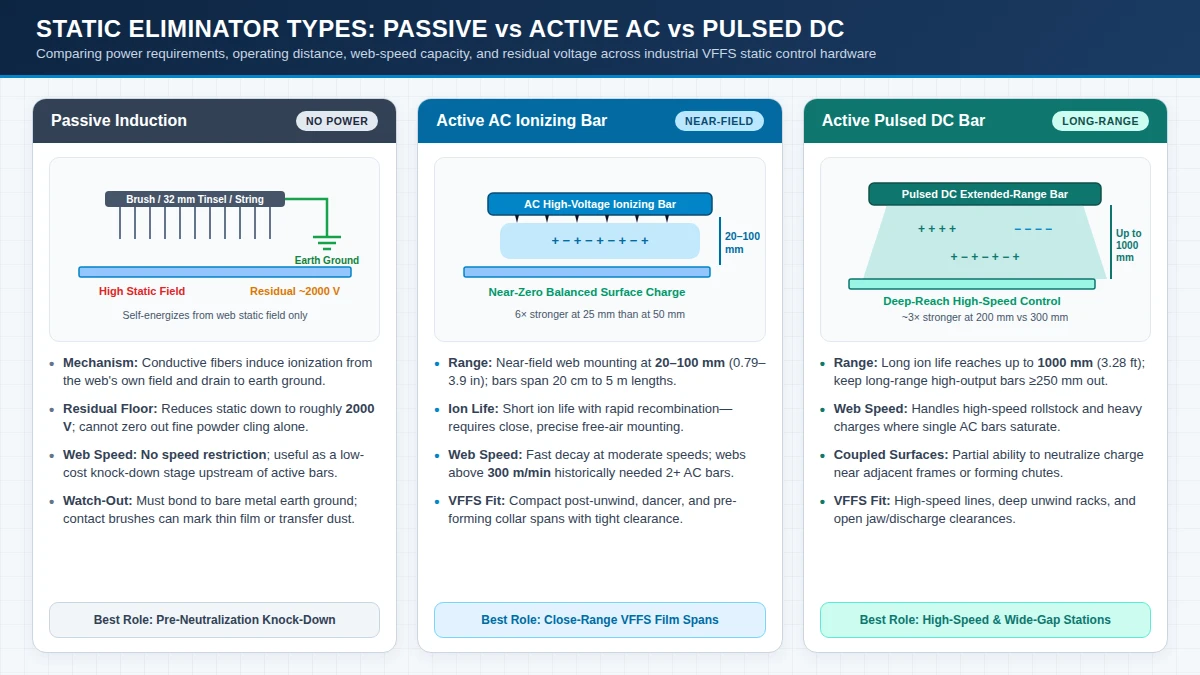
Passive induction devices such as conductive brushes, 32 mm copper tinsel, and grounded strings require no electrical power and impose no web-speed restriction, but they reduce static only down to roughly 2000 V. High-speed VFFS rollstock and fine powder lines therefore pair passive knock-down hardware with powered AC or pulsed DC ionizing bars to achieve near-zero surface charge.
When Passive Tinsel, Grounded String, or Brushes Help—and Where They Stop
Passive static eliminators self-energize by drawing energy directly from the electrostatic field on the moving film, concentrating that field at fine conductive filaments to induce local ionization and bleed charge to earth ground. Common formats include anti-static brushes, multi-strand copper tinsel with a 32 mm (1.25 in) diameter, and conductive-microfiber anti-static string. Because induction requires no mains supply or high-voltage transformer, passive devices are economical, simple to mount, and carry no web-speed limit.
However, passive induction stops working once surface voltage drops to roughly 2000 V—low enough to reduce harsh shock or severe web wrap, yet still strong enough to pull fine flour, coffee, or detergent dust onto heat-sealable film layers. Installation discipline is also strict: copper tinsel must bond securely to earth ground for ESD compliance, and anti-static string must connect to bare grounded metal while suspended slightly clear of—never touching—the moving web. Contact-style brushes pose an additional hazard on VFFS rollstock because physical bristles can mark thin barrier films or collect airborne powder and transfer debris onto clean film. Passive eliminators therefore work best as a primary knock-down stage upstream of powered ionizing bars rather than a standalone powder-seal fix.
Choosing Between Near-Field AC Bars and High-Speed Pulsed DC Bars
Active static eliminators use powered emitter pins to ionize air continuously even when residual film voltage falls well below the passive induction threshold. Industrial anti-static bars span standard lengths from 20 cm (8 in) to 5 m (16 ft), covering everything from narrow stick-pack webs to wide pillow-bag rollstock. Selection between AC and pulsed DC depends primarily on mounting clearance and web speed.
Alternating current (AC) ionizing bars suit tight near-field positions from 20 mm to 100 mm (0.79 in to 3.9 in) where compact frames keep the emitter close to the film span. Because static generation rises proportionally with web speed and AC ions recombine rapidly in air, fast lines running over 300 m/min historically needed two or more AC bars to keep pace. Direct current (DC) and modern pulsed DC bars extend ion life to neutralize across distances up to 1000 mm (3.28 ft), deliver higher neutralization output on fast or heavily charged webs, and maintain partial effectiveness even when charged surfaces sit near adjacent machine bodies. For lines troubleshooting dust-contaminated cross-seals alongside dosing setup, cross-check mechanical dust shrouds in our detergent powder packing machine guide.
How Does Mounting Distance and Free-Air Clearance Affect Neutralization?
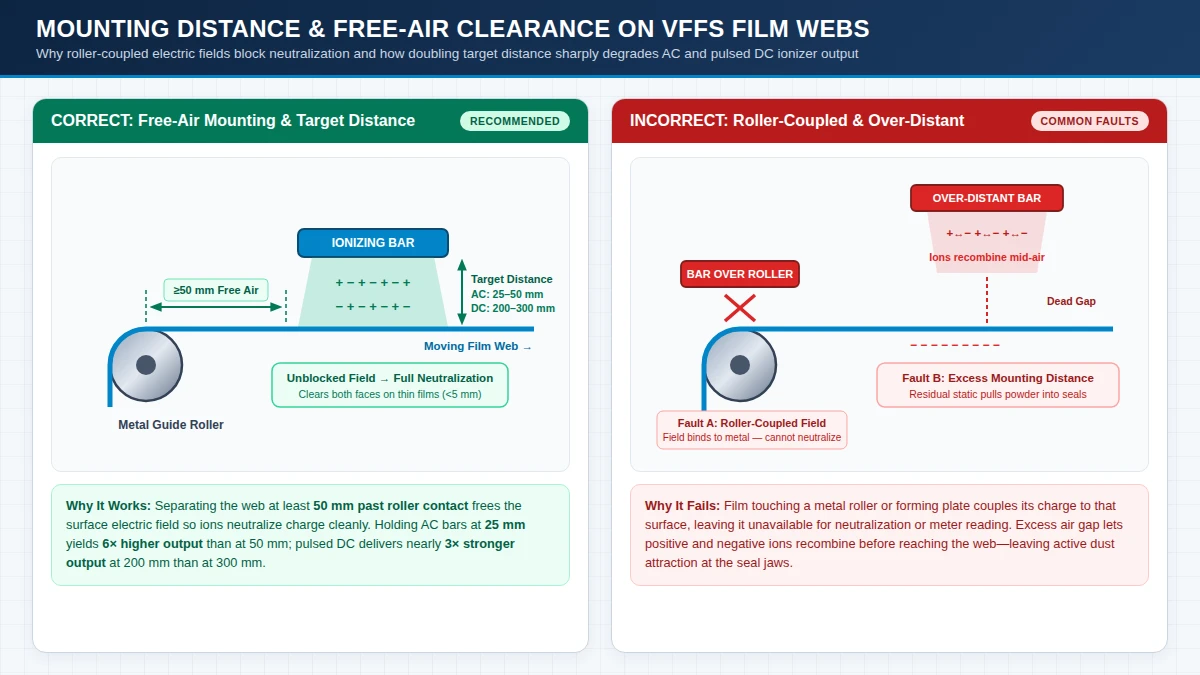
Distance to the target web is the single factor with the greatest influence over static eliminator performance. Short-range AC bar output is six times better at 25 mm than at 50 mm, while long-range pulsed DC output is nearly 3 times stronger at 200 mm than at 300 mm, provided the web travels in free air at least 50 mm past roller contact.
Distance Falloff Across Short-Range AC and Long-Range Pulsed DC Bars
Air ionization decays sharply with travel distance because oppositely charged ions collide and recombine before reaching the web, even inside enclosed ducting (Air ioniser distance physics). On short-range AC bars, ion life is brief, so positioning the emitter as close as mechanical safety permits drives dramatic performance gains: doubling the gap from 25 mm to 50 mm cuts AC bar performance by a factor of six. Mounting an AC bar beyond its 100 mm near-field range wastes most of the ion cloud in mid-air.
Pulsed DC bars maintain longer ion travel and handle deeper clearances up to 1000 mm (3.28 ft), yet distance still governs output sharply: a long-range pulsed DC bar delivers nearly 3 times the neutralizing strength at 200 mm compared with 300 mm. At the same time, long-range high-performance pulsed DC bars require a minimum standoff—avoid mounting them closer than 250 mm so the emitted ion curtain spreads uniformly across the full target width rather than creating uneven polarity stripes.
The Free-Air Rule: Why Film Touching a Roller Cannot Be Neutralized
Aiming an ionizing bar directly at film wrapped over a guide roller, idler drum, or metal chute is the single most common installation mistake on VFFS lines. Whenever a charged film touches another body, its electrostatic field couples tightly into that adjacent surface and becomes unavailable for either neutralization or handheld meter measurement. You must wait until the rollstock separates from the roller into an unsupported free-air span.
Maintain at least 50 mm of free-air travel between the roller separation point and the static eliminator neutralization zone before placing an ionizing bar. Although pulsed DC ionization provides a partial exception because direct-current ion flow can interact somewhat with coupled bodies, free-air placement remains the baseline engineering rule for consistent full-web neutralization.
| Mounting rule or device class | Grounded distance or clearance metric | Engineering reason on VFFS webs |
|---|---|---|
| Free-air separation past roller | At least 50 mm after film exits roller contact | Prevents the web electric field from coupling into the metal roller where ions cannot neutralize it |
| Active AC near-field bar | 20 mm to 100 mm (0.79 in to 3.9 in) operating band; six times better at 25 mm than at 50 mm | AC ions recombine quickly, making tight free-air proximity critical |
| Active pulsed DC extended bar | Up to 1000 mm (3.28 ft) reach; nearly 3 times stronger at 200 mm than at 300 mm; keep long-range high-output bars at least 250 mm out | Longer ion life spans deeper machine gaps while minimum standoff ensures full web coverage |
| Ionized air blower | Nearly three times better at 500 mm than at 1 m | Airflow carries balanced ions across wide open stations without losing entire coverage |
Where Should You Mount a Static Eliminator Bar on a VFFS Bagger?
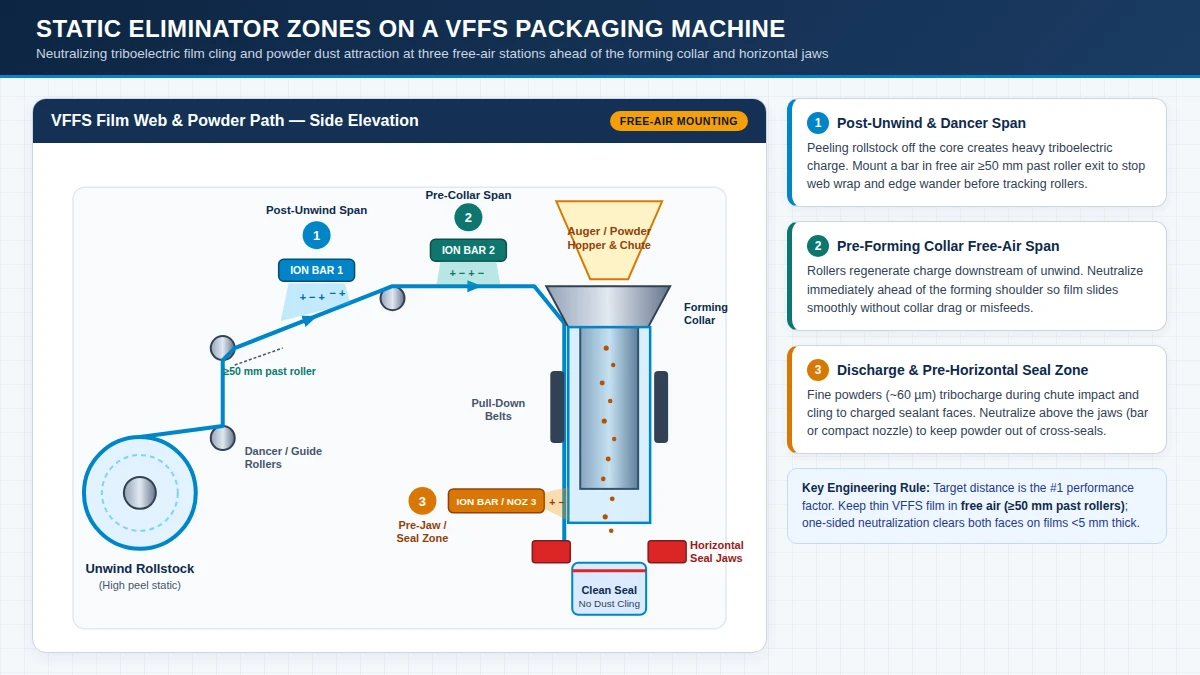
Mount static eliminator bars immediately ahead of each failure zone rather than relying on a single bar at the unwind stand, because guide rollers and forming surfaces regenerate triboelectric charge downstream. Effective VFFS layouts target three free-air spans: post-unwind past the first guide roller exit, immediately before the forming collar, and above the horizontal seal jaws where falling powder charges.
Post-Unwind, Pre-Collar, and Pre-Seal Placement to Prevent Charge Regeneration
Neutralizing too early in a web path leaves the film vulnerable to recharging on every subsequent idler, dancer bar, and forming shoulder. A three-zone strategy addresses each charge source right before it disrupts production:
- Post-unwind and dancer free-air span: Peeling rollstock off the core generates heavy initial static that causes film wrap and edge wander. Place an ionizing bar (optionally preceded by grounded passive tinsel or string for bulk knock-down) at least 50 mm past the roller separation point so tracking rollers and photo-eye sensors see a flat, calm web.
- Pre-forming collar free-air span: Dancer and registration rollers regenerate charge between unwind and forming. Mounting an ionizing bar immediately ahead of the forming shoulder stops charged film from dragging unevenly across the stainless steel collar lip and causing back-seam skew; inspect collar finish and film-tracking geometry in our VFFS forming collar guide.
- Pre-horizontal seal jaw and powder drop zone: Falling powder acquires triboelectric charge inside the auger chute and conveying path—where particle-wall collision counts rise inversely with pneumatic air velocity (Konakbayeva et al.). Neutralizing the formed film tube and drop zone just ahead of the cross-seal jaws stops charged fines from clinging to the inner sealant layer and causing leaking bags. Log recurring seal contamination alongside jaw settings in the VFFS troubleshooting fault record.
Film Thickness, Multilayer Volumetric Charge, Warm Webs, and Dust Bonding
Thin VFFS packaging films behave transparently to electrostatic fields, meaning neutralizing one side of the web clears surface charge on both faces simultaneously. Double-sided neutralization—using opposing bars on both faces—is required only when web or sheet thickness exceeds 5 mm. However, multilayer barrier laminates and corona-treated webs can trap volumetric charge inside internal polymer layers; that embedded charge cannot be neutralized instantly and clears only after migrating back to the outer surfaces.
Temperature and dwell time also alter field results. Plastic surfaces do not reach electrical stability until cooled to roughly 40 °C to 50 °C, so warm webs or newly formed heat-stressed zones can regenerate residual charge after passing an upstream bar. Likewise, statically attracted dust must be neutralized and removed promptly: if dust sits on charged plastic for several days, electrostatic attraction can shift into molecular bonding that ionized air alone can no longer blow off, forcing wet wiping or solvent cleaning.
When Does a Line Need an Ionizing Blower, Air Knife, or Nozzle—and How Do You Verify It?
Add air-assisted static eliminators whenever moving webs cannot pass within bar range or when statically bound dust must be stripped mechanically during neutralization. Ionized air blowers cover wide zones, ionizing air knives amplify airflow up to 25:1 to dislodge particles, compact nozzles reach tight chutes, and inline eliminators clear pneumatic conveying pipes, all verified with a handheld digital static meter.
Matching Blowers, Air Knives, Nozzles, and Inline Eliminators to VFFS Stations
Standard ionizing bars excel on flat film spans with predictable geometry, but complex powder-packaging machinery presents deep clearances, confined chutes, or airborne dust clouds where air-assisted ionization performs far better:
- Ionized air blowers: Deliver high-volume ionized airflow across wide open workstations, packaging areas, or warm surfaces that benefit from concurrent cooling. Distance still governs output—ionized blower performance is nearly three times better at 500 mm than at 1 m.
- Anti-static air knives: Combine an ionizing bar with a precision linear slot to project a laminar high-velocity sheet of ionized air, amplifying compressed-air output up to 25:1 to neutralize stubborn static and sweep dust or fibers off moving webs in one pass.
- Compact ionizing nozzles: Mount inside tight, hard-to-reach equipment spaces—such as around forming-tube exits, chute mouths, and cross-seal jaw throats—using focused ionized air streams to keep particles from re-attaching.
- Inline static eliminators: Install directly into pneumatic or vacuum conveying pipelines feeding flour, starch, or granular blends, using compact bars matched to tube diameter to prevent static-induced clogs and bridging before product even reaches the VFFS hopper.
Compressed-Air Purity and Digital Static Meter Verification Routine
Air-assisted static eliminators rely on compressed-air quality as heavily as high-voltage output. Every compressed-air supply feeding an ionizing nozzle, air-assisted bar, or air knife must be clean, dry, oil-free, and free of moisture and particulate matter; oil mist or water droplets foul high-voltage emitter pins, cause uneven ion balance, and contaminate food-contact packaging zones.
Verify every installation quantitatively rather than guessing by hand feel. Use a handheld, battery-operated digital static meter to read both surface voltage and polarity across free-air web spans before and after each ionizing station while ensuring the technician is properly grounded with anti-static footwear or apparel. During commissioning and routine preventive maintenance, record ambient temperature, relative humidity, airflow, compressed-air pressure, and emitter cleanliness together so seasonal winter dry-air spikes or dirty emitter tips are caught before seal reject rates climb.
Sources
All powder tribocharging measurements, corona charge-decay tests, electrical resistivity and breakdown standards, combustible dust safety statistics, and ozone exposure thresholds referenced in this guide are grounded in the following public technical documents:
- Biegaj et al. — Surface Chemistry and Humidity in Powder Electrostatics: A Comparative Study between Tribocharging and Corona Discharge (ACS Omega)
- Konakbayeva et al. — A New Perspective to Tribocharging for Process Monitoring and Quality Control of Powders (Foods)
- ASTM D 257 — Standard Test Methods for DC Resistance or Conductance of Insulating Materials (ASTM International)
- ASTM D4496 — Standard Test Method for D-C Resistance or Conductance of Moderately Conductive Materials (ASTM International)
- ASTM International — Standard Test Method for Dielectric Breakdown Voltage and Dielectric Strength of Solid Electrical Insulating Materials at Commercial Power Frequencies
- OSHA — Combustible Dust: An Explosion Hazard (U.S. Occupational Safety and Health Administration)
- Air ioniser — ESD neutralisation and ozone exposure limits (Wikipedia)
Frequently asked questions
How does a static eliminator neutralize charge on non-conductive packaging film?
An active static eliminator uses high-voltage AC or DC power to ionize surrounding air molecules into balanced positive cations and negative anions. Because insulating polymer film cannot drain charge through metal grounding alone, the charged web attracts opposite-polarity air ions until its surface charge neutralizes.
Can passive static tinsel or an anti-static brush replace an ionizing bar on a powder VFFS line?
Usually not by itself. Passive brushes, 32 mm copper tinsel, and grounded strings need no power and have no web-speed restriction, but they self-energize only down to about 2000 V. On fine powder VFFS lines, that residual voltage still pulls dust into horizontal seals, so passive hardware works best as an upstream knock-down stage ahead of active ionizing bars.
How close should an AC or pulsed DC ionizing bar be mounted to a VFFS film web?
Mount near-field AC bars within 20 mm to 100 mm of the web—short-range AC output is six times better at 25 mm than at 50 mm. Pulsed DC bars reach up to 1000 mm and deliver nearly 3 times stronger output at 200 mm than at 300 mm, while long-range high-output bars should stay at least 250 mm away for uniform coverage.
Why does an ionizing bar fail when mounted directly over a metal guide roller?
When charged packaging film touches a roller or metal frame, its electrostatic field couples into that body and becomes unavailable for neutralization or meter measurement. Mount the static eliminator over an unsupported free-air span at least 50 mm past the point where the film leaves the roller.
Do thin VFFS films need ionizing bars on both sides of the web?
No. Most thin plastic packaging films are transparent to surface charge, so neutralizing one side clears both faces at once. Double-sided neutralization is generally required only for materials thicker than 5 mm, though multilayer or corona-treated webs with trapped volumetric charge may need downstream secondary neutralization after internal charge migrates to the surface.
Explore the Equipment

Coffee Bean Valve-Pouch Packaging
A misplaced or poorly attached degassing valve can spoil a run of coffee bags. Specify this weigher and VFFS valve line from your valve drawing, film, roast and weight.

Four-Lane Collagen Stick-Pack Machine
Four lanes can hide one lane that under-doses. Specify this four-lane collagen stick-pack machine from your powder density, serving weight and stick size, and sample every lane.
Four-Lane Coffee Powder Stick Packs
Instant, agglomerated, blended and ground coffee do not dose alike on one screw. Specify this four-lane coffee stick-pack line from your exact formula, serving and stick, and check every lane.
Four-Lane Creamer Stick-Pack Machine
Creamer that cakes in the hopper or dusts the seal can cause runs of rejected sticks. Specify this four-lane creamer stick-pack line from your formula, serving, moisture sensitivity and changeover order.