
Quad-Seal Bag VFFS Machine: Forming Collar & Corner Seal Guide
Specify a quad seal bag packaging machine by checking rectangular forming-collar perimeter math, four-corner heater balance, dual-sensor web tracking, and ASTM seal verification against the coffee pouch drawing.
On This Page
Quad-seal box pouch geometry, rectangular forming collars, and web perimeter math
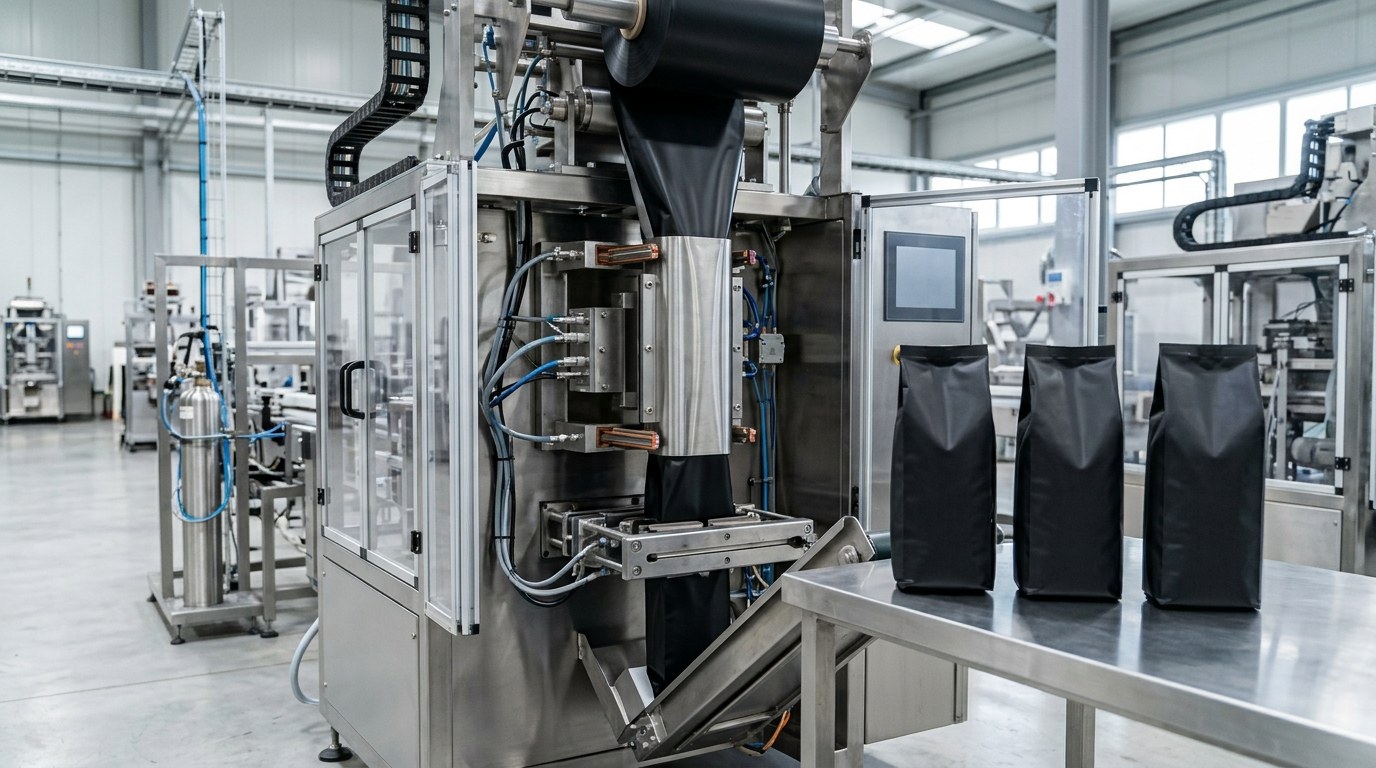
Buyers specifying a quad seal bag packaging machine or a quad seal coffee bag machine need a rectangular forming path that can hold four vertical edges, not a round pillow tube with a single back seal.
Quad-seal bags get their shape from four longitudinal corner seals and are distinct from a flat four-side-seal sachet sealed around the perimeter of a small cavity.
Our Quad-Seal Coffee Packaging configuration adds four sealed edges to the formed bag, sets gussets and base geometry directly from your bag drawing rather than generic format labels, offers in-line degassing-valve integration as an option, and pairs with volumetric, linear, or multihead dosing.
In our quad-seal coffee packaging lineup, standard brick-shaped retail coffee pouch weight formats cover 250 g, 500 g, and 1 kg (8 oz, 16 oz, and 2 lb), and all product contact surfaces are constructed with SUS304 stainless steel to resist coffee oil buildup.
For an ideal rectangular expanded section on a VFFS machine, the film width perimeter equation is W = 2F + 2D + S = 2F + 4g + S, summing two faces (2F), two complete sides (2D or 4g), and the total longitudinal seam allowance (S).
In the assumed rectangular perimeter worked example with front face F = 140 mm, full side depth D = 60 mm (inward tuck g = 30 mm), and seam allowance S = 20 mm, the calculated film width is W = 2 × 140 + 2 × 60 + 20 = 420 mm, compared with 2 × 140 + 20 = 300 mm with no side depth.
For assumed inputs of flat face width W = 160 mm and fin height = 10 mm (back-seal allowance A = 20 mm), the pillow web estimate is 2 × 160 + 20 = 340 mm, and adding unfolded side gusset depth G = 50 mm gives a side-gusset web estimate of 2 × 160 + 2 × 50 + 20 = 440 mm.
In an assumed bag length calculation, a 230 mm cut-to-cut length equals a 230 mm film advance, whereas a 230 mm usable cavity length with two 10 mm cross seals requires 230 + 10 + 10 = 250 mm of film advance.
Those perimeter and length checks belong on the RFQ drawing before a rectangular former is ordered.
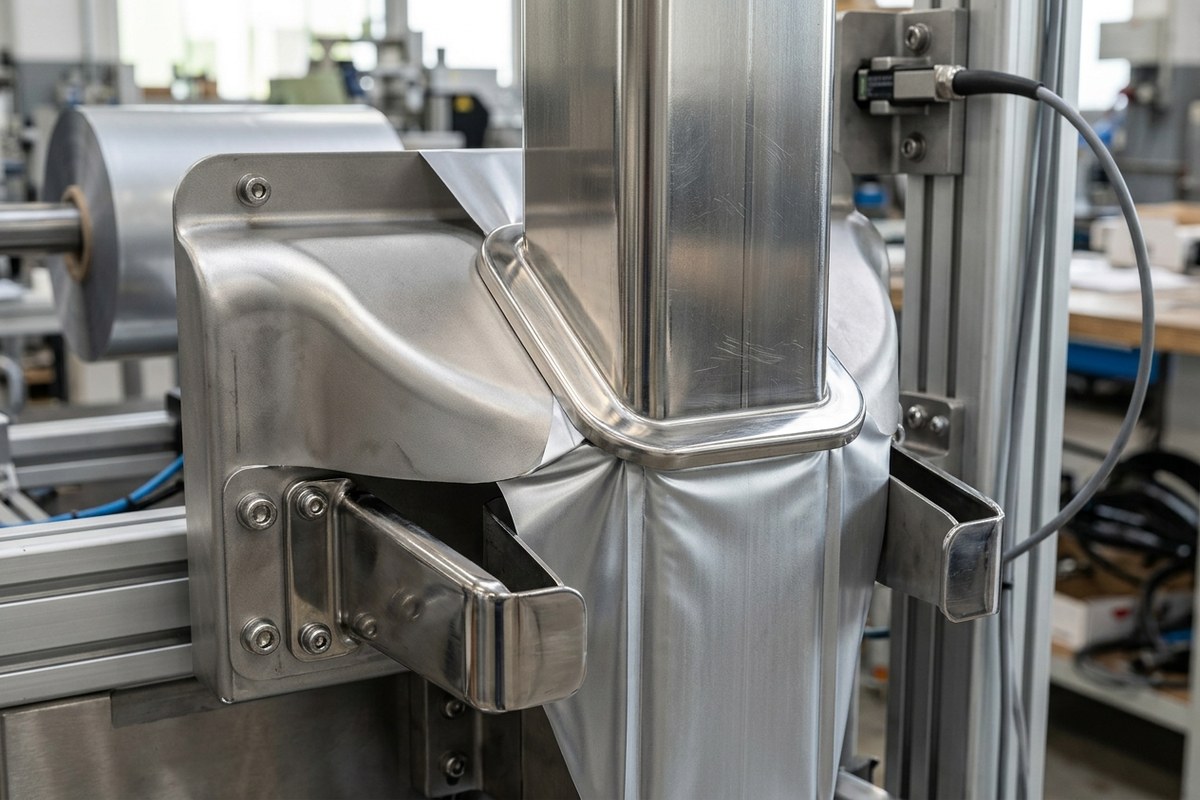
Our VFFS forming shoulder and tube assemblies can be configured as rectangular, round, or oval units with adjustable-crossover backseals, quad and side seals, creaser roller assemblies, gusset finger attachments, flat bottom bag attachments, nitrogen gas flush lines, and vacuum or dust ports.
Clearance between the VFFS forming tube and forming shoulder must remain consistent around the intersection; narrow pinch points create excess tension that can tear film, leave score marks, and reduce the laminate's barrier capacity.
On VFFS forming tubes equipped with integral cones, the product dose is slightly staggered so that it passes through the forming tube bottleneck faster and stays more compact.
Low-friction Armoloy-type forming tube coatings reduce friction as film moves across flat tube surfaces, helping maintain production speeds with thinner metallized films (typically around 35 microns) that tend to stretch.
Composite-stainless forming assemblies (combining stainless steel film-contact surfaces with lightweight structural materials elsewhere) are up to 40% lighter than traditional all-steel formers while remaining just as durable.
We engineer dedicated VFFS forming sets per machine frame and bag format—including Quad-Seal, Doy-Style, Side-Gusset, Pillow, and Block-Bottom forming sets—accommodating film thicknesses from 0.02 mm to 0.12 mm and custom film widths from 35 mm (min) to 800 mm (max).
Use the rectangular-collar checkpoints in the table below when you compare former quotes, and keep the finished bag face, side depth, and seam allowance on one drawing so the unfolded web width stays traceable to the retail pack.
- Review the Quad-Seal Coffee Packaging configuration scope
- Compare quad-seal bag structure with other bag styles
- Calculate pillow and side-gusset film width before ordering reels
- Compare gusset and pillow forming before locking a rectangular former
| Checkpoint | Engineering Parameter | RFQ Drawing Verification |
|---|---|---|
| Pouch Format & Weights | 4 vertical corner seals; 250 g, 500 g, 1 kg coffee formats | Specify rectangular tube vs round pillow tube |
| Unfolded Web Equation | W = 2F + 2D + S = 2F + 4g + S (0.02–0.12 mm film; 35–800 mm width) | Lock face (F), side depth (D = 2g), and seam (S) on drawing |
| Worked Web Comparison | 420 mm web (F=140, D=60, S=20 mm) vs 300 mm flat envelope | Include full side-gusset depth and 2 × 10 mm cross-seal pitch |
| Collar Gap & Surface Finish | Uniform shoulder-to-tube gap; low-friction coating for ~35 µm films | Specify surface treatment and composite-lightweight former option |
Four-corner vertical heater bar balance and multi-layer cross-jaw intersections
Independent corner-heating bars and multi-layer cross-jaw balance decide whether a quad-seal pouch keeps four equal vertical edges.
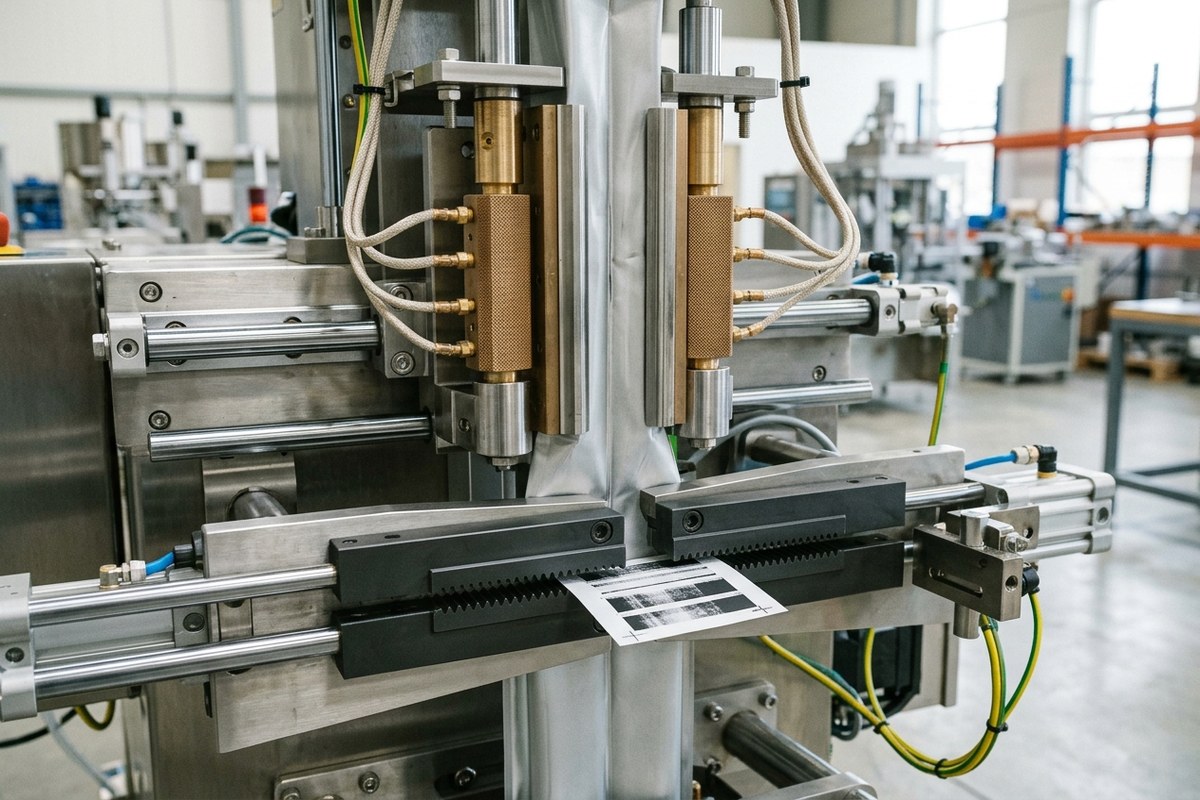
Our quad-seal coffee VFFS configuration uses independent corner-heating bars for four-side edge ironing control that crease and seal the four edges of the laminate before forming.
Where four layers of film intersect at the corner cross-section, our quad-seal VFFS engineering specifies heavy-duty sealing jaws with high-pressure profiles and PID constant temperature control within ±1°C.
On vertical baggers, end seals typically vary in thickness across lap or fin seals and gussets; unintended wrinkles or pleats may at times be unavoidable, and leakers often follow channels at the intersections between two and multiple layers of film and at the corners.
At VFFS end-seal transition points created by fin or lap seals, gussets, wrinkles, creases, and corners, applied heat and pressure must be sufficient to make the sealant layer flow into and seal off multi-layer voids.
Increasing VFFS sealing jaw temperatures to improve seal quality can create hot spots that overheat and distort the package, whereas high-conductivity alloy jaws provide consistent heat transfer across the seal to close channel leakers without overheating the film.
Excess sealing jaw pressure on a vertical bagger can crush or split the end seal, while overheating distorts the seal and can cause poor hot tack where the film springs back open ('moons') before the seal sets.
Nickel Teflon Coating (NTC) on sealing jaws provides slip and release protection so packaging film does not stick to hot sealing bars under high sealing temperatures.
For reciprocating VFFS sealing jaws, carbon paper (rather than carbonless paper) should be used for initial installation, adjustments, and inspections once or twice a week to assess set-up and sealing jaw condition.
For Stabilo and quad-seal pouches, we recommend a laminate with an outer sealant coating or gusset-tack layer when you want the top and bottom gusset ears to stay flat rather than flaring, while weighing higher material usage, film cost, slower cycle speed than pillow bags, and mono-material recyclability targets.
Record those film and jaw choices on the same trial sheet as the corner-bar temperatures so the RFQ team can see which combination produced equal corner widths without crushing the multi-layer junction.
- Match corner-heating bars to the coffee packaging configuration
- Carry corner-seal checks into the packaging machine FAT
| Sealing Zone | Failure Mode if Unbalanced | Commissioning Control |
|---|---|---|
| 4 Vertical Corner Bars | Asymmetric fin width; pouch rocks on shelf | Independent 4-zone PID edge ironing before tube entry |
| 4-Layer Gusset Junction | Capillary micro-leaks at fold-to-corner step | High-pressure serration profile; ±1°C PID jaw control |
| Reciprocating Cross Jaws | Seal fracture, hot spots, or hot-tack 'mooning' | NTC non-stick release coat; weekly carbon-paper impression |
| Gusset Ear Tack Layer | Flaring top/bottom side gussets | Match outer-sealant tack strip to barrier laminate spec |
Laminate web edge guiding, roller parallelism, and pull-belt alignment
Laminate edge guiding and pull-belt alignment keep the rectangular web centered on the forming collar so corner seals stay square.
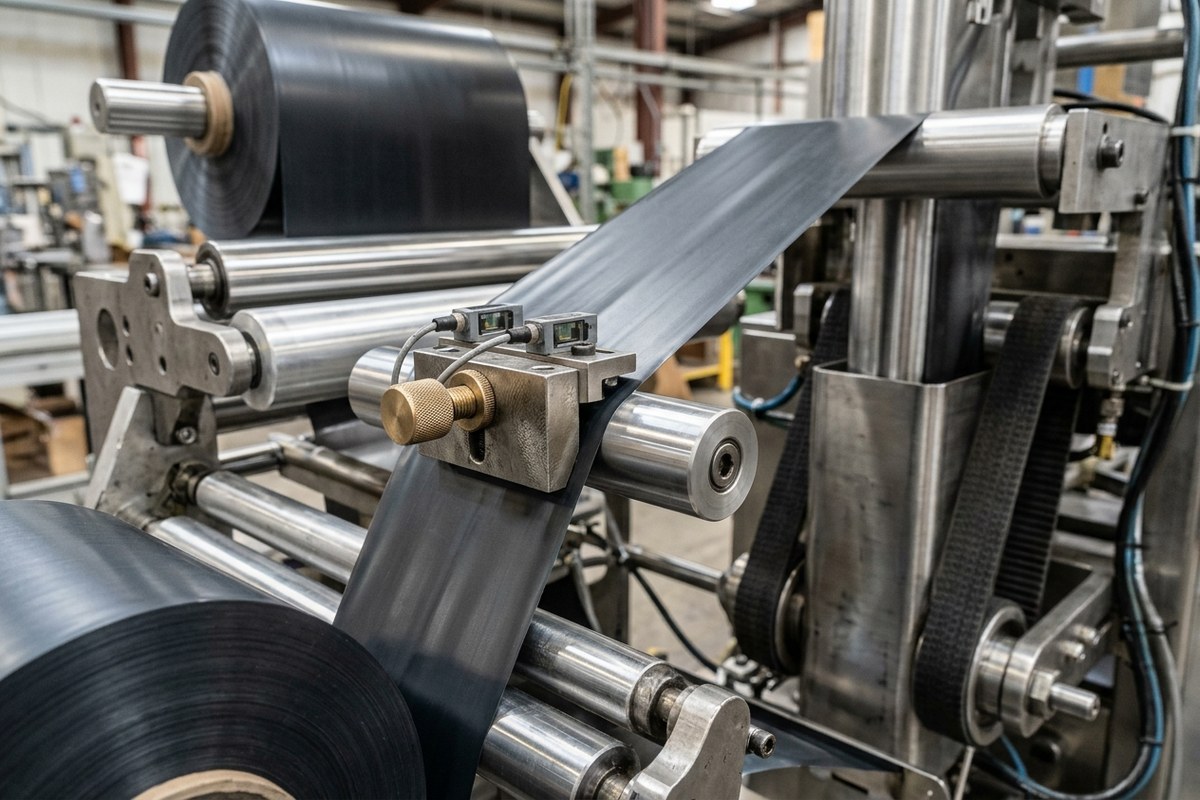
Misaligned film rollers prevent the packaging film from making full contact with the forming collar, resulting in wrinkles, creases, package distortions, and seal problems.
The wing of the VFFS forming collar should completely and evenly support the film as the flat web forms into a tube, because excessive, insufficient, or uneven web tension can cause wrinkles and creases.
On a vertical bagger, make sure film rollers are parallel to the leading edge of the former wing for equal web tension, make sure drive belts apply equal pressure on each side of the film tube with the forming tube flats aligned to the drive belts, and make sure the forming tube is not twisted.
On our automatic film-tracking VFFS carriages, web edge guiding uses 2 optical sensors—one focused on the film path and one focused outside the film path (adjusted horizontally via a bolt with a 13 mm wrench)—and shifts the entire film carriage left or right when the film edge drifts out of range.
In a hypothetical shift comparison of four format changes at 12 minutes each versus four changes at 20 minutes each, total changeover time is 48 minutes versus 80 minutes, a 32-minute difference.
In a hypothetical run of N = 10,000 accepted bags with reel width W = 0.420 m and cut pitch P = 0.200 m, film area is 848.48 m² at a 1% running reject rate (dividing by 0.99) versus 865.98 m² at a 3% running reject rate (dividing by 0.97), a 17.50 m² difference.
Those examples illustrate why carriage tracking and belt pressure deserve the same RFQ attention as the former geometry.
- Plan format changeovers that protect web tracking time
- Request changeover support for dual-sensor carriage setup
On-machine 5-step quad-seal inspection and ASTM seal and leak testing standards
On-machine checks and laboratory seal tests close the loop after forming and sealing settings are locked.
The 5-step Stabilo (quad-seal) VFFS bag quality inspection checks that: 1. bags are air tight when squeezed, 2. bags are the correct length, 3. the four corners of the stabilo seal are all the same width, 4. gusseting depth is equal on both sides of the bag, and 5. the code date is in the correct location.
Under Clauses 1.1, 1.3, and 1.4, the test method measures the force required to separate a test strip of flexible barrier material containing a laboratory or commercial seal and identifies the mode of specimen failure.
Clauses 4.2.1, 4.2.2, and 4.2.3 define Technique A (Unsupported), Technique B (Supported 90° by hand), and Technique C (Supported 180°), and Clause 6.2 (referencing 5.4 of D882) specifies specimen widths of 0.984 in. [25 mm], 0.591 in. [15 mm], or 1.00 in. [25.4 mm].
Clause 8.1 specifies conditioning sealed materials in accordance with Specification E171 for a minimum conditioning time of 40 h unless heat seal strength stability is shown to be reached in shorter times.
Clause 9.6 requires testing the seal at a grip separation rate of 8 to 12 in./min [200 to 300 mm/min].
ASTM F 2029 practice B compares specific web constructions for their suitability for application, including conditions where the dwell time may be too short for the sealing interface to reach the required jaw temperature.
Per SPMC notes on porous medical and sterile-barrier packaging, F1929 dye penetration testing detects package edge-seal channels down to 0.002 in. (50 mm in SPMC text) with a confidence of 98-99%, while F2096 internal pressurization bubble testing detects gross leaks in pouch packages with a sensitivity down to 0.010 in. (250 mm in SPMC text).
Keep the on-machine Stabilo checks on production samples and reserve ASTM seal-strength peel methods for film trials and acceptance evidence.
- Attach ASTM peel and leak methods to acceptance evidence
- Send sample bags and laminate data for seal-check scoping
| Verification Method | Test Parameters & Sensitivity | Application Stage |
|---|---|---|
| 5-Step Stabilo Line Check | Squeeze tightness, cut length, 4 equal corners, equal gussets, date code | Hourly operator sampling at bagger |
| ASTM F88/F88M-15 Peel | 15 / 25 / 25.4 mm strip; Tech A/B/C; 200–300 mm/min (>=40 h E171) | FAT & laminate qualification peel force |
| ASTM F2029 Practice B | Heat-sealability & hot-tack curve under short jaw dwell | High-speed barrier film selection |
| ASTM F1929 & F2096 Leak | 0.002 in. channel dye penetration (98–99%); 0.010 in. gross bubble test | Corner-intersection channel & gross leak audit |
Quad-seal VFFS machine frame benchmarks and project RFQ preparation
Comparing frame envelopes across our quad-seal VFFS lineup helps buyers match film width, bag dimensions, and cycle rate before locking the final coffee configuration.
Our wide-range corner-seal VFFS configurations produce pillow bags and stand-up pouches with or without sealed corners at bag widths up to 380 mm.
Our 420-series quad-seal VFFS configuration specifies a 150–420 mm film width, 80–280 mm bag length, 80–132 mm front width, 20–66 mm side width, 0.04–0.12 mm film thickness, max 320 mm roll diameter, 10–40 bags/min rate, 220 V 50/60 Hz 2.8 kW power, 1390 × 1155 × 1800 mm dimensions, and approx. 600 kg weight.
Our 520-series quad-seal VFFS configuration specifies a 250–520 mm film width, 80–350 mm bag length, 80–150 mm front width, 35–90 mm side width, 0.04–0.12 mm film thickness, max 320 mm roll diameter, 10–40 bags/min rate, 220 V 50/60 Hz 3 kW power, 1492 × 1255 × 2184 mm dimensions, and approx. 700 kg weight.
For higher-speed stand-up quad-seal formats, our compact 320-frame SS304 configuration covers a 260–320 mm film width, 230 mm bag length, maximum 50 bags/min packing speed, 220 V, 50/60 Hz, 3 kW power supply, 0.3 m³/min at 0.6 MPa air consumption, and 1320 × 980 × 1550 mm dimensions.
Stepping up to wider reels, our 430-frame configuration specifies a 260–430 mm film width and 300 mm bag length, while our 520-frame high-speed configuration specifies a 280–520 mm film width and 350 mm bag length; both models feature an SS304 structure and run at maximum 50 bags/min with a 220 V, 50/60 Hz, 4.5 kW power supply and 0.3 m³/min at 0.6 MPa air consumption.
Use these frame ranges when you prepare an RFQ for our Quad-Seal Coffee Packaging configuration, then send bag drawings, laminate structure, and dosing route so our engineers can match a rectangular former, corner-bar layout, and web-tracking package.
Our engineering team targets a configuration enquiry reply within 24 hours.
Sources
Technical references consulted for this forming-collar and corner-seal guide include ASTM F88/F88M-15 seal-strength and ASTM F2029 heat-seal practice standards; Sterilization Packaging Manufacturers Council notes on ASTM F1929 and ASTM F2096 leak tests; and our Quad-Seal Coffee Packaging catalog specifications, gusset-versus-pillow forming guide, bag-size film-width guide, and VFFS forming-set engineering documentation.
Explore the Equipment
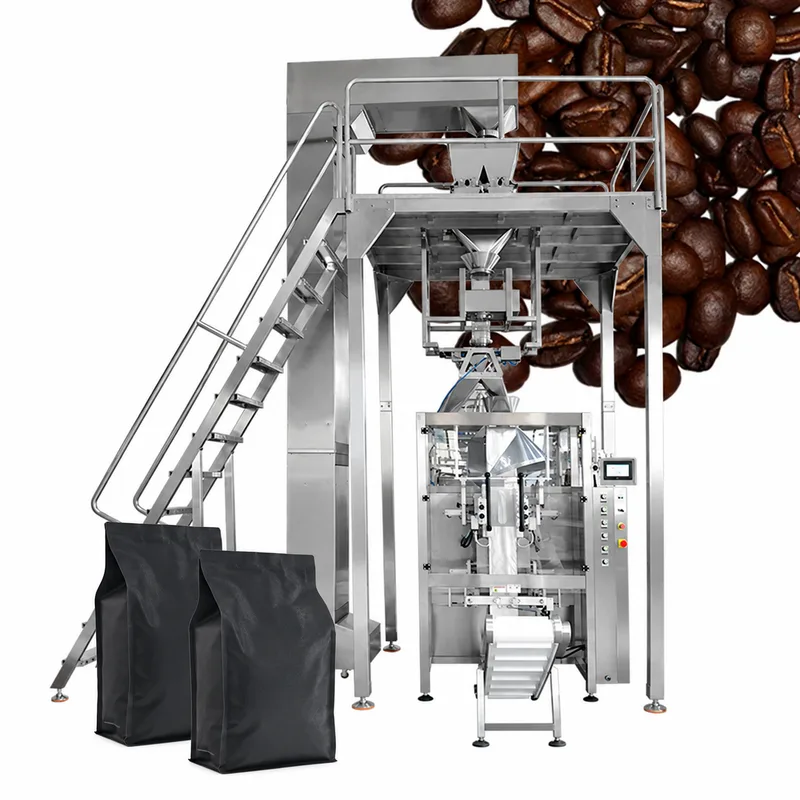
Vertical Form Fill Seal
Quad-Seal Coffee Packaging
A quad-seal coffee bag that will not stand, or skews at the corners, wastes film and coffee. Specify the corners, gussets, base, valve and dosing method from your bag drawing.