
Lap Seal vs Fin Seal: Film Compatibility & VFFS Setup
Compare lap seal vs fin seal back seams on VFFS machines across film compatibility, web-width savings, sealant melting temperatures, ASTM tests, and forming-tube tooling.
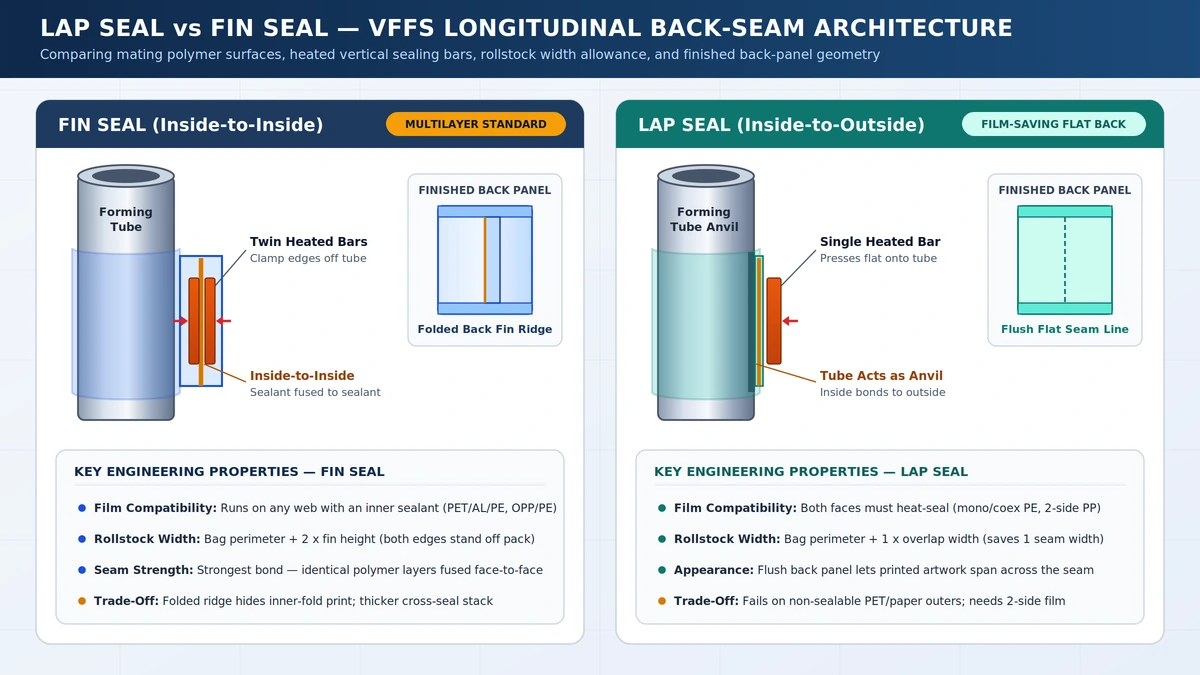
Scroll horizontally to read all columns, conditions and sources.
| Selection criterion | Fin seal (inside-to-inside) | Lap seal (inside-to-outside) |
|---|---|---|
| Mating film surfaces | Inside sealant face of one edge bonded to the inside sealant face of the opposite edge | Inside face of the upper overlapping edge bonded to the outside face of the lower edge |
| Rollstock compatibility | Works on any web with a heat-sealable inner face, including PET/AL/PE, OPP/PE, OPP/CPP, and PE-coated paper laminates | Requires two-side heat-sealable film such as monolayer or coextruded PE, two-side-sealable polypropylene, or a converter-built sealable outer layer |
| Flat film-width allowance | Adds two fin heights beyond bag circumference because both outer edges turn outward to mate | Adds one overlap width beyond bag circumference, reducing rollstock consumption per bag |
| Back-panel appearance and seam strength | Produces a folded vertical ridge that hides print inside the fold; delivers stronger sealant-to-sealant weld consistency | Sits flush against the back panel with a single outer edge line so graphics span the seam; strength depends on outer-face sealability |
| VFFS back-seal hardware and end-seal crossover | Pair of heated vertical bars clamps edges standing off the forming tube; folded fin creates a thicker stack where it crosses the end seal | Single heated vertical bar presses the flat overlap directly against the forming tube as a backing anvil; thinner film stack at the end-seal crossover |
On This Page
What Is the Structural Difference Between a Lap Seal and a Fin Seal?
A fin seal folds both longitudinal edges of the rollstock outward so the inner sealant face of one edge bonds to the inner sealant face of the opposite edge, leaving a standing fin folded flat against the back panel. A lap seal overlaps the two edges flat so the inside face of one edge bonds to the outside face of the other.
How Back-Seam Orientation Changes Pack Appearance and Print Continuity
Both fin seals and lap seals form the longitudinal back seam that runs along the machine film-travel direction on vertical form-fill-seal (VFFS) bags and horizontal flow-wrapped packs. Because both seals sit at the longitudinal sealing station immediately after the flat web wraps around the forming tube, the structural distinction comes down to which two polymer faces touch inside the weld and how the finished seam sits on the back of the package.
On a fin-sealed pouch, the welded fin stands off the back of the pack and is typically folded flat to one side after sealing, though certain pack styles leave the fin standing. That folded ridge interrupts back-panel artwork and conceals the film surfaces tucked inside the two faces of the fold. On a lap-sealed bag, the overlapping edges lie completely flush with the back panel, leaving only the edge of the outer film visible as a single line so printed graphics can run continuously across the back seam. For retail bags hung on display pegs where back-panel layout matters, that flush surface is often the main reason converters specify two-side-sealable rollstock.
Why Fin Seals Stack Thicker at Top and Bottom Cross-Seal Junctions
Longitudinal seam geometry directly affects how the horizontal cross-seal jaws close the top and bottom of every bag. Where the vertical back seal crosses the horizontal end seal, the folded fin stacks thicker than a flat lap overlap. Across flexible packaging architectures, seam integrity at these heat-seal intersections is often the primary constraint on hermetic closure and shelf-life protection, as emphasized in the peer-reviewed packaging sealants review in PMC13258176.
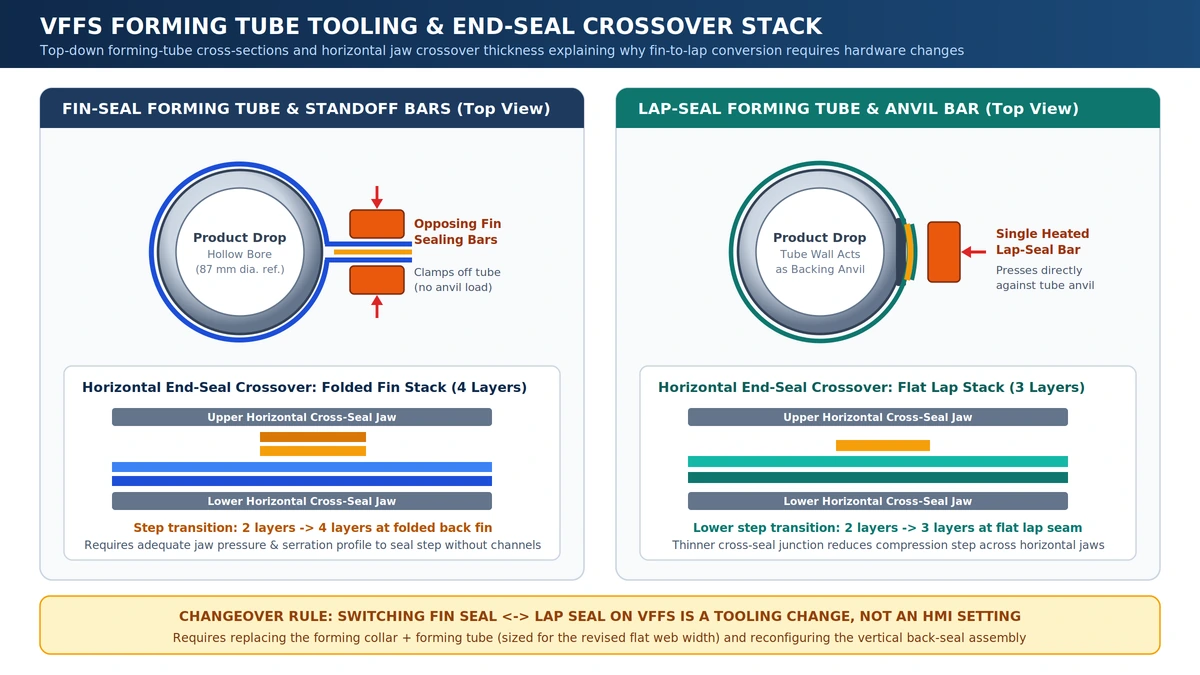
Because the horizontal jaws must clamp across both the flat two-wall bag body and the thicker folded back-fin zone simultaneously, jaw alignment and pressure uniformity are more demanding on fin-seal cross-seals than on flat lap-seal crossovers. Reviewing back-seam geometry alongside overall pouch format on our packaging bag styles hub prevents buyers from choosing a folded fin profile without matching jaw and film specifications.
How Does a Fin Seal Join the Inner Sealant Layers on VFFS Bags?
On a VFFS machine, flat rollstock wraps around the conical forming shoulder and hollow forming tube until its outer edges turn outward into matching flaps. A pair of opposing heated vertical sealing bars clamps those standing edges off the tube wall, melting identical inner sealant layers face-to-face before folding the cooled fin flat against the back panel.
Sealing Pressure and Polymer-Chain Entanglement on Vertical Bars
As described in Wikipedia's vertical form-fill-seal process overview, when the center of the flat web meets the forming tube, its two outer edges wrap around the exterior of the hollow tube and travel downward under pull-down belt transport. At the vertical sealing station, twin heated bars close on the outward-turned edges without using the forming tube wall as a backing anvil. Heat conducts through both outer substrate webs into the mating inner sealant layers, softening and fusing identical polymer chains at the same interface temperature.
Adequate clamping pressure is mandatory to force intimate molecular contact across the vertical seam. In the peer-reviewed VFFS heat-sealing study by Merabtene et al. (2022) in BioResources, laboratory heat-sealing trials recorded the first observable seal at 3 bars and 80 °C; below 3 bars, the sealant layer lacked sufficient pressure for polymer-chain entanglement regardless of jaw temperature. The same study selected 5 bar sealing pressure with a 2 s dwell time for laboratory temperature-window mapping.
Industrial VFFS Jaw Profiles and Seam Strength Stability
Because a fin seal bonds sealant to sealant using the same polymer chemistry on both mating faces, it routinely produces stronger and more forgiving seams than an inside-to-outside weld. In the Merabtene et al. (2022) BioResources industrial VFFS trials on a commercial vertical bagger fitted with an 87 mm diameter forming tube and 140 mm forming shoulder producing 140 mm wide by 200 mm long pillow bags, two 11 mm wide sealing tool profiles operated at 3.1 bar effective pressure for flat jaws and 3.8 bar for serrated jaws.
Under those controlled sealing conditions, PE-coated flexible paper laminates reached a minimum leak-proof seal at 90 °C and required at least 0.4 s dwell at 100 °C, stabilizing at 11 N to 13 N peel force at 120 °C. Understanding how the forming shoulder, pull belts, and vertical jaws interact step by step is covered in our vertical form fill seal process guide.
Which Film Structures Work With a Lap Seal vs a Fin Seal?
Rollstock construction dictates back-seal eligibility before machine speed or bag appearance is considered. Any web with a heat-sealable inner face—including almost all multilayer barrier laminates—runs with a fin seal, whereas a lap seal strictly requires rollstock that is heat-sealable on both the inside and outside faces.
Why Barrier Laminates Like PET/AL/PE and OPP/PE Require a Fin Seal
As detailed in the multilayer packaging review in PMC13468549, engineered barrier laminates divide functional duties across distinct layers: structural outer layers deliver stiffness, printability, and dimensional stability; barrier layers such as EVOH, PVDC, aluminum foil, or inorganic coatings restrict oxygen and moisture permeation; tie layers bond dissimilar polymers; and a dedicated inner sealant layer based on LDPE, LLDPE, PP, or ionomers creates hermetic seams. Biaxially oriented polypropylene (BOPP) and biaxially oriented polyethylene terephthalate (BOPET) are widely selected as outer webs for tensile strength and puncture resistance, as summarized in PMC12886869.
In a standard barrier structure such as PET/AL/PE, the PE inner face melts to form the weld while the outer PET web serves as a non-sealable print surface. The exact same limitation applies to OPP/PE, OPP/CPP, PE-coated paper, and any laminate carrying a non-sealable print, paper, or barrier outer layer—representing most rollstock families run on VFFS packaging lines. Attempting to run a single-side-sealable laminate on a lap-seal forming set places the inner PE sealant against non-sealable PET or paper, preventing fusion and producing open back seams.
Two-Side Heat-Sealable Films Required for Lap Sealing
To form a reliable lap seal, the converter must supply a film whose outside surface heat-seals directly to its inside surface. Common lap-capable structures include monolayer polyethylene, coextruded polyethylene films with compatible outer and inner sealable skins, polypropylene films engineered with sealant on both sides, or custom converter-built laminates incorporating a dedicated heat-sealable outer layer. On these two-side-sealable webs, either a lap seal or a fin seal will form.
Even when the outer surface can seal, lap-seal peel strength depends directly on how well that outer layer bonds to the inner sealant. True two-side-sealable polyolefin films produce lap seams that approach fin-seal strength, whereas webs whose outer layer was optimized primarily for print receptivity or stiffness yield weaker lap bonds. Always coordinate film architecture and surface friction checks early using our packaging film requirements guide.
| Film structure family | Outer vs inner surface behavior | Compatible back-seal style |
|---|---|---|
| Barrier foil laminates (PET/AL/PE) | Non-sealable PET outer print web; PE inner sealant layer | Fin seal only (inside-to-inside) |
| Oriented film laminates (OPP/PE, OPP/CPP) | Stiff, printable BOPP or OPP outer web; LDPE or CPP inner sealant | Fin seal only unless converter adds sealable outer layer |
| PE-coated flexible paper laminates | Printable wood-free outer paper web; inner PE sealant coating | Fin seal only (paper outer cannot fuse to PE inner) |
| EVOH or PVDC multilayer barrier webs | Structural print outer, tie and barrier core, polyolefin or ionomer inner sealant | Fin seal standard; lap seal only with custom sealable outer skin |
| Monolayer or coextruded PE and two-side-sealable PP | Heat-sealable polymer chemistry present on both inner and outer faces | Lap seal or fin seal (both weld reliably) |
How Much Film Width Does a Lap Seal Save Compared With a Fin Seal?
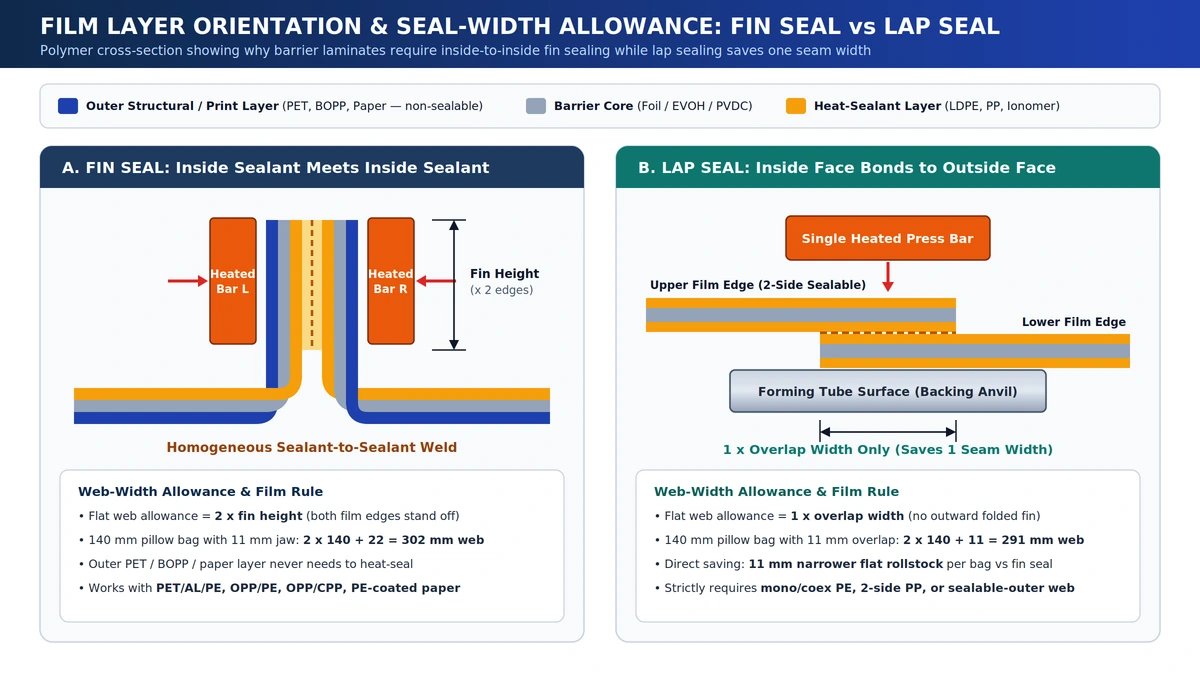
A lap seal saves exactly one seam-width allowance of flat rollstock on every bag compared with an equal-width fin seal. Forming a fin requires both film edges to stand off the bag perimeter by the fin height, adding two fin heights to flat web width, whereas a lap seal adds only one overlap width.
Geometric Rollstock Width Calculation and Worked 140 mm Pillow Bag Example
Flat rollstock width on a VFFS machine equals the unfolded bag perimeter plus the longitudinal seam allowance. For a plain pillow bag, the unfolded perimeter is twice the finished flat face width. Under fin-seal geometry, both outer edges bend outward from the forming tube to meet inside-to-inside, so the total back-seal allowance equals two fin heights. Under lap-seal geometry, one edge overlaps the other flush against the tube wall, so the total back-seal allowance equals one overlap width.
Consider an industrial VFFS pillow bag benchmark matching the Merabtene et al. (2022) BioResources commercial machine setup: a 140 mm wide pillow bag formed on an 87 mm diameter tube with an 11 mm sealing tool width. Using an 11 mm fin height on each side consumes two 11 mm edge strips in the back seam, whereas an 11 mm lap overlap consumes only one 11 mm strip—delivering a direct 11 mm flat web-width reduction on every bag formed. For step-by-step flat width layouts across both pillow and side-gusseted formats, cross-check your drawing against our bag size and film width guide and gusset bag vs pillow bag forming guide.
Balancing Film-Width Savings Against Outer-Layer Material Cost
Using less rollstock per bag makes lap sealing attractive on high-volume monolayer polyethylene lines where the film is inherently heat-sealable on both sides. However, buyers running multilayer barrier structures should never switch to lap sealing for web-width savings without checking the converter's structure cost first.
Because only a lap seal needs a heat-sealable outer face, paying a film converter to engineer a special sealable outer coating onto a barrier laminate can offset the narrow web-width reduction—and there is no reason to pay for a two-side-sealable outer layer on a fin-seal line. Confirm with your film converter which back seal the reel will run before locking roll width or print repeat.
How Do Sealant-Layer Melting Points and Testing Standards Affect Back-Seal Choice?
Sealant melting windows govern whether heat can pass through the outer film without shrinking or distorting the bag before the inner seam fuses. Conventional sealants operate from 90–150 °C for ionomers, 100–160 °C for LDPE, above 115 °C for LLDPE, and 110–170 °C for PP, while OPP outer webs shrink above 140 °C.
Matching Sealant Activation Temperature to Outer-Layer Thermal Stability
In conductive heat sealing, thermal energy travels from the heated vertical bar through the outer film layer to melt the bonding interface. As documented in PMC13468549, LDPE sealants remain the most widespread VFFS benchmark because their 100–160 °C melting range and broad seal initiation window tolerate line fluctuations in pressure, dwell time, and temperature. Ionomer sealants activate even lower at 90–150 °C and preserve seal integrity through fat or particle contamination, whereas polypropylene sealants require higher temperatures of 110–170 °C across a narrower sealing window that demands tighter jaw control.
Published literature summarized in Merabtene et al. (2022) in BioResources illustrates how narrow the margin between inner sealant fusion and outer-web damage can be. Flexible LLDPE films tested from 100 to 130 °C achieved reliable interfacial bonds above 115 °C. On OPP/CPP laminates, peel strength climbed sharply from 110 °C to peak at 120 °C before declining toward 170 °C, while OPP molecular orientation relaxed above 150 °C. In industrial OPP/PE trials, the first noticeable seal appeared at 110 °C, yet temperatures above 140 °C caused the film to coarsen and shrink around the seam. By contrast, PE-coated flexible paper withstood 90 °C up to 220 °C before browning.
On a fin seal, high-melt structural outers such as PET or paper protect the heated bar from sticking while lower-melt inner LDPE or ionomer fuses face-to-face. On a lap seal, both the inner and outer polymer skins must melt and fuse cleanly without sticking to the heated vertical bar or dragging across the forming tube anvil—narrowing the workable thermal window when outer print surfaces are heat-sensitive.
Verifying Back-Seal Quality With ASTM F2029, ASTM F88, and ASTM F1921
Objective seal validation prevents subjective pull-test guesswork when qualifying either a fin or lap film structure. Laboratory heat-sealability curves follow ASTM F2029-16(2021), which standardizes making laboratory heat seals and evaluating sealability strictly through peel strength measured by ASTM F88/F88M-23. Because sample bending alters recorded peel force, ASTM F88 defines three tail-support options—Technique A (unsupported), Technique B (supported 90 degrees by hand), and Technique C (supported 180 degrees)—and recommends holding one technique consistent across every test series.
Because VFFS longitudinal and bottom seals experience product-drop and pull tension while still warm, buyers also specify ASTM F1921/F1921M-12(2018) hot-tack testing, which quantifies seal strength immediately after bar opening before cooling to ambient temperature. Finally, as ASTM F2029 explicitly notes, peel strength alone does not verify seal continuity; leak tightness across back-seam and cross-seal junctions must be confirmed separately through air-leak, dye penetration, visual examination, or microorganism penetration tests.
| Polymer or laminate layer | Documented temperature threshold | VFFS back-seal implication |
|---|---|---|
| Ionomer inner sealant | 90–150 °C sealing range | Low initiation temperature with high resistance to fatty or dusty seam contamination |
| LDPE inner sealant | 100–160 °C melting and sealing range | Broad, forgiving VFFS sealing window across pressure and dwell variations |
| LLDPE sealant film | 100 to 130 °C tested; reliable bond above 115 °C | Requires vertical bar heat above 115 °C for consistent interfacial strength |
| PP / OPP-CPP sealant system | 110–170 °C PP window; OPP/CPP peel peaks at 120 °C | Tighter temperature control needed; OPP orientation relaxes above 150 °C |
| OPP/PE vs PE-coated paper laminate | OPP/PE shrinks above 140 °C; PE-coated paper runs 90–220 °C | Heat-resistant outer webs widen the fin-seal window before outer distortion or browning |
What VFFS Forming Tube Changes Are Needed to Switch Back-Seal Types?
Switching an existing VFFS machine between a fin seal and a lap seal is a hardware tooling change rather than an HMI parameter adjustment. Converting seam styles requires replacing the forming collar and forming tube cut for the revised flat web width, along with reconfiguring the vertical back-seal assembly.
Tube-as-Anvil Lap Bar vs Standoff Twin Fin Bars
The two longitudinal seal styles rely on completely different mechanical clamping geometries at the front of the forming tube. On a fin-seal VFFS station, the forming collar turns both film edges outward away from the tube wall so a pair of opposing heated vertical bars can pinch the standing edges together off the tube. On a lap-seal VFFS station, the forming collar lays one edge flat over the other directly against the forming tube wall, and a single heated vertical bar presses the overlap onto the forming tube acting as a rigid backing anvil.
Because a lap-seal tube bears direct mechanical clamping load and thermal contact from the vertical press bar, while a fin-seal tube guides both film edges outward into standoff bars, the two tube assemblies are not interchangeable without modifying or swapping hardware. Inspecting collar lip geometry, tube bore, and mounting-plate interfaces in our VFFS forming collar sizing guide clarifies what stays on the machine frame versus what swaps in the format kit.
Coordinating Forming-Set Width and Converter Film Orders
Every VFFS bag former is machined for one exact flat web width, and that flat web width depends directly on whether the longitudinal seam uses two fin heights or one lap overlap. Ordering a forming set before settling the film structure creates immediate mismatches: either the rollstock arrives too narrow for a fin-seal collar, or a non-sealable barrier reel arrives for a lap-seal tube.
State the back-seal type and complete film structure together when requesting machine quotations across our VFFS packaging machine configurations, and pass the identical drawing revision to your film converter. Doing so ensures the forming tube diameter, flat rollstock width, vertical sealer hardware, and outer-surface sealability align before steel is cut or printed reels are slit.
Sources
All VFFS heat-sealing trial metrics, polymer sealant temperature windows, multilayer laminate structures, and seal test standards referenced in this guide are grounded in the following public technical documents:
- Merabtene et al. (2022) — Heat Sealing Evaluation and Runnability Issues of Flexible Paper Materials in a Vertical Form Fill Seal Packaging Machine (BioResources 17(1), 223–242, NCSU)
- Adhesives and Sealants in Packaging: Advanced Materials, Performance, and Emerging Technologies (Part II) — PMC13468549
- Adhesives and Sealants in Packaging: Functional Roles and System-Level Classification (Part I) — PMC13258176
- Cracking the Code of Multi-Layer Films to Promote Circularity in Single-Use Plastic Packaging — PMC12886869
- ASTM F88/F88M-23 — Standard Test Method for Seal Strength of Flexible Barrier Materials (ASTM International)
- ASTM F1921/F1921M-12(2018) — Standard Test Methods for Hot Seal Strength (Hot Tack) of Thermoplastic Polymers and Blends Comprising the Sealing Surfaces of Flexible Webs (ASTM International)
- ASTM F2029-16(2021) — Standard Practices for Making Laboratory Heat Seals for Determination of Heat Sealability of Flexible Barrier Materials as Measured by Seal Strength (ASTM International)
- Vertical form fill sealing machine — single-web forming tube and vertical sealing cycle (Wikipedia)
Frequently asked questions
Can you run a lap seal with PET/AL/PE or OPP/PE barrier laminate film?
No. Standard barrier laminates such as PET/AL/PE or OPP/PE carry their heat-sealant layer only on the inside face while the outer PET or OPP surface is a non-sealable print substrate. Those structures require a fin seal unless the film converter specifically builds a heat-sealable outer layer for lap sealing.
Which longitudinal back seal is stronger on a VFFS bag: lap seal or fin seal?
A fin seal is generally stronger because it bonds identical inner sealant layers face-to-face at the same sealing temperature. A lap seal bonds the inner sealant to the outer face, so its strength approaches a fin seal on true two-side-sealable films but is weaker when the outer layer was chosen primarily for printing or stiffness.
How much rollstock film width does a lap seal save compared with a fin seal?
A lap seal saves one seam-width allowance per bag. Because a fin seal requires both film edges to stand off the bag perimeter by the fin height, flat web width adds two fin heights, whereas a lap seal adds only one overlap width—saving 11 mm of flat web width on an 11 mm seam setup.
Can an existing VFFS machine switch from fin seal to lap seal through HMI settings?
No. Moving between fin seal and lap seal on a VFFS machine is a hardware tooling change, not a parameter change. You must replace the forming collar and forming tube sized for the revised flat web width and reconfigure the vertical back-seal assembly between twin standoff fin bars and a single tube-backed lap bar.
Which ASTM test standards verify VFFS fin-seal and lap-seal quality?
Packaging engineers establish heat-sealability curves under ASTM F2029-16(2021), measure cooled peel strength under ASTM F88/F88M-23 using a consistent tail-support geometry (Technique A, B, or C), and evaluate warm in-cycle seam resistance under ASTM F1921/F1921M-12(2018) hot-tack testing, paired with separate leak-continuity checks.
Explore the Equipment
Candy Multihead Weighing & Packaging
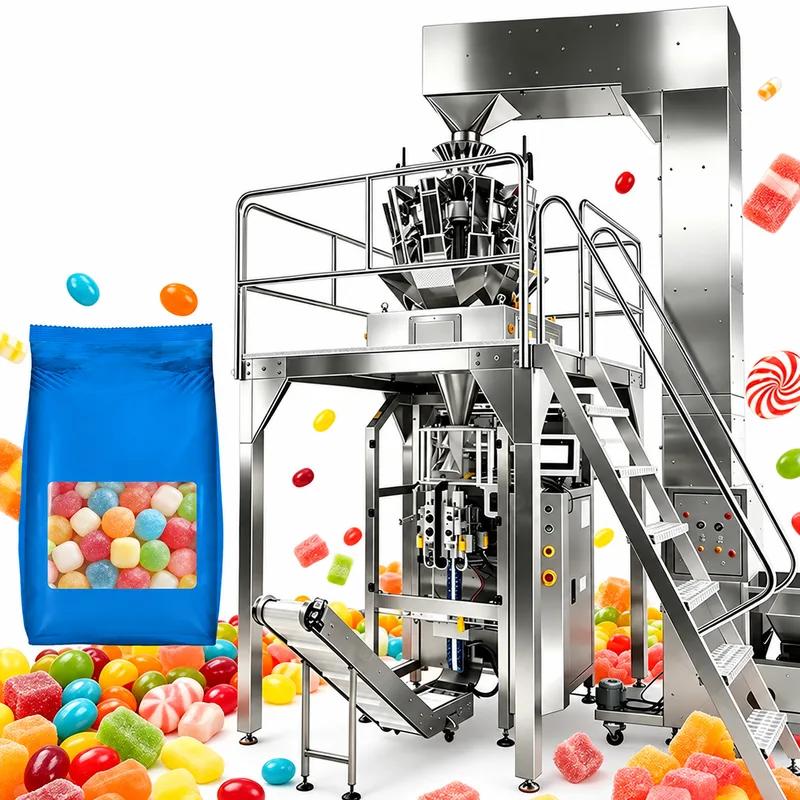
A correct bag weight can still hide broken, stuck or wrongly mixed sweets. Residue held on a contact surface can release into the next bag. This multihead weigher and VFFS line is set up around your candy's coating, size and pack.
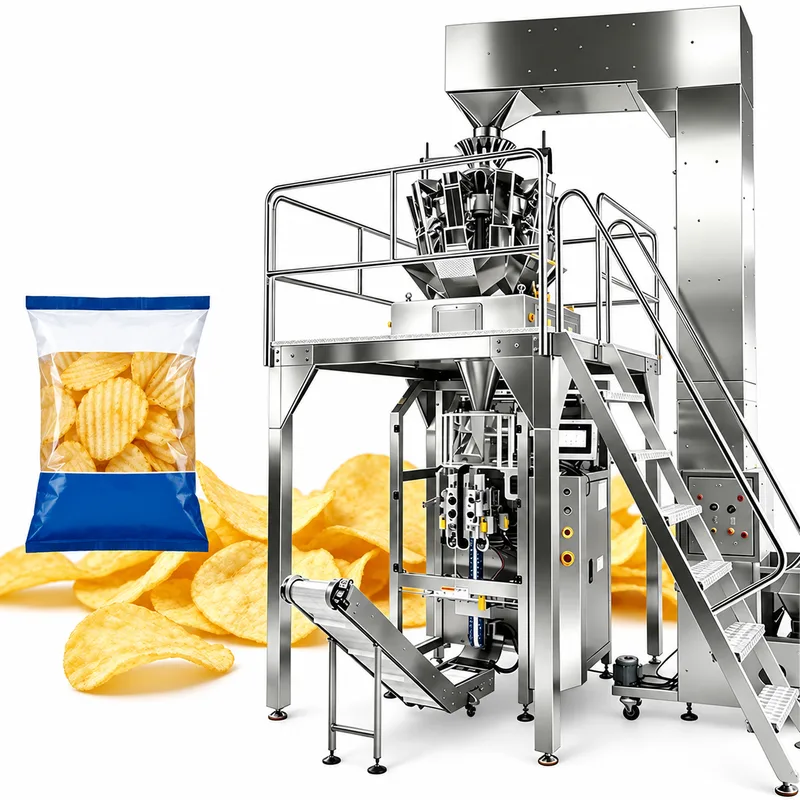
Chips Packaging with Nitrogen Flushing
An inflated bag can hide broken chips, a short fill or a weak seal. Size this weigher, VFFS and nitrogen-flush line from your chip volume, breakage limit and gas supply.
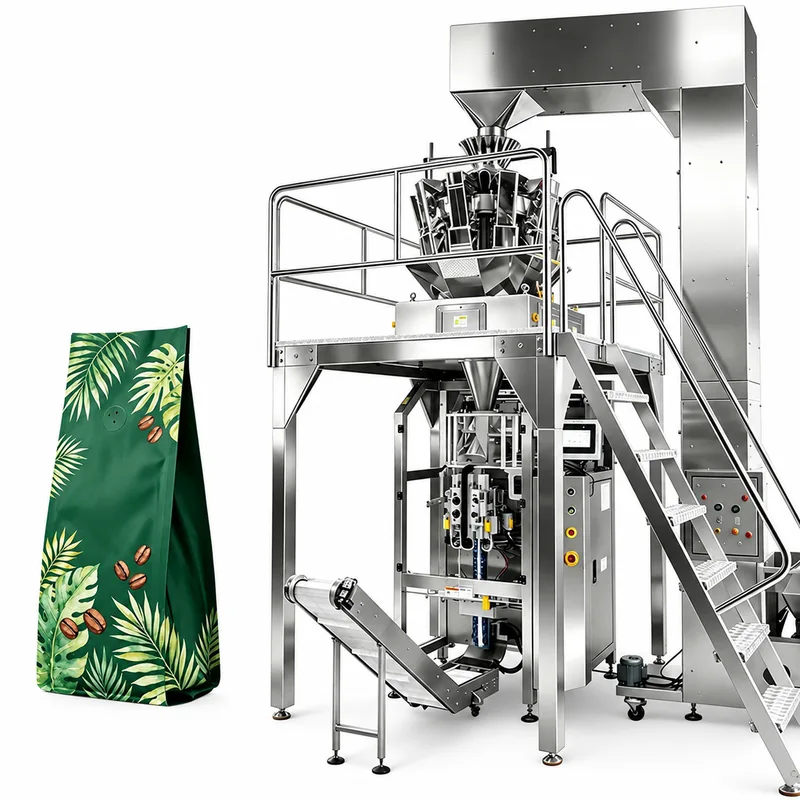
Coffee Bean Valve-Pouch Packaging
A misplaced or poorly attached degassing valve can spoil a run of coffee bags. Specify this weigher and VFFS valve line from your valve drawing, film, roast and weight.
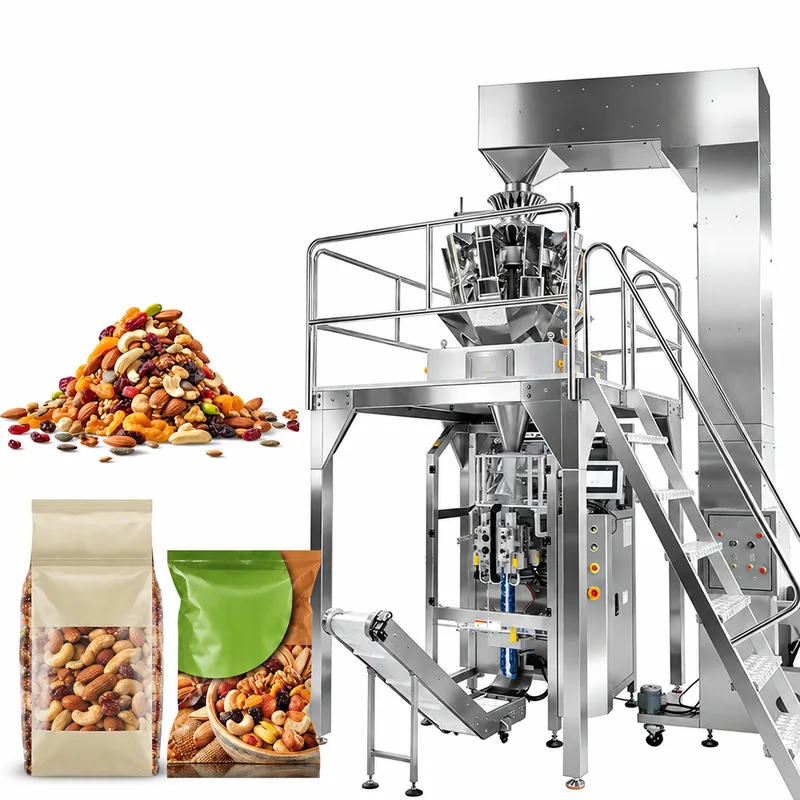
Nuts & Dried Fruit Multihead VFFS
A nut-mix bag can be on weight and still hold the wrong ratio of ingredients. Configure this multihead VFFS line from your blend, coatings, target weight and bag size.