
VFFS Power Consumption: Ratings, Supply Requirements and Missing Measurements
Treating a brochure kW or kVA figure as hourly electricity draw can distort cost models and circuit sizing. Separate VFFS ratings, supply strings and blank kWh logs.
Scroll horizontally to read all columns, conditions and sources.
| Published catalog page & review date | Verified published field | Engineering classification & missing evidence |
|---|---|---|
| High-speed servo VFFS page (up to 420 mm film width; published 2022-12-14, checked 2026-10-17) — field 1 | Main Power: 5.6 kW (printed as 5.6 KW) | Real-power rating (kW) only; heater vs servo split, duty cycle and measured kWh not stated |
| High-speed servo VFFS page (up to 420 mm film width; published 2022-12-14, checked 2026-10-17) — field 2 | Supply voltage: 220 V | Nominal voltage in combined Main Power / Voltage row; phase count and circuit amperage omitted |
| High-speed servo VFFS page (up to 420 mm film width; published 2022-12-14, checked 2026-10-17) — field 3 | Supply frequency: 50 Hz | Grid frequency requirement; does not indicate running power draw or 60 Hz compatibility |
| Volumetric-cup VFFS page (260–680 mm film width; checked 2026-10-06 and 2026-10-17) — field 4 | Supply voltage: 220 V (in 220V, 50/60H,3kW) | Combined supply and power cell; phase count and overcurrent protection rating not stated |
| Volumetric-cup VFFS page (260–680 mm film width; checked 2026-10-06 and 2026-10-17) — field 5 | Power rating: 3 kW (with 50/60H frequency text) | Connected real-power figure (kW); no film gauge, sealing temperature or metered kWh context |
| Intermittent VFFS bagger page (up to 545 mm roll width; checked 2026-10-06 and 2026-10-17) — field 6 | Apparent power: 6 kVA | Apparent-power supply allowance (kVA); active power (kW), power factor and kWh not published |
| Intermittent VFFS bagger page (up to 545 mm roll width; checked 2026-10-06 and 2026-10-17) — field 7 | Supply voltage: 480 V (three phase, 20 AMPS) | Three-phase branch requirement; 480 V and 20 A cannot be multiplied to claim hourly kWh |
| Intermittent VFFS bagger page (up to 545 mm roll width; checked 2026-10-06 and 2026-10-17) — field 8 | Supply frequency: 60 Hz | Grid frequency requirement paired with the 6 kVA / 480 V three-phase supply entry |
| Large quad-seal VFFS bagger page (up to 1,030 mm roll width; checked 2026-10-06 and 2026-10-17) — field 9 | Standard 208-240V, single phase, 60 Hz., 20 AMPS | Electrical supply string only; neither kW nor kVA nor measured kWh is published on the page |
On This Page
Why does a VFFS catalog power figure differ from measured kWh?
Treating a brochure power rating as hourly electricity draw can distort an operating-cost comparison or leave a branch circuit undersized. A VFFS specification sheet usually prints connected real power in kilowatts (kW), apparent power in kilovolt-amperes (kVA), or a supply requirement string (voltage, phase, frequency and circuit amperage), whereas utility billing and energy per pack depend on measured kilowatt-hours (kWh) over a defined run. Separate those four quantities before comparing quotations or estimating shift electricity cost.
Public VFFS product pages mix electrical notations without warning. Across four published vertical bagger pages reviewed in October 2026, nine verified electrical fields appear in four incompatible formats: a high-speed servo VFFS page (up to 420 mm film width, published December 14, 2022) lists `5.6 kW`, `220 V` and `50 Hz` under `Main Power / Voltage`; a volumetric-cup VFFS page (260 to 680 mm film width) compresses `220 V` and `3 kW` into a single `220V, 50/60H,3kW` cell; an intermittent bagger page (up to 545 mm roll width) specifies `6 kVA`, `480 V` and `60 Hz` (`three phase, 20 AMPS`) with no kilowatt figure; and a larger quad-seal bagger page (up to 1,030 mm roll width) prints only `Standard 208-240V, single phase, 60 Hz., 20 AMPS` with neither `kW` nor `kVA`.
None of those four public pages reports measured `kWh` during production, warm-up duration, sealing temperature or connected auxiliary draw. This guide provides the nine-field published rating audit alongside a blank line-boundary and trial energy request sheet so buyers can record what a supplier number actually covers and keep unmeasured `kWh` fields blank until a meter log exists.
Separate kW, kVA, supply strings and kWh on every quotation
Every electrical expression on a packaging machine quotation answers a different engineering or commercial question. Connected real power (`kW`) sums or bounds the active power rating of heaters, servo drives and motors inside the stated machine boundary, often reflecting peak or nameplate capacity rather than average running load. Apparent power (`kVA`) expresses the vector combination of active and reactive power that transformers, disconnects and feeder conductors must accommodate. Supply strings such as `220 V, 50 Hz` or `480 V, three phase, 60 Hz, 20 A` tell facilities engineers which branch voltage, phase arrangement, grid frequency and overcurrent protection the cabinet terminal block requires.
Measured energy (`kWh`) is the time integral of active power over a stated operating window, such as a 30-minute cold-start warm-up or a four-hour steady production run. Multiplying a `5.6 kW` catalog rating by eight hours assumes every heater cartridge and drive runs at 100 percent continuous duty for the entire shift—an assumption that ignores temperature-controller cycling after warm-up and intermittent film-advance pauses. Conversely, dividing a `6 kVA` apparent-power allowance by an invented power factor produces a speculative `kW` figure that no supplier has verified for that cabinet and load state.
Other public VFFS tables introduce further ambiguity when option ranges sit in one cell. For example, one public powder-and-granule VFFS table lists `Power consumption, kW: 4/7 Servo` at `380/50 V/Hz` without stating which dosing head, jaw heater configuration or bag width shifts the rating from 4 kW to 7 kW. Whenever a quotation prints a slash range, a bare `kVA` allowance or a supply-only amperage line, record the exact printed string in its proper unit column and ask the supplier to state the load condition in writing rather than converting units on a spreadsheet.
| Electrical term & unit | What the figure actually describes | What it cannot prove on its own |
|---|---|---|
| Connected real power (kW) | Rated or maximum active power of heaters, drives and motors inside the stated cabinet boundary | Actual average kWh per hour during steady production after jaw warm-up |
| Apparent power (kVA) | Total volt-ampere capacity used to size transformers, disconnects and supply feeders | Real power (kW) without a measured power factor, or metered energy (kWh) per shift |
| Supply string (V / phase / Hz / A) | Required branch voltage, phase count, grid frequency and circuit current rating at the terminals | Continuous running wattage or whether auxiliary feeders and coders share the same drop |
| Measured energy (kWh) | Cumulative active electrical energy logged by a meter over a timed run with stated film and bag output | Performance on a different film gauge, sealing temperature, bag rate or ambient condition |
Audit the machine boundary before summing electrical loads
A vertical bagger rarely operates as a standalone electrical load on a production floor. A complete packaging cell frequently combines a bucket or incline elevator, a multihead weigher or servo auger filler, the base VFFS bagger, a thermal-transfer or hot-stamp date coder, a discharge take-away conveyor, and a downstream checkweigher or metal detector. A single kilowatt figure on a bagger brochure normally covers only the base bagger cabinet unless the quotation explicitly states that dosing and auxiliary drives draw power through the main VFFS disconnect.
Public manufacturer pages confirm that auxiliary units carry independent electrical ratings and sometimes different supply voltages. On one published large auger VFFS page reviewed in October 2026, the base vertical bagger is rated at `400 V, 50 Hz` and `max. 2.5 kW`, while the paired checkweigher is listed separately at `230 V, 50 Hz` and `max. 0.75 kW`. If a buyer copies `2.5 kW` as the whole-line requirement, both the single-phase `230 V` branch and the combined connected load of the dosing elevator and checkweigher disappear from the project record.
Compressed air adds a second boundary error in VFFS energy comparisons. Pneumatic cross-seal jaws, gusset tuckers, film-splice clamps and knife cylinders draw mechanical energy from the plant compressed-air header rather than from the bagger's electrical cable gland. Switching a motion axis from a pneumatic cylinder to a servo motor increases connected electrical drive capacity inside the VFFS cabinet while reducing compressed-air demand at the compressor room. Because plant compressor specific energy varies widely by header pressure, leak rate and dryer type, keep electrical terminal ratings (`kW`, `kVA`, `V/Hz/A`) and pneumatic air demand (`NL/min` or `SCFM` at stated bar/psi) in separate columns rather than blending them into an unverified energy-savings percentage.
Why sealing heaters and duty states govern actual kWh per hour
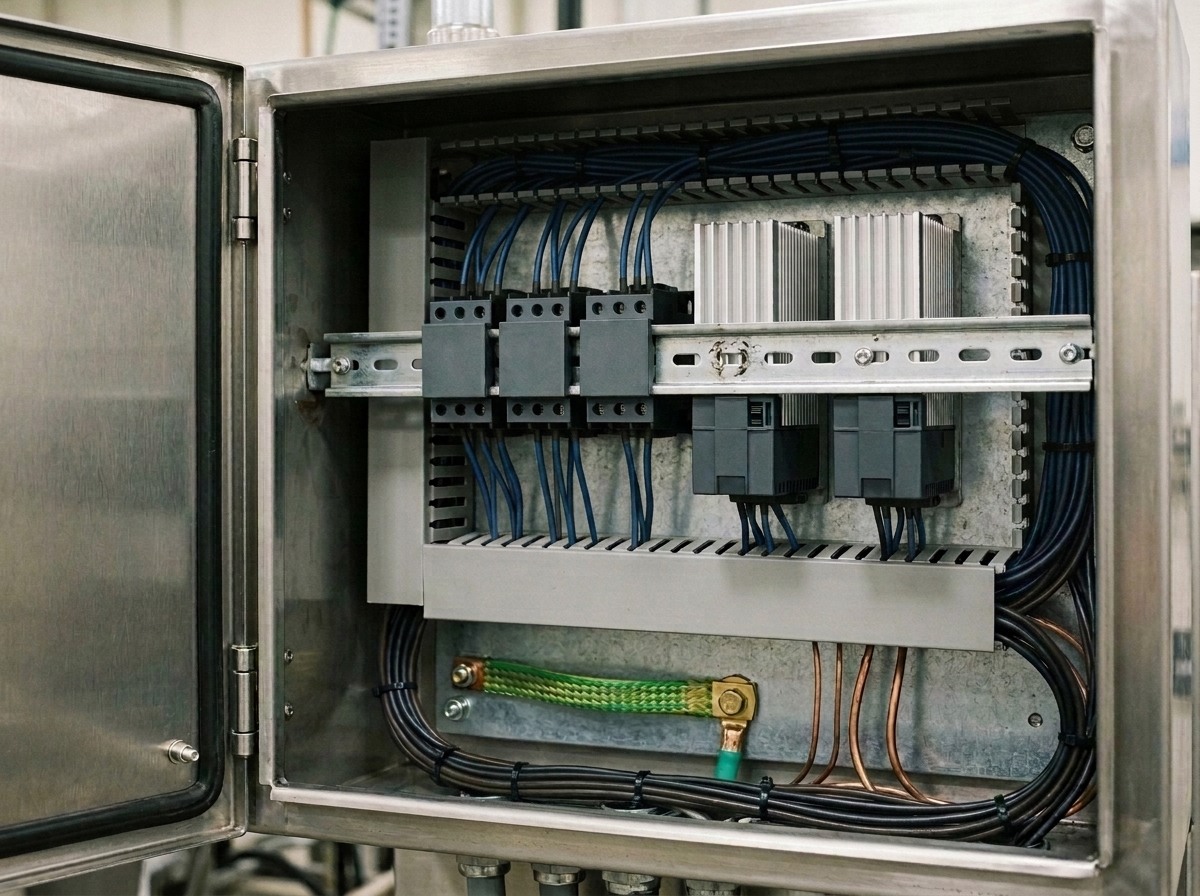
Inside a VFFS electrical cabinet, active power draw divides into two distinct load behaviors: resistive thermal loads for longitudinal and horizontal heat-sealing bands or cartridge heaters, and cyclic motor or servo loads for film pull belts, jaw actuation, unwind assist and dosing screws. During a cold start, cartridge heaters in the vertical lap/fin seal bar and horizontal cross-seal jaws run at high duty cycle until the metal sealing blocks reach setpoint temperature. Once the jaws stabilize, the temperature controller pulses heater power only to replace heat conducted into the moving film web and surrounding air.
Because resistive heat transfer scales with film mass and sealing temperature, actual `kWh` per hour during steady production depends heavily on the laminate structure, total film thickness, jaw dwell time, bag length and ambient room conditions. Running a thick barrier laminate at a higher sealing temperature and higher bags-per-minute rate extracts more thermal energy from the jaw blocks per minute than running a thin monolayer polypropylene film at moderate speed on the same frame. Likewise, frequent hopper-refill pauses or reel splices hold the sealing jaws at standby temperature while zero accepted bags leave the discharge chute, raising the electrical energy consumed per 1,000 accepted packs.
For that reason, no generic online calculator or lookup chart can predict `vffs machine power consumption per hour` from machine frame width alone. When finance or plant engineering asks for an operating electricity figure, require any trial or acceptance log to separate three timed operating intervals: cold-start jaw and cabinet warm-up, steady accepted-pack production at a stated bag rate and film specification, and hot-standby or changeover pauses.
Use a blank line-boundary and kWh log sheet during trials
Before signing a purchase order or scheduling a factory acceptance test, copy the blank line-boundary electrical scope sheet and trial energy log below. Download the CSV file to keep one row per powered assembly—base VFFS bagger, dosing machine, infeed elevator, date coder, discharge conveyor and inspection unit—and record whether each device feeds from the main bagger cabinet or requires its own customer-supplied drop.
In the rating columns, enter only what the supplier's quotation or electrical schematic explicitly states: voltage, phase count, frequency, full-load or maximum current (`A`), connected real power (`kW`), or apparent power (`kVA`). If a supplier provides `kVA` without `kW`, or prints a voltage and amperage string without a power rating, write `Not stated` in the missing column rather than calculating a substitute number. Cross-reference the confirmed connection points with the facility readiness owner on the site utilities checklist.
If energy per hour or energy per 1,000 accepted packs is a commercial decision criterion for your project, ask whether the supplier can log cumulative `kWh` with a calibrated three-phase power analyzer or cabinet energy meter during a witnessed trial on your actual film and product. Record the meter connection point, start and stop timestamps, elapsed minutes, total accepted bags, film structure, vertical and horizontal seal setpoints, and measured `kWh` for each run stage. Where no metered run has been performed, leave the `kWh` columns blank and treat operating electricity cost as an unverified variable in your quotation comparison.
| Line assembly & feed boundary | Quoted supply (V / phase / Hz / A) | Quoted power (kW or kVA — state unit) |
|---|---|---|
| Base VFFS bagger cabinet (drives + jaw heaters) | ____ | ____ |
| Dosing unit (multihead weigher, auger or cup filler) | ____ | ____ |
| Infeed bucket elevator, screw feeder or incline belt | ____ | ____ |
| Date coder / thermal printer and label applicator | ____ | ____ |
| Take-away conveyor, checkweigher and metal detector | ____ | ____ |
| Operating interval & context field | Run condition (film, temp, speed, duration) | Metered electrical reading (kWh / kW avg) |
|---|---|---|
| Cold-start warm-up to sealing temperature setpoint | ____ | ____ |
| Steady production run (state accepted packs & minutes) | ____ | ____ |
| Hot standby, hopper refill or film-splice pause interval | ____ | ____ |
| Derived energy per 1,000 accepted packs (if calculated from log) | ____ | ____ |
Method and sources
This guide combines an audit of nine verified electrical specification fields across four published VFFS product pages in the local packaging machinery research archive with live verification fetches conducted on October 17, 2026 (`evidence_status = partial`). The four audited product pages cover a high-speed servo VFFS model up to 420 mm film width (published December 14, 2022; checked October 7 and October 17, 2026), a volumetric-cup VFFS model for 260 to 680 mm film width (checked October 6 and October 17, 2026), an intermittent VFFS bagger up to 545 mm roll width (checked October 6 and October 17, 2026), and a large quad-seal VFFS bagger up to 1,030 mm roll width (checked October 6 and October 17, 2026). Two additional public SERP product pages reviewed on October 17, 2026 document the `4/7 Servo kW` dual-rating notation (`380/50 V/Hz`) and the split electrical rating between a base auger bagger (`400 V, 50 Hz, max. 2.5 kW`) and its checkweigher (`230 V, 50 Hz, max. 0.75 kW`).
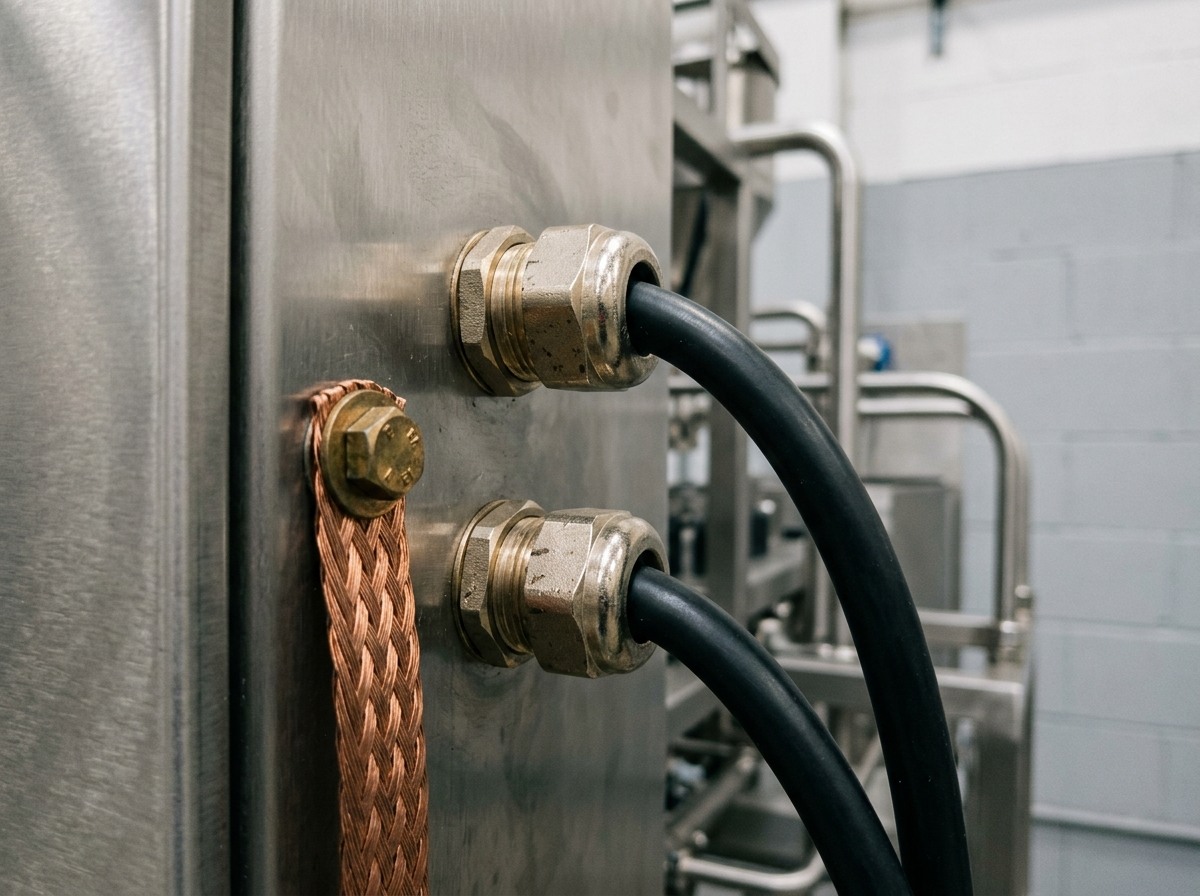
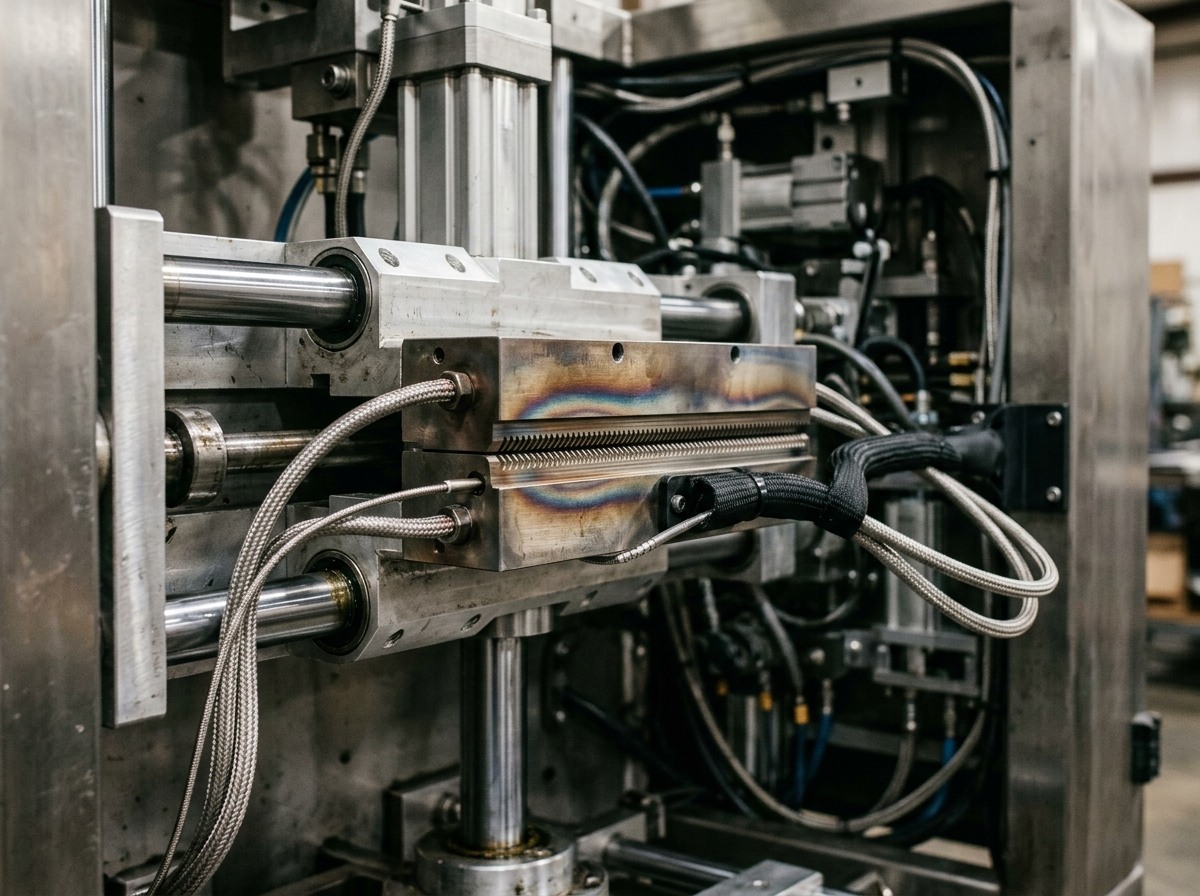
Public competitor figures are cited solely to illustrate how catalog electrical notations vary across published machine pages; they are not adopted as specifications for this site's equipment. No public source reviewed provides verified measured `kWh` under defined film, sealing-temperature and output conditions. All project-specific scope rows and trial `kWh` cells in the tables and CSV download remain intentionally blank (`____`). Workshop photographs illustrate cable entry glands, internal DIN-rail contactor and heatsink groupings, and heated sealing-jaw leads as generic hardware concepts; they do not depict a metered test or certify any model's electrical rating.